Anyone who has wrestled a stubborn shrub with the wrong tool knows how fast yard work turns miserable. This roundup covers five landscaping tools that solve specific problems: digging and transplanting, cutting branches overhead, breaking hard ground, trimming hedges into shape, and keeping all of it organized once you’re done. Whether you’re reclaiming an overgrown lot or just tidying beds each spring, there’s a fit here for your situation.
The Picks In Brief
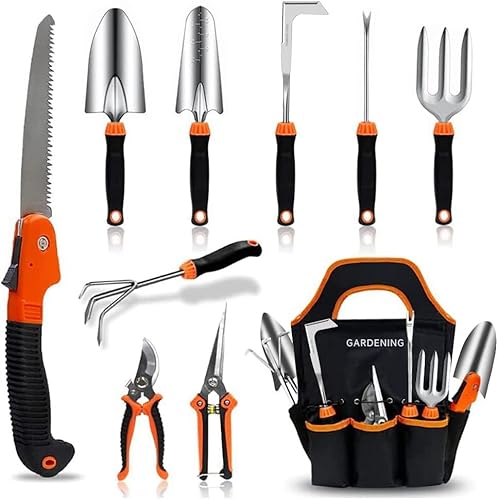
QINGFANGLI 10-Piece Stainless Steel Garden Tool Set

Craft911 11-Inch Folding Pruning Saw SK5 Blade

YRTSH Loppers, Hedge Shears & Pruners Combo Set

Fiskars Pro IsoCore 14″ 2-in-1 Pickaxe & Hoe, 1.5 lb

PIYILO 48 in Garage Tool Organizer Wall Mount
The Details Behind The Selections
Starting a garden from zero usually means buying tools one at a time, which gets expensive and leaves gaps in your kit. This ten-piece set from QINGFANGLI closes those gaps in one purchase: trowels for digging and transplanting, a weeder, a rake, a fork, snips, and a small saw for branches.
The thick stainless steel construction is the detail that matters here. Softer stamped steel tends to bend when you lever out a rock, and owners of budget sets commonly report exactly that failure. For most suburban beds and container gardens, this set should hold up well through regular seasons.
What Pays Off
- Ten pieces cover digging, weeding, raking, cutting, and transplanting without separate purchases
- Thick stainless steel resists bending during tough prying work
- Rust-resistant finish means less wiping down after wet mornings in the beds
- Small saw and snips handle light branch cleanup the hand tools can’t touch
Things To Consider
- Hand-sized tools won’t replace long-handled loppers for thick limbs
- Stainless edges benefit from occasional sharpening to stay effective season after season
Key Specs
Who It Suits Best
First-time gardeners outfitting a new home or renters working raised beds and containers get the most from this complete starter kit.
A Better Fit Elsewhere
Gardeners whose main battle is overgrown hedges will get more mileage from the YRTSH lopper, shear, and pruner trio instead.
Where the QINGFANGLI set stays home by the shed, this Craft911 saw is built to leave it. The blade folds into the handle, so it rides in a backpack or truck door pocket without snagging anything, which is why bushcraft folks and trail maintainers gravitate toward this format.
The cutting hardware is the real story: an 11-inch blade in SK5 high-carbon steel, a Japanese steel grade prized for holding a sharp edge, cut with triple-ground teeth at 7 TPI. That tooth pitch sits in the aggressive range, so each pull bites deep into green wood. Expect fast work on limbs up to roughly four inches, though thicker hardwood will slow any folding saw down.
Reasons It Performs
- SK5 high-carbon steel holds its edge far longer than basic carbon blades
- Triple-cut razor teeth at 7 TPI clear sawdust quickly on green branches
- Folding design protects the blade and your pack between uses
- One tool covers tree trimming, camp firewood, and storm cleanup
Worth Noting
- A light oil wipe after damp weather keeps the high-carbon blade from surface rusting
- Aggressive teeth demand steady two-handed control on springy limbs
Made For
Campers, homesteaders, and homeowners who want one serious saw that travels easily and handles pruning plus firewood duty.
Swap It Out When
If hedge shaping rather than branch removal is the job, the YRTSH combo set gives you shears purpose-built for that clean-up work.
Trimming jobs need three different tools depending on branch size, and buying them separately adds up. YRTSH bundles the full ladder: a 26-inch compound-action lopper for thick limbs, a 23-inch hedge shear for shaping, and an 8-inch bypass pruner for precise cuts near the plant. Compound action, briefly, is a linkage that multiplies your grip force, so the long handles do more of the squeezing.
All three blades are alloy steel with a low-friction coating, which matters more than it sounds. Sap sticks to uncoated blades, drags every cut, and eventually gums up the pivot. The coated surface sheds residue and wipes clean with a rag.
Good Reasons To Consider
- Compound-action linkage makes thick branches noticeably easier on the hands
- Low-friction coated alloy blades resist sap buildup and clean up quickly
- Three lengths cover everything from finger-thick shoots to hedge faces
- Long handles save your back compared to crouching with hand pruners alone
Points To Note
- Three long tools need real storage space, unlike a single folding saw
- Dry pivot points are the usual cause of stiff action, so a drop of oil now and then keeps them smooth
Feature Snapshot
Right Fit For
Homeowners with established hedges and ornamental shrubs who want one coordinated cutting system sized for average-strength hands.
Where A Sibling Pick Shines
Tackling rocky ground or buried roots calls for the Fiskars IsoCore instead, since no amount of leverage cuts what needs prying first.
Every other tool on this list assumes cooperative soil. The Fiskars IsoCore doesn’t make that assumption. One end works as a pick for splitting hardpan and severing roots, the other as a mattock-style hoe for scraping and prying rocks loose, so a single swing covers both jobs depending on how you orient the head.
Two build details justify the Pro label. The forged steel head is riveted inseparably to the handle, eliminating the looseness that plagues cheap heads after a season of hard swings. And the IsoCore shock-reduction handle dampens the vibration that normally travels up your arms, which anyone who has spent a morning in clay will tell you is the difference between finishing the job and quitting early. At 1.5 pounds, it’s manageable for smaller frames too.
The Good Stuff
- Two working ends mean one tool replaces both a pickaxe and a hoe
- IsoCore shock reduction cuts arm fatigue on long digging sessions
- Riveted forged head stays tight where welded heads commonly work loose
- Light 1.5-pound head suits users who find full-size picks exhausting
Honest Caveats
- Overkill for soft loam gardens where a spade does the same job cheaper
- Swinging any striking tool near fence lines or irrigation lines demands care
Whose Shelf It Belongs On
Owners of clay-heavy lots, new construction yards, or rocky ground who break soil regularly will consider this the most-used tool they own.
Reach For A Different Pick When
Your struggle is organizing gear rather than moving earth, and the PIYILO wall rack addresses that problem directly.
Here’s the piece nobody budgets for and everybody needs once the collection grows past three tools. This PIYILO rack spans 48 inches of wall with three rails and six double-layer hooks, giving long-handled gear like the YRTSH loppers a proper home off the floor. Double-layer hooks matter because they hold two tools per position, front and back.
The thoughtful part is the mounting layout: rails are engineered around standard 16-inch on-center stud spacing, the framing interval in most North American walls. Hitting studs means the rack carries heavy shovels and rakes without pulling out of drywall. All mounting hardware ships in the box, and rails can be spaced apart or mounted together depending on your wall.
Notable Upsides
- 16-inch on-center stud spacing aligns with standard wall framing for solid anchoring
- Six double-layer hooks hold up to twelve tools across 48 inches
- Adjustable rail placement adapts to awkward garage layouts
- Complete hardware included, so installation is a drill-and-level afternoon
Practical Considerations
- You’ll want a stud finder and level on hand before drilling
- Oversized odd-shaped items like wheelbarrows still need floor space
Details At A Glance
Built With In Mind
Garage and shed owners drowning in leaning shovels and tangled hoses will wonder why they waited so long to mount this.
Consider Something Else When
You’re still building the collection itself, and the QINGFANGLI ten-piece set fills an empty toolkit faster than any rack can.
What Matters Before You Spend
Match The Tool To Your Soil
Soft loam forgives almost any tool. Clay, rocky ground, and compacted fill do not, and that’s where forged heads and shock-damped handles earn their cost. Walk your property after a rain and note how fast water drains; slow drainage usually signals dense soil worth preparing for.
Weight Beats Features
A lighter head you can swing for an hour outperforms a heavier one that wears you out in twenty minutes. The 1.5-pound Fiskars head exists precisely because fatigue, not strength, ends most digging sessions.
Think In Systems
Cutting tasks layer by size: hand pruners, then loppers, then a saw. Buying coordinated sets like the YRTSH trio avoids the gap where a limb is too thick for one tool and too thin to justify another.
Plan Storage On Day One
Tools left on garage floors rust, dull, and become tripping hazards. A wall-mounted rack sized to your stud spacing costs little and extends the life of everything hanging on it.
Key Considerations Across These Picks
Wrong Turns To Avoid
The classic error is buying for the yard you wish you had instead of the one outside the window. A pickaxe in sandy soil gathers dust while a good pair of shears earns daily use. Measure your thickest recurring branch before choosing cutting gear too, since undersized loppers are the most common regret in this category.
What Separates Premium From Basic
Higher-tier tools spend their extra cost on metallurgy and joints: forged versus stamped steel, coated versus bare blades, riveted versus welded heads. Those differences show up as years of service rather than sharper first-day performance. Paying up makes sense for tools you swing weekly; casual seasonal users rarely notice the gap.
Frequently Asked Questions
Do stainless steel garden tools really resist rust?
Better than carbon steel, yes, especially with a quick wipe after wet use. No steel is fully immune to prolonged moisture, so dry storage still helps.
What size branch can a folding saw handle?
An 11-inch blade with aggressive teeth comfortably manages green wood up to about four inches thick. Larger limbs call for a bow saw or chainsaw.
Are compound-action loppers easier to squeeze?
The linkage multiplies hand force, so thick branches take noticeably less grip effort. Arthritis-prone hands feel the difference immediately.
Why does stud spacing matter for wall racks?
Most residential walls have framing every 16 inches on center. Anchoring into studs lets a rack carry heavy tools safely; drywall anchors alone often fail under load.
How often should pruning blades be oiled?
A drop at the pivot every few uses during peak season keeps action smooth. Wipe blades with oil before winter storage to prevent corrosion.
Closing Remarks
Good landscaping work comes down to matching five or six well-built tools to your actual ground conditions, then giving them a proper home. Start with the tasks your yard demands most, add the storage to protect your investment, and let the collection grow with experience rather than impulse. Your future Saturday self will thank you.