Big fasteners demand big leverage. Whether you’re torquing semi-truck lug nuts or dialing in a carbon handlebar to the inch-pound, the wrong tool turns a ten-minute job into a knuckle-busting ordeal. This shortlist covers both ends of that range, from heavy-duty multipliers built for commercial rigs to precision click wrenches for bike work and digital models for shop use. Each entry below fits a distinct kind of work, so match the tool to your garage before you commit.
How The Shortlist Stacks Up

YIYEIE 8-Piece Click Torque Wrench Set with Adapters
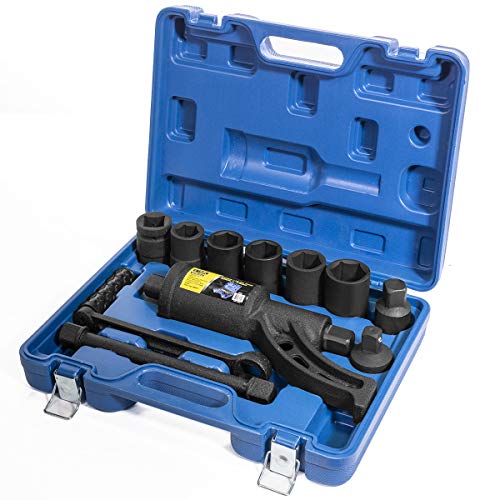
XtremepowerUS Heavy Duty Torque Multiplier Wrench Set

VANPO 1/4-Inch Drive Torque Wrench for Bike, 20-240 in.lb

LEXIVON Inch Pound Torque Wrench 1/4-Inch Drive (LX-180)

ACDelco ARM601-34 Digital Torque Wrench Combo Kit
The Details Behind The Selections
Most garages need more than one torque range, and buying three separate wrenches adds up fast. YIYEIE solves that by bundling 1/4, 3/8, and 1/2-inch drive click wrenches into a single kit, spanning light bike hardware up through automotive suspension bolts.
The dual-scale dials read in both inch-pounds and Newton-meters, so metric service manuals won’t leave you doing mental math on the driveway. Everything stores in one molded plastic case that slides onto a shelf without fuss.
Everyday Perks
- Covers three common drive sizes, so one purchase handles bikes, motorcycles, and cars alike.
- The 1/4-inch wrench adjusts in tiny 1 in-lb steps, which matters on delicate fasteners like brake levers.
- Five included adapters and extension bars let you reach recessed bolts without buying extras.
- A ±3% accuracy rating keeps your torque honest across the whole set.
Small Caveats
- Click-type wrenches should be dialed back to their lowest setting after each session to protect the internal spring.
- Three wrenches mean three tools to calibrate over time, which some owners find tedious.
At A Glance
Who Should Grab It
Weekend DIYers maintaining a mixed fleet of bikes, motorcycles, and family cars get the most value here.
Where A Sibling Pick Shines
Shoppers who want finer low-end control on carbon bike parts will prefer the LEXIVON LX-180’s micro-adjustment head.
Rusted lug nuts on a semi or motorhome can laugh at an ordinary breaker bar. A torque multiplier works differently: an internal gear train multiplies your input effort, so moderate pressure at the handle becomes serious twisting force at the socket. That’s the trick this eight-piece XtremepowerUS set pulls off.
Sockets run from 24mm to 38mm in chrome vanadium steel, sized for commercial trucks, buses, and RV wheels rather than passenger sedans. You seat a socket on the nut, connect the multiplier, anchor the reaction brace against a solid point, and lean. The case keeps all eight pieces together in a truck bed or service bay.
Useful Highlights
- Gear multiplication means stubborn, corroded lug nuts come off without an impact gun or compressor.
- Eight socket sizes cover the wide lug-nut spread found across heavy vehicles.
- Chrome vanadium construction stands up to the abuse of roadside tire changes.
- No air supply needed, which matters on remote jobs far from a shop.
Points To Note
- This is a loosening specialist, not a calibrated tightening tool, so final torque needs a proper wrench.
- Oversized sockets are useless on small cars, and owners report the set is bulky to store at home.
- The reaction brace needs a firm anchor point; sloppy setup wastes force and can slip.
Made For
Fleet drivers, RV owners, and farm operators who change big tires where no compressor follows them.
Swap It Out When
Anyone torquing standard car bolts to spec belongs with the YIYEIE 8-piece set instead.
Bicycle components live in a narrow torque band where overtightening strips threads and undertightening lets things creak loose. The VANPO targets exactly that zone, running 20 to 240 in-lb (2.3 to 27.1 Nm), which covers stems, bars, seat clamps, and most MTB hardware.
Where the LEXIVON later in this list tops out around 150 in-lb, the VANPO stretches higher for chunkier mountain-bike bolts. Its dual-range scale reads in both units, and the click mechanism gives an audible-and-felt signal the moment you hit your setting, so there’s no guesswork mid-repair.
Benefits That Matter
- The upper 240 in-lb reach handles beefy MTB cranks and pedals that smaller wrenches can’t touch.
- A bundled 1/4″ to 3/8″ adapter widens compatibility with common bike-tool sockets.
- The 10cm extension bar reaches recessed bolts inside frames and deep dropouts.
- Dual-unit markings suit riders working from both US and European service guides.
Honest Caveats
- Like any click wrench, it needs storage at its lowest setting or the spring relaxes over time.
- Owners commonly note the scale window can be hard to read in dim garage lighting.
Quick Facts
The Right Fit
Mountain bikers and home wrenchers servicing their own drivetrains benefit most from its extended high end.
Consider Something Else When
Riders needing sub-150 in-lb finesse on lightweight road parts may favor the LEXIVON LX-180’s tighter low range.
Compared with the VANPO’s wider span, the LEXIVON trades top-end reach for refinement down low, running 10 to 150 in-lb (1.1 to 16.9 Nm). That lower starting point matters on fragile hardware: electronics housings, small-engine covers, and delicate road-bike parts where even modest overtightening causes damage.
The build is where this wrench earns its keep. Chrome-molybdenum alloy steel forms the body, and the ratchet head is hardened and heat-treated to resist rounding out under repeated use. A quick-release button seats sockets securely and swaps them fast, and the zippered case protects everything between jobs.
What Stands Out
- Micro-adjustment lets you land on exact settings rather than rounding to the nearest coarse increment.
- A 72-tooth ratchet head gives a shallow swing arc, handy in cramped engine bays.
- Dual-direction clicking works for both left-hand and right-hand threads.
- Chrome-moly construction suggests a long service life under regular shop use.
Things To Weigh Up
- The 150 in-lb ceiling leaves heavier bike bolts out of reach, sending you back to a larger wrench.
- Some users find the adjustment collar stiff until it wears in after several sessions.
Whose Shelf It Belongs On
Road cyclists, drone builders, and small-engine hobbyists working with fragile low-torque fasteners.
Reach For A Different Pick When
MTB riders tackling cranks above 150 in-lb are better served by the VANPO’s 240 in-lb range.
Every other pick here relies on your ear to catch the click. In a noisy shop, that’s a real limitation. The ACDelco combo replaces sound with confirmation you can’t miss: a buzzer plus a flashing LED fires when target torque arrives, useful next to an impact gun or air compressor.
You get two digital wrenches, not one. The 3/8-inch unit spans 3.7 to 37 ft-lbs for brakes and engine accessories, while the 1/2-inch model runs 14.8 to 147.5 ft-lbs for wheels and suspension. Both ship in individual hard-shell cases with an instruction manual, and each runs on four AAA batteries you supply yourself.
Useful Touches
- Audio and visual alerts remove ambiguity when ambient noise swallows a mechanical click.
- Two drives cover the full automotive range from light brackets to lug nuts.
- Digital readouts display exact values, helpful for documenting torque on fleet records.
- Hard-shell cases protect the electronics during transport between job sites.
Worth Bearing In Mind
- Batteries aren’t included, and dead cells mid-job stall the whole workflow, so spares belong in the case.
- Electronics add weight and cost compared with the mechanical picks earlier in this list.
- Calibration checks matter more on digital tools; plan periodic verification for professional use.
Core Details
Right Fit For
Working technicians and serious DIYers who document torque values and work in loud environments.
Another Choice May Suit
Occasional home users on a lighter budget will find the YIYEIE set covers the same ground mechanically.
What Matters Most Before Choosing Large Torque Wrenches
Match the Range to Your Fasteners
The single costliest mistake is buying a wrench whose range misses your bolts. Bicycle stems often call for 4 to 6 Nm, while truck lug nuts may demand well over 100 ft-lbs. Read the service specs for what you actually maintain first, then pick a tool whose scale sits comfortably in the middle of that band, not at its edge.
Understand Accuracy and Calibration
A ±3% accuracy figure tells you how close the wrench lands on its stated setting. Over years of use, springs fatigue and readings drift, which is why shops recalibrate annually. Home users can go longer, but a wrench stored loaded at high torque loses accuracy faster than one dialed down after use.
Mechanical Click Versus Digital
Click wrenches cost less, need no batteries, and fail gracefully. Digital models add precise readouts, multiple units, and alerts, at higher cost and with battery dependence. Loud workshops justify the upgrade; quiet home garages rarely do.
Build Materials and Durability
Chrome vanadium and chrome molybdenum alloy steels dominate quality tools because they resist flexing and head rounding. Hardened ratchet gears extend life further, especially on frequently used 72-tooth heads.
Key Considerations Across These Picks
Wrong Turns To Avoid
Don’t buy a multiplier expecting calibrated tightening; those tools exist to break things loose. Skip ultra-cheap wrenches with vague accuracy claims, and never store any click wrench at maximum spring tension.
When Paying More Pays Off
Higher-tier tools bring hardened internals, tighter tolerance, and calibration certificates. Professionals billing hourly recover that cost quickly, while occasional users gain little beyond bragging rights.
Frequently Asked Questions
What counts as a large torque wrench?
Generally anything handling high ranges, such as 1/2-inch drive models exceeding 100 ft-lbs or heavy-duty multipliers used on truck hardware. The term also covers full-size wrenches versus compact bike-specific ones.
How often should a torque wrench be recalibrated?
Annual calibration is standard practice in professional settings. Casual home users can stretch longer, though drops and overload events warrant immediate checking.
Can one wrench cover both bikes and cars?
Rarely. Bike fasteners live in inch-pound territory while automotive bolts use foot-pounds, and few scales span both accurately. A set like the YIYEIE bridges the gap with multiple drives.
Why does my click wrench need storing at low settings?
Keeping the spring compressed degrades its tension over time, which shifts your calibration. Dialing to minimum after use preserves accuracy noticeably longer.
Are torque multipliers safe for wheel work?
They excel at loosening seized nuts, but final tightening still requires a calibrated wrench. Using a multiplier alone risks wildly inconsistent clamping force.
Bottom Line
Match the tool to the bolts you actually turn. The YIYEIE set serves mixed-garage households best, the XtremepowerUS multiplier owns the heavy-truck niche, and the VANPO and LEXIVON split the bike market by range. Shop technicians get real value from the ACDelco digital pair. Start with your service manual, then pick accordingly.