


A weak signal at the far end of the house is one of those problems you live with until you don’t have to. Whether you’re working from a back-office bedroom, streaming in a detached garage, or trying to keep an RV connected on the road, the router sitting by your modem decides how far your network actually stretches. This roundup covers five routers built to push coverage further, from cellular gateways for rural properties to gaming-grade tri-band units. Each entry breaks down where it excels and where it asks you to compromise, so you can match the hardware to your floor plan instead of guessing.
A Closer Look At The Lineup

GL.iNet GL-BE9300 Flint 3 Tri-Band Wi-Fi 7 Router

GL.iNet GL-X3000 (Spitz AX) Cellular Gateway 5G Router
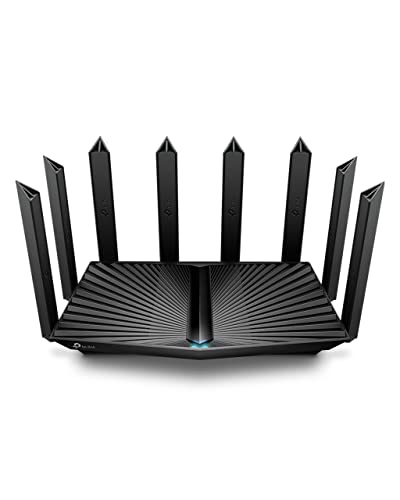
TP-Link AX6000 Wi-Fi 6 Dual Band Router (Archer AX80)

NETGEAR Nighthawk WiFi 7 Router (RS200)

ASUS ROG Rapture GT-AX11000 Pro Gaming Router
What Each Pick Brings To The Table
The Flint 3 is GL.iNet’s flagship, and its personality shows in the details: five 2.5G Ethernet ports and a tri-band Wi-Fi 7 radio setup aimed at people who want both raw throughput and control. Where the TP-Link Archer AX80 later in this list leans on simplicity, this one hands you OpenWrt-style flexibility out of the box.
In practice, that matters most for remote workers who tunnel through a VPN daily. WireGuard and OpenVPN connections can push around 680Mbps here, fast enough that encryption stops being the bottleneck on gigabit-class plans.
A Favorable Mix
- Tri-band Wi-Fi 7 keeps congested 2.4GHz airwaves from dragging down your laptop and console traffic.
- Roughly 680Mbps over WireGuard means VPN users stop sacrificing half their bandwidth.
- Five 2.5G ports let you wire a NAS, desktop, and upstream modem without a switch.
- Built-in AdGuard Home support blocks ad and tracking domains at the DNS level across every device.
- Advanced firmware appeals to anyone who likes granular control over routing and security.
Things To Consider
- The deep feature set carries a learning curve; casual users may find the interface busier than typical consumer routers.
- Real-world VPN throughput shifts with your provider and server location, so treat peak figures as ceilings.
Key Specs
Who It Suits Best
Power users, VPN-dependent professionals, and homelab hobbyists who want flagship speed with open firmware freedom.
Where A Sibling Pick Shines
Households that mostly stream and browse will get everything they need from the simpler NETGEAR Nighthawk RS200 without touching advanced settings.
Not every long-distance connection problem starts at the fiber box. For cabins, farms, and motorhomes beyond cable reach, the Spitz AX turns a cellular SIM into whole-property Wi-Fi 6, which changes what “coverage” even means.
The dual-SIM design is the quiet standout here: two carriers’ SIMs installed at once, ready to fail over when one network drops out. Detachable antennas also let you mount external aerials on an RV roof for noticeably better reception at the fringe of cell range.
Bright Spots
- Dual-SIM slots give you carrier redundancy, a genuine lifeline in rural dead zones.
- Works with major US carriers including T-Mobile and AT&T IoT plans, simplifying setup for road use.
- Detachable antennas upgrade cleanly to external roof-mounted options for weak-signal sites.
- Wi-Fi 6 with MU-MIMO serves multiple devices simultaneously without choking during family road trips.
- Compact footprint stows easily in an RV cabinet or van build.
Potential Sticking Points
- You’ll need an active data plan, so monthly costs continue beyond the hardware purchase.
- Cellular speeds depend heavily on tower proximity and congestion; owners in valleys or dense forests commonly report weaker results than urban users.
- No wired WAN alternative makes it less useful as a primary home router once fiber arrives.
Right Fit For
Rural residents, van lifers, and RV travelers whose address or itinerary sits outside reliable cable service.
Skip It When
Apartment dwellers with fiber already in the wall should look at the TP-Link Archer AX80 instead, since they don’t need cellular backup.
The Archer AX80 takes a refreshingly direct approach to distance: point eight high-gain antennas at the problem and let beamforming steer signal toward each device. Compared with the Flint 3’s enthusiast firmware, this is the set-it-and-forget-it option of the group.
Homes between roughly 2,500 and 3,500 square feet are its natural habitat. You may find the dual-band layout slightly more congested than tri-band rivals during simultaneous 4K streaming and video calls, though Wi-Fi 6 efficiency softens that considerably.
Benefits That Matter
- Combined AX6000-class throughput covers multi-room homes with headroom for gigabit plans.
- Beamforming focuses signal toward individual devices rather than spraying it everywhere equally.
- A 2.5G multi-gig port future-proofs your wired backbone as ISPs raise plan speeds.
- Setup through TP-Link’s app is genuinely beginner-friendly, a contrast to GL.iNet’s deeper menus.
A Few Limitations
- Dual-band only; heavy smart-home loads share the same 2.4GHz airspace.
- Wall placement still matters. Owners frequently report that central, elevated mounting makes the difference between good and great coverage.
Feature Rundown
Made For
Families in mid-size to large houses who want strong coverage without touching a single advanced setting.
Another Choice May Suit
Competitive gamers chasing lowest latency should step up to the ASUS ROG Rapture GT-AX11000 Pro and its dedicated game acceleration stack.
Modern households run dozens of connected gadgets, and older routers buckle under that weight before distance even becomes the issue. The RS200 targets exactly that scenario: Wi-Fi 7 speeds up to 6.5Gbps, capacity for around 80 devices, and rated coverage near 2,500 square feet.
The honest read is that this is the least fussy pick here. Setup is guided, NETGEAR offers expert help along the way, and the 2.5G internet port accepts today’s faster plans without complaint. It trades the Flint 3’s tinkering depth for something the whole family can live with.
Practical Pluses
- Handles simultaneous 4K streams, video calls, and smart-home chatter without visible slowdown for most households.
- Rated for roughly 2,500 sq. ft., enough for a typical two-story suburban layout from a central spot.
- 2.5G port pairs well with upgraded cable and fiber plans.
- Guided setup and access to expert help lower the barrier for first-time router buyers’ replacements.
Points To Keep In Mind
- Dual-band design means fewer traffic lanes than the tri-band ASUS or Flint 3 under extreme load.
- Coverage estimates assume open conditions; thick plaster walls commonly shave the effective radius down.
Who Should Grab It
Busy families replacing an aging ISP rental who want modern Wi-Fi 7 speed with minimal configuration effort.
Swap It Out When
Anyone needing cellular connectivity off-grid should choose the GL.iNet Spitz AX, since the RS200 depends entirely on a wired internet feed.
Everything about the Rapture GT-AX11000 Pro signals intent, from the angular ROG chassis to the triple-level game acceleration that prioritizes packets heading to game servers. This is the heaviest hitter on the list, and it behaves like it.
Tri-band Wi-Fi 6 pushes combined speeds toward 11,000Mbps across three radios, so a houseful of streamers never competes with your ranked matches. RangeBoost Plus strengthens signal reach, and AiMesh compatibility lets you add satellite nodes later instead of replacing the core.
What Stands Out
- Tri-band layout dedicates spectrum so gaming traffic stays smooth while others stream.
- Configurable 10G and 2.5G ports handle either WAN or LAN duty for extreme wired setups.
- RangeBoost Plus extends usable signal into far corners of larger homes.
- Network security runs without an ongoing subscription, keeping long-term costs predictable.
- AiMesh expandability grows coverage room by room as needed.
Trade Offs To Consider
- Its size and styling dominate a shelf; subtle it is not.
- Premium pricing buys capability many households won’t fully exercise.
- The power brick and cooling demand ventilation, so cramped media cabinets are a poor home for it.
The Numbers That Matter
Built With In Mind
Competitive gamers and content creators running latency-sensitive workloads in large, device-heavy homes.
Look Elsewhere When
Budget-conscious shoppers with modest square footage will find the NETGEAR RS200 delivers everyday Wi-Fi 7 performance at a friendlier commitment level.
Factors That Decide How Far Your Signal Travels
Match Radio Generation To Your Devices
Wi-Fi 7 routers like the Flint 3 and RS200 shine brightest alongside newer phones and laptops that speak the same standard. Older gear still connects, but it won’t tap the newest efficiency gains. A household full of 2020-era devices gets more practical value from a proven Wi-Fi 6 unit such as the Archer AX80.
Count Your Walls Before Your Square Feet
Manufacturers rate coverage in open conditions, yet drywall, plaster, brick, and mirrors each chew through signal differently. A 2,500 sq. ft. rating assumes generous assumptions about construction. Homes with masonry or multiple floors often need mesh expansion, which is why AiMesh compatibility on the ASUS earns its place in the spec sheet.
Wired Ports Still Matter
Wireless reach means little if your wired backbone bottlenecks. A 2.5G port handles current multi-gig plans, while the ASUS’s 10G option suits NAS transfers and future-proofing. Check what your modem actually outputs before paying for ports you can’t feed.
Consider Where Your Internet Comes From
Fixed-line routers assume fiber or cable exists at your address. Rural readers and frequent movers should weigh the cellular path first, since a gateway like the Spitz AX solves a fundamentally different problem than a faster radio ever could.
Key Considerations Across These Picks
Wrong Turns To Avoid
Shoppers routinely overspend on tri-band flagships for apartments where a compact dual-band unit performs identically. The opposite mistake is just as common: rating coverage on paper while ignoring wall construction, then blaming the router. Measure your actual space and building materials first, and place any router centrally and elevated rather than tucked behind a TV stand.
What Separates Premium From Basic
Higher-tier models earn their cost through extra radios, multi-gig ports, better processors, and software features like VPN acceleration or game packet prioritization. Heavy households with 60-plus devices and gigabit plans feel that difference daily. A studio apartment streaming on two screens simply doesn’t, and the money is better saved or spent on a mesh node instead.
Frequently Asked Questions
Do I really need Wi-Fi 7 for better range?
Not necessarily. Range comes primarily from antenna design, transmit power, and band selection rather than the standard itself. Wi-Fi 7 helps most with speed and capacity in busy homes.
Can one router cover a three-story house?
Sometimes, depending on construction and placement. Central vertical positioning helps, but tall homes usually benefit from adding mesh nodes like ASUS’s AiMesh satellites.
Will a cellular router replace my home internet?
For light-to-moderate use in areas with strong towers, yes. Data caps, tower congestion, and weather-related variance make it less predictable than fiber or cable.
How much does router placement affect coverage?
Enormously. Moving a router from a floor-level corner to a central elevated shelf commonly transforms dead zones into usable rooms without new hardware.
Are tri-band routers worth it over dual-band?
Tri-band earns its premium in households with many simultaneous high-bandwidth users. Lighter households rarely notice the difference day to day.
Closing Thoughts
Distance problems usually trace back to three things: the wrong tool for your connection type, careless placement, or a house that genuinely needs more than one node. Any of these five routers fixes the first issue decisively, whether your challenge is a rural property, a gadget-crowded family home, or a basement battle station. Start with your floor plan and your internet source, then let the specs above narrow it down. The right match will feel obvious once those two answers are clear.




