Full-size circular saws earn their keep on big sheet goods, but most home projects involve smaller cuts: drywall openings, trim, tile, PVC pipe. That’s where a compact saw earns its spot in the drawer. The five options below cover different needs, from a purpose-built cut-out tool for installed board to a budget cordless kit and even a set of blades that turn an existing rotary tool into a cutter. One of them will likely match how you actually work.
The Leading Options At A Glance

Makita XDS01Z 18V Cordless Cut-Out Saw
WEN 3625 4-1/2-Inch Compact Circular Saw with Laser

Makita XSH04ZB Sub-Compact Brushless 6-1/2-Inch Circular Saw

WORKPRO 20V 4-1/2-Inch Mini Circular Saw with Battery

shengbenhao HSS Cutting Discs for Dremel Rotary Tool
More Details On Our Top Picks
This one does a job no regular circular saw can do well: cutting openings into board that’s already hung on a wall or ceiling. Drywall installers and electricians reach for cut-out saws precisely because the bit plunges straight into the panel and follows a layout line without tearing up what’s behind it.
The XDS01Z runs on Makita’s 18V LXT battery platform, which matters if you already own other LXT tools since batteries swap across the line. Note that this listing is the bare tool, so you’ll need a battery and charger separately unless your collection covers you.
What Stands Out
- Plunges directly into installed drywall or plywood, so there’s no need to pre-drill a starter hole before cutting an outlet opening.
- Cordless design means no extension cord dragging across a finished floor while you work overhead or in tight corners.
- Shares batteries with the wider 18V LXT family, which cuts down on duplicate battery purchases over time.
- Light enough to control one-handed above shoulder height, where heavier tools wear you out fast.
A Few Limitations
- Battery and charger are sold separately, so first-time Makita buyers face extra cost beyond the tool itself.
- It’s a niche tool; owners who rarely touch drywall may find it sitting idle between remodels.
Who It Suits Best
Remodelers, drywall hangers, and electricians who cut openings in installed board regularly and already own LXT batteries.
Where A Sibling Pick Shines
For general-purpose crosscuts in lumber and sheet goods rather than plunge cuts, the Makita XSH04ZB below handles framing-style work far better.
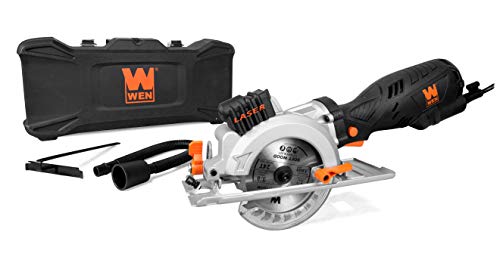
Where the Makita above specializes, the WEN generalizes. Its 4-1/2-inch blade and 5-amp corded motor handle wood, drywall, tile, sheet metal, and plastic pipe, which makes it the sort of tool that stays busy across a whole honey-do list instead of one trade’s task list.
At roughly five pounds, it’s easy to steer one-handed through trim work or shelf cuts. The built-in laser projects a cut line ahead of the blade, and the bevel base lets you tilt for angled cuts. A carrying case comes in the box, so storage stays tidy in a crowded garage.
What Pays Off
- Corded power means the tool never fades mid-cut the way a drained battery can during a long project day.
- The laser guide helps less experienced users keep a straight line without marking every board first.
- Included case keeps the saw, blade, and accessories together instead of loose in a drawer.
- Lightweight body reduces arm fatigue during overhead or extended cutting sessions.
Points To Keep In Mind
- You’re tethered to an outlet, so outdoor or jobsite cuts require a suitable extension cord rated for the load.
- The 4-1/2-inch blade limits depth compared to a full-size 7-1/4-inch saw on thick lumber.
At A Glance
Right Fit For
DIYers tackling mixed household materials who want dependable corded power without investing in a battery platform.
Consider Something Else When
Cordless convenience tops your list; the WORKPRO mini saw below frees you from outlets at a similar size class.
Makita built its Sub-Compact line around a simple idea: 18V power in a body that handles closer to a 12V tool. The XSH04ZB applies that to a 6-1/2-inch circular saw aimed at framing, roofing, and formwork crews who spend all day swinging a saw and feel every extra ounce by lunchtime.
The brushless motor is the headline here. Unlike brushed motors, a brushless design uses electronics instead of physical contacts to drive the motor, which typically means longer runtime per charge, less heat, and fewer wear parts. For contractors, that translates into more cuts between battery swaps and lower long-term maintenance.
Notable Upsides
- Brushless motor extends runtime and service life compared with brushed equivalents in the same voltage class.
- Compact footprint fits between studs and overhead joists where full-size saws bind or refuse to fit.
- Compatible with the extensive 18V LXT battery system, so existing Makita owners need nothing new.
Things To Consider
- Sold as a bare tool, so plan on adding a battery and charger if the LXT platform isn’t already in your kit.
- The 6-1/2-inch blade cuts shallower than a 7-1/4-inch framing saw, which matters on thick dimensional lumber.
Feature Snapshot
Made For
Contractors and serious DIYers who want pro-grade cutting performance in the smallest practical package.
Reach For A Different Pick When
Your cuts are mostly drywall openings rather than ripping lumber; the Makita XDS01Z cut-out saw at number one is built for exactly that.
Most compact saws at this price ship as bare tools, but WORKPRO includes a 4.0Ah battery, which makes this the easiest entry point on the list. Unbox it, charge it, and start cutting; there’s no platform decision to make first.
The motor spins up to 4500 RPM unloaded, plenty for wood, PVC, plastics, tile, and soft metals in thin stock. Weighing about 4.4 pounds, it’s the lightest full saw here, and adjustable depth settings let you match the cut to the material instead of slicing deeper than needed.
Key Advantages
- Battery and charger come included, so the total cost of getting started stays low.
- Adjustable cutting depth gives cleaner results on thin materials like panel and pipe.
- Lightweight build suits occasional users who don’t want forearm strain after ten minutes of cutting.
- Handles a wide material mix, from lumber offcuts to PVC and soft metal, in one tool.
Softer Spots
- The single included battery means downtime while recharging mid-project; a spare pack solves this at added cost.
- Owners commonly report the stock blade dulls faster on abrasive materials like tile, so budget for replacements.
Who Should Grab It
First-time tool owners and casual DIYers who want a complete, working setup out of the box for weekend projects.
Swap It Out When
You need sustained all-day cutting power; the WEN 3625’s corded motor keeps going regardless of charge level.
Not everyone needs another power tool; sometimes the smarter move is upgrading the one already in the drawer. These high-speed steel (HSS) discs fit most small rotary tools, die grinders, and air tools, effectively turning a detail rotary tool into a miniature cutting saw for craft-scale work.
HSS refers to a hardened steel alloy that holds its edge under heat better than plain carbon steel, which is why these discs suit repeated hobby use. They slice wood, plastic, aluminum, copper, thin stone, glass, and ceramic, covering most materials a maker bench throws at them.
Reasons It Performs
- HSS construction resists wear better than basic discs, so each wheel lasts longer between swaps.
- Broad material range means one set serves woodworking, jewelry, model building, and light metalwork alike.
- Installation is straightforward on standard rotary tool arbors, with no adapters required for common models.
Worth Bearing In Mind
- Tiny spinning discs demand eye protection and steady hands; they’re not forgiving of rushed technique.
- Cutting capacity is limited to thin stock, so thicker boards still call for a proper saw.
Core Details
The Right Fit
Crafters, model makers, and home hobbyists doing fine, small-diameter cuts in thin materials.
Not Your Match When
You’re cutting full sheets or dimensional lumber; any of the four saws above will serve that job properly.
What To Look For In A Compact Saw
Power Source First
Decide between corded and battery before anything else. Corded models like the WEN deliver steady output forever but chain you to an outlet, while cordless options such as the WORKPRO and Makita units trade runtime for freedom of movement. If you already own batteries from a brand’s ecosystem, staying within it usually saves real money.
Blade Size And Cut Depth
Blade diameter dictates maximum cut depth. A 4-1/2-inch blade handles trim, panel, and pipe comfortably, while a 6-1/2-inch blade reaches deeper into framing lumber. Match the blade to the thickest material you cut routinely, not the rare exception, otherwise you’ll fight every pass.
Weight And Handling
Compact saws live or die on one-handed control. Anything approaching six pounds gets tiring overhead or in awkward angles, so lighter builds reward anyone working above chest height or for long stretches.
Motor Type On Cordless Models
Brushless motors cost more upfront but convert battery power into cuts more efficiently and last longer with fewer wearable parts. Frequent users recoup that premium quickly; occasional users can happily save money with a brushed motor.
Smart Notes Before You Order
Traps First Timers Fall Into
The most common mistake is buying a bare tool without checking whether you own compatible batteries. Both Makita entries here ship without a battery, and that surprise adds real cost. Second, shoppers often underestimate blade limitations: a mini saw won’t rip thick joists, so match expectations to blade size before checkout.
What The Higher Tier Buys
Spending up generally buys brushless motors, lighter chassis, and brand ecosystems. On the Makita XSH04ZB, those add up to more cuts per charge and a tool that survives daily jobsite abuse. Weekend users gain little from that tier, while professionals typically find it pays for itself in uptime.
Frequently Asked Questions
Can a mini circular saw replace a full-size one?
For trim, panels, drywall, and thin stock, yes, easily. Thick framing lumber and deep rips still favor a 7-1/4-inch saw.
Do these saws cut metal?
Several handle sheet metal and soft metals like aluminum and copper with the correct blade fitted. Always verify the blade rating matches the material.
Why do some listings say “tool only”?
It means the package excludes the battery and charger. Existing owners of that brand’s battery platform save money; new buyers should factor in those extras.
Are laser guides accurate?
They’re close enough to keep a straight freehand line on most cuts. For precision joinery, mark and clamp a straightedge instead.
How often should I replace the blade?
Swap it when cuts start burning wood or requiring extra pressure. Abrasive materials like tile and fiber cement dull blades noticeably faster than softwood.
Wrap Up
Compact saws shine when the job is smaller than the tool you’d normally grab. The Makita XDS01Z owns drywall cut-outs, the WEN covers mixed materials on corded power, and the XSH04ZB brings professional brushless performance to tight spaces. The WORKPRO bundle suits newcomers best, while the shengbenhao discs stretch a rotary tool further than expected. Match the pick to your actual workload and it’ll earn its shelf space quickly.