Trim work, shelving, deck boards, picture frames. Every one of those jobs lives or dies by the accuracy of your cuts, and that’s exactly where a good mitre saw earns its spot in the garage. This roundup covers five tools aimed at different stages of the same journey, from a cordless slider you can carry to a job site to a simple plastic mitre box that costs about as much as a pizza night. Whether you’re fitting baseboard in a rented flat or framing out a garden shed, there’s a match here for how you actually work.
The Essentials At A Glance

Evolution Power Tools R185SMS+ Sliding Miter Saw 7-1/4″
CRAFTSMAN V20 Cordless Sliding Miter Saw 7-1/4 inch

Hanpex 12in High-Tension Hacksaw Frame with Bi-metal Blade

Makita LS1040 10″ Compound Miter Saw
Olympia Tools Mitre Box with 14-Inch Backsaw
A Breakdown Of The Leading Choices
Most saws in this size class handle one material well. The Evolution R185SMS+ is built around a different idea: a single 7-1/4-inch machine with a 210 mm slide, a 45-degree bevel and a 50-degree miter range that cuts timber, plastic and metal alike. For anyone renovating an older house, that flexibility means one tool instead of three.
The sliding action extends crosscut reach beyond what a fixed 7-1/4-inch head manages, so wider boards and shelf stock stay within range. Compared with the cordless Craftsman later in this list, you trade portability for material versatility.
The Upside
- One blade setup covers wood, plastic and metal, which saves real bench space in small workshops
- 50-degree miter range reaches angles many compact saws simply can’t hit
- Sliding arm adds crosscut capacity for wider trim and board stock
- A blade ships in the box, so the first cut happens the day it arrives
Things To Consider
- Multi-material blades wear faster than wood-only discs, so budget for replacements depending on your workload
- You’ll want dust extraction sorted before cutting treated lumber indoors
Made For
Renovators and DIYers who bounce between timber, PVC and steel offcuts and want one machine to handle all of them.
Where A Sibling Pick Shines
If your work stays purely wooden and cordless freedom matters more, the CRAFTSMAN V20 below fits better.
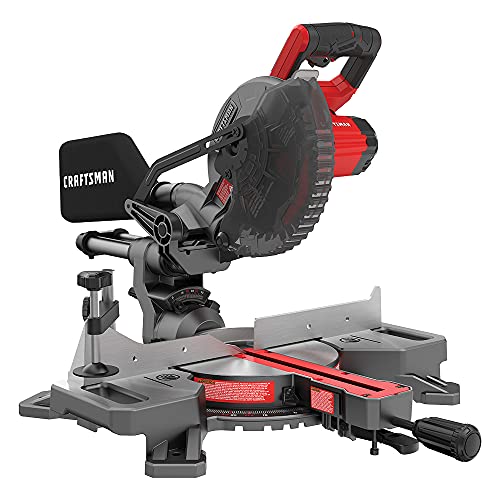
Cutting trim on a second floor with no outlet nearby is exactly the scenario this Craftsman was designed for. The V20 platform runs the whole saw from a battery, and this kit includes both the pack and charger, so nothing extra goes in the cart. At 7-1/4 inches with a slide, it stays light enough to carry up a ladder-friendly staircase.
An LED worklight throws a shadow-free line across your mark, which matters more than it sounds when you’re matching crown angles in a dim hallway. Nine miter detents plus single-bevel tilt cover the standard trim angles most homes demand.
Everyday Perks
- Battery and charger ship together, so the kit works straight away with no hidden extras
- LED light eliminates shadows over the cut line for cleaner accuracy in poor lighting
- Handles 2x lumber, hardwoods, baseboard and trim per the manufacturer’s stated capacity
- Up to 8-inch crosscut reach thanks to the sliding design
Small Caveats
- Battery runtime depends heavily on hardwood density, so long decking sessions may need a spare pack
- Single bevel means flipping the workpiece for opposing compound angles
Feature Rundown
Who Should Grab It
Finish carpenters, landlords doing turnover work, and anyone installing trim where extension cords are a nuisance.
Skip It When
Shop-bound users cutting thick hardwood daily will get more muscle from the Makita LS1040 further down.
Not every cutting job justifies spinning a motor. This Hanpex frame takes a 12-inch bi-metal blade, a construction where hardened teeth are bonded to a flexible backing so the blade resists snapping under pressure, and it handles metal, PVC and wood in short bursts. The 24 TPI tooth count suits thin stock like conduit and plastic pipe rather than heavy framing lumber.
The tension knob is the detail worth caring about. Turning it adjusts blade rigidity against a steel-reinforced core, and a properly tensioned blade tracks straighter and cuts faster than a loose one ever will.
Strengths Worth Knowing
- Bi-metal teeth stay sharp through repeated metal and plastic cuts
- Rotating tension knob lets you match blade stiffness to each job
- Non-slip grip reduces hand fatigue during longer manual sessions
Points To Note
- A hand saw demands elbow effort, so volume cutting gets tiring fast compared with any powered option here
- Fine 24 TPI teeth clog quickly in softwood unless you slow your stroke
The Right Fit
Renters, hobbyists and anyone who needs occasional clean cuts in pipe or thin stock without committing to a power tool.
Another Choice May Suit
For guided angled cuts in wood specifically, the Olympia Tools mitre box next delivers far better results.
This model has been in production long enough that its reputation arrived before it did. The LS1040 runs a 15 amp direct-drive motor, meaning the armature connects straight to the blade rather than through belts, spinning at 4,600 RPM. Fewer moving parts in the drive path typically translates into steadier power delivery and simpler maintenance over years of shop use.
Where the Evolution leans on versatility, the Makita leans on range: miters sweep from 0 to 45 degrees left and 0 to 52 degrees right, with nine positive stops at the angles carpenters reach for constantly. Bevels tilt up to 45 degrees left for compound work.
Advantages To Know
- Direct-drive 15 amp motor holds speed under load without belt slip
- Wider 52-degree right miter range than most compound saws at this size
- Dual-post pivoting arm keeps the head stable through the cut
- Nine positive stops make repeatable angles nearly effortless
Trade Offs
- No sliding arm, so wide boards need a flip-and-second-pass technique
- Bevel tilts one direction only, mirroring the Craftsman’s single-bevel limit
- Corded design ties you to an outlet or generator on remote sites
The Numbers That Matter
Who Will Love This
Dedicated home woodworkers and semi-pro carpenters who value a proven, repairable machine over gadget features.
Reach For A Different Pick When
First-time users wanting guided cuts without a learning curve will find the Olympia box far gentler.
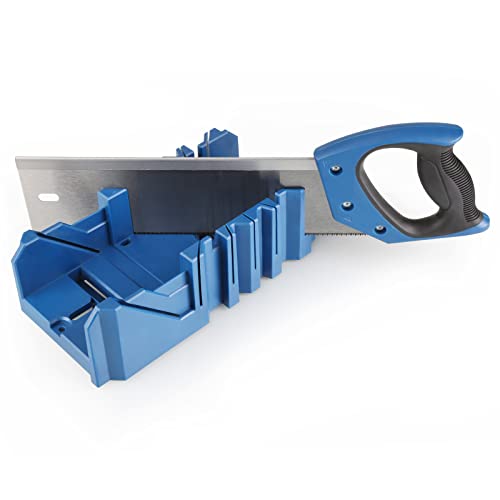
Everyone starts somewhere, and this plastic mitre box paired with a 14-inch backsaw is about as gentle an entry as woodworking offers. Slots molded into the box guide the saw at 90, 45 and 22-1/2 degrees, so square ends and frame corners come out true even with zero experience. Picture frames, small shelves and craft stock all fall comfortably inside its range.
It also doubles as storage, since the backsaw nests inside the box between uses. Against the powered picks above, you give up speed and capacity, but gain silence, safety and a footprint that fits in a closet.
Everyday Wins
- Pre-cut angle slots remove guesswork entirely, which builds confidence early
- Box stores the saw inside, keeping small workshops tidy
- No power needed, so it works anywhere from a balcony to a kitchen table
What To Weigh
- Limited to the three molded angles, anything else requires freehand skill
- Plastic slots can wear with heavy use, so check alignment periodically
Quick Facts
Whose Shelf It Belongs On
Complete beginners, students, and crafters making occasional small wooden pieces in shared living spaces.
Consider Something Else When
Growing past craft-scale projects calls for the Evolution R185SMS+, which scales with your ambitions.
Factors To Consider When Choosing Mitre Saws For Wood
Match The Tool To Your Projects
Decking and fencing demand sliding capacity and raw motor power, while baseboard and crown moulding reward accuracy features like LED guides and positive detents. Write down your next three projects honestly. Buying capacity you won’t use wastes money and bench space.
Power Source And Portability
Corded models deliver steady output for all-day sessions but chain you to outlets and extension leads. Battery platforms cost more upfront yet transform where you can work, from attics to gardens. Renters and mobile tradespeople consistently report the cordless premium pays back in convenience.
Blade Size And Cut Capacity
A 7-1/4-inch blade keeps weight low and suits trim, while 10-inch machines slice deeper stock in one pass. Sliding arms extend reach further still. Measure the widest board you realistically cut, then choose accordingly.
Accuracy Features That Matter
Positive stops lock repeatable angles instantly, and bevel range determines whether compound joints are possible at all. These details separate frustrating tools from ones you trust.
Key Considerations Across These Picks
Traps First Timers Fall Into
The most common error is oversizing. A 10-inch compound saw handles most home needs, yet newcomers often leap to sliding models they never fully use. Another frequent stumble: ignoring blade quality. The disc that ships in the box is usually adequate, not excellent, and upgrading it transforms cut finish more than any other change.
What Separates Premium From Basic
Higher-tier saws spend their extra cost on motors, bearings and fence rigidity, the parts that keep cuts square after years of abuse. Direct-drive designs like the Makita LS1040 trade complexity for longevity. Spend up once your project volume justifies it, not before.
Frequently Asked Questions
Can a mitre saw cut metal too?
Some can, notably the Evolution R185SMS+ with its multi-material blade. Standard wood blades should never touch metal, so check compatibility first.
Is a sliding mitre saw worth the extra cost?
For wide boards and decking, yes, since the slide roughly doubles crosscut reach. Trim-only workers rarely miss it.
What does TPI mean on a handsaw?
Teeth per inch. Higher counts like the Hanpex’s 24 TPI suit thin metal and plastic, while lower counts bite faster into thick wood.
Do I need a stand for my mitre saw?
Not immediately, though long boards benefit enormously from roller support. A sturdy workbench works fine for occasional trim tasks.
How often should I replace the blade?
Dull blades burn wood and require more force. Most hobbyists swap annually; heavy users replace several times per year.
Closing Remarks
The right choice here depends less on specs and more on honesty about your workload. Occasional craft cuts suit the Olympia box, mobile trim work favors the Craftsman V20, and serious shop time rewards the Makita. Whichever direction you lean, measure your typical stock first and let that number decide. Happy building.