


Your first multimeter shapes how confident you feel around household wiring. A good starter tool reads volts, amps, and ohms without burying you in modes you will not touch for months. The five picks below cover the spectrum from simple homeowner checks to entry-level electronics bench work, so you can match the meter to your actual projects instead of paying for features you will never press.
How The Shortlist Stacks Up

Fluke 117 Digital Multimeter (Non-Contact AC Voltage Detection)

AstroAI Digital Clamp Meter Multimeter 2000 Counts (Blue)
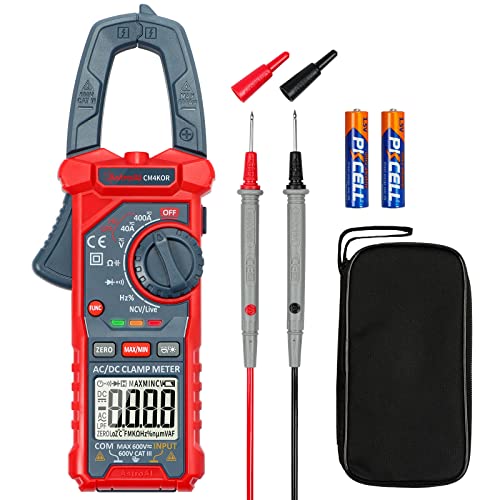
AstroAI Digital Clamp Meter Multimeter 4000 Counts (Blue)

AstroAI Inrush Digital Clamp Meter 1000A TRMS 6000 Counts

Fluke 115 Multimeter
Meet The Standout Selections
Picture standing at a wall outlet wondering whether the circuit is truly dead, and the meter answers before you ever touch a probe. The Fluke 117 packs a non-contact voltage sensor (a small antenna that sniffs live AC through the insulation) right into the body, so you get a quick sanity check without metal-to-metal contact. Low-impedance mode (a setting that prevents stray phantom voltage from masquerading as a real signal) keeps confusing ghost readings at bay on older wiring.
AutoVolt switching decides whether the line is AC or DC on its own, and true RMS (root mean square) means distorted waveforms from dimmers and variable-speed motors still read correctly. The white LED backlight brightens dark breaker panels, and the operating range stretches from -10°C to 50°C for unheated garages in winter. For a first serious meter, the 117 strikes a rare balance between beginner friendliness and professional credibility.
Notable Gains
- Non-contact voltage detection built in for fast safety checks
- Auto AC/DC voltage selection removes the most common beginner stumble
- Low input impedance protects you from misleading phantom readings on old wiring
- True RMS accuracy on dimmer-controlled lighting and motor circuits
- Bright backlit display stays readable in dark panels and crawl spaces
Things To Consider
- Costs notably more than clamp-style starters like the AstroAI 2000-count below
- No current clamp, so inline amp readings require breaking the circuit
- Replaceable 9V battery lives behind a screw-secured door in most production runs
Key Specs
Who It Suits Best
First-time homeowners and trade apprentices who want one meter that grows with them from outlet checks to panel diagnostics.
Consider Something Else When
The AstroAI 2000-count clamp meter makes more sense when your projects revolve around appliance cords and you need to read current without breaking the circuit.
Tracing a parasitic draw on a car battery usually means crawling under a dash with a test light and a prayer. The AstroAI 2000-count clamp lets you wrap the jaw around a single wire and read AC current on the spot, which feels almost unfair the first time you try it. Auto-ranging (the meter picks the right scale instead of forcing you to dial it in) keeps the learning curve shallow, and the NCV (non-contact voltage) function adds a quick live-wire alarm before you ever strip insulation.
2000 counts of resolution (the number of discrete steps the display can show) is enough for outlet-level voltage checks and basic household troubleshooting, even though the higher-count AstroAI below shows finer detail. The blue rubberized housing tends to shrug off bench drops, and the hold button freezes the reading so you can position the clamp and then look at the screen. Compared to the Fluke 117 above, this one trades true RMS and industrial polish for a much friendlier starting cost.
Everyday Perks
- Clamp jaw reads AC current without breaking the circuit
- Auto-ranging removes manual scale selection for new users
- Non-contact voltage alert catches live wires before contact
- Compact body fits in a kitchen drawer or glove box
Points To Keep In Mind
- Cannot measure DC current, so battery and solar work needs a different tool
- Resolution tops out at 2000 counts, so subtle voltage drift can hide
Made For
Renters, DIYers, and HVAC hobbyists who mostly need to check whether an appliance is drawing current and whether an outlet is live.
Look Elsewhere When
The AstroAI 4000-count clamp below fits better when you want both AC and DC current capability in the same tool.
The step up from the 2000-count model looks small on paper and substantial in the hand. Twice the display resolution shows 3.999 instead of 1.999 on a given range, so a battery at 12.41 V reads as 12.41 rather than rounding to 12. Both AC and DC current flow through the clamp jaw, which finally opens the door to solar charge controllers, DC fans, and automotive parasitic draws without swapping meters.
Non-contact voltage detection beeps and flashes when a live conductor sits nearby, and the same auto-ranging logic carries over from its smaller sibling. Continuity, resistance, capacitance, frequency, and live-wire testing cover the bread-and-butter checks a beginner actually runs on a Saturday project. Owners commonly find the rubberized boot gives the meter a planted feel on a metal workbench.
Why It Works Well
- Reads both AC and DC current through the clamp for solar and auto work
- 4000 counts of resolution show fine voltage drift on battery banks
- Non-contact voltage alert with audible and visual cues
- One tool covers household outlets, appliance cords, and 12 V systems
Worth Noting
- Lacks true RMS, so noisy motor circuits may read slightly off
- No temperature input, unlike the higher-tier AstroAI below
- Clamp accuracy drops on very small conductors under heavy loads
Quick Facts
Right Fit For
Garage tinkerers and homeowners with mixed projects who want one meter for both AC outlets and DC battery systems without spending on pro-tier gear.
Skip It When
The Fluke 115 makes more sense when electronics bench work and true RMS accuracy matter more than a clamp jaw.
Motors gulp a brief surge of current the instant they spin up, and that spike tells you whether a winding is failing long before the running current drifts off. The AstroAI inrush model captures those first-millisecond events, with a 1000 A ceiling that leaves headroom for HVAC compressors and small pump motors. VFD mode (variable frequency drive) filters the noise that variable-speed drives smear across normal readings, while LOZ (low impedance) suppresses ghost voltage on long cable runs.
True RMS keeps the numbers honest on choppy waveforms, and the 6000-count display pushes resolution close to mid-tier bench meters. Temperature input accepts a standard K-type thermocouple (a common probe for measuring heat), so the same tool that checks a motor winding can also verify a heat strip. For beginners stepping into HVAC or appliance repair, this is a serious step up from the simpler AstroAI clamp above.
Positive Points
- Inrush capture pinpoints motor startup problems other meters miss
- VFD mode reads variable frequency drive outputs accurately
- True RMS with 6000 counts for precise electronics and motor work
- Temperature input adds HVAC heat-strip diagnostics to the toolkit
Trade Offs
- Feature depth creates a steeper learning curve for a true beginner
- Bulkier jaw than the 2000-count model, harder to fit in tight panels
- Replacement K-type probes are an extra accessory to track
Best Suited To
Beginners shadowing HVAC or appliance repair and homeowners chasing elusive motor or compressor faults.
Swap It Out When
The AstroAI 2000-count clamp is a better entry point when outlet checks and simple appliance diagnostics are the only projects on your list.
Electronics hobbyists chasing a flaky breadboard joint want a meter that sits on a crowded bench without hogging space. The Fluke 115 is the compact cousin of the 117 above, and you give up the non-contact voltage sensor in exchange for a slightly smaller body and a friendlier shelf price. CAT III 600 V safety rating (a category defining the meter can survive the energy of distribution-level wiring faults) keeps it honest on appliance-level troubleshooting, and true RMS handles the choppier signals from switching power supplies.
Min/Max/Average recording tracks signal fluctuations over time, which is handy when a sensor reads 4.97 V sometimes and 5.03 V other times. The same bright white LED backlight from the larger Fluke carries over, so fuse boxes and equipment racks stay readable. For a beginner who plans to grow into electronics work, the 115 lands in a useful middle ground between a basic homeowner tester and a full clamp meter.
Notable Upsides
- True RMS for accurate readings on modern switching electronics
- Min/Max/Average mode captures intermittent signal drift
- CAT III 600 V safety rating for distribution-panel work
- Compact form factor suits tight electronics benches
Honest Caveats
- No current clamp, so inline amp readings need a separate tool
- No non-contact voltage detection like the 117 offers
Spec Overview
Whose Shelf It Belongs On
Electronics hobbyists, IT field techs, and engineering students who want a trustworthy compact meter for bench and service work.
Reach For A Different Pick When
The AstroAI 4000-count clamp below fits better when current measurement and a clamp jaw matter more than a pocketable bench meter.
Choosing Your First Multimeter Without Overpaying
Match The Meter To Your Real Projects
Start by listing what you actually want to probe in the next six months. Household outlet checks, automotive battery work, and electronics bench builds each pull the answer in different directions. True RMS (root mean square, a method that gives accurate readings on modern electronic waveforms) and safety ratings become priorities once you open a breaker panel, while a clamp jaw earns its keep the day you measure current without breaking a wire.
Count resolution sounds technical, but it simply means how finely the display can divide a measurement. 2000 counts rounds a 12 V battery to 0.01 V, and 6000 counts lets you spot a 0.005 V drift. Beginners chasing a single dead outlet rarely need the finer scale, while anyone troubleshooting solar charge controllers starts to appreciate the extra detail.
Safety Ratings And What They Protect Against
CAT ratings define how much electrical energy a meter can survive if something goes wrong. A multimeter rated CAT II suits small appliances and plug-in loads, while CAT III covers distribution panels and permanently installed wiring. Choosing a meter that meets the worst circuit you will touch, not the most common one, is the simplest safety habit to build from day one.
Look for fused current inputs (a sacrificial fuse that blows instead of your meter if you slip a probe into the wrong port) and shrouded probe tips that prevent accidental finger contact with live terminals. These features tend to disappear on the cheapest tools and reappear the moment you spend a little more, so think of them as a baseline rather than an upgrade.
Auto-Ranging And Beginner Workflows
Auto-ranging meters decide the right scale on their own, which removes a common source of wrong readings and burned-out meters from beginner mistakes. Manual ranging still has fans because it locks in faster readings once you know your target, but the first six months with a meter are smoother when the dial is just a function picker, not a scale picker.
Look for a hold button or a backlit display, because both save you from awkward probe positions in dark panels. A rubber boot or a recessed screen costs very little extra and tends to keep a meter working after the inevitable drop off a workbench.
Smart Habits Before You Click
Common Buying Slip Ups
A common first mistake is buying the cheapest meter on the shelf and discovering it lacks a low-impedance mode (a setting that prevents false voltage readings from induced voltages on disconnected wires) when an old outlet reads 80 V phantom. Another is choosing a clamp-only meter and then trying to read DC battery current, which clamp meters without DC support simply cannot do. Picking a meter without the safety rating of the circuit you plan to test is the third, and the costliest, of the usual errors.
The fix is to match the meter to the worst environment you expect to work in, not the easiest. Read the CAT rating, count the current ranges, and confirm true RMS if you will touch anything with a dimmer or a motor drive.
Where The Extra Money Goes
Stepping up from a budget meter to a mid-tier Fluke or a 6000-count AstroAI usually buys three things: better internal protection, more accurate AC measurements on noisy waveforms, and a longer service life under daily use. Higher-tier meters also tend to include accessories like magnetic hangers, temperature probes, or carrying cases that turn a loose tool into a usable kit. For most beginners, the upgrade pays off once projects start involving panels, motors, or anything that runs on a variable frequency drive.
Frequently Asked Questions
What is true RMS, and do beginners need it? True RMS (root mean square) is a measurement method that stays accurate on the choppier waveforms produced by LED dimmers, computers, and motor drives. Beginners working only on basic resistive loads can skip it, but anyone touching modern electronics or HVAC equipment will see cleaner readings with a true RMS meter.
How does a clamp meter differ from a regular multimeter? A clamp meter reads current by clamping around a single wire instead of breaking the circuit to insert the meter in series. The trade-off is usually lower DC current accuracy and a higher starting cost, though many modern clamp meters like the AstroAI models above cover both AC and DC current with respectable precision.
What safety rating should a beginner look for? CAT III 600 V covers most household distribution panels and permanently installed wiring, which is the right baseline for typical beginner work. Higher CAT ratings add protection for service entrance and utility-side work, but a beginner rarely needs them and they add cost.
Can one multimeter handle both household and automotive projects? Yes, provided the meter measures both AC and DC voltage and DC current. The AstroAI 4000-count clamp and the inrush model both cover household outlets and 12 V automotive systems, while the Fluke 117 and 115 focus on AC and DC voltage with current through probe leads instead of a clamp.
How long should a beginner multimeter last? A well-cared-for meter from a recognized brand tends to last a decade or more, with the battery and fuses being the parts that need replacement along the way. The bigger risk for beginners is dropping the meter or leaving it in a damp garage, so a rubber boot and a dry storage spot matter as much as the brand on the front.
Bottom Line
The right starter meter depends less on spec sheets and more on the projects already sitting in your garage. Household troubleshooters get the most from the Fluke 117 or the AstroAI 4000-count clamp, while electronics hobbyists land naturally on the Fluke 115. Whichever path you choose, learning one meter deeply beats juggling five tools you half-understand, and the right tool today will still earn its place years from now.




