


A good multimeter is the one tool electricians reach for before anything else, whether they’re chasing a tripped circuit in a residential panel, verifying a 480V feeder on a commercial site, or sorting out a phantom voltage reading that has a customer convinced the wiring is haunted. The wrong meter costs you time, the right one disappears into the work flow and just returns trustworthy numbers. This roundup covers five solid options at different price tiers, from the pro-grade Fluke that defines the category to clamp meters that handle heavier current work and a carrying case worth grabbing alongside the meter itself.
A Fast Comparison Of The Options

Fluke 117 Digital Multimeter with Non-Contact Voltage Detection

Klein Tools 69401 Multimeter Carrying Case

AstroAI Digital Clamp Meter Multimeter 2000 Counts Auto-ranging
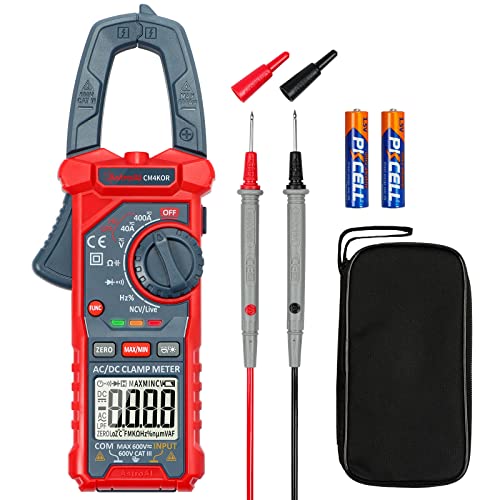
AstroAI Digital Clamp Meter Multimeter 4000 Counts Auto-ranging

AstroAI Inrush Digital Clamp Meter 1000A TRMS 6000 Counts
Why These Options Stand Out
The Fluke 117 sits at the center of the brand’s electrician-focused lineup, and for most residential and light commercial work, it covers the bases without forcing you to think about the meter. It reads AC/DC voltage, resistance, continuity, frequency, and capacitance, and the integrated VoltAlert feature detects live wires without a probe contact, which is genuinely useful when you’re poking around a crowded junction box trying to figure out which conductor is still hot.
AutoVolt picks AC or DC for you, and the low-impedance mode (a setting that presents a low electrical resistance to the circuit under test) helps suppress ghost voltage, those stray induced readings that show up on long wire runs in older buildings. The white LED backlight stays readable in dim panels, and the operating range of negative 10°C to positive 50°C covers most attics, basements, and outdoor enclosures electricians actually work in. For most service work and troubleshooting calls, this is the meter that disappears into the workflow.
The Good Stuff
- Non-contact VoltAlert sensing speeds up safety checks before you touch a conductor.
- True RMS (root mean square, a method that returns accurate readings on modern non-linear loads) handling keeps readings honest on variable-frequency drives and switching power supplies.
- Low-impedance mode suppresses phantom voltage on long cable runs.
- Auto AC/DC voltage selection removes a step from common measurements.
- Backlit display holds up in crawl spaces and dark panels.
- Wide operating temperature range covers most job-site conditions.
Trade Offs
- No current measurement through the leads, so you’ll want a separate clamp tool for amp readings.
- Priced well above entry-level meters, which can sting for apprentices building a first kit.
Built With In Mind
Licensed electricians handling residential service, light commercial maintenance, and HVAC control work who want one reliable meter to read voltage, resistance, and frequency accurately on every call.
Reach For A Different Pick When
You regularly need to read high current without breaking the circuit, in which case the AstroAI Inrush Digital Clamp Meter Multimeter is a better tool for motor and feeder diagnostics.
The 69401 is a soft-side case built specifically for Klein Tools meters, and it solves a problem most electricians don’t think about until a meter has already taken a bad tumble. A dedicated case keeps the meter, leads, and a few accessories in one pouch so you’re not fishing around a tool bag for the right probe at a customer site. Compared to tossing a Fluke 117 loose in a bucket, this is a meaningful upgrade in daily handling.
The shell is 600-denier nylon (a heavy fabric weight used in work gear) for abrasion and tear resistance, with a heavy PVC (polyvinyl chloride, a tough plastic coating) zipper and zinc alloy pull that owners commonly report holds up to repeated daily use. It fits Klein clamp meters, digital multimeters, and other test gear from the brand’s measurement line. For an electrician whose meter lives in a truck, this case is the difference between a meter that lasts five years and one that lasts ten.
Key Advantages
- 600-denier nylon shell resists scuffs, punctures, and tears in truck and bag conditions.
- Heavy-duty zipper with a metal pull tab stays reliable after years of daily opening and closing.
- Purpose-built for Klein meters, so the fit is snug without forcing a squeeze.
Points To Note
- Branded for Klein meters, so it may not fit Fluke or AstroAI shapes as precisely.
- Soft case only, with no rigid shell to protect against heavy impacts.
- Image listings for color options have been unavailable on the listing at times.
Whose Shelf It Belongs On
Electricians who already own a Klein clamp or digital meter and want a single, durable pouch to carry it, leads, and a few adapters between jobs.
Consider Something Else When
You need a measurement tool itself rather than a carrying solution, in which case the Fluke 117 is the more useful starting point for a full setup.
The AstroAI CM2K0R is the entry point in this list, and it earns its place by adding a current clamp to the usual multimeter duties at a price that won’t scare off a first-year apprentice. The 2000-count display (meaning the screen can show up to 1999 units before rolling over, which limits resolution on very small readings) and auto-ranging make it approachable for someone still learning which mode to pick.
It reads AC and DC voltage, AC current through the clamp, resistance, capacitance, and continuity, plus non-contact voltage detection with an audible alarm. The clamp jaw handles current measurement on a single conductor rather than the full power cord, an important distinction when you’re learning the right technique. For home electrical work, appliance troubleshooting, and shop projects, this is plenty of meter for the cost.
The Upside
- Clamp-on AC current reading without breaking the circuit.
- Non-contact voltage detection adds a quick safety check before probing.
- Auto-ranging removes the manual dial-hunting common on cheaper meters.
- Low enough cost to fit a starter tool bag.
Honest Caveats
- Cannot measure DC current, only AC through the clamp.
- 2000-count display limits resolution on low-voltage and low-current readings.
- Not built for daily commercial or industrial duty cycles.
Best Suited To
DIYers, homeowners, and apprentices who need a clamp meter for basic home wiring, outlet testing, and small appliance diagnostics without the pro-tier price tag.
Look Elsewhere When
You need DC current measurement, more display resolution, or industrial-grade durability, in which case the AstroAI 4000-count clamp meter is the logical step up.
The 4000-count AstroAI sits one rung above the 2000-count version, and the upgrade shows up where it counts: more display digits for finer resolution, plus DC current measurement through the clamp. That single addition opens up solar, battery, automotive, and DC motor work that the cheaper model simply can’t handle.
It measures AC and DC voltage, AC and DC current, resistance, capacitance, frequency, duty cycle (the percentage of time a signal is in its “on” state), continuity, and live wire, and the non-contact voltage detector adds a beep-and-light alarm when a live conductor is nearby. For someone running a small electrical side business, doing serious DIY work, or transitioning from hobbyist to light pro use, the feature spread is hard to beat at this cost.
Notable Gains
- DC current measurement through the clamp expands use cases into solar, battery, and DC circuits.
- Higher 4000-count display gives cleaner readings on small signals.
- Frequency and duty cycle readings support control and signal diagnostics.
- Non-contact voltage sensing with audible and visual alerts.
Small Caveats
- Build quality and long-term durability lag behind dedicated pro-grade brands.
- Clamp accuracy on high-current industrial feeders may not match dedicated industrial meters.
Right Fit For
Hobbyists and small-shop electricians stepping into DC system work, residential solar troubleshooting, or light commercial diagnostics who want one clamp meter that does most jobs.
Skip It When
You routinely work on motor controls, large feeders, or variable-frequency drives and need inrush and VFD (variable-frequency drive) mode, in which case the AstroAI Inrush 1000A clamp meter is the better match.
The AstroAI Inrush 1000A is the heavy-hitter of the AstroAI lineup, and it pulls in features you usually only see on dedicated industrial meters. The 1000A current capacity, 1000V DC and 750V AC voltage range, and True RMS reading make it suitable for motor diagnostics, HVAC service, and commercial electrical work, which is a meaningful step up from the 4000-count sibling above.
The dedicated inrush mode captures the brief, high current spike a motor draws at startup, which is often the smoking gun when chasing compressor or pump trips. VFD mode (a filter that stabilizes readings on variable-frequency drive outputs) and LOZ (low impedance) help it read accurately on modern variable-frequency drive outputs that fool ordinary meters. The 6000-count display, temperature input, and full multimeter function set round it out into a serious shop tool.
A Strong Showing
- Inrush capture mode helps pinpoint motor and compressor starting faults.
- VFD mode returns stable readings on variable-frequency drive outputs.
- True RMS (root mean square) keeps accuracy on non-linear electronic loads.
- LOZ mode prevents false readings from ghost voltage.
- 1000A clamp and 1000V DC range handle industrial and HVAC service.
- Built-in temperature input adds another diagnostic dimension.
Factors To Consider
- More features mean a steeper learning curve for first-time owners.
- Higher cost than entry AstroAI models, though still well below premium industrial brands.
- Heavier in the hand than a basic multimeter, which matters on long ladder runs.
Feature Snapshot
Perfect Match For
Industrial electricians, HVAC technicians, and maintenance techs who regularly troubleshoot motor starts, variable-frequency drives, and heavier commercial circuits.
A Better Fit Elsewhere
You’re doing mostly residential voltage and continuity checks with occasional current readings, in which case the Fluke 117 is the more comfortable everyday carry.
What Matters Most Before Choosing Multimeters For Electricians
The first decision is whether you need a traditional multimeter or a clamp meter. A standard multimeter, like the Fluke 117, reads voltage, resistance, frequency, and continuity with high precision, and it remains the right tool for troubleshooting control circuits, receptacles, and low-voltage systems. A clamp meter, like the three AstroAI options above, adds current measurement by clamping around a single conductor without breaking the circuit, which is faster and safer for live panels.
True RMS matters on any modern jobsite. Non-linear loads, meaning electronics that draw current in pulses rather than smooth waves, including LED drivers, computer power supplies, and variable-frequency drives, distort the waveform, and an average-responding meter can read low by 5 to 40 percent. For work involving any of those loads, True RMS capability is worth insisting on.
Safety ratings deserve attention next. Look for a meter rated to the CAT (category) level of the work you do. CAT III covers distribution panels and most commercial wiring, while CAT IV covers the service entrance and outdoor conductors. A meter rated to a higher category than your work is fine, but using a lower-rated meter on a higher-energy circuit is a real hazard.
Resolution, expressed as display counts, affects how cleanly small signals read out. A 2000-count meter tops out near 1999, while a 6000-count meter reads up to 5999 before rolling over. For low-current electronics or fine voltage checks, more counts make readings easier to interpret. For most residential and light commercial work, 4000 counts is a comfortable middle ground.
Finally, ergonomics and ruggedness show up over years of use. A meter that fits the hand, has a clear display, and survives a drop off a ladder earns its keep long after a cheaper model has been replaced.
Key Considerations Across These Picks
Where Shoppers Go Wrong
The most common mistake is buying on display count alone, then discovering the meter lacks True RMS or the right safety category for the panel in front of you. A high-count meter that misreads on a variable-frequency drive is worse than a lower-count meter that reads correctly. Equally common is grabbing a clamp meter and trying to measure current around both conductors of a cord together. Current flows in a loop, and clamping both legs cancels the reading to near zero. Clamp around a single conductor, the source side or the load side, but not the whole cable.
What The Higher Tier Buys
The jump from a budget AstroAI to the Inrush 1000A model pays for features you only appreciate after you’ve been burned by their absence: inrush capture for finding motor start faults, VFD mode for accurate drive output readings, and LOZ for killing ghost voltage on long runs. For an apprentice doing residential work, the cheaper meter is enough. For someone running commercial service calls or HVAC work, the higher tier’s features pay for themselves in a single diagnostic that would have otherwise required a second visit.




