


HVAC work asks a lot of a meter. You swing between 24-volt control signals in an air handler and 240-volt compressor circuits on a rooftop unit, often with one hand on a ladder and sweat on the probe tips. You also need to read microamp draw on a flame sensor one minute and chase a phantom voltage on a long thermostat wire the next. The five meters below cover those scenarios in different ways, from a pro-grade Fluke to a budget-friendly AstroAI that handles the basics. One of them will match your day-to-day workload, your tool pouch, and the kind of service calls you actually run.
The Lineup, Simplified

Fluke 117 Digital Multimeter with Non-Contact Voltage Detection

Klein Tools CL120VP Electrical Test Kit with Clamp Meter

AstroAI Digital Clamp Meter Multimeter 2000 Counts Blue
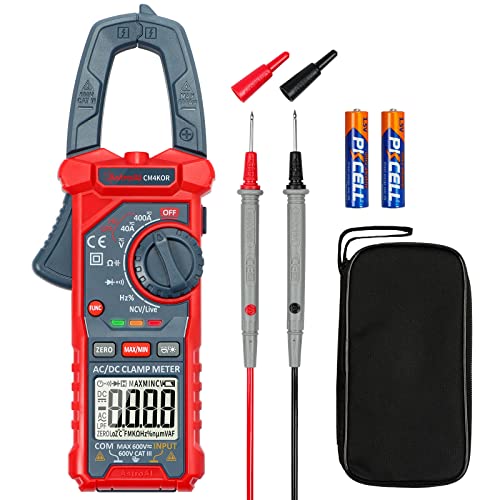
AstroAI Digital Clamp Meter Multimeter 4000 Counts Blue

AstroAI Inrush Digital Clamp Meter 1000A TRMS 6000 Counts
What Each Pick Brings To The Table
The Fluke 117 is the meter you reach for when you need a confident read on a live panel without second-guessing the screen. Its non-contact voltage detection, called VoltAlert, lets you confirm a wire is hot before you put a probe anywhere near it, which matters when you’re troubleshooting a 240-volt compressor circuit in a dim mechanical room.
Where this meter separates itself from a typical hobbyist DMM is the low-impedance mode, a setting that prevents ghost voltage from fooling your reading on long runs of thermostat wire. It also delivers True RMS, meaning it accurately measures non-linear loads like variable-speed drives and modern furnace control boards. Operating temperature spans -10°C to +50°C, so it stays useful in an unheated attic in winter or a hot rooftop unit in summer.
The Case For It
- True RMS delivers accurate voltage and current readings on variable-frequency drives and inverter compressors.
- Low-impedance mode eliminates false readings from ghost voltage on long control wire runs.
- Non-contact VoltAlert lets you confirm a live conductor before probing, a real safety win on rooftop units.
- Large white LED backlight keeps the display readable in dark mechanical rooms and behind air handlers.
- AutoVolt automatic AC/DC selection removes a step when you’re moving fast between control and line voltage.
Things To Consider
- It’s a traditional test leads meter, not a clamp, so measuring compressor amp draw requires a separate clamp accessory.
- Without a temperature input, you’ll want a separate tool for refrigerant line or supply-air thermocouples.
Who It Suits Best
Residential and light commercial HVAC techs who prioritize reading accuracy and brand-grade reliability over clamp-style convenience.
Where Another Pick Suits Better
Techs who need one-handed current checks on live circuits should look at the AstroAI Inrush Digital Clamp Meter 1000A TRMS 6000 Counts for built-in amp measurement.
The Klein Tools CL120VP lands in that useful middle ground: a single padded pouch that holds one clamp meter and three accessory testers, ready to toss in a truck door pocket. It suits a tech who does a mix of HVAC control work and basic residential service calls, since you get a clamp for current plus dedicated tools for outlet and non-contact checks.
The CL120 is an AC auto-ranging 400-amp digital clamp meter, the kind that lets you measure compressor draw without breaking the circuit. The RT210 GFCI receptacle tester checks for common wiring problems at standard outlets, handy when a service call turns into a “the dishwasher keeps tripping” sidebar. For apprentice techs building out a first pouch, this kit covers the everyday electrical checks that pair with HVAC troubleshooting.
Where It Excels
- 400A clamp range covers residential compressor and blower motor amp draws without needing a second tool.
- Three-purpose kit reduces tool bag clutter for techs who bounce between HVAC and light electrical work.
- Padded pouch keeps everything organized and protects the meters between job sites.
Worth Noting
- The kit is optimized for residential service rather than heavy commercial HVAC diagnostics.
- It includes fewer dedicated HVAC functions than the Fluke 117, so advanced frequency or capacitance work may require a separate meter.
Made For
New HVAC techs and residential service apprentices who want a ready-to-go electrical testing kit without buying each tool separately.
Consider Something Else When
For True RMS reads on variable-frequency drives, the Fluke 117 Digital Multimeter with Non-Contact Voltage Detection is the more capable single-tool option.
Homeowners and DIY troubleshooters usually want a meter that handles voltage, current, and a continuity beep without forcing them to read a 30-page manual. The AstroAI CM2K0R is built for that lane: a 2000-count auto-ranging clamp meter in a compact blue housing that fits in a kitchen drawer between calls to the breaker panel.
It’s worth knowing what this meter will and won’t do. It measures AC current by clamping around a single conductor, never the whole power cord, since the whole cord contains both hot and neutral cancelling the magnetic field. It also does not test DC current, which limits its usefulness for some automotive and solar work, but most home HVAC troubleshooting stays in the AC world. The 2000-count display means readings show one decimal place less than higher-count meters, fine for general residential use but a little coarse for fine diagnostics.
The Upside
- Clamp-style current measurement at a price that suits a DIYer’s tool budget.
- Live wire test and non-contact voltage detection add quick safety checks before probing.
- Auto-ranging removes the manual dial hunt for the right scale.
Trade Offs
- No DC current measurement, so 24V DC control circuits on some furnace boards need extra care.
- 2000-count resolution is coarser than the AstroAI 4000-count and 6000-count siblings, which can hide small variations.
- Owners commonly report the included manual is sparse, so plan on a quick online search for your specific model.
Right Fit For
Homeowners handling basic electrical and HVAC checks like verifying a breaker is live or measuring furnace blower amp draw on a single conductor.
Skip It When
Anyone diagnosing variable-frequency drive compressors should step up to the AstroAI Inrush Digital Clamp Meter 1000A TRMS 6000 Counts instead.
The 4000-count AstroAI is the middle sibling in the lineup, and it pulls double duty by adding DC current measurement to the clamp, which the 2000-count version doesn’t offer. That single addition matters if you service any DC control circuits, ECM blower motors, or auxiliary boards where you want to check low-voltage DC current draw.
With a higher display count, you also get a third decimal place on millivolt and microamp readings, which helps when you’re hunting for a slow drain on a flame sensor circuit. The non-contact voltage function still comes with both sound and light alarms, so a glance down a dark return-air plenum is enough to confirm a wire is live. Owners commonly find the auto-ranging responsive, though the mode dial has more positions than some entry-level meters, so a short learning curve is fair to expect.
Well-Handled Touches
- AC and DC current measurement in one clamp tool, useful for ECM motors and DC control boards.
- 4000-count resolution gives finer reading steps than the 2000-count model.
- Continuity, diode, capacitance, frequency, and duty cycle covered in a single auto-ranging meter.
Points To Note
- Still not True RMS, so readings on variable-frequency drives can drift from a true reference.
- No dedicated inrush capture mode like the higher-end AstroAI inrush meter.
Feature Snapshot
Best Suited To
Hobbyists and HVAC-curious homeowners who want more measurement range than a basic 2000-count clamp without stepping up to a pro-tier price.
A Better Fit Elsewhere
Pro techs chasing compressor inrush on rooftop units will find the AstroAI Inrush Digital Clamp Meter 1000A TRMS 6000 Counts more useful.
The AstroAI inrush clamp is the most capable of the bunch, the one you grab when a rooftop unit is randomly tripping a breaker and you need to know if the compressor is pulling too much on startup. Inrush current, the brief high-amp spike when a motor first kicks on, can be 4 to 7 times the running current, and a standard clamp meter often misses it because it samples too slowly.
Beyond inrush, this meter adds True RMS for accurate reads on variable-frequency drives, plus a VFD mode and LOZ (low input impedance) for the same ghost-voltage protection you get from the Fluke 117. It measures up to 1000A AC/DC current, 1000V DC, and 750V AC, so it can keep up with light commercial service. Temperature input via a thermocouple probe also makes it a useful two-in-one for refrigerant line checks during a refrigerant-side diagnosis.
A Favorable Mix
- Dedicated inrush mode captures compressor startup spikes that standard clamps miss.
- True RMS, VFD, and LOZ mode support accurate readings on modern variable-speed equipment.
- 6000-count display and 1000A range handle light commercial HVAC loads comfortably.
- Temperature input via included thermocouple adds a refrigerant line check to the same tool.
Honest Caveats
- Bulkier than the smaller AstroAI models, so it takes more pouch space in a tight tool bag.
- The added feature count means a slightly longer learning curve for techs new to clamp meters.
Whose Shelf It Belongs On
Commercial HVAC techs and serious residential troubleshooters who regularly work on variable-speed compressors and want inrush capture in one tool.
Reach For A Different Pick When
For a lighter everyday residential pouch, the AstroAI Digital Clamp Meter Multimeter 4000 Counts Blue keeps things simpler without the inrush feature.
How To Choose A Multimeter That Fits Your HVAC Work
Start with the workload you actually see, not the workload you want. A homeowner swapping a thermostat once a year needs a different meter than a tech running 10 service calls a day. Look at the current types you measure most: AC-only residential service, or AC plus DC control boards. That single answer narrows your list fast.
Clamp or no clamp matters too. A clamp meter lets you measure current on a live wire without breaking the circuit, which is faster and safer on a compressor or blower motor lead. A traditional test-leads meter like the Fluke 117 reads voltage, resistance, capacitance, and frequency with high accuracy, but you need a separate clamp accessory for current.
True RMS is a feature worth understanding. Standard meters assume a clean sine wave AC signal, which is fine for older equipment. Modern variable-frequency drives produce irregular waveforms, and a non-True RMS meter can give you a reading that’s off by several percent. If you service inverter-driven compressors, ECM blower motors, or any VFD-driven equipment, True RMS pays for itself quickly.
Finally, think about safety certifications and category ratings for the environment you work in. A meter rated for CAT III 600V or CAT IV environments is built to handle the energy available in a service panel or outdoor disconnect. Your line of work dictates the rating you need, not the price tag.
Key Considerations Across These Picks
Where Shoppers Go Wrong
A common slip is buying a multimeter based on display count alone, chasing the highest number without checking whether the meter can measure what you actually need. A 6000-count meter that lacks True RMS still gives you wrong answers on a VFD compressor.
Another trap is assuming any clamp meter measures DC current. The AstroAI 2000-count model and similar entry-level clamps often measure AC current only, which matters once you start checking DC control circuits. Read the current-type specs, not just the amp range.
What Separates Premium From Basic
The jump from a basic clamp to a feature-rich inrush model brings True RMS, VFD mode, low-impedance input, inrush capture, and temperature measurement. Each one addresses a specific failure mode in modern HVAC equipment, ghost voltage on long control wires, inrush spikes that trip breakers, waveform distortion on variable-speed drives. Paying more gets you diagnostic reach, not just durability.
Frequently Asked Questions
What multimeter do HVAC technicians use most?
Most working techs keep a True RMS clamp meter as their daily driver because it handles compressor amp draws and control circuit voltage in one tool. A separate traditional DMM like the Fluke 117 often comes out for finer voltage and frequency checks on control boards.
Do you need a clamp meter for HVAC?
A clamp meter is highly useful for HVAC work because compressor and blower motor current measurements are routine, and a clamp lets you read current without breaking the circuit. You can still do HVAC troubleshooting with a test-leads-only meter, but it costs you time on every amp measurement.
What’s the difference between True RMS and regular multimeters?
True RMS (Root Mean Square) accurately measures AC signals with irregular waveforms, like those from variable-frequency drives and modern electronic loads. A non-True RMS meter assumes a clean sine wave and can read several percent low or high on those signals, which adds up to misdiagnosis on inverter-driven equipment.
Can a multimeter measure AC current?
Standard digital multimeters with test leads cannot measure AC current directly because they require the current to flow through the meter’s internal shunt. Clamp meters measure current by detecting the magnetic field around a conductor, so the AC current measurement lives in the clamp, not the probes.
Is a higher display count always better?
A higher count, like 4000 or 6000, gives you finer resolution, but it doesn’t add accuracy on its own. A high-count meter still needs True RMS and proper category rating to be useful in HVAC work. Count is one spec among several, not a guarantee of quality.
Final Verdict
The Fluke 117 is the right answer for techs who want long-term accuracy and brand reliability, the Klein CL120VP kit suits new residential techs building a pouch, the AstroAI 2000-count clamp fits a homeowner’s drawer, the 4000-count version adds DC current for more involved work, and the AstroAI inrush meter steps up for commercial compressors and VFDs. Match the meter to the calls you run, and the daily readouts get a lot easier to trust.




