A good multimeter for a mechanic is rarely a bench instrument. It gets bounced around in a tool drawer, fished out under a lifted truck, balanced on a fender while you read a parasitic draw, and asked to keep a stable reading with one gloved hand. Mechanics need accurate voltage, dependable continuity, and a clamp that opens wide enough for a battery cable, all without weighing down the toolbox.
This roundup walks through five options built for the realities of mechanical and electrical diagnosis. Whether you specialize in late-model drivetrains, work on heavy equipment, or split time between HVAC controls and home wiring, the right meter is the one that fits your hands, your workload, and your budget. Below, you’ll find honest breakdowns of strengths, real trade-offs, and the kind of shop each model fits best.
A Quick View Of The Lineup

Fluke 117/323 Kit Multimeter and Clamp Meter Combo

Klein Tools MM320KIT Digital Multimeter Electrical Test Kit

AstroAI Digital Clamp Meter Multimeter 2000 Counts (Blue)
AstroAI Digital Clamp Meter Multimeter 4000 Counts (Blue)

AstroAI Inrush Digital Clamp Meter Multimeter 1000A TRMS 6000 Counts
The Picks, Examined More Closely
The Fluke 117/323 Kit pairs two tools designed for daily shop and field use, packaged with test leads, the TPAK magnetic hanger, and a soft carrying case. The 117 multimeter covers AC and DC voltage plus resistance, continuity, capacitance, and frequency, while the 323 clamp meter handles AC current up to 400 amps. Together they form a versatile diagnostic bundle for someone who needs accurate readings without bouncing between separate instruments.
For mechanics who split time between battery diagnostics, charging system checks, and control module troubleshooting, the True-RMS sensing and rugged Fluke build quality are the real draws. Compared to the AstroAI units lower on this list, the Fluke kit delivers a more refined feel, longer-term durability, and a measurement reputation that has made the brand a default in professional shops. In most working environments, this is the kit that disappears into the workflow rather than getting in the way.
A Favorable Mix
- True-RMS sensing (accurate readings on non-linear loads like variable-frequency drives and modern electronics)
- 400 A AC clamp capacity handles most automotive and light-industrial current measurements
- Non-contact voltage detection lets you check live circuits without contacting conductors
- TPAK magnetic hanger frees both hands for probe work under a dash or panel
- Soft carrying case keeps the meter, leads, and clamp organized in a rolling toolbox
Worth Noting
- Carries a premium cost that may be hard to justify for occasional or hobbyist use
- 323 clamp reads AC current only, so DC current measurements on solar or hybrid systems require a different tool
- Replacement leads and accessories tend to cost more than the budget-brand equivalents
Key Specs
Whose Toolbox It Belongs In
Full-time mechanics, field service technicians, and shop owners who rely on a meter every day and want long-term durability backed by a recognized professional brand.
Look Elsewhere When
You mostly handle light residential or hobby projects; the Klein Tools MM320KIT Digital Multimeter Electrical Test Kit is a friendlier fit for outlet and receptacle work, and the AstroAI Inrush Digital Clamp Meter Multimeter 1000A TRMS 6000 Counts makes more sense when motor diagnostics are the priority.
The Klein Tools MM320KIT bundles four separate tools into one organized pouch, a real timesaver for technicians who bounce between voltage checks, continuity tests, and outlet verification. You get the MM320 digital multimeter, an NCVT-3P non-contact voltage tester with a built-in flashlight, an ET45 voltage tester, and an RT210 GFCI receptacle tester, all with the batteries included. The padded storage pouch keeps the kit tidy in a service van or rolling cart.
Mechanics who split time between garage electrical work and on-site service calls tend to appreciate the redundancy here. The NCVT-3P adds a second opinion before probing live conductors, and the RT210 catches mis-wired outlets that a multimeter alone can miss. Compared to the Fluke 117/323 above, this set trades True-RMS performance and clamp-meter capability for breadth: you carry more tools, but each one handles a narrower job well.
The Case For It
- Four tools in a single organized kit reduce trips back to the service vehicle
- NCVT-3P non-contact tester with flashlight speeds up quick live-wire checks
- RT210 GFCI receptacle tester diagnoses mis-wired outlets without disassembly
- Padded pouch protects the meters from scratches and drops during transport
Points To Keep In Mind
- No clamp meter is included, so current measurements require a separate tool or adapter
- NCVT-3P and ET45 both require their own batteries, which adds long-term replacement cost
Made For
Residential service technicians, HVAC installers, and mechanics who also handle outlet and panel verification on the same job.
Consider Something Else When
You spend most of your diagnostic time measuring current draw on motors and battery cables; the AstroAI Inrush Digital Clamp Meter Multimeter 1000A TRMS 6000 Counts is built for that workload.
The AstroAI 2000-count clamp meter covers the basics without the cost of a pro-grade instrument. It reads AC and DC voltage, AC current, resistance, capacitance, and continuity, with a live wire test and non-contact voltage detection for quick safety checks. Auto-ranging removes the need to dial in the right scale, which speeds up work for less experienced users.
For a home mechanic checking battery voltage, tracing a parasitic draw, or verifying alternator output, this unit covers the common shop tasks at a fraction of the cost of the Fluke kit. The trade-off is build weight, clamp precision, and long-term durability, areas where the Klein Tools MM320KIT and the Fluke 117/323 above have a clear edge. For the price, though, this is a competent entry point.
What Works In Its Favor
- Auto-ranging simplifies operation for less experienced users
- Includes non-contact voltage detection for safe live-wire checks
- Reads AC current through the clamp and DC voltage through the probes
- Compact body fits comfortably in a crowded glove box or tool drawer
Practical Considerations
- Cannot measure DC current, which limits use on solar, hybrid, and some charging-system diagnostics
- 2000-count display shows less resolution than the 4000-count and 6000-count siblings in this roundup
- Owners commonly report that the included leads feel lighter than pro-grade alternatives
Feature Snapshot
Right Fit For
Home mechanics, students, and DIYers who want a capable clamp meter for occasional battery, outlet, and small-motor diagnostics without a major investment.
Skip It When
You need to measure DC current or read motor startup spikes; the AstroAI Inrush Digital Clamp Meter Multimeter 1000A TRMS 6000 Counts handles both scenarios in a single tool.
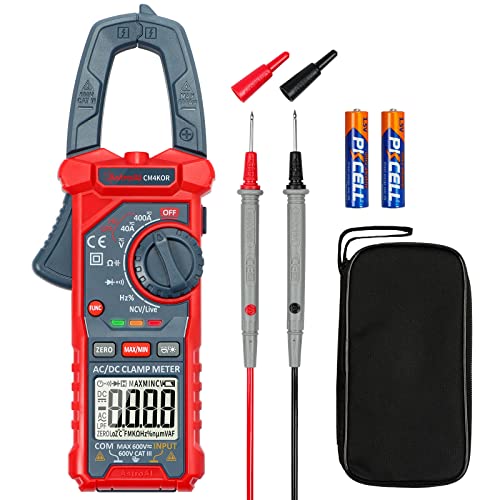
The 4000-count AstroAI clamp meter steps up from the 2000-count version with a higher-resolution display and the ability to read both AC and DC current. The added DC current measurement matters for anyone working on charging systems, solar installs, or hybrid vehicle subsystems. The auto-ranging dial keeps operation simple, while the NCV detection adds a quick safety check before probing live circuits.
Compared to the budget 2000-count pick, this meter reads DC current through the clamp and offers a finer display, which is helpful when measuring small parasitic draws. The jump to 4000 counts also makes the readout more stable when the value is hovering around a decision threshold. For most weekend wrenchers and small-shop mechanics, the extra resolution earns its place without inflating the budget too far.
Noteworthy Benefits
- Measures both AC and DC current, covering charging-system and hybrid diagnostics
- 4000-count display gives finer resolution on low-amp readings like parasitic draws
- Auto-ranging removes manual scale selection for faster troubleshooting
- Includes non-contact voltage detection with audible and visual alarms
Some Limits To Know
- Not a True-RMS meter, so readings on noisy waveforms may drift compared to higher-tier options
- Clamp jaw is sized for typical automotive and household conductors, not large battery lugs
Best Suited To
Garage mechanics, automotive students, and small-shop technicians who want a versatile clamp meter for both AC and DC current measurements on a modest budget.
Not Your Match When
You regularly diagnose motor startups or work on industrial drives; the AstroAI Inrush Digital Clamp Meter Multimeter 1000A TRMS 6000 Counts is purpose-built for that workload with inrush capture and VFD support.
This AstroAI flagship clamp meter pushes the brand’s resolution up to 6000 counts, lifts the current range to 1000 A, and adds features that matter for serious mechanical and electrical work. Inrush current capture, VFD mode (Variable Frequency Drive, used in modern motor controllers), and LOZ (Low Impedance) testing give it real diagnostic muscle on motors, drives, and HVAC equipment. True-RMS sensing keeps readings honest on the noisy waveforms those systems produce.
For mechanics who regularly work on heavy equipment, industrial controls, or commercial HVAC, this meter covers a workload the 2000-count and 4000-count AstroAI units cannot. It also reads temperature, which is useful for checking motor windings and ambient conditions. The trade-off is size and cost: this unit is bigger and pricier than the entry-level AstroAI, so it makes most sense when inrush and VFD readings are part of the routine.
Key Advantages
- Inrush current mode captures motor startup spikes that other meters miss
- VFD mode delivers accurate readings on variable-frequency drive outputs
- True-RMS sensing handles the noisy waveforms common in motor and drive systems
- 1000 A current capacity covers heavy equipment and large battery banks
Honest Caveats
- Larger body and heavier weight than the smaller AstroAI clamp meters
- Feature set is overkill for routine battery and outlet checks in light-duty work
Feature Card
Who Should Grab It
Mechanics, HVAC technicians, and industrial maintenance technicians who regularly diagnose motors, variable-frequency drives, and high-current equipment on the job.
A Better Fit Elsewhere
You mostly handle residential outlets and small appliance repairs; the Klein Tools MM320KIT Digital Multimeter Electrical Test Kit is a more focused, budget-friendly setup for that kind of work.
What Separates A Shop Meter From A Drawer Meter
True-RMS sensing is the single biggest difference between a consumer-grade multimeter and a shop-grade tool. Standard meters assume a clean, smooth sine wave (the basic shape of AC power), which is rarely what you actually measure on a modern vehicle, motor, or drive. True-RMS meters calculate the true heating value of any waveform, so readings stay accurate on the noisy outputs from alternators, switching power supplies, and variable-frequency drives. For most modern vehicles and any equipment with electronic controls, True-RMS is worth the step up.
Clamp capacity matters more than most shoppers expect. A 200 A clamp handles alternators and starter draw on most cars, but a 400 A or 1000 A clamp leaves headroom for jump-starting scenarios, dual-battery setups, and heavier industrial gear. The trade-off is jaw size and weight: bigger clamps mean a larger tool, and the meter is less comfortable to carry in a pocket.
Resolution, measured in counts, affects how stable the readout looks at decision points. A 2000-count meter displays whole numbers up to 1999, while a 4000-count or 6000-count meter shows finer steps, which helps when reading parasitic draw or small voltage drops across a connection. The higher the count, the more useful the meter is for low-current diagnostics.
Safety ratings and category ratings deserve attention if you ever probe panel wiring or service entrance equipment. Category III and Category IV ratings tell you how much transient overvoltage the meter can survive without damage, and a higher rating costs more but protects the tool, and you, on higher-energy circuits.
Quick Notes Across The Lineup
Traps First Timers Fall Into
A common mistake is choosing a meter by display count alone. A 6000-count meter with no True-RMS and no clamp costs more than it should, while a 2000-count clamp meter with True-RMS often delivers more usable diagnostic value. Match the feature to the workload, not the spec sheet.
Another slip-up is skipping the clamp entirely. Probing in-line for current means breaking the circuit, which is slow and risky in a live vehicle. A clamp meter lets you measure current around a single conductor without disconnecting anything, and once you use one, you rarely go back.
Where The Extra Money Goes
Paying more usually buys three things: True-RMS sensing for accurate readings on non-sinusoidal waveforms, a higher safety category for work near service entrance equipment, and a more rugged housing that survives drops and shop abuse. For full-time mechanics, those upgrades pay for themselves in downtime saved and accuracy gained. For occasional home use, the budget AstroAI models deliver the core functionality without the premium price.
Frequently Asked Questions
Do mechanics really need True-RMS?
Yes, especially on modern vehicles with switching electronics and on any equipment driven by a variable-frequency drive. True-RMS keeps readings accurate where averaging meters drift, which can send you chasing a problem that is not there.
Can a clamp meter replace a traditional multimeter?
For most diagnostic work, yes. Clamp meters handle current without breaking the circuit, and they cover voltage, resistance, continuity, and often capacitance. The only gap is measuring very low DC current with high precision, where a bench-style multimeter still leads.
What is inrush current and why does it matter?
Inrush current is the brief surge a motor draws when it first starts, often several times higher than its running current. A standard meter reads too slowly to capture that spike, so an inrush-capable clamp meter helps you diagnose hard-starting motors and weak components.
Is a higher count display always better?
Higher counts give finer resolution, which helps on low-current and low-voltage readings. For most automotive and HVAC work, a 4000-count meter covers the common range comfortably, and a 6000-count unit adds margin for finer parasitic-draw measurements.
How important is the safety category rating?
It depends on where you probe. A Category III rating is appropriate for distribution panels and most fixed wiring, while Category IV is required for service entrance work. Using an under-rated meter on a high-energy circuit is a real hazard, so match the rating to the job.
Closing Remarks
The right multimeter is the one that fits the work you actually do, not the one with the longest spec sheet. For full-time shop duty, the Fluke 117/323 Kit delivers the build quality and accuracy that justify its cost. For mixed electrical and outlet work, the Klein Tools MM320KIT brings useful breadth. For tighter budgets and lighter workloads, the AstroAI clamp meters scale cleanly from basic to industrial. Pick the tool that matches your typical diagnostic, and it will earn its spot in the drawer for years.