


A multimeter used to feel like a technician’s tool, something tucked in a belt pouch rather than a kitchen junk drawer. The current crop of compact DMMs and clamp meters changes that. You can check why a GFCI keeps tripping, confirm an outlet is actually dead before swapping a switch, or trace a parasitic battery drain on the family car, all with one handheld device and a few minutes of patience. The five picks below cover a range of comfort levels, from a pro-grade Fluke to affordable AstroAI clamp meters and a rugged Klein carry case, so you can match the tool to the work you actually do at home.
The Lineup, Simplified

Fluke 117 Digital Multimeter with Non-Contact Voltage Detection

Klein Tools 69401 Multimeter Carrying Case

AstroAI Digital Clamp Meter Multimeter 2000 Counts, Blue
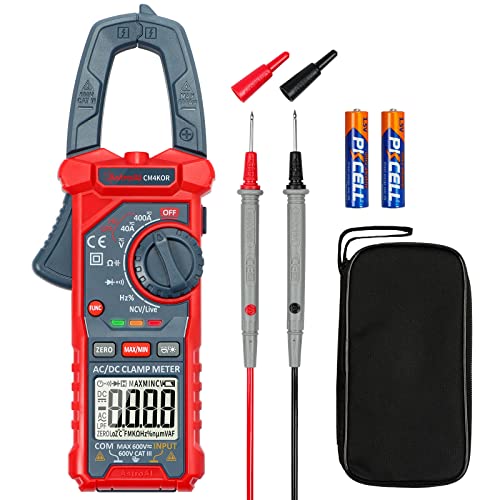
AstroAI Digital Clamp Meter Multimeter 4000 Counts, Blue

AstroAI Inrush Digital Clamp Meter Multimeter 1000A TRMS 6000 Counts
Why These Options Stand Out
The Fluke 117 is the meter many homeowners graduate to once a basic tester feels limiting, and for good reason. Its low-impedance mode helps silence ghost voltage, the phantom readings that show up on long runs of cable in modern homes with significant capacitance. VoltAlert non-contact sensing lets you check a wire or outlet before touching anything, which matters when you are not sure a breaker actually killed the circuit.
Compared with the AstroAI clamp meters further down this list, the Fluke 117 is a traditional probe-style DMM rather than a clamp, so you work with two leads instead of a jaw. You trade current clamping for rock-solid voltage, resistance, continuity, frequency, and capacitance readings on a bright white backlit display. For most home troubleshooting, that trade lands in your favor.
Real Benefits
- Low-impedance mode filters ghost voltage that fools cheaper meters, especially in older or rewired homes.
- True RMS (root mean square, a method that accurately reads non-sine waveforms from modern electronics and dimmers) keeps readings honest around variable-speed drives and LED loads.
- VoltAlert non-contact detection doubles as a quick safety check before you touch any conductor.
- Large white LED backlight stays readable in dim basements, attics, and crowded panel boxes.
- Rated for use from -10°C to 50°C, so it tolerates an unheated garage in winter and a hot attic in July.
Things To Consider
- No clamp jaw, so measuring current requires breaking the circuit or adding a clamp accessory.
- Owners commonly treat it as an investment piece, which raises the entry cost compared with the AstroAI options below.
Key Specs
Whose Shelf It Belongs On
Homeowners and trade-adjacent DIYers who want pro-grade accuracy on a wide range of residential electrical tasks.
Look Elsewhere When
You mostly need to read current on appliance cords and want a clamp, in which case the AstroAI Digital Clamp Meter Multimeter 2000 Counts is a friendlier starting point.
Any multimeter loses value the moment its leads tangle in a junk drawer with screwdrivers and tape. The Klein Tools 69401 solves that boring problem with a soft shell that holds the meter, leads, and a few accessories in one place. It is the only item in this lineup that is not a meter, and that is the point.
Where the Fluke 117 or AstroAI clamp meters handle the measurement, this case handles the routine. Tucked in a closet or clipped to a workbench hook, it keeps the gear you actually use within reach and protected from the inevitable drop off a ladder.
Where It Delivers
- 600D nylon shell resists abrasion, punctures, and tears from sharp sheet metal and staples.
- Heavy-duty PVC zipper with a zinc alloy pull shrugs off the grit and sawdust common in garage workshops.
- Soft pouch format fits Klein clamp meters, DMMs, and similar test gear without custom foam inserts.
- Lightweight design hangs on a nail or hooks onto a tool rail without sagging.
Honest Caveats
- It is a soft case, not a hard case, so a heavy tool drop onto concrete may still dent the meter inside.
- Buyers should confirm their specific meter’s dimensions, since the case is sized for the Klein family of test tools.
Made For
Homeowners and hobby techs who want their meter, leads, and a couple of spares stored in one grab-and-go pouch.
Reach For A Different Pick When
You are still choosing a primary meter, since the Fluke 117 or AstroAI Digital Clamp Meter Multimeter 4000 Counts are the actual measurement tools this case would carry.
The AstroAI 2000-count clamp meter is the friendliest entry point on this list. A clamp meter reads current by clamping around a single conductor, no need to break the circuit or touch bare wire. That single design choice turns intimidating panel work into a quick, visual task.
You get AC current, AC and DC voltage, resistance, capacitance, continuity, live wire test, and non-contact voltage detection, all in an auto-ranging (the meter picks the right measurement range for you) package. The 2000-count display offers reasonable resolution for most home tasks, while the bright blue body is easy to spot in a messy toolbox.
Where It Excels
- Clamp jaw reads current without breaking the circuit, ideal for checking if a window AC is actually drawing its rated amps.
- Non-contact voltage sensing adds a quick safety pass before you touch a conductor.
- Auto-ranging simplifies use for first-timers who do not yet trust manual range dials.
- Lightweight body fits comfortably in one hand during overhead ceiling checks.
Points To Keep In Mind
- DC current is not supported, so automotive parasitic-drain tests will need a different tool or a shunt setup.
- You must clamp a single conductor, not the whole cord, which is a habit new owners commonly have to learn.
- 2000 counts is enough for most home work, but the AstroAI Digital Clamp Meter Multimeter 4000 Counts offers finer resolution for tighter measurements.
Best Suited To
First-time multimeter owners checking outlet voltage, appliance current draw, and basic continuity in a house or apartment.
Swap It Out When
You also want DC current readings or a higher display resolution, in which case the AstroAI Digital Clamp Meter Multimeter 4000 Counts is the logical next step up.
Step up from the 2000-count AstroAI and you land on the 4000-count version, which adds DC current and a sharper display for tighter troubleshooting. Auto-ranging keeps the dial simple, while non-contact voltage detection sounds an audible and visual alarm when AC voltage is sensed nearby.
That combination of AC and DC current in a clamp is a real upgrade for car owners. You can finally chase a parasitic battery drain without stripping a wire to insert an inline meter. The same tool still handles household outlet and panel checks, so it earns space in both the garage and the utility closet.
Notable Gains
- Reads both AC and DC current through the clamp jaw, unlocking automotive parasitic-drain diagnostics.
- 4000-count display doubles the resolution of the 2000-count model for more precise voltage drops.
- Non-contact voltage alarm with sound and light adds a layer of warning near live conductors.
- Covers capacitance, frequency, continuity, diode, resistance, and live wire test in one auto-ranging dial.
Trade Offs
- Still no inrush capture, which the AstroAI Inrush Digital Clamp Meter Multimeter 1000A covers for motor start-up checks.
- Auto-ranging can be slow to settle on fluctuating loads, which may frustrate quick appliance tests.
- Owners commonly report that the included manual is brief, so new buyers should budget a little time to learn the modes.
The Right Fit
Household troubleshooters and car owners who want one clamp that handles both home wiring and basic automotive electrical work.
Consider Something Else When
You need to capture motor inrush or measure VFD (variable frequency drive) output, where the AstroAI Inrush Digital Clamp Meter Multimeter 1000A pulls ahead.
The AstroAI Inrush is the heavy hitter of this list, aimed squarely at people troubleshooting HVAC condensers, shop machinery, and pool pumps. Inrush current is the brief spike a motor draws the instant it starts, often several times its running current, and standard clamp meters can miss it entirely. This one is built to catch it.
With TRMS (true root mean square) accuracy, a 6000-count display, and a 1000 A current capacity, it covers AC and DC current plus AC/DC voltage, capacitance, frequency, duty cycle, resistance, diode, continuity, and temperature. A VFD mode and LOZ (low impedance) setting round out the feature set for modern motor circuits and long wire runs where ghost voltage is a concern.
Useful Highlights
- Inrush capture locks the starting current spike of motors, which is invaluable for diagnosing compressor and pump failures.
- VFD mode reads the noisy output of variable frequency drives without producing erratic numbers.
- LOZ mode drains ghost voltage that trips up less expensive meters on long residential branch circuits.
- 1000 A clamp capacity handles service entrance work that would max out a smaller tool.
Possible Compromises
- Larger jaw and body weight make it bulkier than the 2000-count and 4000-count AstroAI models for everyday outlet work.
- Higher feature count means more menu diving, which can overwhelm homeowners who only need basic checks.
Who It Suits Best
Homeowners maintaining HVAC systems, well pumps, or shop machinery who need to read motor inrush and VFD output.
Where Another Pick Suits Better
Casual users just need an outlet and battery tester, in which case the AstroAI Digital Clamp Meter Multimeter 2000 Counts is a lighter, more approachable choice.
What Matters Most Before Choosing Multimeter Home Uses
Match the meter to the job, not the spec sheet. Start by listing the two or three tasks you actually do at home. Swapping outlets and checking batteries call for a basic DMM or clamp. Chasing motor-start problems or HVAC work pushes you toward a TRMS clamp with inrush capture. The Fluke 117 fits the first scenario, while the AstroAI Inrush earns its keep in the second.
Probe-style DMM vs. clamp meter. A traditional DMM like the Fluke 117 uses two leads for high-accuracy voltage and resistance readings. A clamp meter, like every AstroAI on this list, lets you read current by clamping around a single wire, which is faster and safer for live circuits. Many home toolkits eventually hold both, but the clamp is the more intuitive starting point for most newcomers.
True RMS and LoZ earn their cost on modern homes. Today’s houses run LED dimmers, computer power supplies, and variable-speed motors. Those non-linear loads (draws that pull current in uneven bursts instead of a smooth wave) confuse average-responding meters. True RMS keeps the reading honest, and a low-impedance mode prevents false voltage readings on long cable runs.
Resolution and count. A 2000-count meter displays values down to roughly 1 mV on a 2 V range, which is enough for most outlet work. A 6000-count display offers finer steps for tight voltage drop measurements and small sensor signals. Pick the resolution that matches how much detail your typical task needs.
Avoiding The Usual Buying Traps
Mistakes Worth Dodging
Buying a meter only to leave it in a drawer is the most common waste. A soft pouch like the Klein Tools 69401 or a dedicated shelf spot encourages regular use, so consider storage part of the purchase.
Skipping safety features to save a few dollars is another familiar misstep. Non-contact voltage detection, audible alarms, and LOZ mode all reduce the chance of a wrong assumption on a live conductor, especially in older wiring where labels cannot be trusted.
Where The Extra Money Goes
Higher-tier meters like the AstroAI Inrush add features that matter in specific situations: inrush capture for motor diagnostics, VFD filtering for HVAC work, and TRMS for non-linear loads. If your home does not run those loads, the extra cost adds complexity without much daily payoff. Paying more only makes sense when the new mode solves a problem you actually have.
Frequently Asked Questions
What is a multimeter actually used for at home? The most common jobs are checking outlet voltage, testing batteries, confirming a circuit is dead before swapping a switch, and chasing down why a breaker keeps tripping.
Do I really need True RMS at home? You benefit from True RMS if your home runs LED dimmers, computer gear, or variable-speed motors, since those non-linear loads skew average-responding meters. A simple resistive load like a space heater does not require it.
Can a clamp meter replace a traditional multimeter? For most household tasks, yes, a clamp meter covers current, voltage, resistance, and continuity. A probe-style DMM like the Fluke 117 still wins for very precise low-voltage measurements and tight work in crowded boxes.
What is ghost voltage and why does it matter? Ghost voltage is a phantom reading caused by capacitive coupling on long, de-energized wires. A low-impedance mode, found on the Fluke 117 and the AstroAI Inrush, drains that stray voltage so the meter reads zero on a truly dead circuit.
Is a carrying case worth buying separately? If you plan to keep your meter in a drawer, the leads will tangle. A simple case like the Klein Tools 69401 keeps everything together and ready, which tends to mean the meter actually gets used.
Closing Remarks
The right multimeter or clamp meter is the one you reach for without thinking, whether you are checking a dead outlet, a suspect car battery, or an aging HVAC condenser. Match the tool to the work you actually do, store it somewhere you can find it, and spend up only when a feature solves a problem on your list.




