A reliable multimeter turns guesswork into a number you can act on, whether you’re chasing a dead outlet in the kitchen, sorting a wiring issue in the garage, or diagnosing a parasitic draw in a car. The five options below cover a wide spread of budgets and skill levels, from no-frills hobbyist units to professional-grade instruments built for daily field use. You’ll see where each one shines, where it gives up ground, and which pick matches the kind of work you actually do.
The Picks In Brief

Fluke 117 Digital Multimeter with Non-Contact Voltage Detection
AstroAI Digital Multimeter Tester 2000 Counts (Blue)

AstroAI True RMS 6000 Counts Auto-Ranging Multimeter

AstroAI Digital Clamp Meter Multimeter 2000 Counts (Blue)

Fluke 115 Multimeter
Inside Each Recommended Option
The Fluke 117 sits at the top of Fluke’s 110-series and is built for the kind of mixed commercial and residential work most field techs handle in a day. Its VoltAlert feature senses live AC voltage without contact, which speeds up outlet and panel checks before the probes ever touch a conductor. The low-impedance mode helps prevent the ghost-voltage false readings that often trip up less expensive meters on energized wiring.
True RMS (a method of measuring AC signals accurately even when the waveform isn’t a clean sine wave) keeps readings honest on variable-frequency drives, LED lighting, and modern electronics where simple averaging meters tend to drift. The white LED backlight stays readable in crawl spaces and dim utility rooms. Licensed electricians and HVAC technicians working on live circuits day after day will get the most from this unit.
Everyday Advantages
- Non-contact voltage detection speeds up pre-check safety routines
- Low-impedance mode reduces false positives from induced voltage on dead circuits
- True RMS delivers accurate readings on non-linear loads like LED drivers and VFDs
- Compact form fits in a side tool pouch without weighing down a belt
- AutoVolt automatically selects AC or DC, removing a common point of operator error
Things To Consider
- Costs considerably more than entry-level meters, which is hard to justify for occasional household use
- No current measurement through the leads, so a separate clamp tool is needed for amp readings
- Replacement test leads and holsters add to long-term ownership costs
Feature Snapshot
Who It Suits Best
Licensed electricians, HVAC service techs, and apprentices doing daily live-circuit work where safety features and measurement confidence matter more than upfront cost.
Consider Something Else When
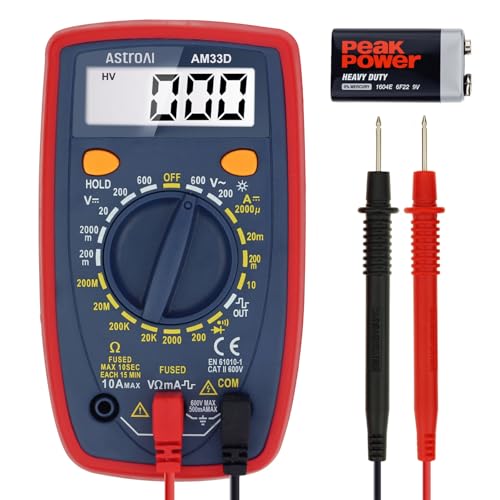
The AstroAI Digital Multimeter Tester 2000 Counts is a more sensible match for hobbyists on a tight budget who only need basic voltage and continuity checks around the house.
The AstroAI 2000-count tester is the meter that gets handed to a new homeowner learning the basics. The blue case is easy to spot at the bottom of a toolbox, and the manual rotary dial encourages new users to think about what they’re measuring before they probe. It covers the core jobs: AC and DC voltage, current, resistance, continuity, and diode testing.
It uses a manual-ranging setup, meaning the user picks the correct scale rather than letting the meter choose, which is a small extra step but a useful habit-builder while learning. The 2000-count display shows readings to three digits, which is enough resolution for outlet checks, battery tests, and simple appliance troubleshooting. For most people, the trade-off is paying less and accepting fewer advanced features, which is usually the right call.
Useful Highlights
- Low price makes it an easy first-meter purchase for homeowners
- Manual dial forces new users to learn ranges, a useful skill for later upgrades
- Compact body fits in a kitchen drawer alongside screwdrivers and tape
- Covers the most common residential measurements in a single tool
Points To Note
- Cannot measure AC current or AC voltage below 100mV, which limits electronics work
- Manual ranging can produce confusing zero readings on the wrong scale, frustrating first-time users
- Test lead quality is basic; replacing them with safer leads is a common first upgrade
Who It Suits Best
Homeowners and first-time DIYers handling outlet checks, battery testing, and basic appliance diagnosis around the house.
Where Another Pick Suits Better
The AstroAI True RMS 6000 Counts Auto-Ranging Multimeter is the smarter step up once you start tackling automotive electrical work or want auto-ranging convenience.
The AstroAI 6000-count meter is the sweet spot for people who want one tool that handles both home wiring and car electrical systems. Auto-ranging removes the guesswork that trips up the entry-level model, so you can move from a wall outlet to a battery terminal without stopping to turn a dial. The 6000-count resolution shows a fourth digit, which helps when chasing small voltage drops on automotive sensors.
True RMS is genuinely useful here: modern cars run variable-output alternators and pulse-width-modulated sensors that confuse averaging meters. The kickstand tilts the display at a comfortable angle on a workbench, and the data-hold function freezes a reading so you can probe in awkward spots and read the screen afterward. Garage tinkerers, advanced DIYers, and small-shop technicians will get a lot of mileage out of this one.
Where It Delivers
- Auto-ranging saves time when switching between household and automotive measurements
- True RMS reads accurately on modern vehicle electronics and dimmable LED loads
- Measures capacitance, frequency, duty cycle, and temperature for broader diagnostic work
- Data hold and backlit LCD help in low-light engine bays and attic spaces
Honest Caveats
- Temperature measurement requires a separate thermocouple probe that’s not always included
- Auto-ranging can feel slower on continuous bench work where manual range would snap faster
Spec Overview
Built With In Mind
Home DIYers, automotive hobbyists, and small-shop technicians who want one meter that handles both wall outlets and car wiring without a steep learning curve.
Look Elsewhere When
The Fluke 115 Multimeter is the better call for working techs who need a tougher safety rating and the long-term reliability of a professional brand.
The AstroAI clamp meter takes a different approach from the other units here: it measures current by clamping around a single conductor rather than breaking the circuit to insert the meter in series. That’s a major convenience when checking whether a car accessory is drawing power with the engine off, or measuring the load on a household circuit without unplugging anything.
It still reads AC and DC voltage, resistance, capacitance, continuity, and includes non-contact voltage detection for quick live-wire checks. The trade-off is that this clamp cannot measure DC current, which matters if you want to verify DC charging current on a vehicle. The jaw opening accommodates most household and automotive wire bundles, and the auto-ranging keeps the dial simple.
The Helpful Details
- Clamp design measures AC current without breaking the circuit
- Non-contact voltage detection adds a quick safety-check layer
- Auto-ranging simplifies operation for occasional users
- Live wire test helps confirm conductor state before probing
Smaller Limitations
- Cannot measure DC current, ruling out some automotive charging diagnostics
- Clamping around both legs of a power cord cancels the reading; the user must isolate a single conductor
- Jaw is for current only, so voltage measurements still need the test leads
Who Will Love This
Car owners, home inspectors, and HVAC troubleshooters who frequently measure current without disconnecting wires.
A Better Fit Elsewhere
The AstroAI True RMS 6000 Counts Auto-Ranging Multimeter is the right call for users who need DC current measurement and a broader set of precision readings.
The Fluke 115 is the compact True RMS meter that lives in the bags of more field techs than almost any other model. It measures voltage, current, resistance, continuity, frequency, and capacitance, covering nearly every reading a service technician needs without pulling out a second tool. The CAT III 600V safety rating means it can be used on distribution boards and most fixed installations without concern.
Min/Max/Average recording captures signal fluctuations automatically, which is handy for chasing intermittent faults on motors or control circuits. The white LED backlight holds up in dim utility closets, and the rugged overmolded case shrugs off the inevitable drops onto concrete. Apprentices and experienced techs alike will find the 115 a reliable daily companion.
Key Advantages
- True RMS accuracy on variable-frequency drives and modern electronic loads
- CAT III 600V safety rating supports work on distribution-level equipment
- Min/Max/Average recording captures intermittent faults automatically
- Tough overmolded housing handles daily job-site abuse
Trade-Offs To Consider
- No non-contact voltage detection, so live checks require probe contact
- Costs more than the AstroAI units without adding features a hobbyist would use
Perfect Match For
Field technicians, electrical apprentices, and service engineers who want a compact, rugged meter with strong safety credentials for daily professional use.
Swap It Out When
The Fluke 117 Digital Multimeter is the better match for techs who want non-contact voltage detection built into the same form factor.
Picking a Multimeter That Actually Fits Your Work
What Category of User Are You
Start with the honest answer to who you are and what you measure. A homeowner checking a dead outlet or testing AA batteries has wildly different needs than a journeyman tracing motor faults in a commercial panel. Hobbyists can save real money with a 2000-count meter and never notice the missing features. Working pros, on the other hand, depend on True RMS, safety ratings, and ruggedness, and those traits justify the price gap.
Accuracy and Measurement Type
True RMS matters more than most shoppers realize. Standard meters assume a clean sine wave (a smooth, repeating AC waveform), but modern electronics, dimmer switches, variable-speed motors, and computer power supplies create distorted waveforms that throw off averaging meters by 10% or more. For most residential troubleshooting on a clean grid, a non-True-RMS meter still works fine. For automotive work, HVAC, or any circuit with switching power supplies, True RMS is the safer pick.
Display Count and Resolution
The “count” rating tells you how finely the meter divides its range. A 2000-count meter shows 0 to 1999, while a 6000-count meter shows 0 to 5999. On a 10V range, that extra digit means the difference between seeing a reading change at 0.01V versus 0.005V. For battery testing and outlet checks, 2000 counts is plenty. For chasing small voltage drops on automotive sensors, 6000 counts makes the job far easier.
Safety Ratings and Build
The CAT (Category) rating, defined by standards like IEC 61010, describes what kind of electrical environment the meter can safely handle. CAT II covers household outlets and plug-in loads, CAT III covers distribution panels and fixed industrial equipment, and CAT IV covers the service entrance and outdoor conductors. Mismatching the meter to the environment risks serious arc-flash danger. Look for the rating printed on the meter and match it to where you actually work.
Form Factor and Extras
Clamp meters trade series-current measurement for the ability to read current without breaking the circuit, which is invaluable for automotive and HVAC work but not necessary for basic household troubleshooting. Backlights, kickstands, data hold, and auto shut-off all add up to a more pleasant experience, especially in awkward spots. None of these features justify overspending on their own, but together they separate a meter you’ll reach for from one that sits in a drawer.
Smart Buying Considerations Before You Decide
Common Shopping Slip Ups
The biggest mistake is buying a meter with more features than you’ll actually use, then resenting the cost every time you open the case. The opposite error is buying the cheapest unit for work that demands True RMS or a real CAT rating, which is how people end up with fried meters or worse. A close third is ignoring lead quality: stock leads on budget meters are often the weakest link, and replacing them with silicone-insulated leads rated for your environment is a cheap upgrade. Match the meter to the job, and replace the leads before the meter.
What The Higher Tier Buys
Spending more on a meter like the Fluke 115 or 117 generally buys three things: better safety certifications, longer mechanical lifespan, and accuracy that holds over years of daily use. Professional meters also tend to include True RMS, better input protection against accidental voltage on the current terminals, and housings that survive drops from ladder height. None of that matters for the once-a-month battery check, but for someone who uses the tool every day, the upgrade pays back in fewer replacements and fewer wrong readings.
Frequently Asked Questions
Do I really need True RMS in a multimeter?
You need True RMS whenever you measure AC signals on circuits that aren’t a clean sine wave, which includes most modern electronics, dimmer switches, and variable-speed motor drives. On standard household outlets supplying simple resistive loads, a non-True-RMS meter reads accurately enough for most purposes.
What is the difference between auto-ranging and manual ranging?
Auto-ranging meters pick the correct measurement scale automatically, while manual-ranging meters require the user to select the range with a dial. Auto-ranging is more convenient for beginners, but manual ranging can be faster for experienced users who already know the expected value.
Can a clamp meter replace a standard multimeter?
A clamp meter can do most of what a standard multimeter does, but it usually measures current only on AC, not DC. For full DC current capability and the highest accuracy on small signals, a traditional multimeter is still the better tool.
What does the CAT III safety rating mean?
CAT III indicates the meter is rated for use on distribution-level equipment like panel boards, motor circuits, and permanently installed loads. It is a step above the CAT II rating that covers standard wall outlets and plug-in appliances.
How long should a good multimeter last?
A quality multimeter used in a home-shop setting can easily last a decade or longer, especially with fresh batteries and occasional lead replacement. Professional meters used daily on job sites typically last many years, with the batteries and leads being the parts most likely to need replacement first.
Closing Verdict
Choosing the right multimeter comes down to honest self-assessment: what you measure, how often, and in what kind of electrical environment. Beginners and homeowners will find everything they need in the AstroAI 2000-count or 6000-count models, while working professionals will appreciate the safety, accuracy, and durability of the Fluke 115 or 117. Match the tool to the work, replace the leads when needed, and any of these five will serve you well for years.