


Multiprocess welders let you handle MIG, TIG, stick, and sometimes plasma cutting from a single machine, which is a genuine shift for home shops and farm repair routines. The five models below cover a wide spread, from a portable 38-pound Miller to feature-heavy 12-in-1 combos that pack a plasma cutter into the same chassis. The right pick depends on your outlets, your metal thickness, and how often you swap between processes. That trade-off is the thread running through every review below.
An Overview Of The Picks
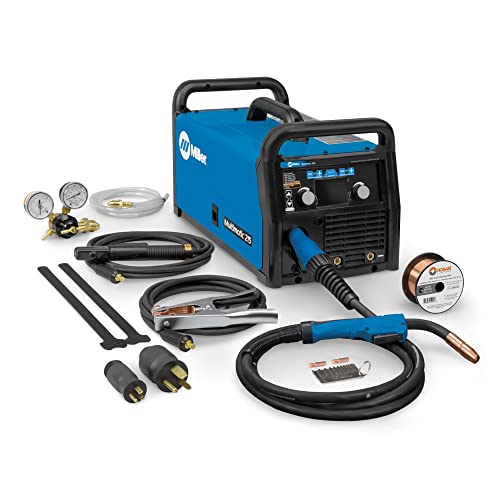
Miller Multimatic 215 Multiprocess Welder

YESWELDER MCT-520 6-in-1 Welder & Plasma Cutter

YESWELDER MP200-PRO 12-in-1 Welder & Plasma Cutter

YESWELDER Firstess SP200 MIG Welder

BESTMIG 145A 4-in-1 Multi-Process Welder
What Each Pick Brings To The Table
The Miller Multimatic 215 is the unit you grab when a job moves from the bench to the truck and back again. At roughly 38 pounds with a dual-voltage hookup (120V or 240V), it works on a standard household outlet for thinner stock and steps up to a heavier circuit when you need more penetration. Auto-Set Elite takes the guesswork out of parameter matching across MIG, stick, and DC TIG, which is helpful if you don’t weld every day.
Miller is the legacy name in this category, and this model is positioned for users who want professional-grade arc behavior in a portable form. It welds up to 3/8-inch mild steel, which covers most fabrication, repair, and hobby work. The catch is the price tier: it sits well above the YESWELDER models below.
A Few Strong Suits
- Truly portable at about 38 pounds for jobsite or driveway work
- Dual-voltage flexibility runs on common 120V household outlets
- Covers flux-cored, MIG, stick, and DC TIG in one chassis
- Auto-Set Elite reduces trial-and-error for occasional welders
Worth Noting
- Costs more than the other picks listed here
- No integrated plasma cutter, so cutting remains a separate tool
Who It Suits Best
Skilled hobbyists and working technicians who want Miller reliability and will use the unit often enough to justify the premium.
A Better Fit Elsewhere
The YESWELDER MP200-PRO 12-in-1 fits users who want a plasma cutter built in and don’t need Miller’s brand pedigree.
Where the Miller earns its keep on arc quality, the YESWELDER MCT-520 earns its keep on raw versatility. Six working modes cover gas MIG, flux core, plasma cutting, HF TIG, MMA stick, and spool-gun aluminum work, putting cutting and joining on the same bench. The 7-inch LED readout keeps the parameter screen visible from a standing position, which matters in a working shop.
Dual-voltage operation (110V/220V) gives the same outlet flexibility as the Miller, so the unit moves between a garage outlet and a 220V farm circuit without drama. Compared to the bigger MP200-PRO covered next, the MCT-520 leans toward users who want plasma cutting without paying for the full 12-in-1 feature stack.
Points In Its Favor
- Plasma cutting built into the same machine as MIG and TIG
- Spool gun compatibility opens aluminum work for thin-gauge panels
- Large 7-inch LED display reads clearly from across the bench
Small Caveats
- Spool gun and TIG torch are sold separately, raising real cost
- More setup modes mean a steeper learning curve than a 4-in-1
Made For
Farm owners, garage fabricators, and field repair techs who need both cutting and welding from one transportable unit.
Reach For A Different Pick When
The BESTMIG 145A 4-in-1 is a smarter match for beginners who want fewer modes and included PPE.
The MP200-PRO is the unit for users who treat their welder like a Swiss Army knife. Twelve modes include pulsed MIG, pulsed TIG, pulsed stick, lift TIG, HF TIG, flux core, standard MIG, stick, plasma cutting, spot welding, and clean mode, plus spool-gun aluminum. That’s a feature list you usually see on industrial three-phase units, repackaged for a 120V/240V home shop.
The trade-off is the interface: more modes mean more menu navigation, and the learning curve is real. For someone running a varied rotation of repairs, bodywork, and fabrication, the flexibility pays for itself. The honest read is that casual users may never touch half the modes.
Standout Benefits
- Twelve processes cover nearly every common welding and cutting task
- Pulsed MIG and pulsed TIG reduce heat input on thinner stock
- Plasma cutter built in for sheet metal and rusty steel
Honest Caveats
- Owners commonly report firmware menus that take time to learn
- Spool gun and TIG torch sold separately, like its smaller sibling
Key Advantages
Best Suited To
Advanced home-shop users and small fabrication shops that switch between thin aluminum, sheet steel, and heavy plate within a single week.
Where A Sibling Pick Shines
The YESWELDER Firstess SP200 is a quieter fit for users who want pulse MIG and lift TIG without the plasma-cutting complexity.
The Firstess SP200 sits in a useful middle ground: seven processes (MIG, pulsed MIG, flux core, spool-gun MIG, spot welding, lift TIG, and stick) without the plasma cutter complexity of the MP200-PRO. The 200A output handles typical home-shop stock comfortably, and dual-voltage 110V/220V support keeps outlet options open.
For users moving up from a basic stick or flux-core machine, this is a sane upgrade path. Pulsed MIG is the headline feature here, and it helps on thin automotive sheet where a standard MIG would burn through. Note that the lift TIG torch and spool gun are optional extras.
What Earns Its Place
- Pulsed MIG reduces burn-through on thin body and sheet-metal work
- Spot welding mode handles small tab and plug welds without a separate rig
- 200A ceiling on a dual-voltage chassis for real fabrication depth
Trade Offs
- Lift TIG and spool gun require extra purchases to unlock those modes
- No plasma cutter, unlike the MCT-520 and MP200-PRO
Perfect Match For
DIYers upgrading from a stick welder who want pulse MIG and TIG capability without stepping into pro-priced territory.
Skip It When
The Miller Multimatic 215 suits users who value long-term brand support over feature count and budget.
The BESTMIG 145A is the entry point of this list, and it shows up ready to weld. Four processes (gas MIG, gasless flux core, lift TIG, and MMA stick) cover the workflows most beginners actually need, and the synergy IGBT inverter adjusts output based on the dialed-in thickness. That automation is genuinely helpful on a first machine, where the usual learning curve is half parameter guessing.
Dual voltage 110V/220V matches the rest of the roundup, and the package ships with an auto-darkening welding helmet and gloves, so the total cost of entry stays reasonable. Wire diameter support spans .030 to .040 inches for solid, flux-cored, and stainless wire, which covers common mild-steel repairs. The realistic cap is the 145A output: thicker steel work will need a more powerful unit.
The Practical Payoff
- Helmet and gloves included in the box
- Synergy inverter removes much of the parameter tweaking
- Dual-voltage for garage and shop outlet compatibility
Factors To Consider
- 145A ceiling limits thicker plate and aluminum work
- Four modes is fewer than any other pick on this list
Quick Facts
Who Should Grab It
First-time multiprocess users and hobby welders who want a low-fuss start with the right safety gear included.
Not Your Match When
The YESWELDER Firstess SP200 fits users ready to step up to pulsed MIG and a higher 200A ceiling.
Picking The Right Multiprocess Welder For Your Shop
Process count matters, but the deeper question is what you’re actually welding day to day. A 4-in-1 like the BESTMIG 145A handles sheet-metal and thin-wall tube work cleanly, while a 12-in-1 like the YESWELDER MP200-PRO earns its keep on mixed-metal fabrication, body panels, and farm repair. Match the modes to your typical project, not the longest possible feature list.
Voltage flexibility is the second decision point. Dual-voltage 120V/240V models work on a standard household outlet at lower amperage and step up to 240V for thicker steel. Single-voltage units need a dedicated circuit from day one, which adds install cost. For most home shops, dual-voltage wins on practicality.
Output amperage tells you the honest ceiling. Anything around 145A is fine for under 1/4-inch steel. Once you start welding 3/8-inch plate or thicker, you want 200A or above. The Miller Multimatic 215 and YESWELDER Firstess SP200 both sit at the higher end, which is why they show up on thicker fabrication jobs.
Finally, factor in consumables and accessories. Several YESWELDER models ship the welder only, with spool guns and TIG torches sold separately. That’s fine for experienced users with existing accessories, but beginners should plan for the add-on cost or pick a bundled option like the BESTMIG package.
Matching Multiprocess Welders To Real Work
Wrong Turns To Avoid
The most common mistake is chasing the longest process list without matching modes to your workload. A 12-in-1 unit is wasted on someone who only runs flux-core MIG on a farm gate. The honest approach is to list the three or four welding tasks you actually do, then pick a machine that covers those with headroom.
Another trap is ignoring circuit requirements. A 240V-only welder needs a dedicated circuit, and many home shops don’t have one. Dual-voltage models sidestep this entirely, which is why three of the five picks here ship with 120V/240V support. Plan outlet access before you buy.
Where The Extra Money Goes
Premium tiers like the Miller Multimatic 215 charge for arc stability, long-term durability, and brand support. For users who weld weekly or run a small business, that reliability pays back over years. The honest read is that for monthly hobby use, the YESWELDER models deliver similar process coverage at a lower entry cost.
Higher-tier models also tend to have better inverter electronics, which translates to cleaner welds on thin material and smoother parameter adjustment. The upgrade makes sense once you’re running pulse MIG on aluminum or TIG on stainless, where arc behavior matters more than raw feature count.
Frequently Asked Questions
What is a multiprocess welder?
A multiprocess welder combines multiple welding methods like MIG, TIG, and stick into one machine, often with a plasma cutter built in. This eliminates the need for separate dedicated units and saves shop space.
Can a multiprocess welder handle aluminum?
Most multiprocess welders can weld aluminum with a compatible spool gun, though the spool gun is usually sold separately. Pure MIG aluminum work requires a push-pull or spool-gun setup because standard MIG torches don’t feed soft aluminum wire reliably.
Do I need 240V for a multiprocess welder?
Not always. Many modern multiprocess welders run on both 120V and 240V, with reduced output on the 120V setting. For thicker steel above 1/4 inch, the 240V circuit is recommended to access full amperage.
Is a plasma cutter built into a multiprocess welder worth it?
A built-in plasma cutter saves bench space and cost versus a separate unit, though the cutting capacity is usually limited to thinner steel. For occasional metal cutting and sheet work, integrated plasma is convenient.
How much amperage do I need for typical home welding?
For sheet metal, automotive body work, and 1/4-inch steel, 145A to 200A is plenty. For 3/8-inch plate or heavier, look for 200A or above on a 240V circuit.
Bottom Line
The right multiprocess welder matches your outlet, your metal thickness, and the processes you’ll actually use. Beginners get the most from a bundled 4-in-1 like the BESTMIG 145A, while advanced shop users will appreciate the 12-in-1 MP200-PRO or the Miller Multimatic 215. Pick the process list that fits your real workload, and the rest of the decision tends to follow.




