


A flaky network link is one of the most frustrating problems in any home or office setup. You swap the cable, reboot the router, and still nothing changes, and the real culprit is usually a single miswired pair hiding in a wall jack. The right network cable tester turns that guesswork into a five-minute diagnosis, whether you are wiring a basement, troubleshooting a small business rack, or just trying to figure out why your office phone line stopped ringing.
How The Shortlist Stacks Up

Klein Tools 80072 RJ45 Cable Tester Kit with LAN Scout Jr. 2

NOYAFA NF-8209 Network Cable Tester with POE and NCV
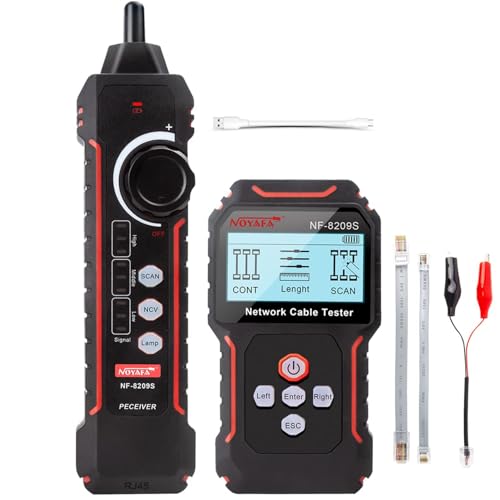
NOYAFA NF-8209S Network Cable Tester Upgrade

TESMEN TLP-528A Network Cable Tester (Green)
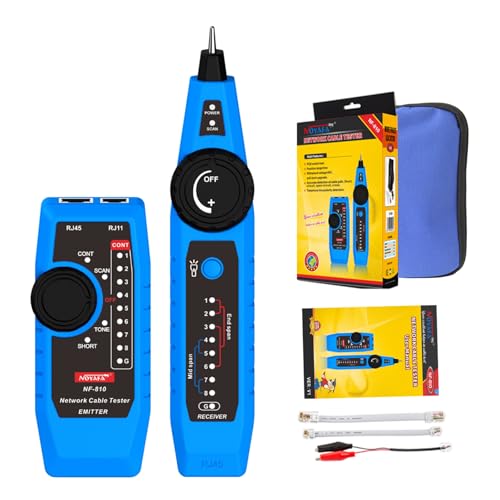
NOYAFA NF-810 Multifunctional Network Cable Tester
More On The Choices That Made The List
The Klein Tools 80072 lands first because it solves the entire cable workflow, not just one slice of it. The LAN Scout Jr. 2 verifies continuity on CAT5e and CAT6/6A runs terminated with RJ45 connectors, which covers the cabling most homes and small offices actually use. The included coax crimper, stripper, and cutter handle the prep work, and the 50-pack of pass-through modular plugs means you can terminate freshly run cable without a second trip to the supply drawer.
For an installer pulling multiple runs in a single afternoon, the kit pays for itself by saving trips back to the truck. DIYers tackling a one-room addition will still find value here, though the 50-pack of plugs may be more than needed for a single weekend project.
A Favorable Mix
- Tests both installed cables and loose patch cords without needing a remote on both ends for basic continuity checks
- Pass-through connector design on the included plugs speeds up termination and reduces miswire errors on long runs
- Crimper, stripper, and cutter share the same tool ecosystem, which matters when you are switching between coax and data prep mid-job
- Klein’s track record in the trade means replacement parts and support stay accessible over the long haul
Points To Note
- The kit costs more than standalone testers, and you only recover that premium if you actually use the crimper and plug supply
- Bulkier than handheld tracers, so it lives in a tool bag rather than a shirt pocket
Key Attributes
Who It Suits Best
Contractors and serious DIYers pulling multiple new data drops in a home or small office will get the most from this kit.
Where Another Pick Suits Better
The NOYAFA NF-810 is a lighter choice for homeowners who mainly need to trace an existing cable rather than build new runs.
The NOYAFA NF-8209 covers the three jobs that come up most often: continuity, tracing, and power. POE detection tells you whether a switch or injector is actually delivering power over the cable, which saves the slow walk back to the closet to check the port. NCV (non-contact voltage detection) adds a layer of safety when you are unsure whether a line is live. The length test feature, in our view, is the sleeper capability here, giving you a ballpark distance reading that helps pinpoint where a break sits inside a long run.
Where the Klein kit feels like a contractor’s tool bag, the NF-8209 feels more like a field diagnostic device. Techs who split time between networks, security cameras, and VoIP phones will find that the multi-function approach replaces several single-purpose gadgets in their kit.
Useful Strengths
- POE testing follows the at/af standard, which covers the bulk of powered devices in homes and small offices
- NCV function adds a quick safety check before you touch a conductor you are unsure about
- Length measurement helps localize opens and shorts to a specific section of cable rather than a full re-pull
Trade Offs
- More features means more menu navigation, and the learning curve is steeper than a simple LED-only tester
- POE readings can vary depending on cable quality, so confirm critical circuits with the actual powered device
- Owners commonly report that the included English manual is thin, so allow time to learn the modes by trial
Right Fit For
Network techs and AV installers who handle a mix of data, voice, and low-voltage power work in the same visit.
A Better Fit Elsewhere
The Klein Tools 80072 is the stronger choice when you are terminating fresh cable rather than diagnosing existing runs.
The NF-8209S is the Sibling pick to the NF-8209 above, and the “S” earns its keep in places where the older model struggles. Anti-interference scanning modes help the tracer cut through the noise floor in environments crowded with power cables, fluorescent ballasts, and adjacent data runs. The port flashing function also helps you identify which switch port a live cable terminates at, which is genuinely useful when you are staring at the back of a 48-port switch with no labels.
Cable length measurement extends out to 500 meters on this generation, which covers the longest runs in a typical warehouse or campus edge. The trade-off is that you pay a small premium over the older NF-8209, and you only get that money back if the extra scan modes solve a real problem in your environment.
What Pays Off
- Anti-interference scan modes keep the tracer audible in electrically noisy ceilings and mechanical rooms
- Port flashing pinpoints the switch port that matches a given wall jack, saving label-reading time
- Length measurement range of 1 to 500 meters handles most residential and small commercial runs
Honest Caveats
- Priced above simpler continuity-only testers, so the upgrade has to earn its keep in your specific environment
- The anti-interference benefit is hard to appreciate in a quiet home office, which is the most common test environment
Feature Snapshot
Best Suited To
Technicians who frequently work in mechanical rooms, ceilings, or industrial spaces with significant electrical noise.
Look Elsewhere When
The TESMEN TLP-528A is a simpler, more approachable pick for homeowners who just need to check cable continuity.
The TESMEN TLP-528A is the easiest entry on this list, and that is the point. A row of clear LED indicators tells you at a glance whether each conductor inside an RJ45 or RJ11 cable is making contact, and a fast or slow test mode lets you pick the speed that matches the situation. CAT5, CAT6, and CAT7 support covers basically any Ethernet patch cable you can buy, which matters because the cabling you actually own is rarely a single standard.
The green housing also helps you find it in a cluttered drawer, which is a small thing until you have spent ten minutes looking for a black tester in a black tool bag. You will not get length measurement, POE detection, or a tracer here, but you also do not have to learn a menu to use it.
The Practical Payoff
- LED layout reads at a glance, which is faster than decoding a screen for occasional users
- RJ11 and RJ45 support covers both data and telephone cables in a single device
- Fast and slow test modes let you trade detail for speed when you are sorting a pile of patch cables
Small Caveats
- No length measurement or tracing function, so it cannot tell you where a break is inside a wall
- QC check function is useful for crimp work but adds another mode to learn for a feature most casual users will skip
Whose Shelf It Belongs On
Homeowners and small office managers sorting through a box of mixed cables will appreciate the straightforward interface.
Reach For A Different Pick When
The NOYAFA NF-810 is a better call when the main job is tracing a hidden cable rather than testing a known one.
The NOYAFA NF-810 is the tracer you grab when the cable has vanished into a wall and you need to follow it. A sound receiver and a yellow-green signal indicator help you locate the right conductor in a bundle, and POE testing checks whether power is reaching the far end without an extra device. Telephone line status checks, including polarity, standby, off-hook, and ringing states, give the NF-810 some crossover appeal if you still maintain a small phone system.
Where the NF-8209 above leans into diagnostic depth, the NF-810 stays closer to the basics. You may find the tracing sensitivity takes some practice in tight bundles, but the price gap compared to heavier diagnostic tools makes the trade worth considering for lighter workloads.
Points In Its Favor
- Tracer function locates the far end of a cable through walls and ceilings without a second person calling out
- POE testing covers the most common deployment scenario for security cameras and access points
- Telephone line status checks add value for small offices that still run a VoIP or analog handset system
A Few Limitations
- Tracing accuracy can drop in dense cable bundles, so plan to spend extra time sorting parallel runs
- No length measurement, which the NF-8209 and NF-8209S both include for that extra level of pinpointing
- Commonly reported as feeling lighter in the hand than contractor-grade units, so handle with care on the job site
Quick Technical Notes
Who Should Grab It
Homeowners and small-office techs who mostly need to trace existing cables and check basic POE on cameras or access points.
Swap It Out When
The NOYAFA NF-8209S is a better match if you regularly work in electrically noisy spaces and need anti-interference scan modes.
What To Weigh Before Picking a Network Cable Tester
Start with the cable types you actually own. Most modern networks run CAT5e or CAT6, but a tester that lists CAT7 support future-proofs you for higher-bandwidth runs. RJ45 is the Ethernet standard you will see on patch cables, while RJ11 shows up on telephone lines, and any tester worth carrying supports both.
Next, think about the depth of diagnosis you need. A simple continuity tester with LED indicators handles the common case of figuring out whether a patch cable has a broken conductor. A multi-function unit with POE detection and length measurement steps in when you need to localize a break inside a wall or confirm that a powered device is receiving voltage. NCV (non-contact voltage detection, meaning the tester lights up near a live wire without touching it) adds a safety check before you handle an unfamiliar conductor.
Portability matters more than people expect. A pocket-sized unit disappears into a shirt pocket and gets used more often, while a larger diagnostic tool with a screen lives in a bag. For a homeowner sorting a drawer of cables, the smaller form factor tends to win. For a contractor running daily service calls, the larger screen pays off in faster reads.
Finally, consider tracer function versus continuity. A continuity tester confirms a known cable is good, while a tracer follows an unknown cable through a wall. If your main problem is figuring out which of thirty unlabeled cords goes where, a tracer is the right tool. If your main problem is sorting a known patch cable pile, a continuity tester is enough.
Key Considerations Across These Picks
Pitfalls Shoppers Hit
The most common mistake is buying a tester that only does continuity when the real problem is tracing an unknown cable. The reverse is also true, where someone pays for a tracer but never uses the audio receiver because the actual fault was a bad crimp on a known cable. Match the tool to the job you do most, not the most impressive spec sheet.
Another trap is ignoring connector compatibility. A tester that only handles RJ45 will leave you stuck the moment you need to verify a phone line, and adapters are an easy thing to lose in a tool bag. Confirming that the unit supports both RJ45 and RJ11 from the factory saves a future headache.
Where The Extra Money Goes
Higher-tier testers earn their price through POE detection, length measurement, and anti-interference scanning modes. POE detection tells you whether a switch or injector is actually delivering power, which matters for cameras and access points. Length measurement localizes breaks without opening a wall. Anti-interference scanning helps in environments with heavy electrical noise, such as mechanical rooms and ceilings near fluorescent ballasts. For most home users, those capabilities remain optional. For working technicians, they tend to pay back quickly.
Frequently Asked Questions
Do network cable testers work on both Ethernet and phone lines?
Most modern testers cover both RJ45 Ethernet and RJ11 phone connectors in a single unit. Verify the listing before you buy, since a few budget models skip the phone side.
What is POE testing and who actually needs it?
POE (Power over Ethernet) testing confirms whether a cable is delivering power from a switch or injector to a device like a camera or access point. It matters for anyone installing or maintaining those devices, and is less critical for general home network use.
Can a cable tester find a break inside a wall?
A continuity tester tells you the cable is faulty, but only a tester with length measurement or a tracer function helps you locate the fault. Tracers are the better tool when the cable runs behind drywall.
How do continuity and tracing differ?
Continuity confirms that each conductor inside a known cable is connected end to end, while tracing follows an unknown cable through a wall using a signal and a receiver. One diagnoses a cable you have, the other finds a cable you have lost.
Are expensive testers worth it for home use?
For most homeowners, a mid-range continuity and tracer unit covers the common needs. The higher price of advanced testers pays off in length measurement, POE detection, and anti-interference scan modes, which matter more in commercial or industrial settings.
Wrap Up
The right network cable tester depends on the kind of work you do most. Contractors pulling new runs will appreciate the Klein Tools kit, while mixed-use techs benefit from the NOYAFA NF-8209 or NF-8209S. Homeowners sorting a cable drawer get a long way with the TESMEN TLP-528A, and anyone chasing cables through walls will find the NOYAFA NF-810 a practical companion. Match the tool to the job, and the rest of the network tends to sort itself out.




