


Cutting concrete with a multitool isn’t a casual job. Most standard bi-metal blades glaze over on masonry, and you’ll waste an afternoon burning through a pack that was never built for the work. The right oscillating blade pair changes that equation completely, turning a tedious, dusty chore into something you can actually finish in a reasonable stretch.
This lineup rounds up five oscillating blade sets and individual blades that hold up on masonry-style tasks like grout removal, tile work, and the occasional concrete patch. There’s a budget bulk pack for the curious DIYer, a diamond-segment set for serious grout and tile work, and a couple of titanium options that bridge wood and metal without torching your wallet. Concrete isn’t easy on blades, so the picks below lean toward materials and segment shapes that survive the heat and grit.
A Quick View Of The Lineup
A Quick View Of The Lineup

CaRoller 100Pcs Universal Oscillating Saw Blades

Diablo Universal Fit Oscillating Blade 3 Pack

KELIN 6 PCS Titanium Oscillating Blade

KELIN 16pcs Titanium Oscillating Multitool Blades
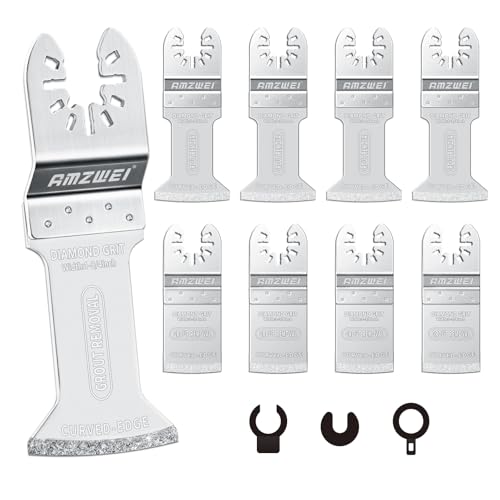
AMZWEI 8PCS Diamond Oscillating Blades Curved Edge
A Closer Look At Each Pick
The CaRoller 100-pack leans into the “try everything” approach. You get a tower of assorted blades covering wood, soft metal, and plastic, which makes it the friendliest starting point if you’ve never committed to a blade type and just want to figure out what your multitool can do. For a homeowner working through a punch list of trim cuts, PVC trimming, and small dry-wall repairs, the volume keeps you from panicking every time a tooth chips.
On genuine masonry work like concrete, these aren’t the right tool. Bi-metal teeth glaze over fast, and you’ll work harder than you save. Treat this pack as the workhorse for everything around the concrete work, then reach for a diamond-segmented option like the AMZWEI set for the actual masonry cuts.
Good Reasons To Consider
- One hundred pieces means you stop rationing blades on small projects.
- Mix of profiles handles trim, PVC, drywall, and soft metal in one drawer.
- Universal fit works on the most common multitool mounting systems.
- Low cost per blade makes it easy to toss a dull one without guilt.
Things To Consider
- Bi-metal construction struggles on cured concrete and will burn through teeth quickly.
- Storage becomes a problem with that many loose pieces; a small case or organizer pays off.
Whose Shelf It Belongs On
A first-time multitool owner who needs a low-risk way to learn what each blade profile does before buying specialty blades.
A Better Fit Elsewhere
If most of your cuts are grout lines or tile, the AMZWEI 8PCS Diamond Oscillating Blades Curved Edge is built for that exact job.
Diablo has built a name in cutting accessories, and this 3-pack focuses on the part that actually decides whether a blade lives or dies: the fit. The universal open-back interface, paired with the 2-1/2-inch width and 1-1/2-inch depth, is engineered to drop onto Bosch, DEWALT, Dremel, Fein, Makita, Metabo, and Hitachi tools, provided those tools have the universal mount rather than a proprietary starlock-style clamp.
Round blade shape, 4-inch overall length, and a fast-cutting tooth pattern make this the kind of blade you grab when the cut is the project, not a side quest. On masonry-grade concrete, it still won’t replace a diamond segment, but it handles plunge cuts, flush cuts, and trim work cleanly enough that you stop blaming the tool.
A Few Highlights
- Multi-brand compatibility covers most mainstream multitool platforms on the market.
- Round profile handles plunge, flush, and straight cuts without swapping heads.
- Sturdy 4-inch body stays stable under load and resists wandering on long cuts.
Points To Note
- Tooth count favors speed, so very fine finish cuts may chip delicate trim edges.
- Universal mount means it won’t fit tools that require proprietary interfaces.
Key Product Details
Best Suited To
A DIYer or pro who bounces between several multitool brands and wants one blade style that fits them all without adapters.
Skip It When
If every cut you do is grout, tile, or cured masonry, the AMZWEI 8PCS Diamond Oscillating Blades Curved Edge will out-grind this Diablo pack on the same work.
Where the CaRoller 100-pack is a sampler, the KELIN 6-piece set is a focused kit. KELIN built this set around the gap between carbide blades, which are too aggressive for wood, and standard bi-metal, which dulls fast on metal. The titanium-plated teeth land in the middle: hard enough to chew through screws and thin metal, gentle enough not to scorch soft wood on the same project.
Six pieces means you keep a couple of spares and use the rest. For a homeowner doing a bathroom remodel where you’re cutting back nail-embedded trim, slicing drywall, and trimming PVC, the small footprint keeps the kit honest. For true concrete, you’ll still want diamond teeth, but the KELIN set handles the supporting work around the masonry with fewer burnt edges than a generic blade.
The Upside
- Six-piece count keeps the kit tidy without sacrificing spares for the inevitable slip-up.
- Titanium plating helps resist heat when cutting screws or thin metal sheet.
- Plays well with wood, drywall, and PVC in the same project, fewer blade swaps.
Worth Noting
- Not designed for cured concrete; reach for the AMZWEI diamond set for that.
- Smaller kit means a wrong cut can empty the pack faster than the 100-piece CaRoller would.
Right Fit For
A homeowner working through a mixed-material repair who wants a small, organized kit without buying a hundred spares at once.
Another Choice May Suit
The KELIN 16pcs Titanium Oscillating Multitool Blades is the same brand and material in a wider set with three blade widths, better for door frame work.
This is the larger KELIN kit, and the headline is the three cutting widths: 34mm, 45mm, and 65mm. That range matters more than it sounds. A 34mm blade slips into tight scribe work on a window jamb, a 45mm handles most trim removals, and the 65mm chews through door frame bottoms where you need reach into a wider kerf. Switching widths mid-project is faster than swapping entire tools.
The titanium plating pushes hardness up enough to extend tooth life on soft metal and hard wood, and the 16-piece count gives you breathing room to wear one out without stopping the job. For door and window repair specifically, this is the kit in KELIN’s lineup that fits the workload. Same caveat as the other titanium sets: concrete itself still wants diamond teeth, so plan to add the AMZWEI set for any masonry cuts.
Strong Points
- Three widths in one box cover narrow scribe cuts and wide door frame work.
- Titanium plating holds up better than plain bi-metal on repeated hard cuts.
- Sixteen pieces leaves enough spares that one bad plunge doesn’t end the project.
Small Caveats
- Wider blades can feel bulky in tight corners, the 34mm earns its keep for that reason.
- Not engineered for cured concrete; masonry work still needs a diamond option on standby.
Feature Snapshot
Made For
A remodeler or serious DIYer who spends a full weekend on door and window repair and wants one kit covering every kerf width they’ll meet.
Consider Something Else When
For pure grout and tile work on bathroom floors, the AMZWEI 8PCS Diamond Oscillating Blades Curved Edge is the more honest choice.
Of the five picks here, this is the one that’s actually designed for the hard stuff. Diamond segments are industrial-grade abrasive grit bonded to the blade body, and they’re the only oscillating blade material that makes sense on cured concrete, grout, and dense tile. AMZWEI ships two blade lengths in the set: 2-3/8 inches for deeper cuts and 1-3/8 inches for aggressive grinding without overshooting into surrounding surfaces.
The curved edge geometry is a smart call. Standard straight diamond blades work, but the curve lets the segment swing into corners where grout lines meet a wall or tub edge, which is the exact spot you need reach in a bathroom refresh. For most tile and grout jobs, the 1/13-inch thickness pairs with a 3/8-inch or 3/16-inch grout line, the two most common joint widths. The honest read is this: if a real chunk of your work involves grout, tile, or concrete, this is the set that earns its place in the drawer.
Useful Highlights
- Diamond segments cut cured grout and tile where bi-metal teeth glaze over instantly.
- Two blade lengths in one set cover deep cuts and short, controlled grinding.
- Curved edge reaches into corner joints where straight blades can’t follow the line.
Honest Caveats
- Diamond segments aren’t meant for wood or metal, and using them there wastes the abrasive fast.
- Fine dust builds up quickly during grout work, so a shop vac or dust extraction pays for itself.
Quick Technical Notes
Who Should Grab It
A remodeler or homeowner pulling out old grout and tile in a bathroom or backsplash who needs blades that actually survive the job.
Look Elsewhere When
For trim, wood, and metal cuts alongside the masonry, the KELIN 16pcs Titanium Oscillating Multitool Blades covers the rest of the project.
Picking The Right Blade For Masonry Work
Blade material decides everything. A diamond segment, meaning industrial abrasive grit bonded to a metal body, is the only practical oscillating option for cured concrete, dense grout, and porcelain tile. Bi-metal teeth work fine for wood, drywall, and soft metal, but on masonry they polish smooth in minutes. Carbide grit falls in between and handles softer masonry like old mortar, but diamond wins on hard tile and concrete.
Connection type matters almost as much as the abrasive. Most multitools accept a universal open-back interface, but some newer tools use a proprietary mount that won’t accept these blades without an adapter. Match the blade to the tool before you match it to the material.
Blade shape affects what you can actually reach. Round blades handle plunge and flush cuts. Straight, wide blades chew through door jambs. Curved diamond segments follow corner grout lines into wall intersections. Choosing by the joint or cut geometry, not just the material, saves a lot of frustration on the job.
Finally, think about dust and heat. Masonry blades throw fine particulate and run hot. A vacuum attachment, a basic dust mask, and letting the blade cool between passes all extend blade life noticeably.
What To Watch Before You Buy
Common Shopping Slip Ups
Buying a generic bi-metal pack and expecting it to grind out old grout is the most common error, and it ends the same way every time. The teeth polish, the blade smokes, and the grout is still there. Match the abrasive to the material first, then buy depth. Another trap is ignoring the tool’s mount. A perfect diamond blade that doesn’t fit the multitool is just an expensive coaster.
When Paying More Pays Off
A higher tier in this category usually means diamond segments instead of bi-metal, and the price jump is justified the moment the cut involves cured concrete or dense tile. Cheaper blades rely on tooth geometry to scrape their way through, which works on wood and almost nothing else. If a real percentage of your work is masonry, paying for diamond upfront is cheaper than burning through three packs of the wrong blade.
Frequently Asked Questions
Can any oscillating blade cut concrete?
Standard bi-metal blades cannot. Only blades with diamond segments or, in limited cases, carbide grit are designed to abrade cured concrete. A regular wood-cutting blade will overheat and lose its teeth within seconds on concrete.
How long do diamond oscillating blades last?
Lifespan depends on the hardness of the material, the pressure you apply, and whether you let the blade cool. On grout, expect hours of intermittent cutting. On dense tile or cured concrete, you may get less. Forcing the blade or skipping dust extraction shortens life noticeably.
Are universal-fit blades truly universal?
For most mainstream multitools, yes. The universal open-back interface is supported by Bosch, DEWALT, Makita, and others, often with the tool’s own adapter. Newer starlock-style tools use a proprietary mount and won’t accept these blades without a converter.
Can one blade handle both wood and concrete?
Not practically. A diamond segment will cut wood slowly and waste its abrasive quickly, while a bi-metal wood blade will burn up instantly on concrete. Keep separate blades for each material and switch as the project changes.
Is wet cutting necessary for oscillating blades?
For most oscillating multitool work, dry cutting is fine. The blade doesn’t run long enough per pass to build serious heat, and water at the tool body can damage the multitool’s motor. The bigger concern is dust, so focus on extraction rather than liquid cooling.
The Takeaway
The right oscillating blade turns a stubborn concrete or grout job from a fight into a finishable project. If most of your cuts are masonry, start with the AMZWEI diamond set. If you’re balancing masonry with wood and trim, pair the AMZWEI with a KELIN titanium kit and you can finish an entire bathroom without leaving the bench. Pick based on the material you actually cut, not the blade that looks toughest in the box.




