


A used car lot, a private sale, or a panel you suspect was resprayed: a paint thickness gauge tells you in seconds what a shiny surface tries to hide. The right one spots bodywork filler, flags prior accidents, and gives detailers and shoppers an honest number for what’s actually under that clearcoat. Most hobbyists and professionals only need five minutes of instruction to start pulling reliable readings, and the five models below cover the range from casual used-car checks to serious shop workflows.
How The Shortlist Stacks Up

POROMETISTO Paint Thickness Gauge for Cars 0–2000μm
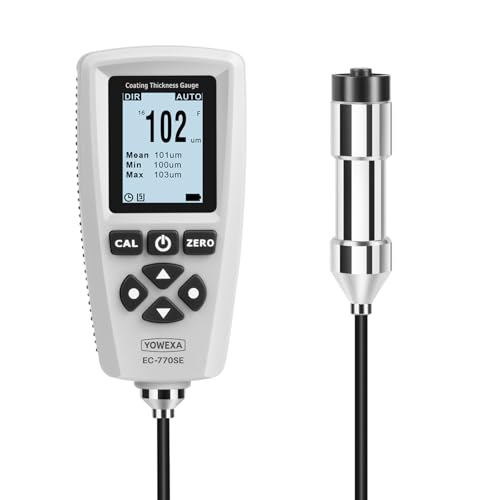
Yowexa Coating Thickness Gauge for Fe/NFe Metals

VVV-Group CM-226Pro Bluetooth Paint Thickness Gauge

VVV-Group CM-205FN Digital Coating Thickness Meter

VVV-Group CM-224 Auto Digital Coating Thickness Meter
Why These Options Stand Out
The POROMETISTO gauge opens the list because its 0–2000μm range swallows just about anything you’ll find on a car, boat hull, or steel structure without clipping. Where a lot of consumer units stop near 1500μm, the extra headroom matters for heavy factory paint, marine finishes, and industrial coatings.
Auto-ID dual tech means the probe figures out whether it’s sitting on iron/steel (Fe) or non-ferrous metal (NFe, which is any metal that isn’t iron-based, like aluminum or copper) the moment you press it down, so there’s no menu diving. For shoppers nervous about prior accident repair, that instant substrate recognition is the difference between a confident negotiation and a guess.
Advantages To Know
- Generous 0–2000μm range covers thicker marine, fleet, and repainted panels without saturating the sensor.
- Auto substrate detection between Fe and NFe cuts the learning curve for first-time owners.
- Suited to automotive, marine, and industrial steel surfaces, giving it real cross-category value.
Things To Consider
- Limited to metal substrates; plastic bumpers, carbon fiber trim, and wood panels are off the menu.
- Bulkier form than pocket-sized units, so it lives in a toolbox rather than a glovebox.
Who It Suits Best
Shoppers evaluating used vehicles with factory-original or resprayed metal panels, plus marine and industrial inspectors needing wide measuring headroom.
Consider Something Else When
Pick the VVV-Group CM-224 Auto instead if you mainly check standard car panels and want the lightest, most pocketable unit on the list.
The Yowexa separates the probe from the body, which sounds minor until you try to read a doorjamb or the inside curve of a fender. Where the POROMETISTO demands a flat-ish approach angle, the detachable probe on this unit gets into recessed and contoured panels that fixed-probe gauges can’t comfortably reach.
It also promises ±(2% of reading + 1μm) accuracy across the same 0–2000μm span, edging out the more common ±(3%+2μm) figure you’ll see on budget units. Paint shop and industrial inspectors doing tight-tolerance work will feel that difference when comparing readings across a panel.
Reasons It Performs
- Detachable external probe reaches into doorjambs, wheel wells, and contoured panels.
- Tighter ±(2%+1μm) accuracy window than most consumer gauges in the bracket.
- Auto, magnetic induction, and eddy current modes for Fe and NFe substrates.
Honest Caveats
- Two-piece design means another cable to manage and store in a busy shop.
- Same metal-only limitation as the other Fe/NFe units in this roundup.
Feature Snapshot
Made For
Paint shop staff and industrial inspectors who probe awkward panel geometry and need a documented accuracy figure on every reading.
Look Elsewhere When
Reach for the VVV-Group CM-226Pro if you want Bluetooth app logging rather than a tethered external probe.
The CM-226Pro is the only gauge here that talks to your phone. The dedicated iOS and Android app displays each measurement in real time, so detailers and dealership inspectors can log a full walkaround without scribbling numbers on a notepad.
Compared with the Yowexa’s wired external probe, the 226Pro keeps a single-body layout and pushes the data workflow onto the screen you already carry. A dedicated Car Mode organizes readings by body panel, which makes handed-over reports to a customer or a buyer far more legible.
Everyday Perks
- Bluetooth app connectivity records every reading digitally for sharing or archiving.
- Rechargeable battery cuts down on disposable cell swaps during long inspection days.
- Car Mode groups measurements by hood, roof, doors, and fenders for cleaner reports.
Points To Keep In Mind
- Depends on your phone and the app for full reporting value; offline use still works but loses the organizational benefit.
- Rechargeable battery means downtime if you forget to top it up before a job.
Best Suited To
Detailers, body shop estimators, and dealership staff who generate written or digital reports from every inspection.
Skip It When
The VVV-Group CM-205FN is a better match for shoppers who want a simple backlit LCD and zero phone pairing.
The CM-205FN is the workhorse pick for first-time owners. Its 0.1μm resolution is finer than the µm-level steps most consumer gauges display, which is genuinely useful when comparing a resprayed panel against an original one right next to it.
Range tops out at 0–1500μm, so it doesn’t reach as high as the POROMETISTO or the Yowexa, but for standard automotive panels that’s more than enough. The backlit LCD is the small detail that matters when you’re peering into a shaded wheel well or a dim garage.
Practical Advantages
- 0.1μm resolution picks up subtle differences between original and resprayed sections.
- Backlit LCD keeps readings visible in low light, a small but real garage upgrade.
- Auto Fe/NFe detection means no manual mode switching for the common steel/aluminum mix.
Trade Offs
- 0–1500μm ceiling rules out very heavy industrial coatings beyond standard auto use.
- Standalone unit with no app sync, so manual logging remains part of the workflow.
Quick Facts
Whose Shelf It Belongs On
Private used-car shoppers and hobbyists who want clear numeric readings without committing to a smartphone workflow.
Where Another Pick Suits Better
Step up to the VVV-Group CM-226Pro if your goal is generating inspection reports for customers rather than personal spot-checks.
The CM-224 Auto is the unit you hand to a friend who has never used a gauge before. Factory calibration means it works out of the box, no menu walk-through or zeroing plate required. Pop in a battery and start probing panels.
Where the CM-205FN leans toward first-time shoppers and the 226Pro targets tech-friendly users, the 224 sits in between with a straightforward body and a large backlit screen. Detection across Fe, Al, and Fe+Zn (zinc-coated steel, common on modern unibody panels) covers the substrates you actually meet in a parking lot.
Features That Help
- Factory-calibrated accuracy, so it’s usable the moment the battery is in.
- Fe, Al, and Fe+Zn detection covers the substrates common on modern vehicles.
- Large backlit LCD is readable in dim garages and outdoor shade alike.
A Few Limitations
- Same 0–1500μm ceiling as the CM-205FN, so very thick industrial coatings are out of reach.
- No smartphone connectivity means manual logging of any reading you want to keep.
Key Product Details
The Right Fit
Casual garage inspectors and first-time gauge owners who want straightforward readings without menus or app pairing.
Reach For A Different Pick When
The POROMETISTO gauge is a stronger fit for inspectors who also work on boats or industrial steel and need that wider 0–2000μm range.
What Matters Most Before Choosing Paint Thickness Gauge
Substrate Compatibility Comes First
A gauge that only reads iron-based steel is useless on an aluminum hood or a galvanized unibody. Look for explicit Fe, NFe, and Fe+Zn (galvanized) detection if you inspect modern vehicles, since most unibody structures use zinc-coated steel to fight rust. The VVV-Group CM-205FN and CM-224 Auto both cover this trio, while the POROMETISTO and Yowexa handle the Fe/NFe split.
Range And Resolution In Real Terms
A 0–1500μm range handles the vast majority of automotive finishes, because factory paint typically runs 100–150μm and a respray rarely pushes past 300μm per pass. Resolution (the smallest change the gauge can display) of 0.1μm is finer than most owners need but helps when comparing two adjacent panels on the same car. If you cross over into marine, fleet, or industrial coatings, the 0–2000μm ceiling on the POROMETISTO and Yowexa earns its keep.
Workflow: One-Hand, Probe, Or App
Standalone units like the CM-224 Auto and CM-205FN keep the workflow in one hand with a backlit screen. The Yowexa adds a tethered external probe for recessed geometry, useful in a shop but more parts to wrangle. The CM-226Pro hands the display to your phone through Bluetooth, ideal when you generate written reports. Match the workflow to the job, not the other way around.
Key Considerations Across These Picks
Common Buying Slip Ups
Buying the cheapest gauge and assuming it will read aluminum panels is the most frequent error. Most budget units in this category target Fe-only substrates, which is fine for older steel-bodied cars but gives nonsense numbers on a modern aluminum hood. Confirm Fe, NFe, and Fe+Zn coverage before you commit.
Where The Extra Money Goes
The step up from a basic standalone gauge to a Bluetooth or detachable-probe model isn’t just marketing. You’re paying for tighter stated accuracy, an external probe that reaches awkward geometry, or a rechargeable battery and an app that automates the paperwork. For a once-a-year used-car check, the bottom tier is plenty. For daily shop work, those upgrades quickly pay for themselves in saved time and cleaner reports.
Frequently Asked Questions
What unit of measurement does a paint thickness gauge use?
Most gauges report in micrometers (μm), often with mils shown alongside for North American users. One mil equals 25.4μm, so a 150μm reading is roughly 5.9 mils.
Can a paint thickness gauge detect a respray?
Yes, in most cases. A respray typically adds 60–200μm per coat on top of factory readings, so a panel that suddenly shows 350μm next to neighbors at 130μm is a strong flag for bodywork.
Do paint thickness gauges work on plastic bumpers?
Standard Fe/NFe gauges are calibrated for metal substrates and give unreliable readings on plastic, carbon fiber, or composite panels. Check the manufacturer’s stated substrate list before probing any non-metal surface.
How often should a paint thickness gauge be calibrated?
Factory calibration holds for typical hobbyist use, but shop environments benefit from a periodic check against a known reference (often included foil shims). For daily professional inspections, an annual calibration is a sensible habit.
Is Bluetooth connectivity worth the extra cost?
It depends on your workflow. Bluetooth app logging shines for shops generating customer reports, while a one-off used-car shopper gains little from the added setup and phone dependency.
Bottom Line
Any of these five gauges will give you honest paint thickness numbers on a metal-bodied vehicle, and the differences come down to range, accuracy, and workflow. Casual shoppers get a long way with the VVV-Group CM-224 Auto, while shop staff and detailers will lean toward the Yowexa or the CM-226Pro for the workflow features that match their day. Match the unit to the panels you’ll actually probe, and the rest takes care of itself.




