Cutting metal, masonry, or thick wood calls for a saw that won’t bog down when the stock gets serious. Cordless and corded cut-off saws handle lighter shop work, but petrol-powered saws bring raw, untethered muscle to job sites, orchards, and remote yards where outlets don’t reach. This shortlist mixes a metal-cutting bench saw, a cordless masonry specialist, and three gas chainsaws built around different bar lengths and engine sizes, so you can match the right tool to your workload, not the other way around.
The Shortlist At A Glance

Makita LW1401 Cut-Off Saw, 14″

DEWALT FLEXVOLT 60V MAX Cut-Off Saw, 9″
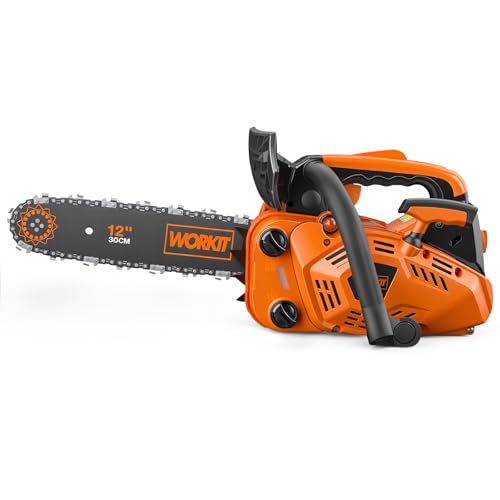
WORKIT 25.4CC Gas Chainsaw, 12-Inch Top Handle

WORKIT 58CC Gas Chainsaw, 18″ / 16″ Bar

WORKIT 62CC Gas Chainsaw, 20″ / 18″ Bar
Why These Options Stand Out
The Makita LW1401 leans into a very specific job: clean, repeatable metal cuts in a fixed shop setting. Its 14-inch abrasive wheel and powerful motor make quick work of rebar, threaded rod, and square tubing, so plumbing and framing shops can size stock without hauling out a torch.
For tradespeople cutting the same profile dozens of times a day, that consistency matters more than portability. You trade mobility for accuracy, getting a stationary tool that stays put and stays sharp at the task it’s built for.
A Few Highlights
- A 15 AMP motor spinning at 3,800 RPM handles thick steel stock without stalling.
- Cuts up to 5-inch round material, a real step up from smaller cutoff saws.
- Adjustable fence helps you repeat identical lengths, useful for fabrication runs.
- Spinning abrasive wheel rather than toothed blade means no worrying about tooth chipping on hard metal.
Things To Consider
- Heavier than handheld options, so you commit to a bench or stand setup.
- Wheel wear means ongoing consumable costs for high-volume shops.
Feature Snapshot
Who It Suits Best
Metalworkers, plumbers, and fabricators who need a stationary bench saw for repetitive cuts in a workshop.
Where Another Pick Suits Better
For jobsite cutting on rebar and concrete without a power outlet, the DEWALT FLEXVOLT 60V MAX Cut-Off Saw, 9″ gives you cordless freedom in a smaller package.
The DEWALT FLEXVOLT 60V MAX Cut-Off Saw swaps the cord for two 60V batteries and never asks you to find a generator on a remote pour. Compared to the Makita LW1401 in slot one, this one trades raw bench stability for genuine jobsite mobility, which matters when you’re cutting expansion joints in a fresh slab.
A brushless motor (a motor with electronic control instead of carbon brushes, meaning less friction and longer life) keeps the cut speed steady under load, and the water-feed attachment turns dry dust into slurry that meets tougher jobsite rules. Crews doing tile demo, paver trimming, or rebar scoring on a patio will appreciate the freedom to walk away from the truck.
Strengths Worth Knowing
- Brushless motor pushes the wheel up to 6,500 RPM for fast scoring passes.
- Rotating 5-position guard lets you change the approach angle without flipping the saw.
- Dual-sided water feed keeps dust down, an OSHA Table 1 (the construction-safety rule for silica dust control) friendly setup when cutting concrete.
- Sealed battery box shrugs off jobsite grit and weather better than open-battery tools.
Worth Noting
- 9-inch wheel limits cut depth, so it won’t replace a 14-inch saw for thick stock.
- Battery and charger bundle weight adds up at the end of a long shift.
Who It Suits Best
Concrete and masonry crews needing cordless cuts without a generator on site.
Skip It When
You mostly cut metal in a fixed shop, where the Makita LW1401 Cut-Off Saw, 14″ stays the smarter long-term pick.
Stepping away from the cutoff saws, the WORKIT 25.4CC chainsaw focuses on the one-handed pruning tasks that punish heavier machines. The 12-inch bar and 2-cycle engine (a gas engine that mixes oil with fuel rather than using a separate oil sump) keep the total weight around 8.2 pounds, light enough for overhead limbing without a shoulder-burning session.
The top-handle layout also suits arborists and orchard work, where you hold the saw vertically for hours. Owners commonly report that the easy-start system takes a real chunk out of the usual 2-stroke yank-and-pray routine, though the small engine still rewards a brief warm-up before you commit to a thick limb.
Everyday Wins
- Lightweight top-handle design reduces fatigue during overhead cuts.
- Easy-start system lowers the barrier for occasional users.
- Auto-oiler keeps the chain fed without manual pumping, extending bar life.
- Compact 12-inch bar reaches tight crotch angles that longer bars can’t.
Trade Offs
- Smaller engine struggles on thick hardwood logs, so it shines more in pruning than felling.
- 2-cycle gas means mixing oil and fuel at every fill-up.
Key Product Details
Made For
Homeowners and arborists handling routine tree pruning, light limbing, and small limb removal.
A Better Fit Elsewhere
For larger trees and storm cleanup, the WORKIT 58CC Gas Chainsaw, 18″ / 16″ Bar brings significantly more engine and bar length to the cut.
The WORKIT 58CC jumps into serious property-maintenance territory, where the compact saw in the previous slot would run out of breath. A 3.6 HP engine and dual 16-inch and 18-inch guide bars let you size the tool to the job, and the larger displacement gives you the torque (rotational force) needed to push through dense hardwood without bogging.
Owners commonly report the easy-start system cuts down on the wrist-tiring pulls that plague older 2-stroke designs. The auto-oiler still does its quiet work in the background, though you should keep an eye on bar oil levels during long sessions, because the larger chain drinks more than the smaller model.
Points In Its Favor
- 58CC engine produces 3.6 HP for taking on thick trunks and storm-fallen limbs.
- Includes both 16-inch and 18-inch bars so you match the bar to the cut.
- Easy-start design reduces the effort needed to fire up cold.
- Auto-oiler keeps the chain lubricated during heavy extended use.
Points To Note
- Heavier than compact saws, so plan on breaks during long cutting sessions.
- Bar swap requires a few minutes of setup, not a one-tool changeover.
Best Suited To
Homeowners with multi-acre lots, small-property owners, and light commercial users handling trees up to medium diameter.
Reach For A Different Pick When
You mostly do overhead pruning in orchards, where the WORKIT 25.4CC Gas Chainsaw, 12-Inch Top Handle stays far easier to manage.
The WORKIT 62CC tops the chainsaw range here, bringing the largest engine and longest bars on the list. Two stroke cylinders of displacement and a 3.7 HP output give it the muscle to chew through 20-inch rounds, which the 58CC saw in slot four would have to attack in stages.
You get both 18-inch and 20-inch bars out of the box, so you can swap down for fast limb work and up for serious bucking (cutting felled logs into shorter sections). For properties with mature hardwoods, storm recovery, or rural firewood prep, that dual-bar setup is a genuine time-saver. It’s also the heaviest option here, so a steady grip and sharp chain are non-negotiable.
Reasons It Performs
- 62CC two-stroke engine rated at 3.7 HP for the largest logs on this list.
- Includes 18-inch and 20-inch bars for switching between cuts without buying extras.
- Replaceable guide bar extends the tool’s working life when one bar wears out.
Potential Drawbacks
- Heaviest saw in this lineup, so casual users may find it tiring over long sessions.
- 2-cycle fuel mix and chain maintenance are a bigger commitment than smaller engines.
Who Should Grab It
Landowners, rural property managers, and frequent users handling mature trees and serious firewood volume.
Not Your Match When
You mostly cut small limbs and want one-hand control, where the WORKIT 25.4CC Gas Chainsaw, 12-Inch Top Handle fits the task better.
Picking the Right Saw for Your Workload
Matching Engine Size to Stock Thickness
Engine displacement (measured in cubic centimeters, or CC) is the single biggest clue to what a chainsaw can handle. A 25CC class engine handles limbs and small trees; 58CC and up steps into trunk and firewood territory. A 2-cycle engine mixes oil directly into the fuel, so you’ll keep a fuel can and 2-stroke oil on hand for every fill-up, but you also get a lighter, simpler powerhead (the engine block of the saw without bar and chain) compared to a 4-cycle alternative.
Bar Length Versus Cut Capacity
A longer bar lets you fell bigger trees and rip wider rounds, but it also adds weight and raises kickback risk if you lean into a cut without control. Match the bar to your most common log size rather than the largest log you might face once a year, because an oversized bar on a small engine just bogs down. For overhead work and tight crotch cuts, a short bar stays far easier to control.
Cutoff Saws: Corded, Cordless, or Petrol
Corded cutoff saws like the Makita LW1401 deliver consistent power and low ongoing cost, but they tether you to an outlet. Cordless models like the DEWALT FLEXVOLT 60V MAX Cut-Off Saw, 9″ trade some depth for mobility and skip the generator. Petrol-driven cut-off solutions come into play on remote sites where neither power nor charged batteries are realistic, and the engine size you need depends on how long you plan to run between refuels.
Weight, Vibration, and Long Sessions
A saw that’s comfortable for twenty minutes may punish you after two hours. Compact top-handle saws shine for pruning because you control them with one hand, while heavy bar-and-chain work calls for breaks, gloves, and a sharp chain to limit the vibration that travels into your hands and arms.
Key Considerations Across These Picks
Mistakes Worth Dodging
Overshoppers often reach for the biggest bar or highest CC rating, then discover the saw is too heavy to use safely. Underbuyers grab a compact pruning saw and expect it to fell a 16-inch oak, which it simply cannot. Match the tool to the most common cut you make, not the rare extreme. Also confirm bar oil and chain oil types before the first start, because running a new chain dry for even a minute can score the bar permanently.
Where The Extra Money Goes
Moving from a 25CC class saw to a 58CC or 62CC model adds engine displacement, longer bars, and often dual-bar kits. You pay for the larger powerhead, the second bar, and the stronger clutch components needed to handle the extra torque. The upgrade pays off for landowners, rural property managers, and anyone felling trees regularly, but a casual homeowner pruning a few limbs a season rarely needs the extra capacity.
Frequently Asked Questions
How often should I sharpen the chain on a gas chainsaw?
Sharpen the chain every couple of hours of cutting, or sooner if you notice fine dust instead of coarse wood chips coming off the bar. A dull chain forces you to push harder, which stresses the engine and accelerates bar wear.
Can I use a cutoff saw on wood?
Cutoff saws are purpose-built for metal, masonry, and tile. Their abrasive wheels generate heat that chars wood and binds in resin, so a chainsaw or circular saw is the right tool for wood work.
What is kickback on a chainsaw?
Kickback is the sudden upward thrust of the bar when the chain tip contacts a solid object or pinches in the cut. Low-kickback chains, sharp cutting angles, and proper stance all help reduce the risk.
Is 2-cycle engine oil the same as bar oil?
No, 2-cycle oil mixes with the gasoline to lubricate the engine internals, while bar and chain oil stays in a separate reservoir to keep the cutting chain and bar lubricated during operation. Use each in the system it’s designed for.
How do I store a gas chainsaw between uses?
Empty or run the tank dry, clean the bar groove, and store the saw in a dry spot away from heat sources. A quick oiling of the bar and chain before storage prevents surface rust during off-seasons.
Bottom Line
A petrol cuts off saw earns its place wherever the work happens far from an outlet, the stock is thick, and the cuts are demanding. Match the engine size and bar length to your most common cut, and the rest of the decision gets easier. The right tool turns a long afternoon into a manageable one.