


Running a CNC table means your cutter has to keep pace with motors, sensors, and long, repetitive cuts without missing a beat. The right plasma cutter stays stable through hundreds of pierces, plays nicely with controller signals, and still cuts clean metal when you step away from the gantry. A poor match, on the other hand, sputters, throws errors, and ruins a Saturday afternoon. The five picks below cover the main paths a CNC hobbyist tends to follow, from a forgiving starter to a workshop workhorse that won’t blink at 1-inch steel.
A Snapshot Of The Selections

SILATU 65Amps Non-Touch Pilot Arc Plasma Cutter, 110/220V IGBT Inverter, Built-In Air Filter
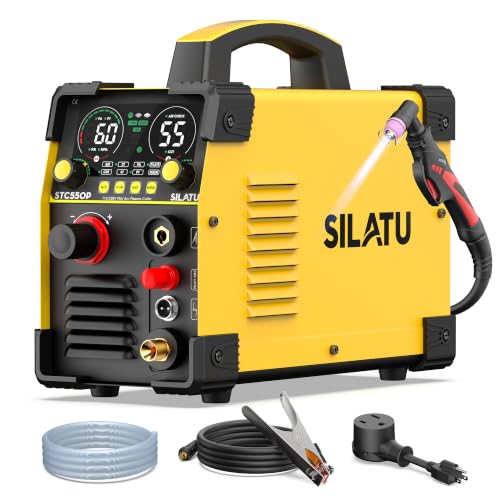
SILATU 55Amps HF Non-Touch Pilot Arc Plasma Cutter, 1/2″ Clean Cut, Mesh Cutting, 110V/220V

SILATU 75Amps HF Non-Touch Pilot Arc Plasma Cutter, Stable Arc, 5/8″ Clean Cut 1″ Max, Dual Voltage

SILATU CNC Plasma Cutter 85Amps Non-HF Blowback, Air Sensor, 1″ Clean Cut, 110/220V Dual Voltage

SILATU 85Amps HF Non-Touch Pilot Arc Plasma Cutter, Air Sensor, 1″ Clean Cut 5/4″ Max, Dual Voltage
The Picks, Examined More Closely
Stepping up from a basic torch, the SILATU 65A brings a non-touch pilot arc (an arc struck without the tip touching the metal) to a price that doesn’t scare off a first CNC build. An IGBT inverter (an efficient switch-mode power circuit that steps up household current to welding-grade output) drives clean output at either 110V or 220V, and a built-in air filter keeps shop grit out of the regulator so you’re not chasing pressure drops mid-job.
Where this unit really earns its place is in the gap between a hobbyist 50A and a serious 85A. Cuts up to roughly 4/5 inch on the heavy end land it firmly in the “do almost everything” lane, including 11-gauge steel sheet work and the kind of 1/4-inch plate that fills most home CNC tables. For a garage or small studio, that’s the sweet spot.
Practical Pluses
- Integrated air filter cuts down on regulator maintenance and clogged tips
- Dual voltage means a single machine covers a home outlet and a 220V shop circuit
- 9/16 inch clean cut handles 90 percent of typical sheet and plate projects
- PT/2T/4T trigger modes let you switch between manual cuts and longer torch-on sessions
Things To Consider
- No dedicated CNC interface, so signal handshaking with table controllers is limited compared to a true CNC model
- Max thickness drops noticeably on 110V, so heavier plate work benefits from a dedicated 220V outlet
Quick Facts
Who It Suits Best
First-time CNC owners who want one machine that handles sheet, plate, and the occasional heavy cut without forcing a 220V install on day one.
Where Another Pick Suits Better
The SILATU CNC Plasma Cutter 85Amps Non-HF Blowback is the better call for shops already running table-side controllers that can’t tolerate high-frequency interference.
Small shops and weekend makers tend to want the same thing: a cutter that’s forgiving, light enough to move around the bench, and doesn’t require an electrical upgrade. The 55A SILATU fits that brief, with a portable frame and a non-touch pilot arc that takes the intimidation out of starting a cut on expanded metal or grid plate.
Its 1/2-inch clean cut is the practical ceiling for most home CNC builds, and the dual-voltage inverter means you can plug it into a standard household outlet at 15–40A for lighter work, then shift to 220V when the project calls for thicker steel. Owners commonly find the mesh-cutting capability genuinely useful for any table that uses slatted beds.
What Stands Out
- Compact and lightweight enough to share a bench with a small CNC router
- Mesh-cutting performance handles expanded metal without stalling
- Digital display gives you a clear readout of current and mode
- Trigger lock modes reduce hand fatigue on long gantry runs
Honest Caveats
- Top-end amperage is lower than the larger SILATU models, so it struggles past 1/2 inch clean cuts
- Air filter and regulator may be external, so plan a bit of extra setup space
Made For
Garage hobbyists and first-time CNC users who mostly cut thin sheet, expanded metal, and the occasional 1/4-inch plate.
Swap It Out When
Step up to the SILATU 75Amps HF Non-Touch Pilot Arc Plasma Cutter if your projects regularly push past 1/2 inch and you want a more stable arc on long runs.
Once a CNC table starts running production hours, an entry-level cutter starts showing its seams. The 75A SILATU is the bridge model for that moment, with a stable HF pilot arc that holds its character across hundreds of pierces, and 220V output that gets a true 1-inch maximum cut on heavy plate.
The LED display and clear mode settings help during setup, while the PT/2T/4T trigger options let the gantry operator run extended cuts without babysitting the torch. Compared to the 65A pick above, the 75A trades a bit of portability for noticeably better arc control on the kind of long, continuous patterns a CNC table produces.
Real-World Strengths
- Stable arc reduces dross (slag clinging to the cut edge) on long, continuous passes
- 1-inch max cut handles 3/8 and 1/2-inch plate without a second pass
- Dual voltage keeps the machine flexible if your shop layout changes
- 75A headroom means cooler tip life on long production runs
Points To Keep In Mind
- Heavier than the 55A, so plan for a fixed shop spot rather than a benchtop perch
- You may need a 220V receptacle installed to unlock the full amperage range
Feature Rundown
Best Suited To
Mid-range fabrication shops and serious hobbyists running repeat CNC jobs in 1/4 to 1/2-inch plate, where arc stability matters more than portability.
Reach For A Different Pick When
The SILATU 85Amps HF Non-Touch Pilot Arc Plasma Cutter is the better match for shops that push into 1-inch plate regularly and want an integrated air sensor.
Plasma cutters that use high-frequency starts can quietly interfere with the sensitive electronics running a CNC table. This model sidesteps that problem by using a non-HF blowback pilot arc (a start method that uses a mechanical air pulse rather than a high-voltage spark), which is purpose-built for life next to stepper drivers, THC controllers (torch height control units that adjust standoff distance in real time), and limit switches.
Add 85 amps of cutting muscle, a 1-inch clean cut, and an air sensor that helps protect the torch if pressure dips, and you have a unit that sits comfortably in a small production shop. It’s noticeably less portable than the 55A above, but the trade-off is stability: this thing settles into a long table session and just runs.
The Good Stuff
- Non-HF pilot arc avoids disrupting nearby CNC electronics
- Air sensor helps the machine self-protect when supply pressure drops
- 1-inch clean cut is the most generous spec in this roundup
- PT/2T/4T triggers cover both manual and automated cuts
Trade Offs
- Blowback starting is generally less effective on heavily painted or rusty plate than HF starts, so a quick surface wipe helps
- Bulkier housing means you’ll want a fixed cart or stand, not a moveable bench setup
The Right Fit
Shops running a CNC table full-time who need clean, repeatable arc starts without high-frequency noise interfering with their controllers.
A Better Fit Elsewhere
The SILATU 65Amps Non-Touch Pilot Arc Plasma Cutter is the smarter pick for hobbyists who mostly do handheld cuts and don’t need CNC-specific signaling.
For shops that want maximum thickness without giving up the convenience of high-frequency starts, the 85A SILATU HF model is the heavy hitter. It shares the same 1-inch clean cut as the CNC-native pick above, but pairs it with an HF pilot arc for aggressive starts on painted or rusty plate. An integrated air sensor watches supply pressure and helps the machine avoid running lean.
Where this unit separates itself from the smaller SILATU machines is headroom. You’ll feel it on long CNC passes through 1/2-inch plate, where the extra amperage keeps the cut moving and the kerf (the width of material removed by the cut) tight. For a one-cutter shop that needs to cover everything from thin sheet up to thick plate, the trade-off is real estate: this is a serious bench machine.
Everyday Wins
- 85A top end handles 1/2-inch plate cleanly without a second pass
- Air sensor reduces tip damage from inconsistent shop air
- 5/4-inch max severance punches well past typical CNC work
- Dual voltage gives you flexibility if the shop layout changes
Where It May Fall Short
- High-frequency start can cause interference with nearby CNC electronics unless well shielded
- Price-adjacent to a step up into industrial CNC cutters, so small hobbyists may not use the extra capacity
Whose Shelf It Belongs On
Small production shops that need a single cutter to span everything from thin sheet to thick plate, with CNC handshaking left to an external controller.
Not Your Match When
The SILATU CNC Plasma Cutter 85Amps Non-HF Blowback is the better fit for table setups where HF noise is a known headache for controllers and drivers.
Matching A Cutter To Your CNC Workflow
Before you settle on a machine, think about the metal that actually lands on your table. A shop cutting mostly 16-gauge sheet and the occasional 1/4-inch plate can run a 50 to 65 amp unit without breaking stride. Step into 3/8-inch or 1/2-inch plate, and the 75 to 85 amp tier starts to pay for itself in faster cuts and cooler tip life.
Voltage matters as much as amperage. A 110V outlet keeps the install simple, but peak output drops noticeably compared to 220V, and heavy cuts slow down. If your breaker panel can spare a 220V circuit, dual-voltage inverters unlock the same machine’s full potential on heavier stock.
Pilot arc style is the detail that separates a true CNC cutter from a general one. HF (high-frequency) starts are convenient and handle dirty metal well, but they can interfere with stepper drivers and THC boards. Non-HF blowback starts use a mechanical air pulse, sidestepping that interference at the cost of slightly fussier starts on rusty plate.
Duty cycle tells you how long a cutter can run before it needs to cool. A 60% duty cycle at rated output is a healthy spec for a CNC table producing long patterns. Lower duty cycles mean more wait time between passes, which adds up over a day of production.
Trigger modes shape how the torch behaves during a cut. PT is a basic pull-and-hold, 2T lets you lock the trigger on for long cuts, and 4T adds a second press to release, which is useful for marker-engraved or timed jobs. All five picks here support the same trio, so the choice comes down to the rest of the spec sheet.
Air supply is the silent partner in any plasma setup. A consistent compressor at the manufacturer-recommended pressure (around 60 to 70 PSI) keeps cuts clean, and an air filter or in-line dryer goes a long way toward tip life. Skip that, and you’ll burn through consumables faster than you expect.
Key Considerations Across These Picks
Pitfalls Shoppers Hit
Buying a plasma cutter on amperage alone often backfires. Two 65A machines can perform very differently if one has poor arc stability or a low duty cycle, and a CNC table is a harsh judge of both. Match the machine to the thickest plate you cut regularly, and make sure the duty cycle and trigger modes line up with how the gantry actually runs.
When Paying More Pays Off
The jump from a 55A to an 85A machine usually buys three things: thicker clean-cut capacity, a more stable arc on long runs, and extras like air sensors or CNC-friendly starts. None of that matters for a hobbyist cutting thin sheet, but for a shop running eight-hour days on a CNC table, the upgrade tends to earn itself through faster cuts, fewer consumables, and less babysitting.
Frequently Asked Questions
Do I need a CNC-specific plasma cutter for my table?
You don’t strictly need one, but a CNC-focused unit with non-HF start and proper trigger signaling is easier to integrate cleanly with a gantry. General-purpose cutters work too, but you may need extra shielding to keep high-frequency starts from interfering with table electronics.
What thickness can a 65 to 85 amp cutter actually handle?
Real-world clean cuts typically land around half the maximum rated thickness, with 65A units handling about 5/8 inch and 85A units reaching closer to 1 inch of clean steel. Severance cuts go thicker, but the edge quality drops and slag increases.
Can I run a dual-voltage plasma cutter on a standard household outlet?
Yes, dual-voltage units step down to 110V for lighter work, though peak amperage and maximum cut thickness both shrink. For full output, you’ll want a 220V receptacle on a properly rated circuit.
What air pressure does a plasma cutter need?
Most plasma cutters in this class want around 60 to 70 PSI of clean, dry air at the recommended flow rate. A small inline filter and water separator go a long way toward keeping consumables alive and cuts clean.
How important is duty cycle on a CNC table?
It matters a lot. A 60% duty cycle at rated amperage is comfortable for typical gantry work, while anything lower means more cooling pauses between long cuts, which slows the whole table down.
Bottom Line
The right plasma cutter is the one that matches your table, your plate, and your patience for setup. Start with a 55 or 65 amp unit if you’re learning, and step up once your projects start demanding thicker plate or longer unattended runs. Match voltage, pilot arc style, and trigger modes to how the gantry actually works, and the rest of the roundup takes care of itself.




