


Pneumatic air cylinders sit at the heart of shop automation, DIY fabrication, and small-batch assembly. Choosing the right one comes down to matching bore size, stroke length, and mounting style to the actual job at hand, not chasing the largest numbers on the spec sheet. The five BAOMAIN cylinders below cover the most common configurations, from compact tabletop builds to longer-reach linear motion. Each one fits cleanly into a standard shop air setup running on typical compressed air lines, so installation stays straightforward for anyone already running pneumatic tools.
The Choices Worth Comparing

BAOMAIN Pneumatic Air Cylinder SC63x200

BAOMAIN Air Cylinder SC63x300 + Clevis

Baomain Compact Thin Air Cylinder SDA50x50

BAOMAIN Pneumatic Air Cylinder SC32x200
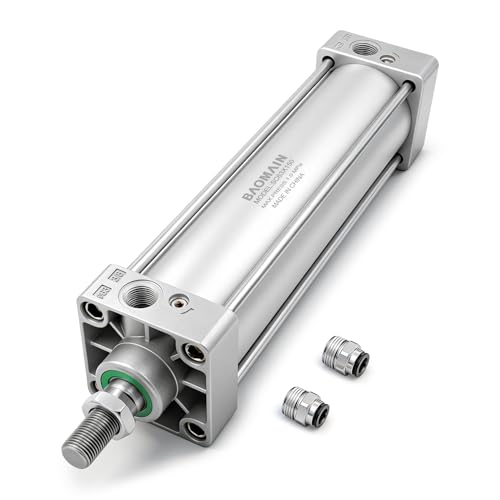
BAOMAIN Pneumatic Air Cylinder SC63x150
The Picks, Examined More Closely
The SC63x200 lands squarely in the middle of BAOMAIN’s standard cylinder lineup, pairing a 2-1/2 inch (63mm) bore with a 7.87 inch (200mm) stroke. The double-acting, single-rod design delivers force on both extension and retraction strokes, which matters for any reciprocating motion that needs controlled return rather than spring pushback.
Shop owners running packaging lines, small stamping stations, or homemade press rigs will find this bore size handles moderate pushing jobs without overstressing a standard compressor. A foot flange mount ships with the unit, simplifying frame attachment for builds that sit flat on a bench or weld plate.
Useful Strengths
- Double-acting operation means controlled force in both directions, useful for clamping and ejecting tasks where a spring return would be too inconsistent.
- Self-lubricating bearing inside the rod bushing reduces routine maintenance, so the cylinder can run for long stretches without scheduled greasing.
- M16x1.5 threaded piston rod accepts standard rod-end fittings, keeping parts sourcing simple for most home shops.
- Foot flange mount included, which removes a common sourcing headache for builders fabricating their own frames.
Things To Consider
- 2-1/2 inch bore demands decent airflow, so a small portable compressor may struggle to cycle it quickly under heavy load.
- Foot flange mounting works well on flat surfaces, but projects needing pivot or clevis-style articulation require separate brackets.
- 8 inch stroke feels short for long-throw applications, where the SC63x300 covers more ground.
Key Specs
Who It Suits Best
Shops and serious hobbyists building mid-force automation like press stations, clamping rigs, or repeatable actuation tasks where a 2-1/2 inch bore handles typical loads comfortably.
Consider Something Else When
The BAOMAIN SC63x300 is the smarter call for projects needing longer reach, since its 12 inch stroke extends well past this model’s travel range.
The SC63x300 stretches the same 2-1/2 inch bore into a 12 inch stroke, giving builders serious reach for long-throw linear motion. It ships with a clevis base mount and Y-joint fitting, which trims a chunk of the usual sourcing list for anyone planning a pivoting or swinging linkage.
Compared to the SC63x200 reviewed earlier, this version trades a slightly longer overall body for travel distance, a worthwhile swap for door operators, conveyor diverters, and longer sliding tables. The PT 3/8 inch port and M16x1.5 thread match the rest of BAOMAIN’s 63mm series, so swap-in replacements stay simple if a shop already runs that family.
Strong Points
- 12 inch stroke handles long-throw projects where shorter cylinders physically cannot cover the distance.
- Included clevis base and Y-joint remove two common extra purchases for builders planning pivoting mounts.
- Same 2-1/2 inch bore as the SC63x200, meaning familiar force output and shared fitting inventory across a shop.
- Double-acting single-rod layout gives consistent retraction force, helpful for horizontal sliding applications.
Worth Noting
- Longer stroke demands more compressed air per cycle, so smaller compressors may need an aux tank to keep up.
- Extended rod length increases the chance of side-load binding, so alignment during installation matters more than with shorter strokes.
- Bulkier body can be harder to fit into compact frames where the SDA50x50 thin-profile design fits more cleanly.
Made For
Builders tackling long-reach automation like gate operators, sliding mechanisms, and conveyor components where a 12 inch stroke replaces what would otherwise need a rack-and-pinion or lead screw setup.
Where Another Pick Suits Better
The Baomain SDA50x50 fits better in tight enclosures, since its compact thin body slips into narrow spaces the SC63x300 simply cannot reach.
The SDA50x50 takes a different path than the other four cylinders in this roundup, trading the round SC-series body for a thin, flat-profile housing. With a 50mm bore and 50mm stroke, it targets tight builds where a standard tie-rod cylinder simply would not physically fit.
Anyone building 3D printer kinematics, small pick-and-place rigs, or compact valve actuators will appreciate the slimmer envelope. PT 1/4 inch ports and an M10x1.5 internal thread on the rod keep it compatible with widely available miniature pneumatic fittings, which makes sourcing straightforward for hobby-scale builds.
Benefits That Matter
- Thin-profile housing drops into narrow enclosures and low-clearance mounts that reject round cylinders.
- Lightweight body suits mobile or handheld pneumatic tools where bulk would throw off balance.
- PT 1/4 inch ports accept common miniature fittings, keeping installation parts inexpensive and easy to find.
- 50mm stroke pairs well with short-cycle applications like sorting gates, indexing tables, and small clamping actions.
Trade Offs
- 50mm bore produces less pushing force than the 63mm series, so heavy load applications fall outside its comfort zone.
- Compact size means less thermal mass for heat dissipation during rapid cycling, so duty cycle may need monitoring in production settings.
- No mounting hardware included in the listed contents, so brackets must be sourced separately.
Right Fit For
Hobbyists and small-shop builders running compact automation projects like tabletop actuators, 3D printer components, and miniature assembly tools where space trumps raw force.
Skip It When
The BAOMAIN SC63x200 handles the job better for moderate-force shop work, since its larger bore and included foot flange give more capability in a similarly accessible package.
The SC32x200 pairs a 1-1/4 inch (32mm) bore with the same 7.87 inch stroke found on the larger SC63x200, scaling down force output while keeping the travel distance. This makes it a sensible pick for lighter pushing tasks where the bigger bore would be overkill.
Indexing mechanisms, light sorting gates, and small marking presses suit this cylinder’s profile well. The M10x1.25 male thread on the piston rod is a step down from the M16 thread used in the 63mm series, but it remains a standardized size that accepts common miniature rod-end hardware.
Points In Its Favor
- Smaller 1-1/4 inch bore runs comfortably on modest compressors without starving the airflow supply.
- Same 7.87 inch stroke as the SC63x200, so builders can swap bore sizes without redesigning the mechanism’s travel geometry.
- Self-lubricating rod bearing cuts down on routine service intervals, helping the cylinder run quietly in home shops.
- Lightweight body simplifies mounting in spaces where heavier cylinders would strain brackets or framing.
Honest Caveats
- 32mm bore limits pushing force, so any application involving significant resistance will stall or slow dramatically.
- Lighter construction can show wear faster in high-cycle production environments compared to larger-bore units.
Best Suited To
Hobbyists and small-shop builders running light-duty tasks like sorting mechanisms, miniature presses, or low-force clamping work where modest pushing power is enough.
Another Choice May Suit
The BAOMAIN SC63x150 is worth a look when a short stroke and higher force matter more than the smaller bore’s airflow efficiency, since its 2-1/2 inch bore handles heavier pushing comfortably.
The SC63x150 rounds out the lineup with a 2-1/2 inch bore paired to a short 6 inch stroke, the most compact body in the 63mm series covered here. Two push-in fittings come in the package, which is a practical bonus for builders who want to plumb and test without a separate parts run.
Press heads, stamping rigs, and clamping systems that need travel but not range benefit most from this shorter configuration. Compared to the SC63x200 reviewed earlier, it sacrifices about 2 inches of stroke for a more compact footprint, a sensible trade for jobs where the mechanism physically does not need the longer throw.
Noteworthy Benefits
- 2-1/2 inch bore delivers the same force output as the larger SC63x200, useful when stroke length is the only variable to trim.
- Push-in fittings included in the box speed up initial plumbing and testing on a workbench.
- Shorter body fits in tighter frames where the SC63x200 or SC63x300 simply will not mount cleanly.
- PT 3/8 inch port and M16x1.5 thread match the rest of BAOMAIN’s 63mm family, keeping spare parts interchangeable.
Points To Note
- 6 inch stroke is the shortest in the 63mm group, so it cannot substitute for the SC63x300’s long reach in extended applications.
- 2-1/2 inch bore still demands steady airflow, so undersized compressors will cycle it slowly under load.
Who Should Grab It
Builders running press-style mechanisms, short-stroke clamps, or stamping rigs where a compact 2-1/2 inch bore body delivers the right combination of force and footprint.
Look Elsewhere When
The BAOMAIN SC63x300 is the clear upgrade for projects needing longer reach, since its 12 inch stroke doubles the travel distance without changing the bore size.
Matching a Cylinder to the Job at Hand
Bore Size Drives Force Output
The bore diameter, the internal width of the cylinder barrel, directly determines how much pushing force the cylinder generates at a given air pressure. A wider bore produces more force because the piston surface area pressing against the compressed air is larger. A 2-1/2 inch bore, like the one on the SC63x200, SC63x300, and SC63x150, sits in a mid-range that suits general shop work without overtaxing standard compressors.
A smaller 1-1/4 inch bore, like the SC32x200, trades force for lower air consumption, which helps when running on a modest tank. You may find the smaller bore underwhelming for heavy resistance, while the larger 63mm series can stall on a small compressor during rapid cycling. Matching bore to compressor capacity prevents frustrating cycle delays.
Stroke Length Defines Reach
Stroke length measures how far the piston rod travels from full retraction to full extension. Longer strokes open up door operators, sliding tables, and conveyor components, while shorter strokes suit presses and clamping systems where over-travel would waste air and risk binding. The SC63x300 at 12 inches covers the longest reach here, while the SC63x150 at 6 inches fits compact press builds. The stroke you need depends entirely on the mechanism geometry, not on which cylinder looks most capable on paper.
Mounting Style Shapes Installation
Mounting hardware affects how a cylinder integrates into a frame. A foot flange, included with the SC63x200, sits flat against a welded plate or bench surface. A clevis base mount, included with the SC63x300, allows pivot motion at the fixed end. The compact SDA50x50 does not list included mounting hardware in the source data, so brackets typically come from a separate parts run. Picking a mounting style that matches the existing frame geometry saves fabrication time.
Double-Acting vs. Spring-Return Operation
A double-acting cylinder uses compressed air to drive both extension and retraction, producing controlled force in each direction. A spring-return cylinder uses air only for extension and relies on an internal spring for the return stroke. Every cylinder in this roundup is double-acting, which is why the SC63x200 and SC63x300 can drive reciprocating mechanisms without losing force on the return cycle. Single-acting spring-return designs cost less but limit what the mechanism can actually do.
Key Considerations Across These Picks
Mistakes Worth Dodging
A common slip-up is choosing the largest bore available without checking compressor capacity, which leads to slow cycling and pressure drops that starve other pneumatic tools on the same line. Another frequent miss is ignoring mounting style, since ordering a foot flange cylinder when the frame needs a clevis pivot forces an extra fabrication step. Picking stroke length by guesswork rather than measuring the actual mechanism travel is the third trap, and it shows up as wasted air, binding, or rods that cannot reach the workpiece.
The Case For Spending Up
Stepping up to the SC63x300 over the SC63x200 costs more but doubles the stroke length, which lets one cylinder cover applications that would otherwise need a custom-fabricated extension. The jump from the SC32x200 to any of the 63mm cylinders brings a meaningful force increase that opens up moderate-load projects like press work and stamping. In this category, spending up buys reach and pushing power, both of which extend the kinds of projects a shop can tackle without ordering additional parts.
Frequently Asked Questions
What does bore size mean on a pneumatic air cylinder?
Bore size is the internal diameter of the cylinder barrel, and it controls how much surface area the compressed air pushes against. Larger bore means more force output at the same air pressure, which is why the 63mm series in this roundup pushes harder than the 32mm SC32x200.
How does stroke length affect which cylinder to pick?
Stroke length sets how far the rod travels, and it must match the mechanism’s actual movement range. Too short and the rod cannot reach the workpiece, too long and the cylinder wastes air and adds bulk where it is not needed.
Are these cylinders double-acting or spring-return?
All five cylinders in this roundup are double-acting, meaning compressed air drives both the extension and retraction strokes. This gives consistent force in each direction rather than relying on a weaker spring return.
What air pressure do these BAOMAIN cylinders need?
Standard shop air running around 80 to 100 psi covers the operating range for the SC-series cylinders listed here, though exact pressure ratings depend on the specific model and the compressor’s regulator settings. A standard regulator and lubricator setup is recommended for consistent cycling.
Can the compact SDA50x50 replace a larger SC-series cylinder?
The SDA50x50 fits where space is tight, but its 50mm bore produces noticeably less force than the 63mm SC series. It is a solid swap for miniature and tabletop builds, but heavier shop work calls for the larger bore family.
Closing Remarks
Picking the right pneumatic air cylinder comes down to honest math: match bore to the force you need, stroke to the travel distance, and mounting style to the frame. The five BAOMAIN cylinders above cover most home-shop and small-business configurations without forcing a custom build. Start with the mechanics of your project, and the right pick tends to make itself obvious.




