


A dull blade is one of the most frustrating small problems in daily life. You can buy a beautiful folder or a trusty fixed-blade hunter, and within months the edge fades after cardboard, rope, and campfire prep. The fix is portable, fast, and surprisingly affordable. A good pocket knife sharpener restores bite on the trail, in the truck, or at the kitchen counter, and the five options below cover most of the sharpening jobs you will actually run into.
How The Shortlist Stacks Up

Work Sharp Guided Field Sharpener 3 Pack

Redi-Edge Mini Multi Tool Sharpener

Orange Ninja 4-Stage Kitchen Sharpener

Orange Ninja Pocket Field Sharpener 6-in-1
5 Precision Adjust 3-Stage Knife Sharpener
The Picks, Examined More Closely
Setting up a sharpening station at a campsite has never been the goal, and the Work Sharp Guided Field Sharpener understands that. It is built around a guided-angle system, so even without a steady bench you can hold a consistent geometry on a folder or fixed blade. The 3-pack format is the unusual part: one for the truck, one for the tackle box, and one for the kitchen drawer.
Five sharpening stages cover repair, edge setting, and finishing in a single compact body. Compared to the bare-bones pocket pull-throughs on this list, you give up a little size in exchange for more control on a damaged edge.
Advantages To Know
- Guided-angle slots remove the guesswork for anyone new to sharpening
- Five stages handle repair, profiling, and finishing on the same tool
- The three-pack format keeps a sharpener wherever you tend to use a knife
- Compact enough for a daypack or a glove box
Trade Offs
- It is larger than a keychain pull-through, so pocket carry feels bulky
- You may find the slot-based design less satisfying than freehand whetstone work for fine kitchen blades
Key Product Details
Who Should Grab It
Outdoorsmen and gift shoppers who want a guided system they can hand to a beginner without a long lesson.
Where Another Pick Suits Better
The Redi-Edge Mini Multi Tool Sharpener is a tighter fit for anglers or hunters who want a true pocket carry on a filet or skinning knife.
The Redi-Edge Mini is small enough to forget in a pocket until the moment you need it. It pairs Duromite inserts for straight blades with a ceramicized rod for serrations, which is unusual in a tool this compact. Pull a few strokes through the slot and the bevel comes back without removing much metal.
Filet and boning knives see real abuse on a boat or cleaning table, and the 30-degree preset geometry gives a fine edge that holds. It costs more than a basic pull-through but lasts far longer.
Positive Points
- Two sharpening systems in one body, including a serration rod
- Duromite inserts stay harder than typical steel, so the tool itself resists wear
- Pocket-friendly size slips into a vest or tackle bag
- Preset 30-degree angle keeps filet and boning knives cutting cleanly
Some Limits To Know
- Preset geometry cannot match specialty angles on premium outdoor knives
- Cleaning the ceramic rod after heavy use takes a quick brush
Right Fit For
Anglers and field processors who carry a pocket folder and want a real edge in the field without a multi-stage kit.
Swap It Out When
The Work Sharp Guided Field Sharpener 3 Pack is a better fit when a damaged edge needs full repair rather than a quick touch-up.
Home kitchens tend to collect a mix of straight chef’s knives and serrated bread knives, and the Orange Ninja 4-Stage addresses both. A coarse carbide slot straightens damaged edges, diamond rods refine the bevel, a fine slot polishes, and a dedicated serration slot touches up the scallops that pull-throughs usually skip.
Where the Work Sharp and Redi-Edge lean toward outdoor blades, this one stays put on the counter next to the knife block. For most home cooks that is exactly the right trade-off.
A Strong Showing
- Four dedicated stages cover repair, sharpening, polishing, and serrations
- Carbide slot rescues edges that have been neglected for too long
- Compact body fits in a drawer without dominating the counter
Things To Consider
- Carbide stages remove more metal than diamond-only systems, so go easy on premium blades
- Fixed slots lock the angle, which limits specialty Asian-style geometry
Feature Snapshot
Made For
Home cooks with a mixed knife drawer who want a single drawer-side tool instead of separate sharpeners for serrated and straight blades.
Not Your Match When
The 5 Precision Adjust 3-Stage Knife Sharpener is the better choice when you want angle control for premium Japanese or custom knives.
Camp chores, dressing game, and everyday cutting all happen on the same trip, and the Orange Ninja Pocket Field Sharpener leans into that. A 220-grit diamond plate repairs dull blades, a 600-grit plate refines, a carbide slot handles quick touch-ups, and a guided system brings it all together for straight edges, serrations, and gut hooks.
It is the closest competitor to the Redi-Edge on this list, with a slightly broader feature set. For an EDC user who wants one tool for everything in the field, the count adds up.
Reasons It Performs
- Six sharpening functions in a body that fits a cargo pocket
- Dual-grit diamond plate covers both repair and finishing
- Carbide slot keeps touch-ups fast when time is short
- Guided system supports consistent results on field-dulled blades
Points To Note
- More features in a small body means each stage is smaller than a single-purpose tool
- Diamond plates tend to need a quick wipe after wet or dirty use
Best Suited To
Hunters, campers, and EDC users who want one pocket tool to cover repair, touch-up, and finishing across a weekend trip.
Look Elsewhere When
The Work Sharp Guided Field Sharpener 3 Pack makes more sense for those who prefer a five-stage guided workflow over a multi-function pocket tool.
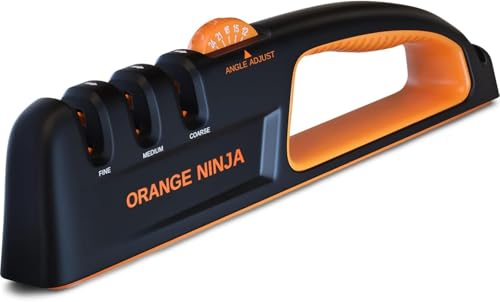
Premium kitchen knives live or die by their angle, and the 5 Precision Adjust treats that as the headline feature. Five settings (12, 15, 18, 21, and 24 degrees) cover everything from delicate Japanese sashimi blades to thicker Western chef’s knives. Three stages walk an edge from reshape to polish.
It is a countertop sharpener, not a pocket tool, so the comparison to the field-focused picks is intentional. The angle range is what sets it apart from the Orange Ninja 4-Stage on this list.
Key Advantages
- Adjustable angle from 12 to 24 degrees suits a wide range of kitchen blade styles
- Three-stage progression handles reshape, sharpen, and finish
- Handheld design with an ergonomic grip keeps the motion controlled
Honest Caveats
- Designed for straight-edge blades only, so serrated knives need a different tool
- Larger footprint than a pocket pull-through, so it lives on the counter
Spec Overview
Whose Shelf It Belongs On
Home cooks and enthusiasts who own premium or custom kitchen knives and want angle control rather than fixed-slot convenience.
Consider Something Else When
The Orange Ninja 4-Stage Kitchen Sharpener is a better fit for mixed knife drawers that include serrated bread or steak blades.
What To Weigh Before Buying Pocket Knife Sharpeners
Matching The Tool To The Blade
Start with the blades you actually carry. Hunting folders, EDC knives, and kitchen chef’s knives have different bevel angles, and a sharpener that locks one geometry will frustrate you on the others. A pocket pull-through is fine for quick touch-ups, but a guided multi-stage tool earns its place on a damaged edge. Match the sharpener’s angle range to the knives in your drawer before anything else.
Materials And Abrasive Stages
Diamond plates cut fast and handle hard steels well, which matters for modern powder-metal blades. Carbide slots reset a damaged edge quickly but remove more metal. Ceramic hones refine without stripping the bevel, which suits finishing work. For most shoppers a three-stage system covers repair, sharpening, and polishing in one tool, and a fourth serration stage helps if you own a bread or filet knife.
Portability Versus Counter Space
A pocket tool earns its keep by being on you when the edge dulls. A countertop system rewards you with angle control and a steadier hand. Many owners keep both: a small field tool in the pack and a station at home. Whichever route you take, the sharpener should fit where you already keep your knives.
Build Quality And Long-Term Use
Hard-insert sharpeners like carbide and Duromite resist wear longer than soft abrasive rods, which is the kind of detail that shows up after a year of regular use. Look for a stable base or grip, replaceable abrasive elements when possible, and a body that tolerates a drop in a pack. The cheapest pull-throughs often skip these details, and a wobbly tool produces inconsistent edges.
Key Considerations Across These Picks
Common Shopping Slip Ups
Many shoppers pick the smallest pocket sharpener and assume it will handle a chipped blade, then wonder why the edge looks worse after a few strokes. Abrasive stage and angle range matter more than size. Another trap is buying a fixed-slot sharpener for a mixed knife drawer; one slot cannot match both Japanese and Western geometry. Match the tool to the knives you own rather than the knives you wish you owned.
What The Higher Tier Buys
Spending more on a sharpener usually buys angle adjustability, harder abrasive inserts, and a guided system that takes the wobble out of freehand work. The 5 Precision Adjust 3-Stage is a clear example, with five angle settings instead of one fixed slot. For a basic EDC touch-up, a budget tool is plenty, but a premium kitchen set or a serious hunting kit benefits from the control.
Frequently Asked Questions
How often should you sharpen a pocket knife?
Light daily users typically need a quick touch-up every few weeks, while heavy users working through cardboard or game may need a full sharpen every couple of months. A few passes on a pocket sharpener after a hard day keeps the edge consistent.
Can one sharpener handle both serrated and straight blades?
A few tools, like the Orange Ninja 4-Stage, include a dedicated serration slot alongside straight-edge stages. Many pocket pull-throughs handle straight edges only, so check the slot layout before counting on serration support.
What is the difference between a pocket sharpener and a whetstone?
A pocket sharpener uses fixed abrasive slots or plates for fast, guided work on the go. A whetstone offers freehand control and finer finishes but takes longer, requires water or oil, and stays at home. Many owners keep both.
Are guided angle sharpeners good for beginners?
Yes, the guided slots remove the hardest part of sharpening, which is holding a steady angle. A guided system like the Work Sharp Guided Field Sharpener is often the fastest way for a new user to get a clean edge.
Do diamond plates wear out pocket sharpeners?
Diamond plates are among the longest-lasting abrasives, but the surrounding body, slots, and guides can wear with heavy use. Cleaning debris from the slots after each session helps the tool hold its geometry longer.
Final Verdict
The right pocket knife sharpener depends on where the blades live. Outdoorsmen get the most from the Work Sharp 3 Pack or the Redi-Edge Mini, while home cooks should look at the Orange Ninja 4-Stage or the 5 Precision Adjust for angle control. Pick the tool that matches the knives already in your rotation, and a sharp edge stops being something you put off.




