A punch down tool is one of those small purchases that quietly decides whether your home network install goes smoothly or turns into a Saturday of frustration. You press individual copper conductors into the insulation-displacement contacts (IDCs) of a keystone jack or patch panel, then trim the excess in a single, satisfying stroke. Done right, the termination holds a tight gas-tight connection for years; done wrong, you chase intermittent drops for months.
This roundup focuses on tools and consumables for terminating twisted-pair cabling, from one-motion speed tools to classic impact punch downs, plus the keystone jacks and wall plates you’ll pair them with. Each pick is matched to a real install scenario, so you can match the tool to the job rather than the other way around.
A Closer Look At The Lineup

Everest easyJACK 90° Angled Speed Termination Keystone Tool

Klein Tools VDV427-300 Impact Punchdown Tool with 66/110 Blade
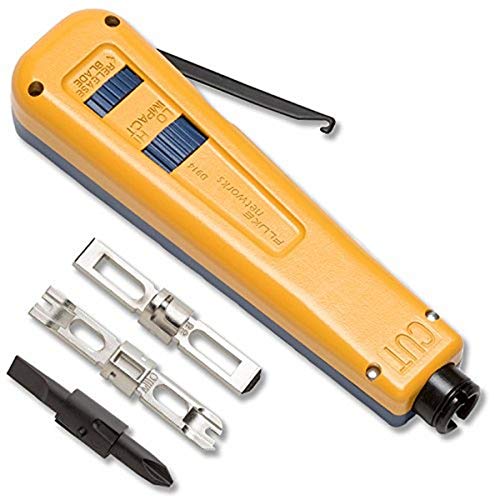
Fluke Networks D914 Impact Punch Down Tool with EverSharp 66/110 Blade

On-Q Legrand 1-Gang 2-Port Keystone Wall Plate, White, 25-Pack

VCELINK Speed Punch Down Tool for VCE 90-Degree Keystone

VCE UL Listed Cat6 Keystone Jacks 10Gbps 25-Pack, Blue

Everest 90 Degree RJ45 Cat6 Keystone Jacks Slim Profile 50-Pack White

Everest 90 Degree RJ45 Cat6 Keystone Jacks Slim Profile 50-Pack Blue

Pro’sKit 700-008 Punch Down Tool Blade, 66 Type
A Breakdown Of The Leading Choices
Most impact punch downs terminate one pair at a time, so a 24-port patch panel eats an evening. The Everest easyJACK reverses that rhythm: it sits the 90-degree keystone at an angle, seats all eight conductors, and trims them in a single, fluid press. You only need one hand free, which matters when the other is holding a bundle of Cat6 against a wall plate.
The catch is real and worth stating plainly. This tool is locked to Everest’s own 90-degree angled jacks, so it is not a generalist. If your existing patch panel uses standard straight jacks, you will want a different tool. For someone planning a full Everest ecosystem run, though, the time savings stack up quickly over a multi-room job.
Strengths Worth Knowing
- Terminates all eight wires and trims the excess in one motion rather than eight separate cycles
- Angled seating approach reduces wrist strain during long patch-panel sessions
- Single-hand operation leaves your other hand free to manage the cable bundle
- Pairs directly with Everest 90-degree jacks for a matched system, no adapter needed
Honest Caveats
- Works only with Everest 90-degree keystone jacks, limiting flexibility if you mix brands
- No storage compartment for spare blades, so a pouch or bench tray helps keep the workspace organized
Who It Suits Best
Installers working through a 20-plus drop whole-home run who want to finish before the second pot of coffee is gone.
Skip It When
You are terminating a mix of brands on an existing panel, in which case the Klein Tools VDV427-300 covers 66 and 110 blocks with one tool.
The Klein VDV427-300 is the kind of punch down you hand to someone who has never touched a keystone jack, and they figure it out inside a few minutes. A spring-loaded impact delivers a clean, repeatable seat on both 66 and 110 terminals, the combination blade flips between styles without a separate swap, and a cushioned grip absorbs the shock that cheaper tools let travel straight into your palm.
Adjustable impact force is the small detail that makes a real difference on mixed jobs. Soft 24 AWG data pairs in a residential keystone need less force than the older 22 AWG voice runs you might find in a legacy telecom block. You can dial it down for delicate work and crank it up for stubborn copper without swapping tools. For homeowners stepping into structured wiring, that flexibility takes the anxiety out of the install.
Real-World Strengths
- Combination 66/110 blade handles both telecom and data panels with no accessory swap
- Adjustable impact force prevents over-seating on smaller-gauge keystone pairs
- Cushioned non-slip grip reduces hand fatigue over long runs
- Built-in pick and spudger tucked into the handle for small adjustments on the fly
Trade Offs
- Terminates one pair at a time, so a 48-port panel takes longer than with the Everest easyJACK
- Replacement blades are brand-specific and tend to cost more than generic equivalents
Right Fit For
DIYers and small-office techs handling a mix of 66 and 110 blocks who want one tool for both jobs.
Look Elsewhere When
You are batching dozens of identical Everest jacks, where the easyJACK’s one-motion approach saves hours of labor.
The Fluke Networks D914 has been a fixture on telecom trucks for years, and the reason is simple: it survives the field. The EverSharp blade stays usable long after cheaper edges have gone dull, the body shrugs off drops out of a ladder tray, and a built-in hook plus spudger turn the handle into a small multi-tool for rework. Compared to the Klein VDV427-300, the D914 trades some user-friendliness for raw, field-tested durability.
Two impact settings, low for 24 and 26 gauge data pairs and high for 22 gauge voice, sit on a rotating collar so you can switch between them mid-run without pulling the tool away. The trade-off is weight. The D914 sits heavier in the hand, which helps drive the seat but adds fatigue over marathon patch-panel days. You can feel the difference after about two hours of continuous work.
Everyday Wins
- EverSharp blade geometry holds its edge through heavy use
- Dual impact settings handle 22, 24, and 26 gauge wire cleanly
- Built-in hook and spudger reduce trips back to the tool bag
- Adapter blade storage in the handle keeps a spare close at hand
A Few Limitations
- Heavier body causes more wrist fatigue over long sessions than lighter options
- Premium price makes it overkill for a single-room weekend install
Made For
Working telecom and data technicians who need a tool that takes abuse and keeps terminating cleanly for years.
Swap It Out When
You only need a tool for one weekend’s residential job, where the lower-priced Klein VDV427-300 covers the same ground at a friendlier entry cost.
The punch down tool gets the glory, but the wall plate is what you actually look at every day. On-Q Legrand’s 1-gang 2-port plate snaps in standard keystone inserts, so any jack you terminate with the VCE Cat6 or Everest 90-degree styles sits flush and secure. The 25-pack format is the part most people miss when pricing a retrofit, since buying singles adds up fast across a whole house.
Flame-retardant plastic gives a small measure of confidence inside the wall cavity, and the white finish blends with most standard trim without painting. If you are running one or two rooms, the bulk pack feels like overkill, but for a four-bedroom retrofit you will run out of plates before you run out of cable.
Benefits That Matter
- 25-pack format lowers the per-plate cost across a full retrofit
- Standard keystone cutout accepts most RJ45 inserts on the market
- Flame-retardant construction adds a layer of safety in the wall cavity
- White finish matches most trim without requiring paint
Soft Spots
- Two-port only, so rooms needing three or more drops require stacking plates or a different layout
- Screws included are basic and may not match specialty trim, plan on reusing existing hardware in some installs
Best Suited To
Homeowners running structured cabling across multiple rooms who want a clean, consistent look without buying singles at full price.
Consider Something Else When
You only need one or two drops, where smaller retail packs keep the budget in check.
Think of the VCELINK speed tool as the VCE-branded answer to the Everest easyJACK, with the same core promise and the same closed-garden limitation. The sharp blade head seats all eight wires and trims the excess in a single press, which is meaningfully faster than a classic one-pair-at-a-time punch down. On a 24-port residential panel, that compounds.
The tool only fits VCE’s C265 90-degree keystone series, so anyone mixing jack brands ends up back at a standard punch down. There is also no adjustable impact here, since the head is shaped to a specific jack geometry. For the right install, it is genuinely fast; outside that ecosystem, it is essentially a paperweight.
Real Benefits
- One-stroke termination across all eight conductors trims install time significantly
- Matches the C265 90-degree keystone family without an adapter
- Lightweight handle reduces hand fatigue over panel-scale runs
Potential Drawbacks
- Only compatible with VCE C265 90-degree jacks, so it is not a generalist tool
- No impact adjustment, so the same fixed force is applied to every wire
Who Should Grab It
Installers already committed to VCE C265 jacks who want to cut their termination time without changing jacks.
Reach For A Different Pick When
Your patch panel mixes brands or uses straight keystone jacks, where the Klein VDV427-300 is a more flexible fit.
The VCE Cat6 keystone is the jack that pairs with a standard punch down and shows up in more retrofit closets than almost any other. The slim profile is the part that matters in real life: thinner jacks fit two or three side by side in a decora wall plate without crowding the bend radius on your Cat6 cable. Color-coded 110 blocks underneath the lid keep T568A and T568B wiring straightforward, even on your first attempt.
The integrated snap-in clip locks the jack into a wall plate or patch panel with a confident click, which prevents the slow drift that loosens cheap connectors over the years. 10-gigabit-rated performance covers any residential or small-office backbone you’ll reasonably run. You may find the blue color a bit loud in a white wall plate, but that is what color-coded jacks are for.
Everyday Perks
- Slim profile fits side by side in multi-port wall plates without crowding cables
- Color-coded 110 blocks support both T568A and T568B wiring standards
- Integrated snap-in clip holds firmly in standard wall plates and patch panels
- 10 Gbps rating covers current and near-future residential backbone needs
Where It May Fall Short
- Blue color stands out visually in white or ivory wall plates, which some homeowners find jarring
- Requires a standard punch down tool rather than a one-motion speed tool, so termination takes longer per jack
Perfect Match For
Residential retrofitters running mixed rooms who want a reliable, color-coded jack that fits standard wall plates.
Another Choice May Suit
Anyone already invested in the Everest easyJACK system should pair it with the matching Everest 90-degree jacks for one-motion termination.
These 90-degree jacks are the other half of the Everest easyJACK equation. Terminate one with a standard punch down and stand, and they behave like any other slim keystone. Terminate one with the easyJACK tool, and the angled cable exit plus single-stroke seat turn a 30-second per-jack chore into a 5-second one. That matters when you are running a 40-drop whole-home network.
Performance is honest residential-to-small-office: gigabit to 328 feet and 10-gigabit up to 165 feet, tested to 500 MHz, and compatible with 23 to 26 AWG copper. The white finish blends with most wall plates without drawing attention. The 50-pack format rewards the homeowner who plans ahead, since you will inevitably miscount by a few.
Notable Upsides
- Pairs directly with the Everest easyJACK for one-motion eight-wire termination
- 90-degree cable exit keeps bend radius inside spec inside shallow wall boxes
- Gigabit and 10G performance ratings cover current residential backbones
- 50-pack format lowers per-jack cost for whole-home projects
Less Ideal Details
- 50-pack is excessive for small single-room jobs, leading to leftover inventory
- Works best with the easyJACK tool, so pairing matters for full speed gains
Whose Shelf It Belongs On
Whole-home installers running a long, planned Cat6 retrofit who want consistent jacks across every drop.
A Better Fit Elsewhere
For a quick two-room upgrade, the 25-pack VCE Cat6 jacks are a more budget-friendly match.
Functionally identical to the white Everest 50-pack, the blue version earns its place through color coding. In a busy residential panel with data, voice, and guest runs, or a small-office closet with separate networks, blue jacks at a glance tell you which drop is which without tracing cables back to a label. The slim 90-degree profile still plays nicely with the easyJACK tool.
The trade-off is purely aesthetic. If your wall plates are white or ivory, the blue jacks poke out visually, which is the point in some installs and a problem in others. Owners commonly report that mixing white and blue packs within the same wall reads as inconsistent, so commit to one color per run for a clean result.
What It Does Well
- Color-coded body simplifies service identification in mixed-use panels
- Same 90-degree geometry and gigabit performance as the white 50-pack
- Compatible with the easyJACK speed tool for fast termination
Things To Weigh Up
- Blue finish contrasts with neutral wall plates, so visual consistency is harder to maintain
- 50-pack volume is too large for a one-off repair, leaving most jacks unused
Built With In Mind
Installers managing multiple services on one panel who need quick visual separation between circuits.
Consider Something Else When
A single-service residential install is the goal, in which case the white 50-pack blends in more cleanly with standard trim.
The Pro’sKit 700-008 is not a full tool, it is a replacement blade, but the right one to keep in the drawer if you ever touch a 66 block. Twist-lock mounting fits the Pro’sKit 700-007 handle and most standard impact tools, so it slots into an existing kit without buying new hardware. For a homeowner who terminates one phone line a year, that is the practical purchase.
The 66 style block is the older telecom standard, so this blade earns its keep on landline rewires, punch-down blocks in legacy panels, or small-business phone systems that never moved to 110. If your work is entirely modern Cat6 keystones, the blade sits unused. For the right niche, it is a five-minute fix instead of a whole-tool purchase.
Everyday Advantages
- Twist-lock mount fits the Pro’sKit 700-007 handle and most standard twist-lock bodies
- Cost-effective way to add 66-block capability to an existing punch down tool
- Compact size stores easily in a tool drawer or pouch
Practical Considerations
- Only works on 66-style blocks, so it has no use for modern 110 keystone terminations
- Requires a compatible twist-lock handle, so it is not a standalone tool
Who Will Love This
Anyone maintaining older telecom blocks or landline runs who already owns a compatible twist-lock punch down handle.
Look Elsewhere When
You terminate modern Cat6 keystones exclusively, in which case the Klein VDV427-300’s combination blade covers 66 and 110 in one tool.
Picking The Right Punch Down Setup For Your Project
Choosing a punch down tool comes down to the jacks you have, the volume of terminations, and the standards your cables meet. A standard impact tool with a 66/110 blade is the safe starting point for most homeowners, since it works across virtually every keystone and patch panel format. Cat6, the current residential standard, supports gigabit Ethernet up to 328 feet and 10-gigabit up to about 165 feet, so any jack rated to those specs handles a typical home run.
Match the tool to the jack family. Single-motion speed tools like the Everest easyJACK and VCELINK speed punch down only work with their own 90-degree keystone systems, so committing to one brand keeps your install consistent. For mixed panels, a standard 110 impact tool remains the most flexible choice. Cable gauge matters too: 23 to 26 AWG covers most residential Cat6, and an adjustable impact setting prevents over-seating on the smaller gauges.
Wall plates and jack count are the quieter decisions. A 25-pack plate format lowers per-room cost on whole-home retrofits, while single-port plates suit one-off repairs. Slim-profile keystones fit two or three side by side in a decora plate without crushing the cable’s bend radius, which is the spec that protects signal integrity inside the wall.
Key Considerations Across These Picks
Where Shoppers Go Wrong
Buying a speed punch down before checking jack compatibility is the most common trap. The Everest easyJACK and VCELINK speed tool only work with their own 90-degree keystone families, so pairing them with off-brand jacks leaves you with a tool that cannot seat a wire. Equally common: underestimating how many wall plates a project needs and reordering mid-install at higher per-unit cost.
When Paying More Pays Off
A higher-tier impact tool like the Fluke Networks D914 earns its cost through blade life, impact consistency, and field durability. The premium also buys dual impact settings for mixed gauge work, which cheaper tools handle with a single fixed force. For a one-room job, the upgrade rarely makes sense, but for ongoing terminations, the time savings and reliable seats stack up quickly.
Frequently Asked Questions
What is a punch down tool used for?
A punch down tool presses individual copper conductors into the insulation-displacement contacts of a keystone jack or patch panel, trimming the excess in one motion. The mechanical impact creates a gas-tight electrical connection that holds for years.
Can one tool handle both 66 and 110 blocks?
Combination blades like the one on the Klein VDV427-300 flip between 66 and 110 styles, so one tool covers both standards. Dedicated 110-only or 66-only blades also exist for tools that accept swappable heads.
Do I need a speed tool for a small install?
For one or two jacks, a standard 110 impact punch down is plenty fast and costs less. Speed tools start to make sense around ten or more terminations, where the per-jack time savings become significant.
Are Cat6 keystone jacks backward compatible with Cat5e cable?
Yes, Cat6 jacks accept Cat5e cable, though the run performs at Cat5e speeds rather than Cat6. The reverse also works, with Cat6 cable terminated into Cat5e-rated jacks at the lower performance level of the jack.
How long does a punch down tool blade last?
Blade life depends on volume and cable hardness, but a quality EverSharp or combination blade typically handles several hundred terminations before seating quality drops. Replace the blade when cuts leave ragged edges or pairs feel loose in the contact.