


A good cordless drill earns its place in the garage the same way a good kitchen knife earns its place in the drawer: you reach for it without thinking. The picks below cover tight apartment fixes, weekend deck builds, and daily contractor work, so you can match the right tool to the kind of projects you actually do. Battery platforms, chuck sizes, and motor types all matter, but the real question is how a drill feels in your hand after the twentieth hole. Here is a lineup that covers the spread, from ultralight 12V pocket drivers to multi-tool kits that replace a small workshop.
The Lineup, Simplified

DEWALT 20V MAX Cordless Drill/Driver Kit with 100-Piece Bit Set
DEWALT 20V Max Cordless Drill Driver Kit (DCD771C2)

DEWALT 20V MAX Drill and Impact Driver Combo Kit (DCK240C2)
Bosch GSR12V-300FCB22 12V Max Flexiclick Drill/Driver
Bosch PS21-2A 12V Max Two-Speed Pocket Driver Kit

Bosch GSR12V-140FCB22 12V Max Flexiclick Drill/Driver

DEWALT 5-Tool 20V MAX Combo Kit (DCK551D1M1)

DEWALT 20V MAX Brushless Drill Driver (DCD777D1)

Makita XFD131 18V LXT Brushless Driver-Drill Kit
A Closer Look At Each Pick
Starting a tool collection from zero usually means a second trip to the hardware store for drill bits. This DEWALT kit solves that in one box, pairing a compact 20V driver with a 100-piece accessory spread that covers pilot holes, driving, and light masonry. The drill itself is light enough for shelf mounting overhead without wearing out your wrist, and the 300 unit watts out (UWO) rating means it has the muscle for clean holes in softwood and drywall.
Where this kit earns its keep is the included Tough Case, which keeps the bits organized and stops the small parts avalanche in your garage drawer. Compared with the bare-tool DEWALT 20V drill on its own, you save a separate bit-buying trip.
Notable Upsides
- Compact frame fits inside cabinet boxes and between studs where bigger drills bind up.
- 100-piece bit assortment covers furniture assembly, anchor setting, and pilot drilling out of the box.
- Two-speed transmission lets you switch between high RPM (revolutions per minute) for pilot holes and lower torque for driving long screws without stripping.
- Onboard LED light brightens dark corners like under-sink plumbing repairs.
Worth Noting
- The 1.3Ah battery is on the small side, so long deck-building sessions will mean mid-project charging breaks.
- Brushless motor (a motor design that runs cooler and lasts longer than brushed versions) is absent here, so the motor will wear faster under daily contractor loads.
Key Specs
Whose Shelf It Belongs On
First-time homeowners and apartment dwellers assembling IKEA builds, mounting TVs, and hanging shelves.
Where Another Pick Suits Better
The DEWALT DCD777D1 brushless model is a better match for homeowners planning frequent weekend renovation work.
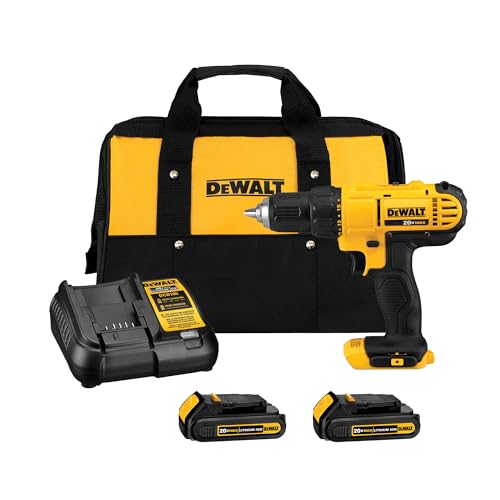
The DCD771C2 has been a go-to entry drill for years because it nails the basics without fuss. The 20V motor produces the same 300 UWO as the bit-kit version above, but this package leans into runtime by including two 1.3Ah XR batteries and a contractor bag. That means one battery charges while the other works, which is a quiet upgrade for anyone tired of mid-task waiting.
The drill weighs about 3.6 pounds with a battery installed, so it sits in the middle of the pack: not a pocket tool, not a heavy framing hammer either. For homeowners who already own a few DEWALT 20V batteries, the value math shifts a little since you might be doubling up on packs.
The Good Stuff
- Two batteries keep projects moving when one runs dry mid-board.
- Lightweight enough for vertical drilling in ceiling boxes without shoulder strain.
- Keyless chuck (a chuck that tightens by hand, no separate key needed) accepts bits up to 1/2 inch, which covers most general-purpose hole saws.
- Contractor bag holds the drill, charger, and a handful of bits for grab-and-go jobs.
Points To Note
- Brushless motor is absent, so expect a shorter service life under daily use than brushless alternatives.
- Plastic gearing is the common failure point owners report when pushing the tool into dense hardwood or thick metal.
Who It Suits Best
Homeowners tackling weekend repair lists, from re-hanging doors to building raised garden beds.
Look Elsewhere When
The Bosch PS21-2A pocket driver is a better fit for overhead HVAC work where every ounce of weight matters.
Most projects need two tools, not one. This combo kit bundles the DCD771 drill/driver with a 1/4-inch hex impact driver, which uses concussive rotational force to sink long lag bolts and deck screws without stripping the heads. The two tools share batteries and a single charger, so your bench stays cleaner than running two separate kits.
The 20V MAX 1/2-inch chuck on the drill handles hole saws and spade bits up to a useful diameter, while the impact driver is the one you reach for when a 4-inch timber screw would stall a regular drill. Compared with the single-tool DCD771C2 above, the upgrade question is simply: do you need impact performance for decking or framing.
What Helps Most
- Impact driver handles lag bolts and deck screws that stall a standard drill.
- Shared 20V battery platform means one charger and one wall outlet for both tools.
- Compact 1/2-inch chuck fits common hole saw sizes for plumbing and electrical rough-in.
- Carrying bag keeps both tools, batteries, and the charger together for transport.
Honest Caveats
- Both tools use brushed motors, so the kit is heavier and shorter-lived than brushless equivalents.
- No Flexiclick-style modular head, so tight inside-corner work still requires a right-angle adapter.
Quick Facts
Made For
DIYers building a deck, framing a small shed, or running plumbing and electrical rough-in around the house.
Swap It Out When
The Makita XFD131 is a smarter pick for users who prioritize high-torque drilling and brushless efficiency in a single tool.
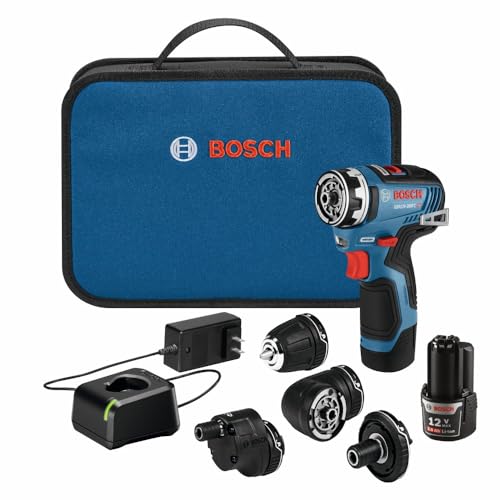
Bosch’s Flexiclick system is the closest thing cordless drills have to a Swiss Army knife. The chuck head detaches and swaps for a right-angle adapter, an offset adapter, or a hex bit holder, and the head rotates to 16 positions without pulling the attachment off the tool. For cabinet installers and electricians working inside boxes, that modularity replaces a small bucket of specialty tools.
The brushless motor (a motor design that runs cooler and lasts longer than brushed versions) is the quiet improvement over the older 140-series Bosch, with longer runtime per charge and a higher 300 in-lb torque rating. You trade the raw power of a 20V tool for the precision and reach of a 12V system, which most trim carpenters consider a fair deal.
Everyday Perks
- Modular Flexiclick head turns the drill into a right-angle, offset, or bit-holding tool in seconds.
- 1.2-pound tool weight is genuinely easy on the wrist during all-day trim work.
- Two-speed transmission tops out at 1,750 RPM for fast pilot drilling.
- Brushless motor stretches battery life, useful on long trim runs without a charger nearby.
Some Limits To Know
- 12V platform cannot match 18V or 20V drills for thick lumber or hole-saw work.
- Flexiclick attachments are sold separately in many configurations, so the kit cost climbs if you need every head.
Best Suited To
Cabinet makers, finish carpenters, and remodelers who spend most days driving screws in tight cavities.
Another Choice May Suit
The DEWALT DCD777D1 is a stronger pick for general homeowners who do more drilling than cabinet assembly.
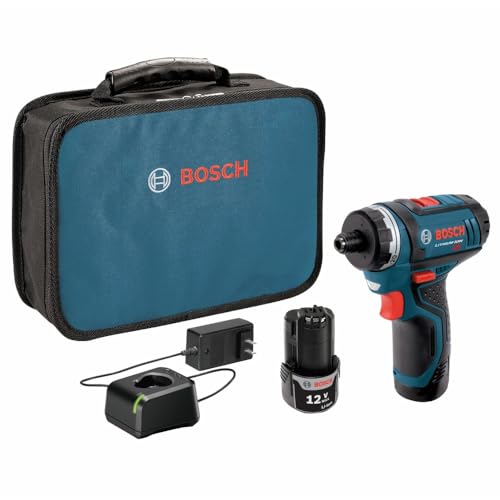
At roughly 1.4 pounds with battery, the PS21-2A earns its pocket-driver name honestly. The drill is short enough to fit in a tool belt pouch and light enough to hold overhead for electrical box work without that familiar forearm burn. It uses a 1/4-inch hex chuck (a quick-change sleeve that accepts driver bits directly), so bit swaps are one-handed.
The 265 in-lb torque figure is modest compared with the Flexiclick 300FCB22 above, but the smaller body is the trade you accept for working in cramped spots. Twenty clutch settings give you fine control for delicate fastening in thin materials like cabinet backs or drywall.
What Makes Sense
- 1.4-pound total weight makes overhead fastening genuinely comfortable for long stretches.
- 20+1 clutch positions let you dial in exact torque for thin or soft materials.
- LED work light and belt clip come standard, no accessory purchases required.
- Two-speed gearbox covers 0-350 RPM low for driving and 0-1,300 RPM high for drilling.
Small Caveats
- Hex-only chuck means round-shank drill bits need a separate adapter for true hole drilling.
- 12V platform lacks the punch needed for thick deck lumber or repetitive hole-saw cuts.
Feature Snapshot
Who Will Love This
Electricians, HVAC techs, and anyone doing repetitive overhead fastening where tool weight compounds fast.
Not Your Match When
The Bosch GSR12V-300FCB22 Flexiclick is a better call when you need a true keyless chuck plus modular heads.
The GSR12V-140FCB22 sits one step below the 300FCB22 in Bosch’s 12V Flexiclick family, and the spec gap is small for most users. You get the same modular 5-in-1 attachment head and the same 16-position rotation, but the motor is brushed rather than brushless, which means shorter runtime and a slightly heavier 1.8-pound body. The lower 265 in-lb torque is still plenty for cabinet and electrical work.
For users who do not drill enough hours per week to justify the brushless premium, the 140-series saves real money. The trade-off shows up when you push the tool into dense oak or run a hole saw repeatedly. The brushed motor will run warmer and wear faster under that load.
The Helpful Details
- Flexiclick modular head accepts the same attachments as the higher-tier 300FCB22.
- Right-angle adapter gets into stud bays and inside cabinet cavities a straight drill cannot reach.
- Lightweight 12V body reduces fatigue during all-day trim work.
- Lower price point than the 300-series makes the modular system accessible.
Practical Considerations
- Brushed motor produces more heat and wears out sooner under heavy daily use.
- Battery runtime is shorter than the 300FCB22 brushless sibling, so charging breaks come sooner.
The Right Fit
Remodelers and cabinet installers who want the Flexiclick modularity without paying for brushless technology.
Consider Something Else When
The Bosch GSR12V-300FCB22 is the better long-term buy for users logging several hours of drilling per day.
Sometimes the right tool is the one you do not have to buy next month. The DCK551D1M1 bundles a 1/2-inch drill/driver, a 1/4-inch impact driver, a 6-1/2-inch circular saw, a reciprocating saw, and a brushless oscillating multi-tool into one bag with two batteries and a charger. The 6-1/2-inch circular saw rips 2x4s at a 45-degree angle in a single pass, which is the kind of capability that turns a deck rebuild into a one-weekend project.
Compared with the two-tool DCK240C2 above, this kit adds cutting tools, so the value math changes for anyone doing renovations rather than just fastening. The cost is heavier in the bag and heavier in the wallet, but the price-per-tool is often lower than buying each piece separately.
Points In Its Favor
- Five tools cover framing, cutting, and trim work without separate purchases.
- Brushless oscillating multi-tool handles grout removal, flush cuts, and detail sanding.
- Two batteries (2.0Ah and 4.0Ah) match tool demand: bigger battery for high-draw saws, smaller for drivers.
- Single 20V MAX battery platform across all five tools simplifies charging.
Where It Is Less Suited
- Full kit is heavy to carry onto second-story job sites or up ladders.
- Oversized for homeowners who only need a drill for the occasional repair.
Feature Card
Right Fit For
Remodelers, garage builders, and homeowners tackling whole-room renovations over a single season.
Skip It When
The DEWALT DCD777D1 single drill is enough if you only need one tool for occasional home repairs.
The DCD777D1 is the kind of drill that quietly outlasts its brushed siblings. The brushless motor is more efficient, so the 2.0Ah battery runs longer per charge than the 1.3Ah packs in the entry DCD771C2 above. The 1/2-inch ratcheting chuck grips bits more securely, which matters when you push into tough material and the bit tries to walk.
You also get 340 UWO of power, which is meaningful when the project list includes drilling through old-growth 2x4s or thin-gauge steel. The LED light is positioned to throw less shadow on the work surface, a small detail that helps when drilling close to a wall.
What Works In Its Favor
- Brushless motor extends runtime and motor life compared with brushed DEWALT drills.
- 340 UWO handles dense lumber and thin metal cleanly.
- Single-sleeve ratcheting chuck tightens securely with one hand, even with gloves.
- Compact 7.5-inch length fits in tight spots that longer drills cannot reach.
Some Limits To Know
- Single 2.0Ah battery means mid-project charging on heavy workloads.
- No Flexiclick-style modular head for cabinet or electrical work.
At A Glance
Perfect Match For
Homeowners upgrading from a brushed drill who want one tool that handles most household and renovation drilling.
Reach For A Different Pick When
The Makita XFD131 is the stronger choice for users who regularly drill large-diameter holes and want higher torque per charge.
Makita’s XFD131 is the workhorse end of this list. The 18V LXT platform is a mature ecosystem, and the brushless motor produces 440 in-lb of torque, which is the kind of headroom that turns a hole saw in 2x lumber from a strain into a routine task. The 3.0Ah battery is a generous starter pack for a drill that size.
The mechanical two-speed transmission runs 0-500 RPM low and 0-1,900 RPM high, which is the widest spread in this lineup. Low gear handles fastener driving without stripping, while high gear pushes through metal and masonry bits. The trade-off is weight: at about 3.8 pounds with battery, this is not a drill you forget you are holding.
The Case For It
- 440 in-lb torque is the highest in this lineup, useful for hole saws and large auger bits.
- Brushless motor delivers more work per charge than brushed competitors.
- Wide 0-500 / 0-1,900 RPM speed range covers both fastening and high-speed drilling.
- 3.0Ah battery is larger than the 1.3Ah packs in entry kits, extending runtime per swap.
Possible Compromises
- 3.8-pound weight is heavier than the 12V Bosch pocket drivers, so fatigue adds up on long overhead jobs.
- 18V-only platform locks you into Makita batteries and chargers for future tool purchases.
Built With In Mind
Pros, serious DIYers, and homeowners who want one drill powerful enough to replace specialty tools.
Where A Sibling Pick Shines
The Bosch PS21-2A pocket driver is the better call for repetitive overhead fastening where weight matters more than torque.
What Matters Most Before Choosing Rechargeable Drill Drivers
Match the Voltage to the Workload
A 12V drill handles cabinet assembly, electrical boxes, and most homeowner fastening without complaint. An 18V or 20V drill earns its place when the project list includes hole saws, lag bolts, or thick lumber. Most users land on 18V or 20V for that reason, but a 12V companion is a quiet upgrade for tight-space work.
Brushless vs Brushed Motors
Brushless motors run cooler, last longer, and squeeze more work out of each battery charge. Brushed motors cost less up front, and the difference in service life only matters if you use the drill weekly. For occasional home use, brushed is fine. For daily contractor loads, brushless pays back the premium.
Chuck Type and Bit Capacity
A keyless chuck (a chuck that tightens by hand) is standard now, and a 1/2-inch chuck accepts larger hole saws than a 3/8-inch chuck. Hex-only chucks like the one on the Bosch PS21-2A are faster for bit swaps but limit you to driver bits without an adapter.
Battery Platform Lock-In
Pick a platform you can grow into. DEWALT 20V MAX, Bosch 12V Max, and Makita 18V LXT all have large accessory ecosystems, and future tools, batteries, and chargers all share that platform. Switching platforms later means replacing batteries too.
Where Shoppers Slip Up and How To Dodge It
Pitfalls Shoppers Hit
Buying the cheapest drill in the lineup is tempting, but a brushed motor with a 1.3Ah battery will leave you waiting on the charger mid-project. Calculate the cost of an extra battery into the budget so you always have one charging while the other works. Also, check the chuck size: a 3/8-inch chuck is fine for general use, but hole saws above 1 inch typically need a 1/2-inch chuck.
When Paying More Pays Off
The jump from a brushed entry kit to a brushless drill costs more up front, but the motor lasts roughly twice as long and the per-charge runtime is meaningfully longer. The upgrade pays off fastest for users who drill more than a few hours per week, and it pays off slowly for occasional homeowners who might never push the tool hard enough to notice.




