


Cast iron punishes ordinary blades. A bi-metal tooth that chews through drywall studs in seconds will dull out on a soil pipe in under a minute, and the wrong tooth pitch turns a clean cut into a heat-fried mess. Picking the right reciprocating saw blades for cast iron comes down to tooth geometry, TPI (teeth per inch), and whether the blade was actually engineered for thick metal or just labeled for it. This roundup sorts through eight options that show up in this category, including a couple of adjacent picks worth knowing about, so you can match a blade to the cut, not the other way around.
The Shortlist At A Glance
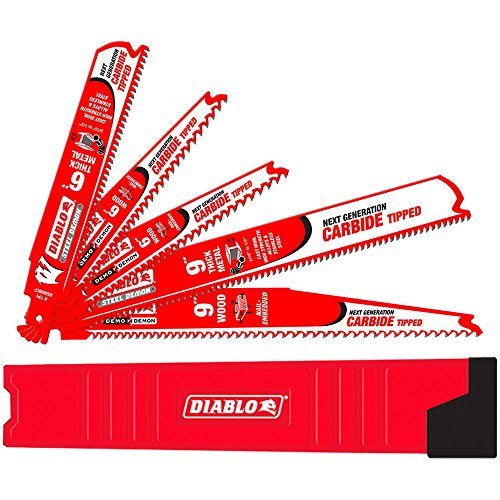
Diablo Steel Demon/Demo Demon Reciprocating Saw Blade Set 5-Pieces

Diablo Steel Demon DS0908CF Reciprocating Saw Blade 6″ 8 TPI

FRITZFURT 15 Inch Japanese Teeth Pruning Blade 6TPI 1/2″ Shank

FRITZFURT 65-Piece Laminate Flooring Tools Kit with Pull Bar

PRETEC 9 Inch Wood Pruning Reciprocating Saw Blades 5 PCS 5TPI

PRETEC 9 Inch Wood Pruning Reciprocating Saw Blades 10 PCS 5TPI

FRITZFURT 10-Piece Reciprocating Saw Blade Set with Case

FRITZFURT Heavy-Duty Portable Drill Guide 0°–60° 1/4″ Hex Shank
The Strengths Of Each Pick
This set covers a real-world range that single-purpose blades can’t match, which makes it the most flexible starter pack for shops that handle both cast iron repairs and structural demo. Three of the blades lean into nail-embedded wood and general teardown, while the remaining pair are carbide-tooth cutters built for cast iron, thick-wall tubing, and stainless stock. That mix means you grab one case on the way out instead of three separate packs.
Where the carbide Steel Demon blades earn their keep is in plumbing retrofits and any demo where a buried soil stack or old radiator needs to come out in pieces. Compared to a basic bi-metal blade, the TiCo Hi-Density tooth formulation is designed to outlast standard metal-cutting geometry by a wide margin when the workpiece includes embedded fasteners or scale.
Strengths Worth Knowing
- Two blade types in one pack, covering both demo wood and dedicated cast iron cuts
- Carbide tooth formulation built for thick metal, tubing, and stainless steel
- Reduces the need to swap between separate packs on a job
- Handles occasional embedded nails without destroying the tooth line
Things To Consider
- Carbide blades cost more per blade than a basic bi-metal alternative
- 5-piece count is modest for shops that burn through blades quickly
- Storage case is not always included, so loose blades can stack up in a drawer
Key Specs
Built With In Mind
Plumbers, remodelers, and facility maintenance crews who switch between cast iron cuts and wood demo in the same visit.
Skip It When
You mostly cut thin sheet metal or plastic, where the FRITZFURT 10-Piece Reciprocating Saw Blade Set covers everyday variety at a lower per-job cost.
Single-blade picks make sense when your cut count is low but your material is brutal, and the DS0908CF fits that exact profile. The 6-inch length slots into tight crawlspaces where a longer blade flexes and chatters, and the 8 TPI tooth count hits a sweet spot for stock in the 3/16″ to 9/16″ wall range. It’s a one-job specialist, not a generalist.
For homeowners and tradespeople facing a single soil-pipe replacement or a stubborn cast iron fitting, this blade tends to outlast several rounds of generic bi-metal attempts. The trade-off shows up in price per blade, and there’s no storage case here, so it’s worth keeping a sleeve or marker on the bench to track used vs. fresh edges.
The Helpful Details
- Carbide-tipped edge aimed at thick metal, including cast iron and high-strength alloys
- 6-inch length is easier to control in tight plumbing cavities
- 8 TPI balances speed and finish on medium-wall stock
- Single-blade purchase keeps upfront cost lower than a full set
Worth Noting
- Per-blade cost is higher than bulk bi-metal options
- Not suited for demolition wood or nail-embedded framing
- One blade means a backup is smart on big jobs
At A Glance
Whose Shelf It Belongs On
Tradespeople handling isolated but stubborn cast iron cuts who want one dependable blade on hand rather than a multi-pack.
Consider Something Else When
Your day mixes metal with framing lumber or PVC, where the Diablo Steel Demon/Demo Demon 5-Piece Set covers both worlds in one case.
This blade is the odd one out in a cast iron list, and it’s worth flagging for the gardeners reading along. The arc-shaped Japanese tooth profile is engineered to bite fresh, sappy wood rather than dense metal, so on green branches and orchard pruning it cuts faster and cleaner than a straight-tooth pruning blade. For anyone who’s been fighting a recip saw through hedge maple, that geometry change is a real relief.
The 15-inch reach and 1/2″ shank mean you need a saw that accepts the larger mounting footprint, and the 6TPI count is far too coarse for anything resembling cast iron. You wouldn’t reach for this on a soil pipe, but for limb work and storm cleanup it’s a noticeable step up from a generic wood blade.
Useful Highlights
- Curved Japanese tooth profile clears green wood quickly
- 15-inch length reaches into higher limbs from the ground
- Triple-ground teeth reduce tear-out on live wood
- 1/2″ shank fits higher-torque pruning saws
Trade Offs
- Wrong tool entirely for cast iron or any metal
- Requires a recip saw with a 1/2″ shank slot
- Long blade can flex in dense hardwood
Feature Snapshot
Right Fit For
Homeowners and orchard owners trimming live branches and storm-felled limbs with a high-torque recip saw.
Look Elsewhere When
Your workload is metal-focused, where the Diablo Steel Demon DS0908CF 6″ 8 TPI handles thick stock without complaint.
This entry breaks the saw-blade pattern, but it earns its slot by solving a real problem that shows up the moment a cast iron pipe runs under the floor you’re about to install. The kit bundles a heavy-duty pull bar, an LVP tapping block, a double-faced mallet, knee pads, and a sleeve of spacers, so a first-time installer gets every specialty tool in one box instead of piecing it together across three hardware runs.
For a weekend flooring project in a single room, the included pull bar and tapping block alone are worth the kit, and the 60 spacers mean you won’t run short mid-row. The honest read is that this has nothing to do with cutting cast iron, so it lands here as the supporting gear for a renovation that often involves both.
Features That Help
- Pull bar handles tight clearances against walls where a mallet can’t reach
- Tapping block protects plank edges during seam closure
- 60 spacers cover multiple rooms without restocking
- Knee pads save joints during long floor sessions
Points To Keep In Mind
- Not a cutting tool, so it doesn’t replace any blade in this list
- Kit weight is higher than a single specialty tool
- Spacers may be more than a small bath job needs
Best Suited To
DIY homeowners tackling their first laminate or vinyl plank floor in a medium-sized room.
A Better Fit Elsewhere
Anyone who only needs one cast iron blade for a single plumbing repair should grab the Diablo Steel Demon DS0908CF 6″ 8 TPI instead.
Like the FRITZFURT pruning blade, this PRETEC pack belongs to the wood-pruning family rather than the metal-cutting family, and the 9-inch length plus 5TPI tooth count is the standard pruning-shop spec. Heat-treated chrome vanadium steel is the body material, which gives the blade more spring memory than a basic carbon-steel alternative and reduces the chance of a bent tooth after a season of cuts.
For most suburban backyards with the occasional limb coming down, a 5-pack covers a full pruning season without leaving you short mid-job. The trade-off is that you only get five blades, so a heavy storm cleanup may burn through the set faster than expected.
Everyday Wins
- Heat-treated chrome vanadium body resists bending under load
- 9-inch length is a versatile general-pruning size
- 5TPI is fast enough for branches without choking the cut
- Compact count suits a small tool drawer
Honest Caveats
- Wrong material family for cast iron or any metal cutting
- Five blades run out quickly on a busy cleanup day
- 5TPI leaves a rougher cut on ornamental wood than a finer pitch
Feature Card
Who Should Grab It
Homeowners with small yards and occasional branch work who want a compact backup pack for a recip saw.
Reach For A Different Pick When
You split time between wood and metal work, where the FRITZFURT 10-Piece Reciprocating Saw Blade Set covers both without two separate packs.
Same blade body and tooth geometry as the 5-pack above, but doubled in count, which is the real reason to step up. Ten blades in a single order gives a pruning contractor or a homeowner with a long-overgrown lot a full work cycle before restocking. Per-blade cost drops meaningfully against the 5-pack version.
You still get heat-treated chrome vanadium steel and 5TPI teeth, so cut feel and durability match the smaller pack. The catch is storage, since ten loose blades will scatter across a drawer without a case, and a case is not part of this bundle.
The Case For It
- 10-blade count covers a heavy season of pruning
- Lower per-blade cost than the 5-pack version
- Same heat-treated body as the smaller sibling
- Reduces restocking trips mid-project
Points To Note
- No storage case included
- More blades than a casual weekend user may ever need
- Still the wrong tool for any metal cutting
Who Will Love This
Frequent pruners, small landscaping crews, and homeowners with multi-acre lots facing repeated cuts across a season.
Swap It Out When
Your work includes any cast iron pipe, where the Diablo Steel Demon/Demo Demon 5-Piece Set is the only entry in this list built for it.
This is the everyday generalist set in the list, the kind of pack you throw in the truck on a mixed job where wood, metal, and plastic all show up before lunch. The 10 pieces include both 14 TPI and 24 TPI metal blades, a couple of wood blades, plus a 9-inch and a 10-inch longer-reach option, and the included storage case is the detail that ties it all together. Having a real case means blades stay sorted by TPI instead of rattling loose in a toolbox.
The honest read is that none of these blades are true heavy-metal specialists, so on real cast iron the pack is a starting point rather than a finishing tool. For light-gauge metal, wood framing, and odd-job demo, though, it’s a sensible starter kit that gets used more than the premium set in most home shops.
Useful Strengths
- Storage case keeps blades sorted by tooth count and length
- Mix of 14 TPI and 24 TPI covers thin to medium metal
- Wood blades included for framing and trim demo
- Longer 9-inch and 10-inch blades reach into deeper cuts
Potential Drawbacks
- Not engineered for cast iron or thick-wall tubing
- Bi-metal construction wears faster than carbide on hard stock
- 10 pieces is enough to lose track of which blade is which without the case labels
Feature Rundown
Made For
DIYers, handymen, and homeowners who want one case to cover most household cuts without buying separate packs per material.
Where A Sibling Pick Shines
On dedicated cast iron cuts, the Diablo Steel Demon DS0908CF 6″ 8 TPI outperforms this set with carbide-tipped teeth built for the job.
This final entry is a different tool entirely, included because cast iron jobs almost always include a step where you need a clean drilled hole rather than a sawed one. The 0° to 60° adjustable angle range and self-centering base bring drill-press alignment to a handheld drill, so you can drill square or angled starter holes without hauling a full press to the site. The 1/4″ hex shank fits standard drill chucks and most impact drivers.
For bracket mounting, plumbing hangers, or angled bolt holes, this jig is the kind of thing you wonder how you lived without. The bit range tops out at 25/64″, so very large hole saws are out of bounds, but for the size range most cast iron repairs actually need, it lands in the sweet spot.
Notable Upsides
- 0° to 60° angle range covers straight and angled hole layouts
- Self-centering base keeps the bit from walking on startup
- Accepts 1/4″ hex shank bits and fits standard drill chucks
- Portable enough to move between job sites without a press
Smaller Limitations
- Max bit capacity is 25/64″, so large hole saws won’t fit
- Not a substitute for a full drill press on production runs
Feature Overview
Perfect Match For
Tradespeople and serious DIYers who need straight or angled holes on location without dragging out a benchtop press.
Not Your Match When
You only need a single cast iron cut and nothing else, where the Diablo Steel Demon DS0908CF 6″ 8 TPI is the leaner purchase.
Matching Blades To Real Cutting Jobs
The right reciprocating saw blade for cast iron lives or dies on tooth material and tooth count. Carbide-tipped options, like the Steel Demon blades in picks one and two, are designed to outlast bi-metal geometry on dense, abrasive stock, and an 8 TPI count generally hits the sweet spot for pipe walls between 3/16″ and 9/16″ thick. Lower TPI cuts faster but leaves a rougher edge, while higher TPI in the 14 to 18 range works better on thin-wall metal and tubing where heat buildup is the real risk.
Blade length matters more than people expect. A 6-inch blade, like the DS0908CF, stays straight in tight crawlspaces and minimizes flex, while a 9-inch or 12-inch blade reaches into deeper cuts but can wander if the saw lacks rafter hooks or a steady hand. For plumbing retrofits and any cut where the blade enters a wall cavity, shorter is usually safer.
Tooth geometry also signals intent. A curved or arc-shaped Japanese tooth pattern is built for green wood and pruning, not metal, so a blade labeled for “tree trimming” has no business in a cast iron project. The pruning picks in this list are included to show what the wrong blade family looks like, and to give gardeners reading along a useful alternative for yard work that often happens on the same property as a plumbing job.
Key Considerations Across These Picks
Common Shopping Slip Ups
The most frequent mistake is buying a blade based on tooth count alone without checking the material the teeth are made from. A 14 TPI bi-metal blade and a 14 TPI carbide blade look similar on the shelf, but the carbide version will outlast the bi-metal by a wide margin on cast iron, and the price gap reflects that. Equally common is underestimating the role of blade length. Long blades in tight cavities cause more binding injuries than short ones, and a stubby 6-inch blade often finishes a plumbing cut faster than a 12-inch blade that keeps snagging on the framing.
What The Higher Tier Buys
Spending up on a carbide-tipped Steel Demon blade over a generic bi-metal alternative is a real upgrade, not a marketing one. The tooth material stays sharp through embedded fasteners and the abrasive scale that builds up inside old cast iron, so a single premium blade can replace several rounds of cheaper replacements. The cost shows up per blade rather than per cut, and for anyone cutting cast iron more than once a season, the math works out in favor of the carbide option.
Frequently Asked Questions
What TPI works best for cast iron?
For cast iron pipe and thick-wall fittings, 8 TPI is the practical starting point. It balances cutting speed with chip clearance and avoids the heat buildup that comes with very fine tooth counts.
Can a wood blade ever cut cast iron?
No. Wood blades lack the carbide or hardened bi-metal teeth needed for metal, and forcing one through cast iron will dull it in seconds and may shatter the tooth line, which is a real safety risk.
How long should a cast iron blade last?
Lifespan depends heavily on the material being cut and how much scale or rust is present. A carbide-tipped blade on clean cast iron can handle multiple cuts before performance drops, while a bi-metal blade may dull in a single heavy job.
Do I need a special saw for carbide blades?
Most modern corded and brushless cordless reciprocating saws accept standard 1/2″ shank blades, which is what carbide recip blades use. The key is matching the saw’s speed to the material, since lower RPM reduces heat on metal.
Is it worth buying a multi-pack for occasional use?
For most homeowners, a single high-quality blade or a small 2 to 5 piece set is plenty. Large multi-packs make more sense for active remodelers or plumbers who replace blades often enough to justify the storage case.




