


Walls demand a specific kind of roller, and the wrong tool shows up fast in lap marks, missed edges, and aching shoulders. The list below pulls together extension poles, J-rollers, a wide extendable wall roller, and a few accessories that solve adjacent problems like seam pressure, threading mismatches, and roller cover cleaning. Each pick maps to a real wall scenario: high ceilings, tight inside corners, peel-and-stick wallpaper seams, or a single accent wall that needs even, bubble-free pressure. Skim for the use case, then drill into the spec card and the honest caveats.
How The Shortlist Stacks Up

Wooster SR055 Sherlock Extension Pole (4 ft)
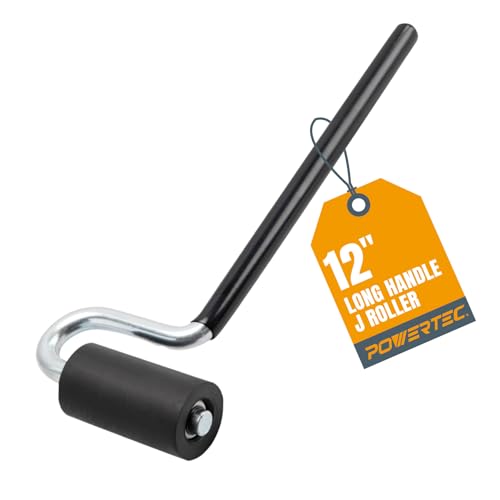
POWERTEC 12″ Long Handle J Roller (71010)

POWERTEC 14″ Curved Handle J Roller (71011)

Wooster SR054 Sherlock Extension Pole (2-4 ft)

Wooster SR053 Sherlock Extension Pole (1-2 ft)

PinStone 8-in-1 Paint Brush and Roller Cleaner
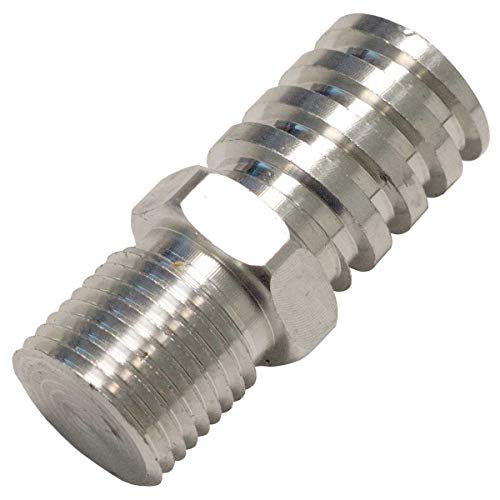
Columbia Aluminum Coarse Thread Adapter

POWERTEC Extendable Floor and Wall Roller (71033V)
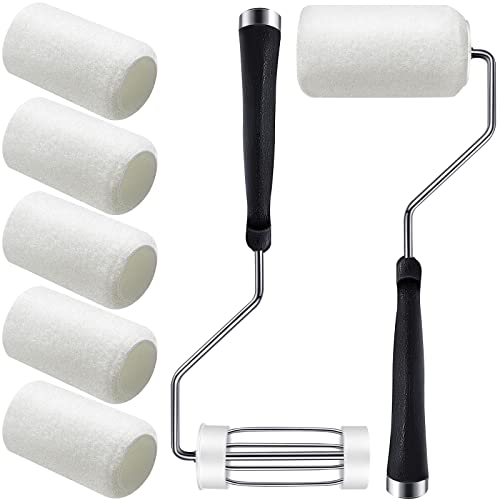
Tessco 4-Inch Mini Roller Kit (2-Pack)
The Strengths Of Each Pick
The SR055 is the long-reach workhorse in the Wooster Sherlock line, a 4-foot fixed extension that turns a standard roller into a ceiling-safe tool. Built in the USA, it pairs a hexagonal aluminum inner section (a six-sided shape that resists twisting under load) with a fiberglass outer sleeve, the same combo that makes the shorter SR053 and SR054 feel solid in the hand. The universal threaded tip accepts virtually any roller frame, so swapping between nap covers and J-rollers does not require an adapter.
For wall work, the payoff is reach without a ladder on standard 8 to 9 foot ceilings, with comfortable head clearance for the average adult. The fiberglass outer also dampens vibration when you push a stiff cover across a long run, which helps reduce fatigue during a whole-room repaint. Compared with the shorter SR054 below, this one skips the telescoping joint entirely, meaning fewer points of potential slop and a stiffer feel for heavy rolling.
The Practical Payoff
- Made in the USA, with a fiberglass outer shell that resists flex under load
- Hexagonal inner aluminum core keeps the roller from twisting mid-stroke
- Universal threaded tip fits most roller frames, so no extra adapter is needed
- Cuts ladder time on single-story rooms, which speeds up large wall areas
Honest Caveats
- Fixed 4 ft length is overkill for short walls, and the long shaft can feel unwieldy in tight bathrooms
- No telescoping feature, so storing it requires a garage corner or a long closet
At A Glance
Best Suited To
Single-story homeowners repainting a full room of standard 8 to 9 foot walls who want ladder-free rolling.
Look Elsewhere When
The Wooster SR053 Sherlock Extension Pole (1-2 ft) is a better fit for tight spaces like behind toilets and inside narrow closets.
A J-roller earns its place on any wall project where seams and edges need firm, even pressure. This 12-inch POWERTEC model uses a 1-1/2 inch diameter rubber roller that is 3 inches wide, a compact face that fits perfectly along wallpaper overlaps and edge banding. The long straight handle gives you leverage without forcing your wrist into a bent position, which is the usual complaint about shorter J-roller designs.
The tool shines when you are rolling out peel-and-stick wallpaper, contact paper, or veneer strips on a wall, because the rubber face grips the surface and pushes trapped air toward the seam. Compared with the curved-handle POWERTEC 71011 below, this straight design trades a little wrist comfort for direct downward force, which most people prefer for short bursts at inside corners.
Reasons It Performs
- 3-inch rubber roller face applies even pressure on seams and edges
- 12-inch handle keeps the wrist in a neutral position during use
- Compact enough to fit inside corners where wider rollers miss
- Works for wallpaper, veneer, and laminate edge banding on vertical surfaces
Points To Keep In Mind
- Rubber face can mark delicate wallpaper prints if pressed too hard
- Not designed for paint, so it is a one-purpose tool for most wall projects
Feature Snapshot
Made For
DIYers hanging peel-and-stick wallpaper or applying edge banding who need firm pressure on a small footprint.
Skip It When
The POWERTEC 71011 Curved Handle J Roller is a better fit for anyone running long seams across an entire wall and wanting a more ergonomic grip.
The 71011 keeps the same 1-1/2 inch by 3 inch rubber face as the 71010 above, but the handle is reshaped into a 14-inch curved profile. That bend is the whole point: instead of pushing straight down with a straight bar, you rock the roller across the surface, which keeps your knuckles off the wall and your wrist in line. For long wallpaper runs or full-wall veneer projects, the ergonomic difference adds up.
The trade-off is reach. The longer, curved handle is harder to maneuver in a tight alcove, where the 71010’s straight shaft still wins. As a wall-only tool, this one lives between the mini J-roller and the wide floor-and-wall roller further down the list, filling the gap when a 3-inch rubber face is the right size but a straight grip feels punishing.
A Strong Showing
- Curved handle reduces wrist and knuckle fatigue on long sessions
- Same compact rubber face as the 71010, so it fits inside corners
- Distributes pressure evenly across the seam without flattening the bar
Worth Noting
- Longer curved handle can be clumsy in tight bathrooms and closets
- Single-purpose tool, since the rubber face is not designed for paint pickup
Whose Shelf It Belongs On
Anyone wallpapering an entire accent wall and wanting a wrist-friendly grip for repeated rolling passes.
Reach For A Different Pick When
The POWERTEC 71010 Long Handle J Roller suits better in tight spaces where a straight, compact shaft is easier to maneuver.
The SR054 is the middle child of the Wooster Sherlock trio, telescoping from 2 to 4 feet with the same hexagonal aluminum core and fiberglass outer sleeve found on the SR055. The thumb-operated locking collar adjusts in roughly 6-inch increments, which is a meaningful upgrade over generic friction-fit poles that slowly sag mid-stroke. The universal threaded tip accepts any standard roller frame.
For most wall work in a typical home, the 2-to-4 foot range is the sweet spot. You get enough reach for a 9-foot ceiling when fully extended, and the shorter collapsed length fits behind a door or in a hallway closet. The trade-off versus the fixed SR055 is one extra joint, and any telescoping joint introduces a small amount of twist, though the hex inner core keeps that minimal under normal rolling pressure.
Positive Points
- Telescopes from 2 to 4 feet, so it handles most wall and ceiling jobs in a typical home
- Hexagonal aluminum inner core resists twist under load
- Fiberglass outer sleeve adds stiffness and reduces hand vibration
- Adjusts in roughly 6-inch increments for fine-tuned reach
Room For Improvement
- Telescoping joint adds a small amount of flex compared with the fixed SR055
- Thumb lock can loosen with heavy downward pressure over long sessions
Right Fit For
Homeowners with a mix of standard ceilings and shorter accent walls who want one pole that adjusts to both.
A Better Fit Elsewhere
The Wooster SR055 Sherlock Extension Pole (4 ft) suits someone who always works at full reach and prefers a stiffer, joint-free shaft.
The SR053 is the shortest of the three Wooster Sherlock poles, telescoping from 1 to 2 feet, and it solves a problem that longer poles actually make worse: tight access. Behind a toilet, inside a small closet, or under a low soffit, a 4-foot shaft is a liability. This one is short enough to stand on the floor and still reach the work, with the same hex aluminum core and fiberglass outer as its longer siblings.
The wall-use scenario is narrow but real. Most people buy the SR053 to pair with a mini roller frame like the Tessco 4-inch kit further down, or to extend a J-roller for a small seam repair on a wall. For a full-room repaint, the reach is too short, and you will be back on a step stool. The honest read is that this is a specialty tool that earns its place once you have a job that demands it.
A Favorable Mix
- Short 1 to 2 foot range is ideal for tight spaces where longer poles cannot fit
- Hex inner core and fiberglass outer match the build quality of the longer Wooster poles
- Universal threaded tip fits any standard roller frame
Trade Offs
- Not enough reach for a standard 8 to 9 foot ceiling without a ladder
- Only useful for short, specific jobs, so it sits unused for many homeowners
Perfect Match For
Anyone rolling behind toilets, inside closets, or under soffits where a full-length pole is too long to maneuver.
Swap It Out When
The Wooster SR054 Sherlock Extension Pole (2-4 ft) is a better all-around pick for standard walls and ceilings with mixed reach needs.
Roller covers and brushes are consumables, but their lifespan is directly tied to how well you clean them between sessions. The PinStone 8-in-1 is a stainless steel multi-tool that pulls double duty: one end works as a paint brush comb for flat, angled, and round bristles, and the other end shapes to fit 2, 4, 9, and 12-inch roller covers, plus 18-inch covers in a pinch. It also folds out as a scraper, putty knife, and a few smaller helpers like a bottle opener and a gouger.
For wall projects specifically, the cleaning end is the headline. Pulling dried latex out of a nap cover with your fingers destroys the cover, and a dedicated comb extends the life of a 4-inch mini cover like the ones in the Tessco kit below. The scraping and putty knife ends also handle the small wall-prep tasks that come up before rolling, like lifting a peeling corner of old paint.
Positive Takeaways
- Comb end fits multiple brush shapes, so it handles flat, angled, and round bristles
- Roller end cleans covers from 2 inches up to 18 inches wide
- Stainless steel build resists rust in a wet cleaning bucket
- Folds out as a scraper and putty knife for wall prep
Small Caveats
- Single-tool design means no replacement parts if a tip bends
- Scraper edge is short, so large wall scraping jobs still need a full putty knife
Who It Suits Best
Anyone running multiple wall projects per year who wants one tool to clean brushes, de-lint roller covers, and handle small scraping jobs.
Not Your Match When
The Tessco 4-Inch Mini Roller Kit is a better fit for someone who only needs a small roller setup and not a separate maintenance tool.
This is not a roller in the conventional sense, it is a small aluminum adapter that solves a specific compatibility problem. Drywall corner roller handles, like the All-Wall X1 or Rankee extendable models, use a fine thread pattern. Standard paint roller cages use a coarse Acme 3/4 inch thread. The Columbia adapter bridges the two, with a fine male thread on one side and a coarse Acme male thread on the other, so a standard roller cage can be mounted on a drywall corner handle.
The wall-use case is narrow but valuable: if you already own a drywall corner roller and want to switch between corner work and a flat-wall roller without buying a second handle, this $10-ish part makes that possible. For most people, it is a non-purchase. For the people who need it, it is the exact part that was missing from the tool kit.
Strengths Worth Knowing
- Fine male thread on one end, coarse Acme 3/4 inch on the other for cross-compatibility
- Aluminum build resists corrosion and holds threads under load
- Allows a standard roller cage to mount on drywall corner handles like the X1 and Rankee
Things To Consider
- Only useful if you already own a compatible drywall corner handle
- Adds a coupling point, which can loosen if not checked between sessions
Who Should Grab It
Existing owners of All-Wall X1 or Rankee drywall corner handles who want to mount a standard roller cage on the same shaft.
Where Another Pick Suits Better
The Wooster SR054 Sherlock Extension Pole (2-4 ft) is a better fit for anyone who simply needs a quality extension pole and does not already own a corner roller handle.
The 71033V is the heavyweight in this list, a 7.5-inch wide roller on a handle that telescopes from 17 to 27 inches. The wide face means each pass covers more area than a standard 9-inch paint roller, and the extendable handle plus a die-cast secondary grip gives you real leverage for pressing seams flat. POWERTEC markets it for vinyl flooring, tile, linoleum, LVP, veneer, carpet, and wall coverings, which is a long list, but the core job is the same: firm, even pressure across a sheet material.
For wall work specifically, this is the right tool when you are hanging large sheets of vinyl wall covering, wide wallpaper, or peel-and-stick panels. A standard 9-inch frame would take many more passes, and a J-roller is too narrow for a full sheet. The trade-off is bulk, since the wide roller cannot get into tight inside corners, and the roller itself is a consumable that wears with heavy use.
What Stands Out
- 7.5-inch roller face covers large sheets faster than standard 9-inch frames
- Handle extends from 17 to 27 inches, with a die-cast second handle for two-handed leverage
- Works on vinyl wall coverings, LVP, veneer, and similar sheet materials
A Few Limitations
- Wide face cannot reach inside corners where a 3-inch J-roller is required
- Heavier than a standard paint roller, so overhead work on ceilings is tiring
Quick Facts
Built With In Mind
Installers and serious DIYers hanging large vinyl or peel-and-stick wall panels who want pressure across a wide face.
Consider Something Else When
The POWERTEC 71011 Curved Handle J Roller is a better fit for narrow seam work, inside corners, and standard wallpaper overlaps.
Mini rollers earn their place on walls when the job stops being a flat expanse and starts being a list of edges, frames, and narrow strips. The Tessco kit ships with two 4-inch self-locking frames and six covers, so you get a backup frame and enough cover material to switch between primer, paint, and a different nap length for textured walls. The handles have an anti-fatigue soft grip, which sounds like marketing until you have rolled a dozen door frames in a row and notice the difference.
The wall-use scenarios are concrete: door frames, window sills, narrow accent walls, and inside corners that a 9-inch frame cannot reach without getting paint on the adjacent ceiling. The self-locking frame holds the cover in place during use, which is helpful for anyone who has had a cover slide off mid-stroke on a cheaper frame. Compared with the POWERTEC 71033V above, this kit trades width for precision.
Bright Spots
- Two frames plus six covers cover primer, paint, and nap changes in one kit
- Self-locking frame holds the cover securely during use
- Anti-fatigue soft grip handle reduces hand strain on long trim sessions
- 4-inch size fits trim, frames, and inside corners a full-size roller cannot reach
Possible Compromises
- Mini roller width means a full accent wall takes significantly more passes than a 9-inch frame
- Covers are consumables, so the kit is a starting point rather than a permanent supply
Right Fit For
First-time DIYers and homeowners painting trim, door frames, and small wall sections where a full-size roller is overkill.
Another Choice May Suit
The POWERTEC Extendable Floor and Wall Roller is a better fit for large vinyl or peel-and-stick wall panels where a 7.5-inch face is more efficient.
What To Weigh Before Choosing Rollers For Walls
Match the tool to the wall surface
Paint, wallpaper, vinyl, and veneer all want different things from a roller. A standard 9-inch nap cover handles most latex paint on drywall, but a J-roller is the right tool for wallpaper seams and edge banding, while a wide 7.5-inch roller is better for large vinyl sheets. A few extra minutes matching the tool to the surface saves a redo later.
Reach matters more than most people expect
A 4-foot extension pole changes how a room gets painted, especially for single-story ceilings where ladders slow you down. For taller foyers or stairwells, a longer fixed pole like the Wooster SR055 makes sense. For mixed ceilings and tight spaces, the telescoping SR054 is the better all-around pick. Buying the cheapest pole on the shelf usually means fighting flex and wobble for an entire weekend.
Frame material, nap length, and roller width
A 4-inch mini roller with a soft-grip handle fits trim work, while a 9-inch frame is the standard for open wall areas. Nap length, the thickness of the fuzzy cover, should match the wall texture: short nap for smooth drywall, longer nap for orange-peel or knockdown textures. The frame material affects how much twist you feel during pressure, and aluminum or composite frames with reinforced cores hold up longer than budget plastic.
Maintenance extends the life of every roller
A cover that gets cleaned promptly with a tool like the PinStone 8-in-1 can be reused across multiple sessions. Covers that sit with dried paint get tossed. Brushes benefit from the same treatment. For extension poles, a quick wipe-down of the locking collar and the threaded tip prevents the two failure points that show up first.
Real-World Notes Across These Picks
Where Shoppers Go Wrong
The most common mistake is buying one roller to do every job, which usually means a 9-inch frame is used for both large walls and trim, and the result is sloppy edges and sore hands. A small kit like the Tessco 4-inch set solves trim and inside corners for almost no extra cost, and pairing it with a quality extension pole covers the rest of the room. The second mistake is underestimating the value of a J-roller, which costs little and is the difference between a wallpaper seam that lifts in a month and one that stays flat.
Where The Extra Money Goes
Premium poles like the Wooster Sherlock line use a hexagonal aluminum core to resist twist and a fiberglass outer sleeve to dampen vibration, and both upgrades show up in the hand after a full room of rolling. Cheaper poles twist under load, and the cover drifts off-line mid-stroke, leaving visible lines. The upgrade is worth it for anyone painting more than one room per year, less so for a single touch-up job.




