


A crooked picture frame is annoying. A sloped deck or misaligned tile floor is something you live with for years, which is why rotary laser levels matter. The right one turns a two-person layout job into a confident solo project, projecting a continuous reference line around the room or across a job site. These eight models cover indoor remodels, full-room tile work, and outdoor foundation layouts where the human eye simply cannot keep a line true.
The Essentials At A Glance

DOVOH Outdoor Laser Level H3-360G-KIT with Receiver

3×360° Self-Leveling Green Laser Level with Digital Display

4D 360 Laser Level, 16-Line Green Self Leveling

3×360° Laser Level with Tripod, Pro Grade
Lasers Level with Tripod, Green Self-Leveling

CIGMAN 4×360° Laser Level for Tile

DEWALT 20V MAX Laser Level Kit, 3×360, Green
DOVOH 4D Laser Level Self Leveling, K4-360G
Meet The Standout Selections
Bright sun washes out any visible beam, which is why the H3-360G-KIT leans on a bundled receiver rather than promising a long visible range. A self-leveling rotary (a tool that automatically finds true horizontal once set on a roughly flat surface) projects 360 degrees while the handheld detector picks up the signal and beeps as you walk a grade stake or footing form. For anyone setting fence posts, deck footings, or a small slab where the line stretches past 50 feet, that receiver pairing is the whole point of the kit.
The setup leans toward outdoor crews, but the same beam works fine indoors for basement floors or garage builds. You may find the included bracket a touch basic if you mount it on tall perimeter forms, and you’ll want to confirm the receiver’s mounting clip fits your preferred staff before committing.
Benefits That Matter
- Detector extends usable range to roughly 400 feet in real outdoor conditions
- 360-degree line covers an entire room or jobsite perimeter from one setup point
- Green beam stays visible longer in shaded daylight than older red units
- Self-leveling cuts setup time when you reposition the tool between pours
Points To Keep In Mind
- Receiver batteries tend to drain on long uninterrupted days, so spares are worth packing
- Bracket feels light when you mount it on tall foundation forms
Whose Shelf It Belongs On
Contractors and serious DIYers laying footings, decks, or fences in bright outdoor conditions where a visible beam alone is not enough.
Not Your Match When
You’re working strictly indoors on small remodels, in which case the CIGMAN 4×360° Laser Level for Tile offers a simpler, detector-free setup.
Most laser levels make you guess at brightness level or battery life. This model puts that information on a digital readout on the housing, which sounds minor until you’re halfway through a long cabinet install and wondering whether the dimming line is a setting or a dying cell. Three 360-degree planes (one horizontal plus two vertical) cover floors, walls, and ceilings from a single tripod position.
The readout is the headline, but the three-plane coverage is the real productivity gain for interior fit-out work. It depends on your tolerance for reading a small screen in low light, since the display is not backlit aggressively.
A Favorable Mix
- Digital screen shows battery, mode, and brightness at a glance
- Three 360-degree planes reduce repositioning during square layouts
- Pulse mode works with common green-beam detectors for longer reach
- Manual tilt mode supports staircase stringers and angled installs
Small Caveats
- Display can be hard to read in dim basement conditions without a headlamp
- No bundled tripod, which adds a separate purchase for first-time users
Right Fit For
Remodelers and finish carpenters running cabinet, drywall, or drop-ceiling layouts who appreciate at-a-glance status info during long days.
Consider Something Else When
You’re working mostly outdoors in direct sun, in which case the DOVOH H3-360G-KIT ships with a dedicated receiver that handles bright conditions more cleanly.
Sixteen lines sounds like overkill until you’re setting out a kitchen with upper cabinets, a tile backsplash, and a dropped ceiling. The 4D setup fires four 360-degree planes, which means a reference line hits the floor, both side walls, and the ceiling without rotating the unit. The trade-off is a busier beam field, which is helpful in a gutted room and noisier in a furnished space.
Self-leveling engages quickly, and an audible alert fires when the tool sits beyond its leveling range, so a tilted tripod stops being a silent source of errors. The housing holds up to typical jobsite handling, though it lacks the rubber overmolding of heavier-duty options like the DOVOH K4-360G covered later.
What Makes Sense
- Four 360-degree planes cover floor, walls, and ceiling simultaneously
- Out-of-level alert catches setup mistakes before you mark a wall
- Sixteen visible lines let multiple trades work from the same reference
- Pulse mode supports receiver use for longer interior runs
Worth Noting
- More lines mean more visual clutter in tight, finished spaces
- Housing is rigid plastic rather than rubber-armored for impact zones
Best Suited To
Trades running open-floor remodels where floor tile, wall layout, and ceiling grid all need references at the same time.
Look Elsewhere When
You mostly need a single floor-to-ceiling reference for repetitive tile work, where the CIGMAN 4×360° Laser Level for Tile offers a more focused 4-plane setup at a similar feature level.
The “pro grade” label usually means very little, but here the bundle delivers where it counts. Three 360-degree planes pair with a 40mW green laser module, so lines stay visible in normally lit rooms without leaning on a detector. The included adjustable tripod matters more than people expect, since a stable platform is the difference between chasing a wandering line and trusting your layout.
Two-second self-leveling keeps the workflow tight when you’re stepping the tool between rooms. You may find the bundled tripod’s leg locks slightly slower than premium aftermarket heads, but for the price of the kit, the savings on a separate tripod are real.
Positive Takeaways
- Three 360-degree planes reduce repositioning during tile and cabinet work
- Upgraded 40mW green module keeps lines visible in lit interiors
- Adjustable tripod included for immediate setup out of the box
- Two-second self-leveling trims minutes off every room change
Trade Offs
- Tripod leg locks feel a touch slower than premium aftermarket heads
- Carrying case has limited padding for repeated truck-cab transport
Made For
Tile pros, remodelers, and serious hobbyists who want a full kit (laser, tripod, case) ready to go on day one without sourcing accessories separately.
Skip It When
You only need a single floor reference for small patch jobs, where the simpler Ludotline Green Self-Leveling laser offers a more compact and lower-cost setup.
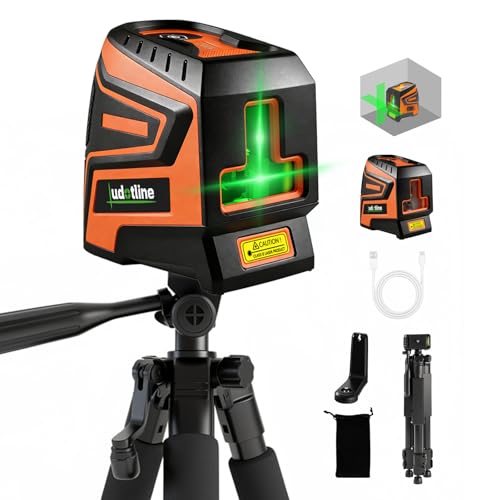
Two seconds is faster than most people take to walk from the tool to the wall, and that is the entire pitch for this Ludotline model. The 3mm accuracy rating at 10m (roughly 1/8 inch over 33 feet) is enough for shelf alignment, backsplash tile, and picture-hanging grids. Owners commonly appreciate that the manual mode switch lets you lock the line at an angle for staircase work without fighting the auto-level.
The included tripod is what makes this a “kit” rather than just a laser, and it gets you set up in a spare bedroom or garage without sourcing extra hardware. Depending on your room height, the tripod’s maximum extension may leave you crouching for ceiling-grid work, but for floor and wall layouts it sits at a comfortable working height.
Useful Touches
- Two-second auto-leveling keeps weekend projects moving
- Manual mode switch supports angled layouts like stair stringers
- Visible range up to 100 feet covers most single-room layouts
- Pulse mode extends usable range to 165 feet with a detector
- Bundled tripod removes one extra purchase for first-time users
Some Limits To Know
- Tripod tops out at modest height, awkward for ceiling grid work
- Single-plane coverage means more repositioning for whole-room remodels
Who It Suits Best
DIYers tackling shelf layouts, backsplash tile, or single-room remodels who want a self-contained kit without learning a feature-dense pro interface.
Swap It Out When
You’re running open-concept remodels with simultaneous floor, wall, and ceiling references, where the 3×360° Pro Grade Ludotline covers all planes from one position.
Floor tile is unforgiving: a quarter-inch drift over ten feet ruins the grout line. The CIGMAN CM-G16 fires four 360-degree planes with sixteen green lines, so you can square a tile field from any wall without re-leveling the tool. The horizontal and vertical planes intersect at right angles, which is the exact reference you need for a square layout, and that is what sets tile-focused units apart from general-purpose cross-line lasers.
The 4-plane setup is overkill for hanging a single shelf, but for a bathroom floor or kitchen backsplash, it eliminates the chalk-snap step entirely. The trade-off shows up when you only need one line, where a simpler 2-line model feels less busy and easier to read at a glance.
Everyday Wins
- Four 360-degree planes square a tile field without chalk lines
- Green beam stays visible under typical interior lighting
- 16-line output supports multiple workers from the same reference
- Self-leveling engages fast for room-to-room workflow
- Manual lock supports diagonal tile patterns and accent borders
Honest Caveats
- Sixteen lines create visual clutter for single-task jobs
- No bundled tripod in the standard kit for first-time users
Perfect Match For
Tile installers, flooring contractors, and remodelers running bathroom or kitchen floor layouts where square accuracy defines the finished job.
Reach For A Different Pick When
Your layout work is mostly cabinet hanging or shelf alignment, where the 3×360° Ludotline with tripod offers a less beam-heavy approach.
DEWALT’s DCLE34031D1 runs on the same 20V MAX battery platform as the rest of your cordless tools, and that one detail often decides the purchase for pros already invested in that ecosystem. The kit ships with a battery and charger, so the tool is genuinely ready to work on arrival. Three 360-degree lines handle the standard floor, wall, and ceiling references that most interior jobs require.
IP54 ingress protection (a rating that resists dust and splashes from any direction) keeps the unit functional in dusty remodels, and a pendulum lock prevents internal damage during truck transport. Indoor range tops out near 130 feet without a detector, and the DEWALT DW0892G detector extends that further for longer commercial runs.
Everyday Perks
- 20V MAX battery compatibility for shops already in the DEWALT platform
- IP54 rating handles dusty remodel and shop conditions
- Pendulum lock protects internals during transport between job sites
- Detector compatibility extends indoor range past 300 feet
Less Ideal Details
- Higher cost than non-battery-platform competitors with similar beam output
- Detector sold separately for outdoor and long-range use
- Bundled case is large compared to compact foam-padded options
Who Will Love This
Pros already running DEWALT 20V MAX tools who want a laser that shares batteries, chargers, and the brand’s existing service network.
A Better Fit Elsewhere
You’re just starting a tool kit or only do occasional DIY, in which case the CIGMAN 4×360° Laser Level for Tile delivers similar 4-plane coverage without the battery-platform premium.
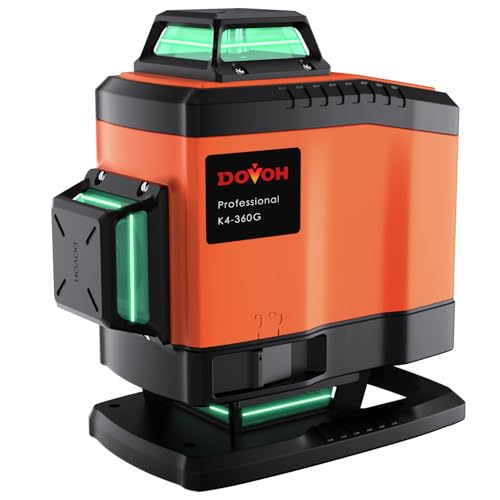
Lasers that survive a crew environment earn their keep on the second drop, not the first. The K4-360G wraps its internals in an overmold rubber housing, which is a soft, grippy shell molded directly over the harder plastic core to absorb the corner-of-truck-bed impacts that finish cheaper tools. The 4D layout fires two horizontal and two vertical planes, so the top laser handles ceiling work while the bottom plane keeps floor references live.
This is a crew tool first, hobby tool second. You may find the rubber housing adds bulk versus slimmer single-plane units, but the survival trade-off is the entire point when the laser travels to a different site every day.
Noteworthy Benefits
- Overmold rubber housing absorbs jobsite drops and corner impacts
- Two horizontal planes let you reference floor and ceiling at once
- Two vertical planes support square layouts across wide rooms
- Green beam improves visibility in partially shaded outdoor conditions
Where It May Fall Short
- Bulkier than slim 2-line models meant for occasional home use
- Heavier to mount on small tripods for overhead work
Who Should Grab It
Working contractors and remodel crews who transport their laser daily and need a unit that survives truck beds, scaffolding, and crowded job boxes.
Where A Sibling Pick Shines
You’re a weekend DIYer working on home projects, where the lighter Ludotline Green Self-Leveling laser with tripod offers a more portable fit at a lower entry cost.
What Matters Most Before Choosing Rotary Laser Levels
Beam Color and Visibility
Green beams appear up to four times brighter to the human eye than older red beams under typical indoor lighting. That difference shrinks outdoors, where direct sun washes out either color and a detector becomes the only reliable read. For interior work in lit rooms, green is the practical default. For exterior layout in daylight, beam color matters less than detector support.
Self-Leveling Range and Accuracy
Self-leveling only works within a window, typically 3 to 5 degrees from true level. Set the tripod outside that range and the tool should alert you, not silently mark a tilted line. Accuracy ratings are listed as a margin over a distance, so 3mm at 10m means a 1/8-inch drift over 33 feet, which is fine for tile and trim but tight for long foundation runs.
Plane Count and Mounting
A single-plane laser works for shelf or backsplash layouts but forces repositioning for whole-room remodels. Three or four 360-degree planes cover floor, walls, and ceiling from one setup point, which saves real time on larger jobs. Match the plane count to the project scope, and check whether the kit includes a tripod or whether you’ll be sourcing a stable mount separately.
Durability and Power Source
Rechargeable battery platforms make sense for shops already invested in one brand, since batteries and chargers are shared across tools. Replaceable batteries (usually AA or Li-ion packs) simplify field swaps but add cost over time. For crew use, an IP rating and rubber overmolding often matter more than beam specifications, because the tool that survives year two is the one that paid for itself.
What Separates Premium Models From Basic Ones
Where Shoppers Go Wrong
The most common mistake is buying on plane count alone, then discovering the housing cannot survive a real job site. Another is assuming a brighter beam handles outdoor work, when in fact a detector is the only practical solution in direct sun. Some shoppers also skip checking the self-leveling range, which leads to silent errors on slightly tilted ground. Confirm detector compatibility, IP rating, and self-leveling window before chasing extra features.
What The Higher Tier Buys
Premium models add detector support, longer pulse ranges, and more durable housings, which translates to fewer resets and longer service life. They also tend to include better mounting hardware and more accurate pendulum systems, so the line stays where you set it. The upgrade pays off for daily or professional use, where downtime costs real money. For occasional weekend projects, mid-tier kits deliver the same layout results without the extra spend.




