


Sanding eats into a project’s time more than almost any other step, and the tool you pick decides whether that time goes fast or slow. A random-orbit sander handles most furniture, cabinet, and refinishing work without leaving swirl marks, which is why almost every shop reaches for one. The picks below cover corded workhorses, a cordless option for garage days without an outlet, and a few replacement pads that keep your current sander running when the original hook-and-loop surface gives up.
The Shortlist At A Glance

DEWALT Random Orbit Sander DWE6423 Variable Speed
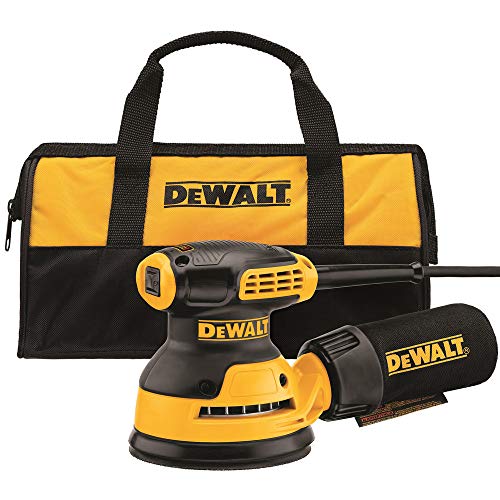
DEWALT Orbital Sander Kit DWE6421K 5-Inch

DEWALT Orbital Sander DWE6421 5-Inch

DEWALT Orbital Sander Kit DWE6423K Variable Speed

DEWALT 20V MAX Orbital Sander DCW210D1 Cordless

Makita XOB01Z 18V LXT Cordless Sander

Dincerpen Replacement Pad for DEWALT 2-Pack

Dincerpen Metal Replacement Pad for DEWALT 2-Pack
Dincerpen Cross-Brand Replacement Pad 2-Pack
Taking A Closer Look At The Options
Variable-speed control sets the DWE6423 apart in a crowded corded field, letting you dial back the orbit speed on heat-sensitive finishes and ramp it up for aggressive stock removal. The 3-amp motor produces between 8,000 and 12,000 OPM (orbits per minute), which is the metric that tells you how many sanding passes the pad makes every minute, and the separate counterweight is the kind of detail that genuinely shows up in long sessions because it keeps the vibration honest.
Compared with the single-speed models that follow it on this list, this one gives you a hook-and-loop pad, a rubber overmold grip, and a low-profile body that lets you press the pad flush against the work without the motor housing getting in the way. For furniture refinishing, tabletops, and cabinet doors, the honest read is that variable speed earns its place.
The Practical Payoff
- Adjustable speed lets you match the orbit rate to the grit and the finish, which helps avoid burning through veneer on delicate pieces.
- Counterbalanced design reduces hand fatigue during full-day sanding sessions on a dining table or set of cabinets.
- Rubber overmold grip stays secure even when dust and sweat build up over hours of work.
- Hook-and-loop pad swaps discs in seconds, so changing from 80 to 220 grit feels almost instant.
Worth Noting
- Corded design means you’ll need an extension cord and a nearby outlet, which can be limiting in detached garages or outdoor projects.
- Dust collection works best when paired with a shop vac; the included bag fills quickly on heavy sessions.
- 5-inch pad is great for flat surfaces but feels undersized on broad tabletops where a 6-inch model covers more area per pass.
Who It Suits Best
Intermediate to advanced woodworkers refinishing furniture or finishing cabinets who want speed control without stepping up to a cordless platform.
Where Another Pick Suits Better
For budget-focused first-time sander owners, the DEWALT DWE6421K kit covers the basics at a friendlier entry point.
The DWE6421K trades variable speed for a friendlier entry point, which is exactly the right call for homeowners sanding a few projects a year. The 3-amp motor runs at a steady 12,000 OPM, and the included carrying case plus the hook-and-loop pad means you have everything to start sanding the day the box arrives.
Where the variable-speed DWE6423 gives you a tuning dial, this single-speed kit gives you simplicity. You press the trigger, the pad orbits, and you focus on the surface. For refinishing a dining chair or stripping paint from a small shelf, that simplicity is a feature, not a compromise.
Real Benefits
- Complete kit with case, dust bag, and sanding disc ready for first use, so there’s no extra shopping trip before starting.
- Counterweighted motor housing reduces vibration transfer to your hand, which helps during longer stripping sessions.
- Short body height keeps the pad close to the work, making it easier to sand the inside faces of cabinet doors without tipping the tool.
- 12,000 OPM pace is brisk enough for fast stock removal on softwoods without feeling uncontrollable.
Trade Offs
- Single-speed design means you can’t slow the orbit for delicate veneers, so caution is needed on thin plywood edges.
- Included dust bag is small; owners commonly find it needs emptying every few minutes during heavy sessions.
Made For
First-time sander owners and homeowners tackling small refinishing projects who want a complete, ready-to-go kit without paying for features they won’t use.
Consider Something Else When
Workshop users who frequently switch between rough and fine sanding will prefer the DEWALT DWE6423K with its tunable speed dial.
The bare DWE6421 shares the same motor and pad platform as the kit version above, but ships without the carrying case and accessories. For anyone who already owns a stack of hook-and-loop discs and a shop vac, that stripped-down approach keeps the focus on the tool itself.
It’s the same 3-amp single-speed setup at 12,000 OPM, with the same low-profile body and counterweighted design. The 5-inch hook-and-loop pad handles the same furniture and cabinet tasks, just without the extras that a first-time owner might need.
Positive Points
- Same proven motor and counterweight platform as the kit version, so reliability and feel stay consistent.
- Lightweight enough for one-handed use on smaller pieces like picture frames or drawer fronts.
- Locking dust bag attaches with one hand, leaving your other hand free to hold the workpiece steady.
Small Caveats
- No case or extra discs included, so budget for dust collection and storage additions if you don’t already have them.
- Single-speed operation again means no fine-tuning for heat-sensitive finishes.
- Replacement hook-and-loop pads wear out over time, and a worn pad makes disc changes less secure.
Right Fit For
Existing DEWALT tool owners or repeat DIYers who want the same sander platform as the kit without paying for accessories they already own.
Look Elsewhere When
Someone buying their first sander should grab the DEWALT DWE6421K for the included case and starter accessories.
The DWE6423K combines the variable-speed motor from the bare DWE6423 with the full kit presentation of the DWE6421K. You get the same 8,000 to 12,000 OPM range, the same counterweighted body, and the same hook-and-loop pad, plus a carrying case and dust collection bag to round out the package.
Think of it as the “ready for anything” version: variable speed for material flexibility, full kit for shop organization, and a tool that works just as well on a small picture frame as it does on a dining table. The 3-amp motor doesn’t flinch at either task.
What Helps Most
- Variable speed dial covers everything from aggressive stripping on rough lumber to fine finishing on hardwood.
- Kit includes case, dust bag, and starter disc, so the tool is shop-ready out of the box.
- Counterweighted design and overmold grip keep the tool controllable even at the top end of the speed range.
- Locking dust bag is one-handed to attach, which matters when the other hand is holding a piece steady on a workbench.
Points To Note
- Carrying case is roomy but not rugged, so it’s best kept on a shelf rather than tossed in a truck bed daily.
- Corded only; users in cordless-heavy shops may want to look at the DEWALT DCW210D1 instead.
Best Suited To
Home shop owners and hobbyist woodworkers who want one sander that handles both rough and fine work without swapping tools.
A Better Fit Elsewhere
Cordless-only shops will be happier with the DEWALT DCW210D1, which trades the outlet requirement for a battery platform.
The DCW210D1 is the cordless answer to everything the corded DEWALT models handle, with a brushless motor that delivers the same 8,000 to 12,000 OPM range and a variable-speed dial for matching the pace to the task. The 20V MAX battery and charger ship in the box, and a storage bag keeps everything organized for the truck or the jobsite.
The trade-off, as always with cordless tools, is runtime versus the unlimited stamina of a corded tool. For shop work, mobile repairs, or sanding in spaces where dragging an extension cord would be a hassle, the freedom is worth it. For all-day production sanding, the corded models still have the edge.
Bright Spots
- Brushless motor (which uses electronic control instead of carbon brushes to drive the rotor) extends runtime and motor life compared to brushed cordless models.
- Variable-speed dial covers the same 8,000 to 12,000 OPM range as the corded DWE6423, so performance parity is real.
- Battery and charger included in the kit, so the tool is usable the day it arrives without extra purchases.
- Storage bag protects the tool and battery during transport between sites.
Honest Caveats
- The included 2.0Ah battery delivers shorter runtime than larger 5.0Ah packs, so heavy users may want a second battery on hand.
- Cordless sanders weigh slightly more than their corded siblings due to the battery, which can show up during overhead work.
Quick Facts
Who Will Love This
Existing DEWALT 20V MAX platform users and mobile woodworkers who need cordless freedom for jobsite or garage work without giving up variable speed.
Skip It When
Workshop users with power outlets everywhere will save money and weight with the corded DEWALT DWE6423K.
The Makita XOB01Z steps outside the DEWALT lineup with an 18V LXT platform and three discrete speed settings of 7,000, 9,500, and 11,000 OPM. The “tool only” designation means the battery and charger are sold separately, so this pick is squarely aimed at Makita users who already have 18V batteries on the bench.
The three-speed approach is a slightly different philosophy than DEWALT’s variable-speed dial: instead of infinite adjustment, you choose from three preset speeds. For most users, that’s enough range to handle rough stripping, general sanding, and finish work without overthinking it.
Where It Excels
- Three preset speeds cover rough, medium, and fine sanding tasks without a continuously variable dial.
- Up to 40 minutes of runtime per charge on a single 18V LXT battery, which is solid for typical refinishing jobs.
- Tool-only pricing rewards existing Makita platform owners who already own batteries and chargers.
Possible Compromises
- Battery and charger are not included, so first-time Makita buyers face a higher total cost than the kit suggests.
- Three fixed speeds are less flexible than DEWALT’s continuously variable dial for unusual materials or specialty finishes.
Perfect Match For
Makita 18V LXT platform owners who already have batteries on hand and want a sander that matches their existing cordless ecosystem.
Another Choice May Suit
Shop owners without a Makita battery platform will find the DEWALT DCW210D1 more practical because the battery ships in the box.
Even the best random-orbit sander eventually loses its hook-and-loop grip, and the Dincerpen replacement pad is built to bring a tired DEWALT DWE6423, DWE6421, or related model back to life. The 5-inch pad matches the original dimensions, with four screw holes and eight dust-collection holes for proper vacuum integration.
It’s not a glamorous purchase, but it’s the kind of part that turns a sander headed for the trash into a working tool again. For anyone who already owns a compatible DEWALT sander, a two-pack of replacement pads is a small investment that extends the tool’s useful life by years.
The Helpful Details
- Compatible with the DEWALT DWE6420, DWE6421, DWE6421K, DWE6423, and DWE6423K models, covering most of the corded lineup in this guide.
- Eight dust holes align with the original pad pattern, so shop vac connection works without modification.
- Two-pack format means a backup is on hand when the first pad eventually wears through.
What To Weigh
- Aftermarket pad, so the hook-and-loop density may not match the original DEWALT pad exactly, and disc grip can feel slightly looser at first.
- Screw-hole spacing must be confirmed against your specific sander before installation to avoid drilling mismatches.
Quick Facts
Who Should Grab It
Owners of older DEWALT DWE6421 or DWE6423 sanders whose hook-and-loop pads have lost their grip on discs.
Reach For A Different Pick When
Owners of older DEWALT, Makita, or Porter-Cable sanders with different mounting patterns should choose the Dincerpen cross-brand 2-pack instead.
Where the standard replacement pad uses a molded backing, the metal-backed version of the Dincerpen pad adds rigidity and durability for heavy production work. The 5-inch pad, four-screw mounting pattern, and eight dust holes remain identical to the standard pad, so installation is a straight swap.
The metal backing pays off in shops where the sander runs daily on production work, because the pad resists flexing under pressure. For occasional weekend refinishing, the standard pad is usually enough. For someone running a sander hard every day, the upgrade is reasonable.
A Few Strong Suits
- Metal backing resists warping under heavy pressure, extending pad life in production settings.
- Direct compatibility with the same DEWALT models as the standard pad, so no adapter or modification is needed.
- Eight dust holes maintain proper airflow for shop-vac dust collection.
Factors To Consider
- Metal backing adds a small amount of weight, which is noticeable on overhead sanding work.
- Higher rigidity can transfer more vibration to the user’s hand over long sessions, depending on grip pressure.
Built With In Mind
High-volume shops and production woodworkers who sand daily and need a pad that stands up to constant disc changes and pressure.
Swap It Out When
Casual users refinishing a few pieces a year will do fine with the standard Dincerpen replacement pad at a friendlier price.
The cross-brand Dincerpen pad covers a wider compatibility list than the DEWALT-only pads, including Makita BO5010 through BO5041 models, several DEWALT DW421 through DW423 and D26450 through D26453 sanders, and Porter-Cable 343, 382, and 390 models. For shops running a mix of brands, that compatibility is the main reason to choose it.
The mounting pattern differs from the DEWALT DWE6423 pads above, with three screw holes and a 35 mm center distance. That makes it the right pad for older DEWALT, Makita, and Porter-Cable sanders, but the wrong pad for the newer DWE6421 and DWE6423 series covered earlier in this guide.
Strong Points
- Cross-brand compatibility covers Makita BO5010 to BO5041, older DEWALT DW421 to DW423, and Porter-Cable 343 to 390 models.
- Three-screw-hole pattern matches the original mounting on these older sanders, so installation is straightforward.
- Eight dust holes keep shop-vac dust collection working properly.
Details To Watch
- Not compatible with the newer DEWALT DWE6421 and DWE6423 series, which use the four-screw pattern from the previous pads.
- Center hole diameters come in two sizes (15 mm and 28 mm) to match different models, so confirm your sander’s pattern before ordering.
Quick Facts
Whose Shelf It Belongs On
Shops and homeowners with older DEWALT, Makita, or Porter-Cable sanders whose original pads have worn out and need a direct replacement.
Not Your Match When
Owners of the newer DEWALT DWE6421 or DWE6423 should pick the Dincerpen DEWALT-specific 2-pack instead.
What Matters Most Before Choosing Sanders
Speed Control Versus Simplicity
Variable-speed sanders like the DEWALT DWE6423 and the cordless DCW210D1 give you a dial to tune the orbit rate, which matters when you switch between rough stock removal and fine finishing. Single-speed models like the DWE6421K are simpler, lighter on the wallet, and ideal for one-task projects. For a sander that will see one or two projects a year, single speed is plenty. For a workshop workhorse, variable speed earns its keep.
Corded Versus Cordless
Corded sanders run as long as you have power and typically weigh a bit less. Cordless sanders like the DEWALT DCW210D1 and the Makita XOB01Z free you from extension cords, which matters on jobsites, decks, and detached garages. The trade-off is battery cost and runtime: the included 2.0Ah pack on the DCW210D1 will not run all day, so heavy users often pick up a higher-capacity spare.
Pad Compatibility And Replacement
The 5-inch hook-and-loop pad is the standard for random-orbit sanders in this category, and the discs are widely available. Replacement pads, like the Dincerpen options covered above, are the part that wears out first, so compatibility with your sander’s screw pattern and dust hole layout matters more than brand loyalty. Older DEWALT, Makita, and Porter-Cable sanders use a three-screw pattern, while the newer DWE6421 and DWE6423 series use four screws.
Ergonomics And Vibration
A counterweighted motor housing and a rubber overmold grip, both featured across the DEWALT lineup in this guide, reduce hand fatigue over long sessions. Lower-profile bodies also help because the pad gets closer to the work without the motor housing bumping the surface. For short jobs, ergonomics are easy to overlook; for a full dining table refinish, they decide whether your hands are usable the next day.
Key Considerations Across These Picks
Common Buying Slip Ups
A common mistake is choosing a sander based on price alone without checking pad compatibility for future replacements. A budget sander with a proprietary pad system becomes expensive once the original wears out. The Dincerpen replacement pads covered above only fit specific models, so confirm the screw pattern before committing to a sander brand. Another slip is assuming cordless sanders match corded runtime; in practice, a 2.0Ah battery delivers roughly 30 to 40 minutes of heavy use, so cordless sanders are best treated as mobile tools, not all-day production workhorses.
When Paying More Pays Off
The premium you pay for a variable-speed model like the DWE6423 over the single-speed DWE6421K is essentially a tax on flexibility. For woodworkers who sand many different materials and finishes, the ability to slow the orbit for delicate work pays back every time a thin veneer or a heat-sensitive finish is on the bench. Cordless models like the DEWALT DCW210D1 and the Makita XOB01Z add convenience, with brushless motors (which use electronic control instead of carbon brushes) extending motor life and runtime. The upgrade is worth it for anyone already invested in a battery platform, but a corded model will still outlast and outperform on all-day production work.
Frequently Asked Questions
What Is A Random-Orbit Sander Used For?
A random-orbit sander is used for sanding flat and gently curved wood surfaces without leaving visible swirl marks, making it the standard tool for furniture refinishing, cabinet work, and final surface prep before staining or painting. The pad orbits in a random pattern rather than spinning in a single direction, which is what prevents the directional scratches that older sheet sanders left behind.
What Does OPM Mean On A Sander?
OPM stands for orbits per minute, and it measures how many times the sanding pad completes a full orbital cycle in one minute. Higher OPM numbers generally mean faster material removal, while lower OPM numbers give finer control on delicate finishes. Most random-orbit sanders in this guide fall between 8,000 and 12,000 OPM.
Corded Or Cordless Sander: Which Is Better?
Neither is universally better; it depends on where you sand and how long you sand. Corded sanders like the DEWALT DWE6423 deliver unlimited runtime and are typically lighter, while cordless models like the DEWALT DCW210D1 offer mobility for jobsites, decks, and detached garages. For workshop use with a nearby outlet, corded sanders are usually the more practical pick.
How Often Should You Replace A Sander Pad?
You should replace a sander pad when the hook-and-loop surface stops holding discs securely, which is usually after one to three years of regular use depending on how aggressively you sand. Once discs start slipping or peeling off mid-task, the pad has reached the end of its useful life. Replacement pads like the Dincerpen options covered above restore the original grip for a fraction of the cost of a new sander.
Can You Use A Random-Orbit Sander On Walls?
You can use a random-orbit sander on walls for paint removal or surface smoothing, but a dedicated drywall sander is usually faster and produces less dust. Random-orbit sanders work well for spot repairs and detail sanding on drywall, but covering entire walls calls for a purpose-built tool.




