


Stripping an old finish off a tired dresser or smoothing a tabletop before staining feels different the moment you switch from hand-sanding to a powered random-orbit sander. The right tool turns a long, dusty chore into a job you can finish in a single afternoon. The wrong one leaves swirl marks, gummy dust, and a sore wrist.
The picks below cover corded and cordless random-orbit sanders, plus a couple of bench-mounted options for shops that do bigger work. Every model here earns its place for a specific kind of refinishing project, from your first furniture flip to a long restoration weekend.
How The Shortlist Stacks Up

DEWALT Random Orbit Sander 5-Inch Variable Speed (DWE6423)
DEWALT Orbital Sander Kit 5-Inch (DWE6421K)

DEWALT Orbital Sander 5-Inch Palm Sander (DWE6421)

DEWALT Orbital Sander Kit 5-Inch Variable Speed (DWE6423K)

DEWALT 20V MAX Orbital Sander Cordless 5-Inch (DCW210D1)

Compact Grinder Sander Combo 6-Inch Wheel and Belt

Makita BO5041K 5-Inch Random Orbit Sander

6-Inch Variable Speed Bench Grinder with LED Light
Why These Options Stand Out
Stripping a thick coat of old varnish off a dining table or smoothing a chalk-painted dresser before sealing becomes a far less punishing job with a 5-inch random-orbit sander like the DWE6423. The 3-amp motor moves the pad at 8,000 to 12,000 OPM (orbits per minute), which gives you the range to ease up on delicate veneer or push hard through stubborn paint. The low-profile body keeps the pad close to the work surface, so you can roll right up to a chair leg or a tight corner without the motor housing bumping into the wood.
Where the bare DWE6423K adds a hard case, this bare tool ships without one, which matters if you already own a stack of them or you store gear in a drawer. For most refinishing jobs around the house, this is the sander you reach for first.
Why It Works Well
- Variable speed from 8,000 to 12,000 OPM lets you match aggression to the finish
- 3-amp motor handles thick paint and stain removal without bogging down
- Counterweight design reduces vibration, so longer sessions stay comfortable
- Hook-and-loop pad swaps sanding discs in seconds during a multi-grit sequence
- Low-profile housing gives you access to edges and tight chair spindles
Worth Noting
- Stock dust bag fills fast on big tabletops, so a vacuum hookup is the practical upgrade
- Corded design limits reach unless you already own a long extension cord
- Comes as a bare tool, so no case or extra discs in the box
Key Specs
Whose Bench It Belongs On
Anyone refinishing furniture a few weekends a month who wants one corded sander to handle nearly every wood surface.
Look Elsewhere When
The DEWALT 20V MAX Orbital Sander Cordless (DCW210D1) makes more sense for refinishing pieces far from an outlet, like outdoor patio sets.
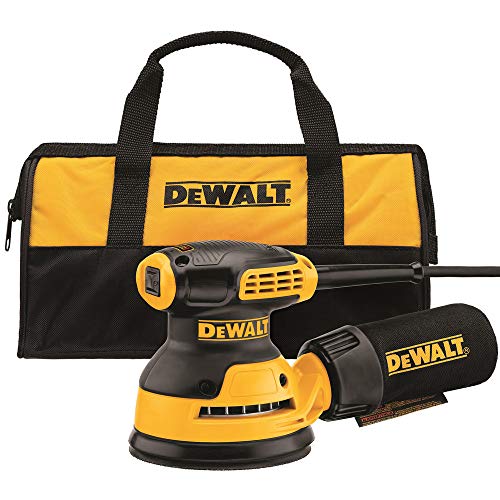
The DWE6421K trades the variable-speed dial of its DWE6423 sibling for a fixed 12,000 OPM and a more approachable price. For someone new to refinishing, that single-speed approach removes a layer of guesswork, since the tool always runs at the speed the manufacturer dialed in for general sanding. The 3-amp motor still pulls its weight through latex paint and old polyurethane when you keep the pad flat and moving.
It comes as a kit, so the box includes a dust bag and a hard case, which most first-time refinishers appreciate. Compared with the DWE6423K, you give up the speed dial but save a few dollars and still walk away with a ready-to-go setup.
Notable Upsides
- Hard case and dust bag included, so you can start sanding out of the box
- Counterweight and rubber overmold grip keep hand fatigue manageable
- Hook-and-loop pad makes disc swaps quick during multi-grit work
Trade Offs
- Fixed 12,000 OPM offers no slowdown for soft veneer or heat-sensitive finishes
- Heavier feel than the bare DWE6421 because of the counterweight and full kit body
- Corded only, so the reach is limited to where your extension cord ends
Built With In Mind
First-time furniture refinishers who want a forgiving, kit-ready tool without wrestling with speed settings.
Consider Something Else When
You frequently switch between hard paint removal and delicate veneer work, in which case the variable-speed DWE6423K gives you finer control.
The bare DWE6421 is the no-frills version of the DWE6421K, shipping without the kit extras but keeping the same 3-amp motor and 12,000 OPM output. It’s the pick for refinishers who already own a drawer full of cases and discs, or who only need a sander for the occasional nightstand or picture frame. The short, low-profile housing puts the pad close to the workpiece, so you can sand flush against a chair rail without the body catching.
Against the DWE6423 above, you give up the variable-speed dial and the slightly more modern dust sealing. In return you get a lighter package that’s easier to toss in a closet between projects.
The Value In It
- Same 3-amp motor found in the pricier DEWALT orbit sanders
- Compact housing fits comfortably in smaller hands
- One-handed locking dust bag keeps the tool stable during setup
Soft Spots
- No carrying case or extra accessories included
- Single-speed operation offers no adjustment for delicate veneer work
Right Fit For
Anyone restoring a single piece at a time who already has a basic sanding disc stash and wants a lightweight tool.
Skip It When
You want a complete starter kit, in which case the DWE6421K ships with the dust bag and case ready to go.
The DWE6423K wraps the variable-speed DWE6423 motor in a kit that adds a hard case and dust bag, the configuration most regular refinishers eventually wish they had bought from the start. The 8,000 to 12,000 OPM dial lets you slow the pad on a soft pine tabletop before the grit burns through the early coats, then ramp it back up for stripping an old painted door. The 3-amp motor handles the back-and-forth without slowing the pad.
If the bare DWE6423 above is the workshop workhorse, this kit version is the same tool plus a place to keep it. For someone who sands every other weekend, that’s a meaningful upgrade.
A Favorable Mix
- Variable speed dial covers both paint stripping and finish sanding
- Hard case protects the tool and keeps discs organized in transit
- Low-profile body and counterweight design reduce wrist strain
Small Caveats
- Heavier in the bag than the bare DWE6423, which adds up over a long carry
- Corded, so outdoor refinishing still needs a long extension cord
Feature Card
Who It Suits Best
Refinishers who tackle a few pieces a month and want the variable speed of the DWE6423 with proper storage.
Another Choice May Suit
The Makita BO5041K is worth a look if you prefer a different grip shape or want a variable-speed range that extends down to 4,000 OPM.
Refinishing an Adirondack chair on a back patio, a kitchen table that won’t fit near a wall outlet, or a set of salvaged cabinets in a garage with no power: those are the moments a cordless random-orbit sander earns its place. The DCW210D1 ships with a 2.0Ah 20V MAX battery, charger, and storage bag, so it’s a complete package right out of the box. A brushless motor (a design that uses electronic commutation rather than carbon brushes to reduce wear) helps stretch the runtime and keep the tool cooler on long jobs.
Compared with the corded DWE6423K, you trade the constant wall power for genuine portability. For furniture flips and yard-sale rescues, that’s a fair swap.
The Helpful Details
- Variable speed dial from 8,000 to 12,000 OPM for flexible material control
- Brushless motor extends runtime and reduces internal wear over time
- One-handed locking dust bag keeps the tool steady during setup
- Battery and charger included, so no extra purchases to start sanding
Points To Keep In Mind
- 2.0Ah battery gives shorter runtime than larger packs on heavy paint removal
- Heavier than the corded DEWALT sanders, which adds fatigue on long sessions
- Not ideal as a primary shop sander if you have easy outlet access
Best Suited To
Mobility-first refinishers who already own 20V MAX batteries or who work on outdoor and remote projects.
Reach For A Different Pick When
You mostly refinish pieces at a fixed workbench, since the corded DWE6423K delivers unlimited runtime.
Random-orbit sanders cover flat and gently curved surfaces beautifully, but chair legs, tool handles, and knife edges want a stationary machine. The Greteefor combo pairs a 6-inch grinding wheel with a 2-by-27-inch abrasive belt, so the same bench unit sharpens a chisel and smooths a turned table leg. The 2.5-amp induction motor (a brush-based AC motor built for steady, continuous-duty work) runs at 3,600 RPM, which suits light-to-medium grinding and shaping.
This isn’t a replacement for the hand-held sanders above. It’s a companion bench tool for the parts of a refinishing project that need to be held still while the abrasive moves.
Positive Points
- Doubles as a sharpener and a sander in a single bench footprint
- 6-inch grinding wheel handles lawnmower blades and dull chisels
- 2-by-27-inch belt fits long tool handles and turned furniture parts
Worth Bearing In Mind
- Not a finish sander, so it won’t replace a random-orbit tool for tabletops
- Requires a permanent spot on a workbench or sturdy stand
- Emits sparks and dust, so a clear work area and eye protection are essential
Key Specs
Perfect Match For
Home woodworkers who also sharpen tools and want one bench machine to cover both jobs.
Not Your Match When
You need a portable sander for furniture refinishing, in which case the DEWALT DWE6423K stays the right primary tool.
The Makita BO5041K is a long-running favorite among refinishers who value comfort over sheer speed. The 3-amp motor delivers a variable 4,000 to 12,000 OPM range, which is the widest spread on this list and useful when you’re working down to a fine-grit finish on a delicate surface. An ergonomic rubberized palm grip sits naturally in the hand, and the counterbalance design keeps vibration low across long sessions.
Against the DEWALT DWE6423K above, you trade the 8,000 OPM minimum for a 4,000 OPM minimum, which makes a real difference on soft woods. For someone refinishing heirloom pieces, that extra control is often worth the switch.
What Works In Its Favor
- Wide 4,000 to 12,000 OPM range covers coarse to fine sanding
- Rubberized palm grip and handle reduce hand fatigue on long refinishing days
- Counterbalance system lowers vibration transfer to the wrist
Honest Caveats
- Corded only, so reach depends on extension cord length
- Heavier than the bare DEWALT options, which can tire smaller hands
Who Should Grab It
Refinishers tackling long sessions on heirloom furniture who want the lowest comfortable vibration level and the widest speed range.
A Better Fit Elsewhere
The DEWALT DWE6423K makes more sense if you already run other 20V MAX or DEWALT corded tools and want brand continuity.
For a shop that needs serious metalworking alongside wood refinishing, the Greteefor 6-inch variable-speed bench grinder pulls double duty. The 2.5-amp brushless induction motor runs from 1,725 to 3,450 RPM, which is slower than a typical grinder and far better for tool sharpening and precision grinding. A cast-iron base keeps the unit planted on the bench, and an LED work light plus eye shields make detail work safer and easier to see.
Like the combo tool above, this is a stationary partner to a random-orbit sander, not a substitute for one. Where it pulls ahead is build quality and the variable-speed range, which is wider than most bench grinders offer.
The Upside
- Variable 1,725 to 3,450 RPM covers sharpening and grinding in one tool
- Brushless motor runs cooler and lasts longer than brushed equivalents
- LED work light and eye shields improve visibility and safety on detail work
- Cast-iron base reduces walking and vibration on the bench
Possible Compromises
- Takes up permanent bench space, which is tough in small apartments
- Not a finish sander, so a random-orbit tool is still needed for flat work
- Heavier than handheld options, so it isn’t portable between job sites
Quick Facts
Made For
Shop owners and serious hobbyists who want a stationary grinder that pairs with a handheld sander for full refinishing setups.
Swap It Out When
You mostly refinish flat tabletops, since the DEWALT DWE6423K covers that work in a far more portable package.
What To Weigh Before Choosing a Wood Sander
Choosing a sander for refinishing wood comes down to matching the tool to the work, not picking the one with the most features. The most useful starting point is the size and shape of the pieces you refinish, since that determines whether a 5-inch random-orbit sander covers your needs or whether you also need a stationary belt or grinder.
For most furniture work, a 5-inch random-orbit sander is the right starting point. The 5-inch pad hits a balance between coverage on broad surfaces and control in tighter spots like chair spindles and table aprons. Smaller pads (often 3 or 4 inches) get into corners better but slow you down on tabletops, while larger 6-inch pads cover more area but feel unwieldy on smaller pieces. If you mostly refinish chairs, cabinets, and side tables, 5 inches is the practical sweet spot.
Speed range matters more than peak speed. The OPM (orbits per minute) rating tells you how fast the pad moves, but the range matters more for refinishing. Variable-speed sanders let you slow the pad on soft woods like pine to avoid burning through early finish coats, and ramp up to strip thick paint from hardwood. Fixed-speed tools are simpler but offer no adjustment when you switch between materials. For refinishing specifically, a wider range is more useful than a higher top speed.
Corded or cordless depends on your work location. Corded sanders run indefinitely and tend to weigh less for the same power, which makes them the right choice at a fixed workbench. Cordless sanders, like the DEWALT 20V MAX model above, free you to work in the yard, garage, or anywhere without a convenient outlet, in exchange for managing battery runtime. If you already own batteries in a particular platform, that often tips the choice.
Dust collection keeps both your shop and your finish clean. Most 5-inch random-orbit sanders include a one-handed dust bag, and many accept a vacuum hose. On a refinishing project that produces fine finish dust, a vacuum hookup makes a meaningful difference in what you can see and breathe. Bags are fine for short sessions, but for a full day of stripping, plan on hooking up a shop vac.
Smart Angles Before You Commit
Common Buying Slip Ups
One trap refinishers fall into is buying the cheapest random-orbit sander they find, then discovering it lacks variable speed the first time they sand a softwood tabletop. A wider OPM range pays for itself the moment you switch from stripping paint to sanding bare wood. Another common miss is forgetting about dust collection: a dust bag fills within minutes on big projects, and the difference between a clean shop and a coated one comes down to a vacuum hookup. Plan for that accessory from day one rather than discovering it mid-project.
Where The Extra Money Goes
Higher-tier sanders earn their cost through a brushless motor, a wider speed range, and better vibration control. A brushless motor lasts longer and sips battery power, which matters most for cordless tools. A wider speed range, like the 4,000 OPM minimum on the Makita above, lets you slow the pad on delicate work. And lower vibration translates directly to less hand fatigue across a full refinishing day. None of these features matter on a single weekend project, but they add up fast if you refinish furniture regularly.
Frequently Asked Questions
What speed should I use for sanding bare wood versus stripping paint?
For stripping paint or varnish, run the sander at the higher end of its OPM range, typically 10,000 to 12,000 OPM, and use a coarser 60 to 80 grit disc. For sanding bare wood before staining, drop to the lower end of the range and step up through finer grits (120, 150, 220) to avoid scratching the surface.
Can a 5-inch random-orbit sander handle large tabletops?
Yes, a 5-inch pad covers a dining table efficiently as long as you keep the pad flat and moving in overlapping passes. For very large surfaces like full plywood sheets, a larger 6-inch pad saves time, but for furniture-scale work, 5 inches is plenty.
Do I need a cordless sander if I have a garage with power?
Corded sanders deliver unlimited runtime and tend to weigh less, which makes them the right pick for stationary bench work. A cordless model earns its place when you refinish pieces away from an outlet, like patio furniture, salvaged finds, or detached garage projects.
How often should I replace the sanding disc on a refinishing project?
Replace the disc as soon as the abrasive looks shiny or stops cutting cleanly, typically every 15 to 30 minutes on paint removal, and less often on finish sanding. A worn disc generates heat, leaves swirl marks, and forces you to press harder, which can damage the workpiece.
Is a bench grinder useful for furniture refinishing?
A bench grinder is more useful for sharpening chisels, plane blades, and other tools you use during refinishing rather than for sanding the wood itself. Random-orbit sanders handle flat and curved wood surfaces far better, while a grinder earns its bench space for tool maintenance.




