


Spend a Saturday sanding a tabletop without dust extraction and you’ll understand the appeal fast. A fine cloud of particles settles on every nearby surface, lungs protest, and cleanup eats the time you wanted to save. Sanders with vacuum attachment solve that by pulling debris straight from the pad into a bag or canister, or routing it to a shop vac. The shortlist below covers palm, random-orbit, and detail sanders from SKIL, DEWALT, and Makita, each engineered to keep your workspace and lungs cleaner while you work.
How The Shortlist Stacks Up

SKIL 2.0 Amp 1/4 Sheet Palm Sander 7292-02

DEWALT DWE6423 5-Inch Random Orbit Sander
DEWALT DWE6421K 5-Inch Random Orbit Sander Kit

DEWALT DWE6421 5-Inch Random Orbit Sander

DEWALT DWE6423K 5-Inch Variable Speed Kit

Makita XOB01Z 18V Cordless Random Orbit Sander

Makita BO5041K 5-Inch Random Orbit Sander

SKIL SR211601 5-Inch Random Orbital Sander
SKIL SR232301 Multi-Function Detail Sander
A Deeper Look At The Lineup
Quarter-sheet palm sanders earn their keep on small trim, doors, and craft pieces where a five-inch pad feels clumsy. The SKIL 7292-02 leans into that niche with a pressure control feature that flags you when you lean too hard, a common beginner mistake that kills swirl-free finishes. A clear-view dust canister shows when to empty it, and the built-in vacuum adapter lets you route debris straight to a shop vac for heavier sessions.
For a first-time sander, the soft-grip body and featherlight 2.0-amp motor feel approachable rather than industrial. You won’t strip paint off a deck in minutes, but for sanding a picture frame or refinishing a drawer front, it does the job without a steep learning curve. The 1/4 sheet design means standard pre-cut sheets snap on without hook-and-loop fuss.
Strong Points
- Pressure control signal helps new users avoid gouging soft wood
- Transparent dust canister removes guesswork on emptying timing
- Vacuum adapter port turns the included canister into an optional exhaust
- Compact body fits into tight spots where random-orbit pads can’t reach
Worth Noting
- 2.0-amp motor bogs down on heavy stock removal compared to larger random-orbit models
- Quarter-sheet format means more sheet changes on big panels
- Owners commonly report the dust canister seals need occasional cleaning to stay airtight
Quick Facts
Who It Suits Best
Newcomers tackling small trim, craft builds, and furniture touch-ups who want a forgiving first sander.
Consider Something Else When
Refinishing full tabletops calls for the DEWALT DWE6421, whose five-inch random-orbit pad covers more ground per pass.
Variable-speed random orbit sanders earn their price tag when you bounce between paint removal, bare wood, and finish sanding in a single afternoon. The DEWALT DWE6423 covers that range with a 3-amp motor turning between 8,000 and 12,000 OPM, which means you can dial aggression down for delicate veneers and crank it back up for leveling a slab. Its hook-and-loop pad swaps abrasive discs in seconds, and a rubber overmold grip takes the edge off vibration.
Compared to the SKIL 7292-02 we covered above, this is a step up in both power and pad size, trading precision for coverage. The low-profile body sits close to the work surface, so you get a clear sightline to edges, and a separate counterweight reduces the hand fatigue that plagues cheaper orbital sanders. Owners commonly appreciate how the included dust port accepts both the stock bag and standard shop-vac hoses.
The Upside
- Adjustable OPM range handles everything from rough stripping to finish passes
- Counterweight design cuts vibration during long sessions
- Hook-and-loop pad changes abrasive discs in one motion
- Compatible with standard shop-vac hoses for cleaner extraction
Trade Offs
- Variable-speed dial adds cost over single-speed models like the DWE6421K
- 5-inch pad is overkill for narrow trim work where the SKIL 7292-02 shines
- Corded design limits reach to wherever an outlet and extension can stretch
Right Fit For
Woodworkers juggling paint, stain, and bare wood on the same project who want one sander that adapts to each stage.
Skip It When
Working far from an outlet in a garage or yard calls for the Makita XOB01Z, which trades corded power for genuine battery mobility.
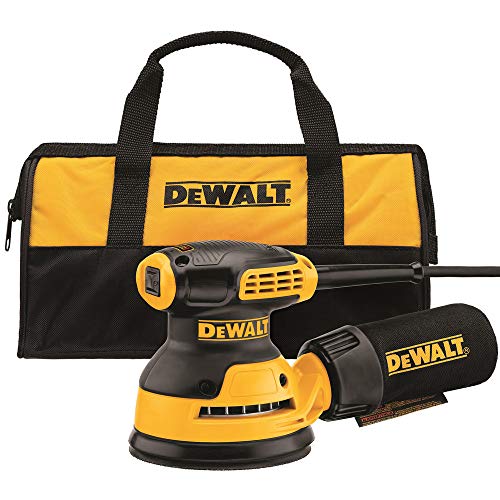
The DWE6421K strips out the variable-speed dial and ships as a complete kit with dust bag and sanding discs, making it a sensible middle ground for hobbyists who don’t need fine-tuned OPM control. Its 3-amp motor pushes a fixed 12,000 OPM through a hook-and-loop pad, which is plenty for most furniture refinishing, cabinet prep, and final-pass sanding before stain or paint.
What you gain is straightforward operation, fewer parts to fumble with, and a slightly lower price than the DWE6423 above. The shorter body design helps you get close to vertical surfaces, and the one-handed locking dust bag clicks on without fuss. For a workshop where 12,000 OPM handles nearly everything, the missing speed dial rarely feels like a real loss.
What Pays Off
- Single-speed simplicity removes dial confusion for newer users
- Kit format includes the dust bag, so you can start collecting debris immediately
- Compact body geometry makes overhead and vertical sanding less awkward
- Locking dust bag stays attached during pad changes
Some Limits To Know
- Fixed 12,000 OPM can’t slow down for heat-sensitive finishes or thin veneers
- Kit packaging adds bulk if you only need the bare tool
Made For
First-time orbital sander owners working on furniture, cabinets, and trim who want a turnkey kit rather than separate accessories.
Another Choice May Suit
Pros who need speed flexibility for finish-grade work should look at the DEWALT DWE6423K, which adds the variable-speed dial back in.
The bare-tool version of the DWE6421K drops the kit extras and ships just the sander, which appeals to anyone who already owns dust bags or routes everything through a shop vac. The motor and pad stay identical: 3 amps at 12,000 OPM on a hook-and-loop backing, with a low-profile body that helps on tight interior corners. For a dedicated workshop, it’s the tool-only form most pros actually buy.
You lose the convenience of the included bag, so plan to grab a dust bag or hook this up to a vacuum from day one. The upside is a lower entry cost for people who already have accessories on the shelf, and a slightly tidier unboxing for those keeping their toolbox lean. Versus the DWE6423 above, you trade variable speed for the simpler single-speed workflow.
Positive Points
- Tool-only price lands lower than the full DWE6421K kit
- Compact body keeps your wrist closer to the work surface
- Standard hook-and-loop pad accepts common 5-inch discs
Worth Bearing In Mind
- Dust bag and discs sold separately, so factor those into the budget
- Single-speed limit returns for users who need gentler finishing passes
Best Suited To
Workshop regulars who already own dust collection accessories and want a stripped-down sander at a friendlier price.
Look Elsewhere When
Refinishing projects that demand dust extraction from the first pull call for the SKIL SR211601, which ships with a cyclonic dust box ready to go.
Take the DWE6423 motor and pair it with the kit accessories, and you get the DWE6423K, a variable-speed sander bundled with a dust bag and sanding discs. The 3-amp motor sweeps between 8,000 and 12,000 OPM, and a separate counterweight keeps vibration manageable when you spend an evening leveling a tabletop. The kit framing makes it a natural upgrade path from the DWE6421K for anyone who later realizes they want speed control.
For a hobbyist finishing cabinets or refinishing a dining table, the variable-speed dial earns its keep on the final passes, where slowing the orbit down helps avoid burning through thin veneer. The dust bag locks on with one hand, so swapping accessories mid-project stays painless. You pay a little more than the bare-tool DWE6423, but the bundle removes the guesswork of matching the right bag to the sander.
Reasons It Performs
- Variable-speed range supports both rough leveling and final finishing
- Counterweight design keeps hands steady across extended sessions
- Kit includes the matched dust bag and starter discs
- Rubber overmold grip reduces fatigue on vertical surfaces
Possible Compromises
- Heavier price tag than the single-speed DWE6421K
- Corded setup means you still need extension cord access
Feature Snapshot
Who Should Grab It
Refinishers ready to step up from a single-speed sander and want the matched accessories included from the start.
Swap It Out When
Battery-only workshops without easy outlet access should consider the Makita XOB01Z, which trades the cord for an 18V platform.
Job sites, barn workshops, and second-floor bedrooms rarely have outlets where you actually need the sander. The Makita XOB01Z runs on the 18V LXT battery platform, which means if you already own Makita drills or impacts, the same batteries power this tool. Three speed settings cover 7,000, 9,500, and 11,000 OPM, and the tool-only listing lets you skip the battery cost when you already have a charger on the bench.
Where the DEWALT DWE6423K we just looked at relies on extension cords, this one gives you about 40 minutes of run time per charge, enough for most furniture pieces before swapping packs. Ergonomics lean toward long sessions, with a rubberized grip that stays comfortable overhead. Owners commonly report that pairing it with a small cordless vacuum for dust extraction completes a fully untethered workflow.
What Works In Its Favor
- Cordless freedom opens up remote jobs and yard workshops
- Three speed settings match the orbit to the material
- Compatible with existing Makita 18V LXT batteries and chargers
- Compact tool body balances well for overhead work
Soft Spots
- Battery and charger sold separately, raising the total cost for new users
- 40-minute runtime may interrupt larger refinishing projects
- Slightly less torque than corded 3-amp competitors on heavy stock removal
Perfect Match For
Makita ecosystem owners and anyone working in locations where running an extension cord isn’t realistic.
Where Another Pick Shines
Users with a permanent bench outlet who need raw power for full-day sessions should reach for the DEWALT DWE6423K instead.
The BO5041K earns its place when finish quality matters more than convenience extras. A 3-amp motor drives a variable-speed dial from 4,000 to 12,000 OPM, the widest range in this lineup, which gives precise control when sanding between finish coats or polishing out a final surface. The rubberized palm grip and handle design feel natural during the long, slow passes that define fine finishing work.
Compared to the DEWALT DWE6423K, the lower end of Makita’s OPM range opens up sanding possibilities on heat-sensitive surfaces, where high-speed friction can scorch or gum up the abrasive. Owners commonly report that the smoothest paint jobs they’ve produced came from this tool running at its lowest setting on the final pass. The kit ships with a hard case, dust bag, and a stack of discs, so the unboxing is project-ready.
A Favorable Mix
- 4,000 to 12,000 OPM range covers rough work to delicate finishing
- Rubberized palm grip and rear handle reduce hand fatigue
- Hard case included for storage between projects
- Smooth low-speed performance avoids burning through thin finishes
Things To Weigh
- Heavier than smaller palm-style sanders like the SKIL 7292-02
- Corded only, so reach depends on extension cord length
Who Will Love This
Detail-oriented finishers working on heirloom furniture, musical instruments, or restoration projects where surface quality is non-negotiable.
Not Your Match When
Quick trim work and small repairs fit the SKIL 7292-02 better, with its lighter body and pressure-sensing feedback.
Cyclonic dust collection separates debris by spinning it inside a sealed chamber, which keeps the filter clear far longer than passive bags. The SKIL SR211601 leans into that idea with a built-in X-Flow dust box that you can empty, rinse, and reinstall without buying replacement bags. For an apartment workshop or a finished basement where dust fallout causes real problems, that built-in solution is the main selling point.
The motor sweeps 7,000 to 13,000 OPM through a 5-inch hook-and-loop pad, and vibration control keeps the body steady when you push the speed up. Owners commonly report using it indoors without trailing dust across the house, which is a real lifestyle change for hobbyists sharing space with a kitchen or living area. The package includes three sanding sheets, so the unboxing jumps straight to the first project.
Useful Strengths
- Cyclonic dust box cuts down on replacement bag costs
- Wide 7,000 to 13,000 OPM range handles varied materials
- Vibration control reduces fatigue during longer sessions
- Rinseable dust chamber simplifies routine maintenance
Honest Caveats
- Cyclonic box adds bulk compared to a slim dust port
- Variable-speed dial sits at the rear and may need two hands to adjust mid-pass
Feature Snapshot
Built With In Mind
Apartment and shared-space hobbyists who need genuine dust containment without routing to a shop vac.
Reach For A Different Pick When
Hardcore production sanding in a dedicated shop calls for the Makita BO5041K, whose lower-end speed range handles delicate finishing work.
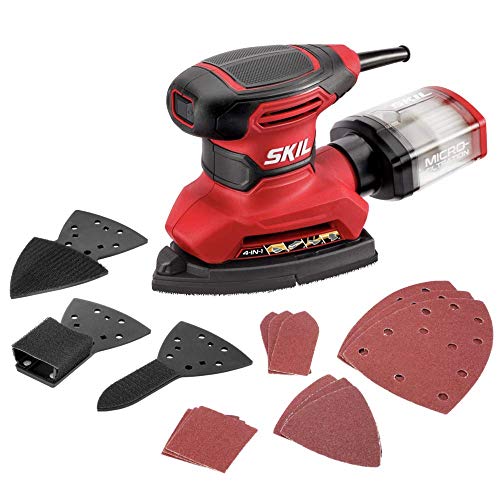
Detail sanders, also called mouse sanders, take over where round pads can’t reach: window mullions, louvered shutters, tight inside corners. The SKIL SR232301 ships with three interchangeable profile attachments that swap in without tools, plus a 1-1/4 inch dust port that accepts either the included micro-filter box or a vacuum hose. The 1.2-amp motor pushes 13,500 OPM, which sounds small but is plenty for the precision work this format exists to handle.
You won’t level a slab with it, and that’s the point. Where the DEWALT DWE6421 we covered earlier dominates flat surfaces, this one slips into the geometry that round pads skip. Twelve sanding sheets come in the box, covering the immediate range of grits a restoration project usually wants. For furniture repair, shutter refinishing, and detail prep before painting trim, it handles the awkward parts of a project that big sanders leave undone.
Practical Advantages
- Four-in-one design with swappable profile pads for varied contours
- Tool-free attachment changes speed up mid-project swaps
- 1-1/4 inch dust port accepts vacuum hose or micro-filter box
- 13,500 OPM gives a smooth cut on fine detail work
Points To Keep In Mind
- Small triangular pad covers far less area than a 5-inch random orbit
- Lower 1.2-amp motor struggles on heavy paint or thick finish layers
- Not a replacement for a primary sander, more a specialty companion
Whose Shelf It Belongs On
Restorers and trim painters who already own a primary sander and need a dedicated tool for corners, profiles, and louvered surfaces.
Where A Sibling Pick Shines
Big flat panels and furniture faces go much faster with the DEWALT DWE6421K, which is the better primary sander to pair alongside this one.
What To Think Through Before Choosing A Dust-Collecting Sander
Match The Pad To The Project
A sander’s pad geometry shapes what it can actually do. Random-orbit sanders with five-inch hook-and-loop pads cover flat furniture faces, tabletops, and cabinet panels efficiently. Quarter-sheet palm sanders like the SKIL 7292-02 work better on narrow trim and craft pieces, where their small footprint reaches into spots a round pad can’t. Detail sanders with triangular or profile attachments cover the gaps between, sliding into corners, louvers, and tight curves that round pads skip.
For a first sander, a five-inch random-orbit model earns its keep across the widest range of projects. Add a detail sander later if your work trends toward restoration or trim.
Vacuum Port Versus Built-In Canister
Every sander in this list supports dust extraction, but how they handle it differs. Most corded random-orbit models include a one-handed locking dust bag and a vacuum port that accepts standard shop-vac hoses. The bag keeps things self-contained for short sessions, while a shop vac handles longer projects without frequent emptying. The SKIL SR211601 takes a different path with a cyclonic dust box that separates debris for reuse, eliminating bag replacements entirely.
Hobbyists working indoors tend to appreciate the cyclonic approach. Dedicated workshop users with a shop vac on hand can skip the bag altogether.
Corded Power Versus Cordless Freedom
Corded sanders deliver consistent torque across long sessions, which matters when stripping paint or leveling slabs. Cordless sanders like the Makita XOB01Z trade that consistency for the freedom to work anywhere, but they need charged batteries and time between pack swaps. If your projects live near an outlet, corded models remain the practical default. Job sites, outbuildings, and room-to-room refinishing jobs benefit from going cordless.
For mixed use, a corded primary sander paired with a cordless detail sander covers nearly every scenario without compromises.
Smart Considerations Before You Pull The Trigger
Pitfalls Shoppers Hit
Buying a sander with a dust port but skipping the actual shop vac leaves you emptying the included bag every few minutes, which defeats the convenience. Plan for either a vacuum or a model with a self-contained cyclonic system. Another common slip is choosing a five-inch random-orbit sander for narrow trim, where a quarter-sheet palm sander actually finishes faster. Match the tool geometry to your most common project, not the average project.
Where The Extra Money Goes
Higher-tier sanders in this category earn their price through variable-speed dials, counterweight vibration control, and rubber overmold grips. Those features show up during long sessions, where hand fatigue and heat buildup slow you down. A casual hobbyist finishing a few projects a year may not feel the difference, while someone sanding multiple pieces each month notices immediately. The upgrade pays off when session length grows and finish quality matters, which is the natural arc of most sanding hobbies.




