A drywall saw is one of those tools you don’t think about until you need it. Punch a hole for an electrical box, slice out a section of damaged sheetrock, or open a wall for a plumbing fix, and the right jab saw makes the difference between a clean opening and a ragged mess. The picks below cover folding jab saws, multi-blade hand saw kits, and compact hacksaws, so the right tool matches the right job.
The Lineup, Simplified

KATA Folding Drywall Jab Saw Soft Grip
KATA 5-in-1 Folding Hand Saw with 4 Blades

KATA Folding Drywall Saw with Sheath

KATA 6 Inch Drywall Saw SK5 Blade
KATA 2-in-1 Folding Hand Saw
KATA 10 Inch Mini Hacksaw 4-Piece Blades

KATA 10 Inch Mini Hacksaw 3PCS Blades

KATA Hand Saw Kit 12″ 10″ 6″ Set

Goldblatt Folding Drywall Saw 5-Inch
Meet The Standout Selections
Cutting an outlet opening in fresh drywall is the kind of job where a cheap saw fights you the whole way. The KATA Folding Drywall Jab Saw keeps things simple: a 65Mn steel blade with 7 TPI (teeth per inch) triple-ground teeth pierces the surface fast, and the folding frame protects the edge when you toss it in a kitchen drawer between projects.
The soft-grip handle keeps your hand comfortable across a day of patch work. Compared with the KATA 6-Inch jab saw below, this one runs a longer blade that reaches deeper into wall cavities, which is handy when an opening sits behind a stud.
A Strong Showing
- Pointed tip starts cuts without a pilot hole, saving time on outlet boxes.
- 65Mn steel construction holds an edge through repeated sheetrock passes.
- Soft-grip handle reduces fatigue during longer patching sessions.
- Folding frame protects pockets and tool bags during transport.
Points To Keep In Mind
- Aggressive teeth can wander if you push too hard, so a steady hand helps on visible cuts.
- Single blade limits you to rougher sheetrock work, not finish cuts on thin trim.
- Wipe the blade dry after wet jobs to slow surface rust on the steel.
Who Will Love This
Homeowners tackling patch jobs, outlet cutouts, and small plumbing access panels benefit most from this lightweight starter saw.
Skip It When
The KATA 5-in-1 Folding Hand Saw suits you better when your projects span drywall, wood, plastic, and light metal in the same weekend.
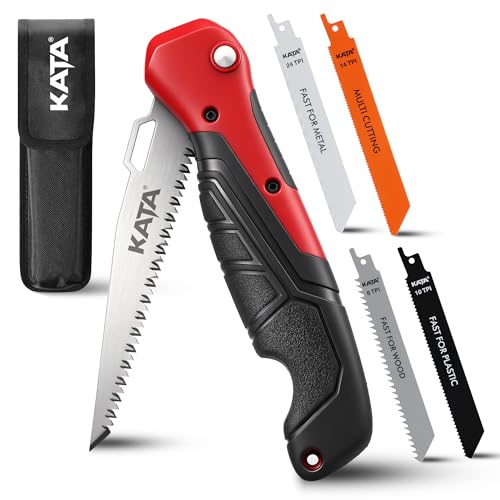
Rummaging through a junk drawer for the right blade gets old fast. The KATA 5-in-1 ships with an 8 TPI aggressive blade installed plus four spares: 6 TPI for fast wood, 10 TPI for plastic, 14 TPI multi-cut, and 24 TPI fine-tooth for light metal, all packed in a canvas roll that keeps the set organized.
Swapping blades takes only a moment, so a weekend remodeler can move from ripping drywall to trimming PVC pipe without grabbing a second tool. Where the KATA Folding Drywall Jab Saw above focuses on a single job, this kit is built for variety.
What Works In Its Favor
- Five blade profiles cover drywall, wood, plastic, and light metal in one kit.
- Canvas roll keeps every blade accounted for during storage and transport.
- Folding frame protects teeth and your hands when the saw is stowed.
- Higher TPI blades produce cleaner edges on trim and finish work.
Trade Offs
- More parts to keep track of, so misplacing a blade mid-project is a real risk.
- Fine-tooth blades struggle on thick metal stock beyond light-gauge work.
- Folding frame adds bulk versus a fixed drywall saw, depending on your grip style.
Right Fit For
Renters, hobbyists, and homeowners juggling mixed-material projects in a small toolbox benefit most from the all-in-one format.
Look Elsewhere When
The KATA 10 Inch Mini Hacksaw fits better when metal cutting dominates your workflow and a dedicated fine-tooth frame is worth the extra tool.
Repeated cuts in dusty sheetrock punish a blade fast, which is where the KATA Folding Drywall Saw with Sheath pulls ahead. A 65Mn steel core carries a black Teflon coating that resists rust and helps dust slide off rather than building up in the gullets. The included sheath protects the edge when the saw lives in a work truck or job-site bucket.
Versus the entry-level KATA Folding Drywall Jab Saw, this version leans toward users who log hours on real remodels. The folding body also helps when you work overhead in tight ceiling boxes where a fixed saw gets in the way.
What Stands Out
- Teflon-coated surface slows rust and sheds dust during long cutting sessions.
- Sheath protects the edge and the user during storage in shared tool spaces.
- Triple-ground 7 TPI teeth stay sharp across multiple sheetrock sheets.
- Foldable frame reaches into narrow gaps better than rigid jab saws.
A Few Limitations
- Premium coating pushes the price above basic jab saws in the lineup.
- Sheath adds a small step to your workflow every time you grab the tool.
- Still a single-purpose sheetrock blade, not a multi-material system.
Best Suited To
Renovation contractors, handymen, and serious DIYers who cut drywall weekly appreciate the corrosion-resistant finish and protective sheath.
Swap It Out When
The KATA 5-in-1 Folding Hand Saw makes more sense for homeowners who want one tool to span drywall, plastic, and light metal projects.
A 6-inch jab saw is the sweet spot for tight pattern work, and the KATA 6 Inch Drywall Saw fills that role. An SK5 steel blade with 8 TPI triple-ground teeth punches through pumpkin rinds, drywall, and plywood with equal ease, while the short profile lets you steer around stenciled outlines for jack-o’-lanterns.
Where the longer KATA Folding Drywall Jab Saw reaches deep into wall cavities, this compact saw is more about controlled, detail-oriented cuts. Owners commonly keep it on a craft shelf rather than a tool bench for that reason.
Noteworthy Benefits
- SK5 steel stays harder than basic 65Mn for tougher sheetrock and wood cuts.
- Short 6-inch blade is easier to control on stenciled or curved cuts.
- Pointed tip starts cuts without predrilling, handy for pumpkin carving.
- Aggressive 8 TPI tooth pattern clears chips quickly on soft materials.
Honest Caveats
- Short blade limits reach inside deep wall cavities behind studs.
- Not a folding design, so storage demands a sheath or a dedicated slot.
Whose Shelf It Belongs On
Parents carving Halloween pumpkins and crafters working on shaped plywood signs get the most out of this short, agile saw.
Reach For A Different Pick When
The KATA Folding Drywall Saw with Sheath is a smarter choice for anyone cutting full drywall sheets where a longer, protected blade matters more.
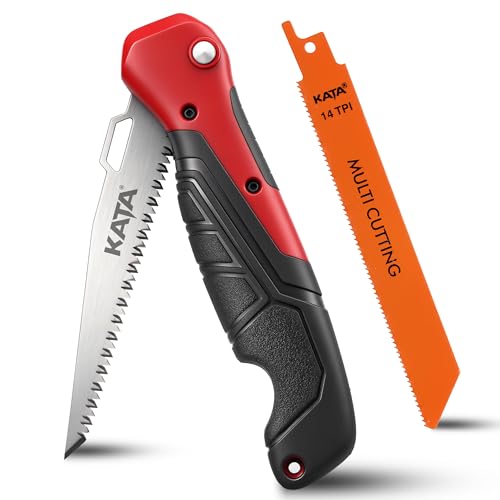
Sometimes two blades are all you really need. The KATA 2-in-1 Folding Hand Saw ships with an aggressive pointed blade for fast drywall and plywood work, plus a 14 TPI blade for cleaner cuts in plastic, wood, and light metal. The folding frame slips into a kitchen drawer next to a tape measure and a screwdriver.
Versus the larger KATA 5-in-1, this stripped-down version trims the kit down for people who don’t want a canvas roll. It’s a tidy middle ground between a single drywall jab saw and a full multi-blade system.
Useful Highlights
- Aggressive pointed blade handles drywall, sheetrock, and plywood cuts.
- 14 TPI spare blade adds controlled cutting for plastic and trim.
- Compact folding body stores easily in a kitchen junk drawer or apartment closet.
Worth Noting
- Only two blades, so heavier metal jobs fall outside the comfort zone.
- Lower TPI on the primary blade leaves rougher edges on finish trim.
Made For
Apartment dwellers and casual DIYers who need one folding tool for the most common household materials will appreciate the minimal kit.
A Better Fit Elsewhere
The KATA 5-in-1 Folding Hand Saw is a stronger match when you want five blade profiles in the same folding package.
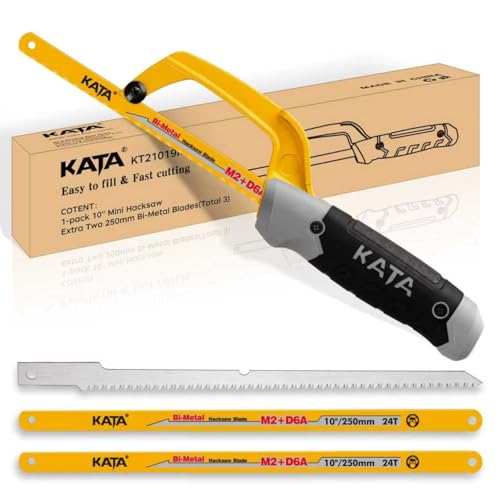
A 10-inch mini hacksaw reaches spots a full-size frame can’t. The KATA Mini Hacksaw runs an aluminum body for lighter handling, ships with a 65Mn wood blade plus three bi-metal spares, and tucks into a drawer between garage sessions. Bi-metal construction bonds high-speed steel teeth to a flexible backing for longer life under hard use.
Versus the drywall-focused picks above, this is a different tool in the same family. A jab saw rips sheetrock; a mini hacksaw handles rods, PVC, and small wood trim when a renovation goes beyond the wall.
Where It Helps
- Compact 10-inch frame reaches into tight spots where full hacksaws fail.
- Four-piece blade set covers metal, wood, and plastic from the same handle.
- Aluminum body keeps weight down on overhead or extended cuts.
- Bi-metal spares last longer than standard carbon blades on hard stock.
Some Limits To Know
- Not the right tool for clean drywall cuts, since hacksaw teeth can chip paper faces.
- Short frame limits how quickly you can make long, straight cuts.
Feature Card
Perfect Match For
Garage tinkerers, hobbyists, and homeowners who trim PVC, copper, and small wood pieces alongside drywall projects.
Where A Sibling Pick Shines
The KATA Folding Drywall Jab Saw is a smarter grab when the work is purely sheetrock and you want a tool that punches through fast.
For purely metal-focused work, a 24 TPI bi-metal blade is the right call. The KATA 10 Inch Mini Hacksaw ships with one installed blade and two flexible bi-metal spares at 24 TPI, which is fine enough for clean cuts on thin metal rods, small bolts, and copper pipe without chewing the edge.
It shares the same compact aluminum frame as the four-piece kit above, but trades the wood blade for a second metal blade. That makes it a cleaner pick when your cuts are mostly ferrous or non-ferrous stock.
Everyday Perks
- 24 TPI bi-metal teeth cut cleanly through rods, bolts, and copper pipe.
- Three included blades keep spare teeth on hand when one dulls mid-job.
- Compact 10-inch frame fits inside a kitchen junk drawer or work apron.
Practical Considerations
- No wood blade, so wood cuts require a swap from another kit.
- 24 TPI blades cut slower on thick stock than coarser-tooth options.
Who Should Grab It
Plumbers, electricians, and homeowners who trim small-diameter metal and PVC around repair projects will find this focused set useful.
Not Your Match When
The KATA 10 Inch Mini Hacksaw 4-Piece Blades fits better when you need both wood and metal coverage from a single frame.
Stocking a tool bench from scratch is a bigger commitment than most people expect. The KATA Hand Saw Kit bundles a 12-inch heavy-duty hacksaw, a 10-inch mini hacksaw, and a 6-inch drywall jab saw in a single purchase, with M2 + D6A bi-metal blades combining high-speed steel teeth with a flexible backing for longer life.
Versus the folding jab saws above, this set adds a full-size hacksaw for long straight cuts on PVC and metal rod. It’s a one-stop answer for someone moving into a first workshop or apartment.
Positive Takeaways
- Three saws cover drywall, metal, and wood in one bundle.
- Bi-metal blades resist wear longer than standard carbon steel.
- Full-size 12-inch hacksaw handles long, straight cuts on pipe and rod.
- Compact 10-inch mini and 6-inch jab saw fill the smaller gaps the big frame can’t.
Factors To Consider
- Three frames take up more shelf space than a single multi-blade folding saw.
- Higher upfront cost than buying one drywall saw at a time.
- Some users may find one frame goes unused depending on their typical projects.
Built With In Mind
New homeowners building a complete tool kit, or anyone setting up a workshop for the first time, gets the most out of this three-saw bundle.
Consider Something Else When
The Goldblatt Folding Drywall Saw is a cleaner single-tool choice when drywall is the primary material and you don’t need a full hacksaw set.
A bi-metal blade on a folding drywall saw is rare at this size, and the Goldblatt Folding Drywall Saw leans into that advantage. The 5-inch bi-metal blade runs 8 TPI with triple-ground teeth that cut in both directions, so every stroke clears material rather than wasting the pull. The folding frame collapses flat for tool belts and pouches.
Where the KATA drywall picks focus on aggressive cuts for repair work, the Goldblatt targets clean edges that finish better with less sanding. For detail-oriented users, the trade-off feels worth it.
The Helpful Details
- Bi-metal blade cuts in both push and pull directions for faster material removal.
- Triple-ground teeth produce cleaner edges on visible drywall cuts.
- Compact 5-inch blade reaches tight outlet box corners.
- Folding frame keeps the edge protected in a tool belt or pouch.
Details To Watch
- Shorter 5-inch blade limits reach on deep wall cavities.
- Bi-metal construction typically costs more than standard carbon blades.
Feature Card
The Right Fit
Finish-oriented drywallers, trim carpenters, and detail-focused DIYers who want clean edges and a folding frame benefit most from this saw.
Where Another Pick Suits Better
The KATA 6 Inch Drywall Saw is a stronger fit for shorter, more aggressive cuts where control matters more than bi-metal longevity.
Choosing The Right Drywall Saw For Your Project
A jab saw looks like a simple tool until you stand in the hardware aisle comparing options. Blade material, tooth count, and frame design all change how a saw feels in your hand, and matching the tool to the job saves time on every cut.
Blade Tooth Count And Cut Speed
Tooth count, measured in TPI (teeth per inch), shapes how a saw cuts. Lower TPI blades, around 6 to 8, slice through sheetrock and soft wood faster because each tooth removes more material per stroke. Higher TPI blades, from 14 to 24, produce cleaner edges on plastic and metal but cut slower.
Drywall-focused saws typically run 7 to 8 TPI, which balances speed and control. For finish cuts on visible drywall, lean toward a bi-metal blade with triple-ground teeth, since those hold an edge longer than standard carbon steel.
Frame Design And Storage
A folding frame protects the blade tip and your tool bag, but it adds a hinge that can loosen over years of use. Fixed-frame jab saws feel sturdier in the hand but demand a sheath or a dedicated drawer slot.
Folding designs also work better in cramped ceiling boxes where a full-length saw catches on framing. For jobs that involve both tight corners and long cuts, a kit that pairs a folding jab saw with a full hacksaw, like the KATA Hand Saw Kit 12″ 10″ 6″ Set, covers both ends of the spectrum.
Material Range And Blade Swaps
A single drywall saw handles one job well. If your projects cross into PVC, copper, or plywood, a multi-blade folding saw such as the KATA 5-in-1 Folding Hand Saw lets you swap profiles in seconds. Look for kits that include a canvas roll or pouch, since loose blades tend to disappear from job sites faster than expected.
Bi-metal blades cost more up front, but they last noticeably longer on metal and resist tooth chipping on hidden nails or screws behind drywall.
What Most Shoppers Overlook
Where Shoppers Go Wrong
Picking the cheapest drywall saw often backfires on the second or third project, when aggressive teeth start wandering and the blade refuses to hold an edge. Material matters too: a 24 TPI fine-tooth blade looks premium, but on half-inch drywall it simply chews dust without cutting clean lines. Match the TPI to the material rather than reaching for the highest count on the shelf.
When Paying More Pays Off
Higher-tier drywall saws earn their price through bi-metal construction, harder steel like SK5, and protective coatings such as Teflon that slow rust. The Goldblatt Folding Drywall Saw is a good example: the bi-metal blade costs more than a basic carbon-steel jab saw, but it cuts in both directions, holds an edge across multiple sheets, and folds into a tool belt. For anyone cutting drywall weekly, the upgrade pays for itself in fewer blade swaps and cleaner finish work.
Frequently Asked Questions
What TPI works best for cutting drywall?
For standard half-inch drywall, 7 to 8 TPI is the sweet spot. Lower counts cut faster but leave rougher edges, while higher TPI blades cut too slowly on gypsum and paper facing.
Can a drywall saw cut other materials?
Yes, with the right blade. A jab saw handles drywall, plywood, and soft wood. For plastic, PVC, or light metal, swap to a higher TPI blade or use a mini hacksaw from the same kit.
Why pick a folding drywall saw?
Folding designs protect the tip and your tool bag during transport, and they fit better in tight ceiling boxes where a fixed saw catches on framing. The trade-off is a hinge that can wear over years of heavy use.
How long does a drywall saw blade last?
A basic carbon-steel blade dulls after a few full sheets, while a bi-metal blade with triple-ground teeth can handle dozens of sheets before needing replacement. Storing the blade dry and clean extends its life.
Are jab saws safer than power saws for small drywall cuts?
Jab saws give you more control on small openings like outlet boxes and patch repairs, and they produce less airborne dust than a powered rotary tool. For long, straight cuts across full sheets, a utility knife scores the line cleanly and a jab saw finishes the cut.