


A blunt pair of kitchen shears ruins prep work, slips on food, and turns a five-minute job into ten. Whether you’re slicing herbs, trimming packaging, or maintaining a workshop bench, a decent sharpener restores that clean bite in seconds. The challenge is sorting through dozens of designs: pull-through electrics, handheld rods, bench stones, and travel-friendly pocket tools all promise different things.
This roundup focuses on gear that lives in the kitchen or workshop, scissor-friendly and knife-capable, and built for everyday households. You’ll find countertop electric sharpeners for hands-off maintenance, compact manual pulls for tight drawers, and portable kits for the field. The goal is simple, to help you match the right machine to the way you actually cut, not to sell you on a single “best” answer.
The Shortlist At A Glance
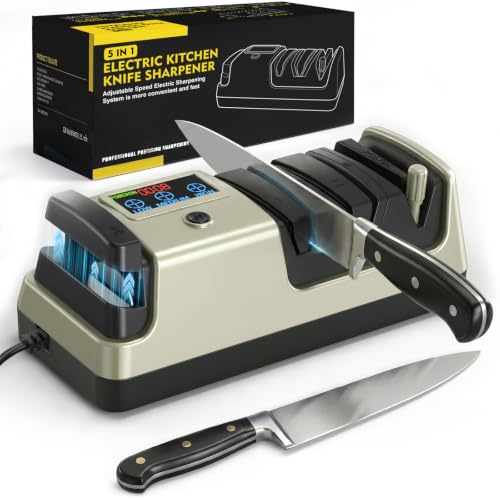
Newise Electric Knife Sharpener 3-Stage (Light Gold)

AccuSharp Knife Sharpener (White)

Newise Electric Knife Sharpener 3-Stage (Silver)

Newise Electric Knife Sharpener 3-Stage (Black)

AccuSharp Pocket Stone Sharpener with Pouch

Work Sharp Guided Field Sharpener

Newise Electric Knife Sharpener 3-Stage (Grey)
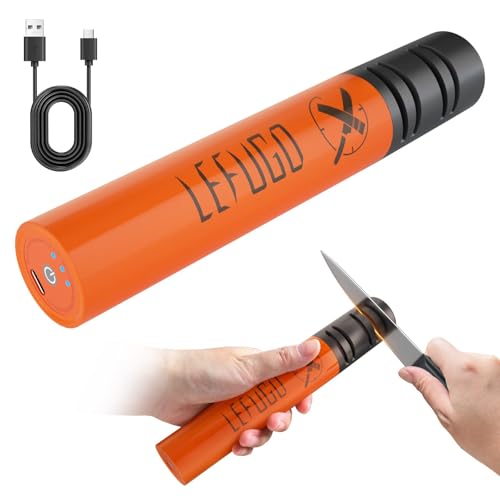
Cordless Electric Knife Sharpener 3-Speed 7000RPM

Newise Electric Knife Sharpener 3-Stage (White)
Why These Options Stand Out
The Newise 3-Stage in light gold earns its top spot because it balances ease-of-use with genuine multi-stage refinement. The slots walk a blade from coarse reshaping through fine honing, so a neglected chef’s knife doesn’t need a separate stone session. For households with a mixed blade drawer (chef’s, paring, serrated, and the occasional pair of kitchen shears), that one-device approach removes the usual friction.
At roughly the size of a small toaster, it tucks into a corner or a deep drawer without dominating the counter. In everyday use, you press a button, draw the blade through three or four times per stage, and you’re done. The light gold finish is the kind of detail that matters more than it should, since you’ll be looking at it every morning.
What It Does Well
- Three progressive stages reshape and polish in one pass, saving you from buying a separate honing rod.
- Compatible with common kitchen blade types, so you won’t need a second tool for serrated edges or shears.
- The light gold housing hides minor smudges better than silver or white finishes in busy kitchens.
- Pull-through design reduces the learning curve for anyone who has never sharpened a knife by hand.
Things To Consider
- Heads out of stock more often than the plain silver variant, so backup timing matters.
- Harder to deep-clean than a simple manual sharpener, since internal slots collect metal dust over time.
Key Specs
Right Fit For
Busy home cooks who want consistent edges on a full drawer of mixed blades without learning freehand technique.
Skip It When
You need to maintain a hunting or fishing kit on the go, since the Work Sharp Guided Field Sharpener is built for that exact scenario.
The AccuSharp pull-through is the kind of tool you forget about until you need it, then wonder how you lived without it. Where the Newise electric relies on a motor, this little handheld unit runs on nothing but a few firm strokes across a tungsten carbide slot. The ergonomic handle does the heavy lifting, so a tired grip or arthritic hand can still get a clean pass.
It works on both straight and serrated blades, which is unusual for a manual at this size. For a quick midweek touch-up before slicing tomatoes, this is the right tool. The Newise unit above gives you more stages, but the AccuSharp gives you zero setup time and a footprint that fits in a junk drawer.
Noteworthy Benefits
- No electricity or batteries, so it works at the grill, the picnic table, or a camp stove.
- Single-stroke operation means even first-timers can get a usable edge in seconds.
- Tungsten carbide heads stay sharp across years of regular kitchen use.
- Compact enough to store in a drawer rather than dedicating counter space.
Points To Note
- One-stage design means it can refresh an edge but not fully reshape a badly damaged blade.
- Replaceable sharpening heads are sold separately, adding long-term maintenance cost.
Best Suited To
Renters, small kitchens, and anyone who wants a grab-and-go tool rather than a countertop appliance.
Reach For A Different Pick When
You want a hands-free electric workflow, since the Newise Electric Knife Sharpener in light gold handles that with guided stages.
The silver version of the Newise 3-Stage shares every functional spec with the light gold model but trades warmth for neutrality. In a kitchen full of stainless steel appliances, that matters. The matching tone keeps the unit looking like it belongs rather than an accent piece that fights the rest of the lineup.
Internally, you still get the same three-stage progression from coarse repair to fine polish, and the slot geometry handles kitchen shears alongside standard chef’s and paring blades. Owners of stainless kitchens who skipped the gold finish for aesthetic reasons will find this the easy compromise.
Strengths Worth Knowing
- Matches common stainless steel appliance finishes for a cohesive counter look.
- Three-stage progression handles everyday dullness and light nicks alike.
- Guided slots enforce a consistent angle across the entire blade.
Room For Improvement
- Silver finish shows fingerprints more readily than the gold or black variants.
- Identical performance to siblings means your choice here is mostly cosmetic.
Made For
Anyone designing a stainless-heavy kitchen where appliance-matching matters as much as function.
Where Another Pick Suits Better
Travelers and field users get more value from the AccuSharp Pocket Stone Sharpener, which slips into a pack and runs without power.
Black is the most forgiving finish in the Newise lineup, and on a busy counter, that translates to less wiping. The matte housing hides smudges, water spots, and the faint metal dust that builds up after months of regular sharpening. If you keep appliances plugged in permanently, this is the variant you’ll rarely need to clean.
Performance mirrors the silver and gold siblings exactly: three progressive stages, electric pull-through, broad blade compatibility. The honest read is that you’re choosing aesthetics and maintenance frequency here, not a different sharpening experience. For dark granite, slate, or matte-black kitchens, the visual fit alone justifies the pick.
Where It Helps
- Black finish conceals fingerprints and minor surface dust between cleanings.
- Same three-stage sharpening as siblings, so no functional compromise.
- Guided slots prevent the angle drift common with freehand stones.
Honest Caveats
- Harder to spot chips or damage on the dark housing during routine inspection.
- Not a separate model from the silver and gold units, so value depends on your aesthetic priorities.
Who It Suits Best
Owners of dark-counter kitchens who want a low-maintenance sharpener that disappears into the background.
A Better Fit Elsewhere
Mobile users and RVers get more flexibility from the Cordless Electric Knife Sharpener, which untethers you from a wall outlet.
Stepping away from electrics entirely, the AccuSharp Pocket Stone is a 3-inch dual-sided sharpening stone in a protective pouch. One side handles aggressive repair work, the other polishes the edge to a clean finish. The included pouch is the real selling point for travelers: it keeps the stone dry, prevents grit from grinding against other gear, and slips into a backpack pocket or glove box.
Unlike the Newise electrics earlier in this roundup, a stone rewards practice. Your first few passes may feel slow, but you gain the ability to set a custom angle for specialty blades. For fishing hooks, hunting knives, and straight-bladed tools, the learning curve is worth it.
Real Benefits
- No power source, no moving parts, nothing to break in the field.
- Dual grit design covers both rough restoration and fine finishing in one stone.
- Pouch protects gear and lets you toss it in a pack without worrying about scratches.
- Natural Arkansas stone material hones edges rather than grinding them away.
Practical Considerations
- Requires freehand skill, so expect a learning period if you’ve only used guided sharpeners.
- Slower than electric options for full blade restoration on kitchen knives.
Feature Snapshot
Whose Shelf It Belongs On
Campers, anglers, and preppers who want a low-tech, durable tool that works anywhere without batteries.
Look Elsewhere When
Your primary need is fast kitchen-knife maintenance, since the Newise Electric Sharpener handles that in seconds per pass.
The Work Sharp Guided Field Sharpener is the most feature-dense option in the roundup, packing diamond plates, ceramic rods, a leather strop, and sharpening guides into a single block. That density is the point: it covers everything from a chipped hunting blade to a polished EDC (everyday carry) edge in one compact tool. Where the AccuSharp Pocket Stone is simple, this is the workshop-in-your-pocket approach.
The guides lock in consistent angles, so even beginners avoid the tilted-edge mistake common with freehand stones. Diamond plates handle aggressive repair, while the ceramic rod (which rotates to expose coarse and fine surfaces) takes over for finishing. A leather strop at the end removes the last micro-burr.
Everyday Advantages
- Four sharpening surfaces in one tool cover everything from chip repair to final polish.
- Guided angle slots make it approachable for users new to hand sharpening.
- Removable diamond plates expose a broad wrench for field adjustments, a small but useful bonus.
- Compact enough for a range bag, hunting pack, or truck glove box.
Worth Bearing In Mind
- More parts to learn than a simple pull-through, so expect a longer onboarding period.
- Ceramic rods can chip if dropped on hard ground, a real risk in rough outdoor use.
Perfect Match For
Hunters, anglers, and outdoors enthusiasts who want a single field tool that handles every sharpening task without carrying multiple stones.
Not Your Match When
You only need quick kitchen touch-ups, since the Newise 3-Stage electrics earlier in this list do that with less effort.
Grey sits in the middle of the Newise color range, neither warm like gold nor stark like silver or black. In a rental or apartment kitchen where the appliances and counters often clash, that neutrality becomes an asset. The unit blends in rather than standing out, which matters when you can’t replace the toaster to match.
Functionally, you get the same three-stage electric pull-through as the other Newise colorways. For renters, students, or anyone with limited counter space and mismatched appliances, the grey finish is the safe visual choice without sacrificing sharpening capability.
A Strong Showing
- Neutral grey finish suits a wide range of kitchen color schemes without clashing.
- Three-stage electric system delivers consistent edges on common kitchen blades.
- Pull-through design eliminates the learning curve of freehand stones.
Some Limits To Know
- Same internal design as the gold, silver, and black variants, so the choice is purely cosmetic.
- Limited availability in some markets, which may push shoppers toward better-stocked colors.
Who Will Love This
Renters and apartment dwellers who need a sharpener that adapts to whatever kitchen palette they’re working with.
Consider Something Else When
You sharpen on the road, since the Cordless Electric Knife Sharpener handles that scenario without a wall outlet.
The LEFUGO cordless sharpener breaks the tether to a wall outlet with a rechargeable 2000mAh battery. For an RV, a remote cabin, a food truck, or a kitchen with too few outlets, that’s the whole pitch. Three speed settings up to 7000 RPM let you dial aggression to the blade condition, and the compact 1.5-by-8.4-inch body fits in a drawer or a travel bag.
Compared to the Newise 3-Stage electrics earlier in the list, the LEFUGO trades fixed stage slots for variable speed control. That gives you more flexibility on unusual blade types, but the learning curve is steeper. For users who sharpen away from home regularly, the cordless design pays for itself in convenience.
Everyday Wins
- Rechargeable battery frees you from outlet placement in kitchens, RVs, or workshops.
- Three speed settings adapt aggression to blade condition and steel hardness.
- Compact footprint stores in a drawer rather than occupying permanent counter space.
Trade-Offs To Consider
- Variable speed requires more judgment than guided slots, increasing the learning curve.
- Battery life is limited between charges, so heavy users may need to plan charging cycles.
Quick Facts
Built With In Mind
RVers, mobile vendors, and anyone sharpening away from a fixed kitchen counter who still wants electric convenience.
Where A Sibling Pick Shines
Stationary home cooks get simpler operation from the Newise Electric Knife Sharpener in light gold or black.
The white Newise 3-Stage rounds out the color lineup with a bright, clean finish that pops against dark counters and complements Scandinavian or coastal kitchen palettes. In a space with white cabinetry and pale stone, the unit blends in cleanly. Against darker surfaces, it acts as an intentional accent piece.
Like every other Newise variant in this roundup, the sharpening system is identical: three progressive stages, electric pull-through, broad blade compatibility. The white finish is the most visible when it gets dusty, so plan to wipe it down more often than the black or grey versions. In exchange, you get a unit that looks intentionally designed rather than just functional.
What Helps Most
- White finish brightens dim corners and pairs with light-themed kitchen designs.
- Three-stage electric system handles most household blade types in one device.
- Pull-through design removes the skill barrier of freehand sharpening.
Less Ideal Details
- White housing shows dust and metal particles more readily than darker finishes.
- Identical performance to other Newise colorways, so the decision is mostly aesthetic.
The Right Fit
Owners of light-themed or minimalist kitchens who want the sharpener to feel like part of the design rather than a hidden appliance.
Swap It Out When
You sharpen outdoor tools or hunting blades, since the Work Sharp Guided Field Sharpener handles that scenario far better.
What To Weigh Before Choosing A Scissor Sharpening Machine
The first decision is sharpening style. Electric pull-through models (like the Newise 3-Stage line) handle kitchen blades and shears with consistent angles and minimal skill, while manual stones (the AccuSharp Pocket Stone) reward practice with more control over specialty edges. Cordless electrics (LEFUGO) sit between, offering motor-driven speed without needing an outlet.
Next, consider where you’ll actually use it. A countertop electric fits a fixed kitchen. A field-friendly unit (Work Sharp) belongs in a hunting pack or glove box. Cordless designs suit RVs, food trucks, and remote setups. Blade compatibility matters too, so check whether the device supports serrated edges and shears, not just straight chef’s knives. The tungsten carbide slot in the AccuSharp, for instance, handles serrated blades that many pull-throughs can’t.
Finally, weigh maintenance and storage. Electric units collect internal metal dust over time, so plan for occasional deep cleaning. Stones need oiling (for natural Arkansas) or just dry storage in a pouch. Multi-tool guided systems (Work Sharp) have more parts to learn but replace several single-purpose tools, which can justify the extra complexity for outdoor households.
Key Considerations Across These Picks
Common Shopping Slip Ups
The biggest mistake is choosing a pull-through electric and expecting it to fix a chipped or heavily damaged blade. Most consumer-stage sharpeners are designed for routine maintenance, not blade restoration, so a badly rolled edge may need professional sharpening first. Another trap is overlooking power requirements: corded electrics need an outlet within reach, and assuming your kitchen has one can lead to frustrating cable management later.
Many shoppers also ignore the difference between a “sharpening” stone and a “honing” rod. A honing rod realigns an existing edge, while a stone removes material to create a new one. If your knife is dull rather than damaged, a honing steel may be all you actually need, and a full sharpening system would be overkill.
What The Higher Tier Buys
Premium electric sharpeners add features like replaceable abrasive modules, finer diamond grit, and quieter motors. In practice, the upgrade matters most for households with high-end Japanese knives, harder steels, or specialty blade angles. For a standard German chef’s knife drawer, the jump in price often buys refinement you’ll never fully use.
Higher-tier manual systems (like multi-surface guided field sharpeners) add diamond plates, leather strops, and rotating ceramic rods. The case for spending up is strongest if you maintain a variety of tools (fishing hooks, hunting knives, kitchen blades) and want one device to cover all of them. For single-use cases, a simpler sharpener does the same job at a fraction of the cost.
Frequently Asked Questions
Do electric knife sharpeners work on scissors and shears?
Most multi-stage electric sharpeners include a dedicated scissor slot, though placement varies by model. Check the product listing for a “scissor” or “shears” mention before assuming compatibility. Manual pull-throughs (like the AccuSharp) usually work on shears as well, since the sharpening surface doesn’t lock to a specific blade length.
How often should a typical kitchen knife be sharpened?
A home cook who uses knives daily benefits from a light honing once a week and a full sharpening every two to three months. The exact interval depends on the cutting board material, with wood and plastic preserving edges far longer than glass or ceramic boards. Electric pull-throughs make quick touch-ups easy enough that most owners end up sharpening more often than they expect.
Are natural sharpening stones better than synthetic?
Natural Arkansas stones cut slower but produce a finer polish, which experienced sharpeners often prefer. Synthetic diamonds and ceramics remove material faster, making them more practical for beginners or heavy repair work. For most home cooks, the difference comes down to patience and how much control you want over the final edge.
Can a dull knife be dangerous?
Yes, a dull blade requires more pressure to cut, which increases the chance of slipping and causing injury. A sharp knife slices with less force, giving you more control during prep work. Keeping edges maintained is actually a safety practice, not just a convenience, especially on slippery foods like tomatoes and onions.
What is a pull-through sharpener?
A pull-through sharpener uses fixed-angle slots with abrasive surfaces (tungsten carbide, diamond, or ceramic) inside. You draw the blade through the slot from heel to tip, and the guides enforce a consistent angle. The design removes the skill required for freehand sharpening, making it the most beginner-friendly option in this category.




