


A deck only stays square as long as the fasteners holding it down do their job. Pick the wrong screws and boards start backing out, mushrooming around the head, or streaking rust across the surface after a couple of wet seasons. Pick the right ones and you stop thinking about them, which is exactly what a good fastener should do. This lineup covers the most common scenarios you’ll run into: framing repairs, fresh deck builds, structural connections, and jobs near saltwater where corrosion eats plain steel alive.
A Snapshot Of The Selections

GRK Fasteners 96080 R4 Multi-Purpose Screws
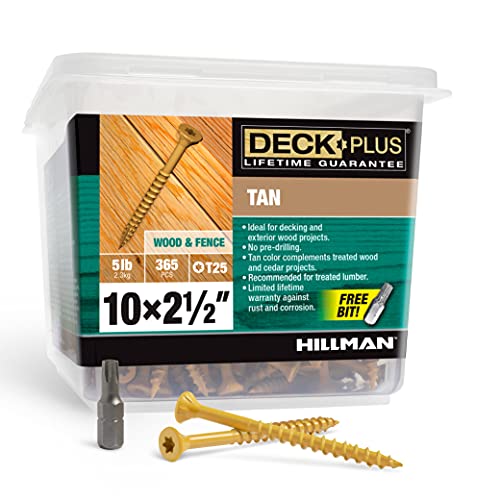
Deck Plus Deck Screws #10 x 2-1/2in Tan

Deck Plus Wood Screws #8 x 2in Tan

Deck Plus Deck Screws #10 x 3in Green
Simpson Strong-Tie SDWS22312DBB Structural Screw

Wensilon #10 x 3″ Deck Screws Bronze

Wensilon #10 x 3″ Black Deck Screws
Wensilon #10 x 3″ 304 Stainless Steel Deck Screws

LIONMAX Deck Screws 3 Inch 25 lb Bulk Tan
A Deeper Look At The Lineup
Short framing screws tend to live in a drawer that gets opened for everything, and that’s exactly the job the GRK 96080 R4 is built for. The 1-1/4 inch length handles light framing, blocking, and trim without poking through the back of thinner stock, and the Zip-Tip point is meant to skip the pilot-hole step on most softwoods and hardwoods. A star drive (the six-lobe Torx pattern) resists the cam-out you get with cheaper Phillips heads when the bit slips sideways under load.
For most shop jobs, this is a fastener that disappears into the background. The 110-count pack suits a small deck repair or a weekend of punch-list work rather than a full rebuild, so plan accordingly. Where the longer Deck Plus picks below shine for board-on-joist fastening, this one is more at home fastening cleats, brackets, and sub-frame pieces before the decking goes down.
Everyday Perks
- Self-starting tip cuts down on prep time, so a 2×4 cleat can be fastened without switching to a drill bit first.
- Star drive head keeps the bit engaged longer, which means fewer chewed-up screw heads on the jobsite.
- Rated for both interior and exterior work, so the same box travels between the shed and the porch project.
- Short shank works well in tight spots where a 3-inch screw would blow out the back of the workpiece.
Points To Keep In Mind
- Count is small for anything bigger than a minor fix, so expect to buy multiple boxes for a deck build.
- Coating is suitable for general exterior use but not specified for constant saltwater exposure, where the stainless option further down fits better.
- Length is too short for fastening 5/4 deck boards to joists; pair it with a longer screw for the visible surface.
Who Should Grab It
DIYers keeping a mixed fastener drawer who want one screw for blocking, brackets, and light framing around a deck project.
Skip It When
You’re fastening actual deck boards, where the longer Deck Plus #10 x 2-1/2in or Wensilon #10 x 3″ options below make more sense.
Two-and-a-half inches is the workhorse length for fastening 5/4 decking to standard joists, and the Deck Plus #10 x 2-1/2in lands right in that sweet spot. Coarse threads bite into soft pressure-treated pine without demanding a separate pilot hole, and a star drive head keeps the bit seated so you can sink a whole box without stopping to flip a stripped screw. The 4-layer epoxy coating is what gives the tan head its color and is built to handle the corrosive chemistry in modern pressure-treated lumber.
For most homeowners building a standard 16-inch-on-center joist layout, this size hits the board without blowing out the bottom. The 365-piece count is enough for a modest deck, and the box is sized to sit on a sawhorses without sliding off. If your joists are 24 inches on center, you may find the shorter grip leaves a slightly softer hold than the 3-inch siblings further down the list.
What Pays Off
- Self-drilling point design pairs with coarse threads, which means fewer stripped boards and faster row-by-row work.
- Tan epoxy coating blends into pine and cedar decking better than a bright silver screw head.
- 4-layer corrosion protection holds up against the copper-based treatments in modern pressure-treated lumber.
- Star drive resists cam-out under the high torque an impact driver delivers.
Honest Caveats
- Count is geared toward smaller projects; full-deck builds will chew through a 5 lb box quickly and may need the LIONMAX bulk option below.
- Tan head shows against dark composite boards, so a color-matched screw is the better pick for those surfaces.
Quick Facts
Made For
Homeowners building or re-skinning a standard pressure-treated deck who want a familiar 2-1/2 inch screw that won’t fight the bit.
Look Elsewhere When
You need a green head to disappear into dark treated lumber, in which case the Deck Plus #10 x 3in Green option is a better match.
Stepping down to a #8 shank from the #10 picks above gives you a slimmer fastener that suits thinner deck boards, fascia trim, and lighter framing. The 2-inch length is right for fastening 1x nominal trim or 5/8-inch decking where a longer screw would over-penetrate. The 625-piece count in a single 5 lb box is the real headline, since trim and sub-frame work tends to burn through fasteners faster than the visible decking does.
The same self-drilling point and 4-layer epoxy coating from the larger Deck Plus siblings carries over, so corrosion resistance stays consistent across the box. The trade-off is grip: a #8 shank doesn’t bite as aggressively into the joist as a #10 does, so for structural connections you may want the Simpson Strong-Tie or a longer Deck Plus option instead.
Everyday Wins
- High piece count keeps the box from running out mid-project on long runs of trim or pickets.
- Tan epoxy head blends into pine and cedar trim without flashing against the surface.
- Slim #8 shank reduces the chance of splitting narrow boards during fastening.
- Same corrosion protection as the larger Deck Plus screws, so the trim and the decking match in finish life.
Practical Considerations
- Shorter 2-inch length means less thread engagement, so it’s not the right pick for structural framing.
- Lower torque capacity than #10 screws, so the bit can walk under heavy pressure from an impact driver.
Best Suited To
Finish carpenters and DIYers handling fascia, picture-frame borders, and picket infill where slim profile and a high count matter more than brute grip.
Reach For A Different Pick When
You’re fastening 5/4 deck boards to joists, in which case the Deck Plus #10 x 2-1/2in Tan will seat more securely.
The 3-inch sibling to the tan pick above is the right call when you need extra bite into the joist, and the green head is the reason many homeowners reach for it. The colored epoxy is meant to disappear against pressure-treated lumber, which arrives at the lumberyard dyed green and then fades to a warm brown over the first season. A silver screw head would catch the eye on every row; this one mostly blends in.
That extra half inch matters on wider joist spacing or when fastening 2x nominal deck boards instead of 5/4 stock. The coarse threads and self-drilling point carry over from the rest of the Deck Plus line, so behavior on the driver feels familiar. For most backyard decks, you may find this length holds the boards tighter over time as the wood expands and contracts with the seasons.
Benefits That Matter
- Green-tinted head disguises against pressure-treated lumber, so the deck reads cleaner from above.
- 3-inch length reaches deeper into the joist, which helps on wider joist spacing or 2x deck boards.
- Star drive head keeps the bit engaged on long drives into dense wood.
- 4-layer epoxy coating is rated for direct contact with modern pressure-treated lumber chemistry.
Trade Offs
- Count of 310 is on the lighter side for a full deck, so a large project may need more than one box.
- Color match works against green-treated wood but stands out against cedar or composite, where the tan or black options fit better.
- 3-inch length is overkill for thin trim pieces, which can split if the screw is driven too close to the end.
Feature Snapshot
Right Fit For
Homeowners building a new pressure-treated deck who want the fastener head to disappear visually after the first weathering cycle.
A Better Fit Elsewhere
You’re working with composite decking, where the Wensilon black-head option is built for darker surface colors.
Standard deck screws fasten surface boards, but they aren’t the right tool when you’re connecting a post to a beam or building a pergola that has to carry real load. The Simpson Strong-Tie SDWS22312DBB sits in that heavier category: a .220 inch shank and 3-1/2 inch length built to take the place of a through-bolt in many timber-frame situations. The black double-barrier coating is designed for outdoor use, and the patented SawTooth point is meant to start fast without a pilot hole in most softwoods.
This screw also pairs with the Outdoor Accents decorative hardware line if you’re going for an architectural look. Under-head nibs help the head seat cleanly without spinning off, which matters when you’re countersinking into a beam. For most residential decks, only a small percentage of the total fastener count needs to be at this strength level, so the 50-quantity box is sized for those critical connections.
Positive Points
- Thick .220 inch shank handles load-bearing connections where standard deck screws would shear under stress.
- SawTooth point reduces installation torque and skips the pilot hole in most common softwoods.
- Black double-barrier coating is rated for exterior structural applications.
- Compatible with the matching Outdoor Accents washer for exposed architectural hardware on pergolas.
Factors To Consider
- Overkill for fastening surface deck boards, where a standard #10 screw will sink easier and cost less per piece.
- Requires a higher-torque driver or drill to seat properly without burning out the bit.
- 50-piece count is sized for structural connections rather than a full deck surface.
Whose Shelf It Belongs On
Builders and serious DIYers connecting posts, beams, and pergola rafters where load capacity matters more than speed.
Where Another Pick Suits Better
You’re fastening 5/4 deck boards to joists, where the lighter Deck Plus or Wensilon picks are easier on the driver and the wallet.
Wensilon’s 3-inch deck screw comes in at a useful middle ground for a small repair or a single deck section. The body is heat-treated steel, which adds a bit more hardness than you get from a standard cold-headed screw, and the four-layer anti-corrosion coating is the same approach the Deck Plus line uses. The bronze tone sits in the middle of the color spectrum: dark enough to read as a fastener, light enough to not stand out harshly against most wood tones.
Serrated threads on the head section are the subtle feature here. They work to pull the board down tight against the joist and reduce the chance of the screw loosening as the wood moves through wet and dry cycles. The 137-piece count in a 2 lb box suits a weekend project, and the included T25 star bit is a small touch that prevents the all-too-common moment of realizing the right driver bit is still in the other tool bag.
Good Reasons To Consider
- Heat-treated steel construction adds toughness for driving into dense or aged lumber.
- Serrated threads on the head section pull the board tight and reduce loosening over time.
- Four-layer anti-corrosion coating holds up in outdoor exposure and pressure-treated lumber.
- Includes a T25 star bit, so the box is ready to use even if other driver bits are misplaced.
Trade-Offs To Consider
- Smaller piece count than the 5 lb Deck Plus boxes, so multiple boxes are needed for a full deck surface.
- Bronze head sits between light and dark, so it doesn’t fully disappear into green-treated or dark composite boards.
Perfect Match For
Homeowners handling a focused deck repair or a small add-on section who want a tougher-than-average screw in a manageable box size.
Swap It Out When
You’re working near saltwater or pool chemicals, where the Wensilon 304 stainless version is the safer long-term pick.
Dark composite and painted decking surfaces show every silver and tan screw head, which is the gap the Wensilon black-head version is built to close. The body is the same 3-inch, #10 heat-treated steel construction as the bronze sibling, so the on-the-driver behavior matches. The black epoxy head just reads as a small dot against a dark deck instead of a flashing silver ring.
The 137-piece count is on the smaller side, so the box suits a deck re-skin or a defined section rather than a fresh large build. For homeowners with Trex-style or other dark composite decking, a color-matched head is one of those small details that separates a finished-looking project from one that reads as DIY. The included T25 bit means you’re not hunting for a driver the day the box arrives.
A Favorable Mix
- Black head disappears against composite, painted, and dark-stained deck boards.
- Same 3-inch, #10 heat-treated body as the bronze Wensilon, so handling is consistent.
- Four-layer epoxy coating handles outdoor exposure and treated-lumber contact.
- Star drive reduces the chance of stripping the head during high-torque driving.
Points To Note
- 137-piece count runs short on a full deck surface, so a large project needs multiple boxes.
- Black head against light cedar or pine will draw the eye more than the bronze or tan options.
Feature Rundown
Who Will Love This
Homeowners re-skinning or building with dark composite decking who want the fastener head to read as a small dot rather than a flash of metal.
Not Your Match When
You’re working with natural cedar or pine, where the Deck Plus tan or Wensilon bronze versions blend more naturally into the surface.
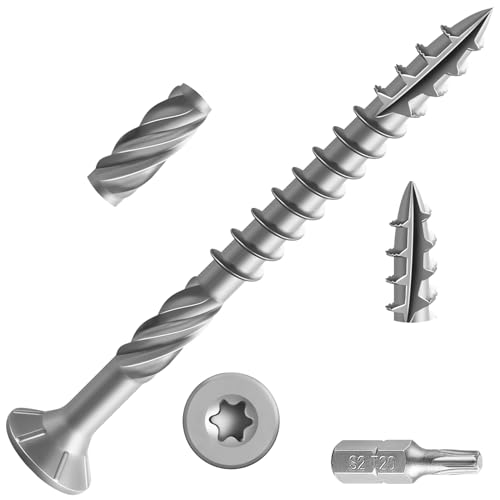
Where the rest of this list runs on coated carbon steel, the Wensilon 304 stainless version is built for the worst corrosion scenarios a residential deck sees. Salt air, pool-splash zones, and treated lumber with high copper content all chew through epoxy coatings over time, and 304 stainless steel sidesteps that problem at the material level rather than fighting it with a surface layer. The 3-inch length and #10 shank are the same dimensions as the coated Wensilon siblings, so the on-the-driver feel matches.
The trade-off for that corrosion resistance is a softer screw body. Stainless steel doesn’t have the same hardness as heat-treated carbon steel, so the bit can walk under high torque, and predrilling is more often needed in dense hardwoods. For most coastal builds, the longevity win is worth it, and the bronze head color still blends with most wood tones.
Positive Takeaways
- 304 stainless steel construction resists rust at the material level, not just at the coating.
- Suited for coastal environments, pool surrounds, and other high-moisture deck locations.
- Compatible with pressure-treated lumber chemistry that would attack a standard coated screw over time.
- Same 3-inch, #10 size as the rest of the Wensilon line, so driver handling stays consistent.
Less-Strong Areas
- Stainless body is softer than heat-treated carbon steel, so the bit can walk in dense hardwoods without predrilling.
- Costs more per piece than coated alternatives, which adds up across a full deck.
- Smaller 151-piece box suits repair or a defined section rather than a fresh large build.
Built With In Mind
Coastal homeowners and anyone building a deck near a pool or salt-air environment where coated fasteners tend to streak and fail.
Where A Sibling Pick Shines
You’re inland on a standard treated-lumber deck, where the Wensilon bronze or Deck Plus tan options deliver similar performance at a lower per-piece cost.
Building a full deck or replacing a fence eats through fasteners faster than most people expect, and running out of screws mid-row is the kind of small disruption that breaks a day’s rhythm. The LIONMAX 25 lb bulk box is sized to cover that problem: 1,700 pieces of #10 x 3 inch deck screws in a resealable container that doubles as a storage bucket. For most decks in the 300 to 500 square foot range, this box is the whole project’s worth of fasteners in one trip.
The tan epoxy coating is rated to hold up through extended sun, rain, and humidity exposure, and the Torx drive head (a six-point star pattern) prevents the slippage that ruins both the bit and the screw head. Three T25 driver bits are included, so a stripped bit doesn’t have to stop work. The bucket is genuinely useful afterward for storing leftover screws in the shop rather than letting them roll around in a junk drawer.
What It Does Well
- 1,700-piece count in a single 25 lb bucket covers a full deck or large fence build without a mid-project reorder.
- Resealable bucket doubles as a storage container, which helps keep leftover screws from rusting in the shop.
- Three T25 driver bits are included in the box, so a worn bit doesn’t have to stop work.
- Tan epoxy coating is rated for sun, humidity, rain, and snow exposure over time.
A Few Limitations
- 25 lb of screws is a heavy box to move around a jobsite, so plan to stage it near the work area.
- Coated carbon steel, not stainless, so coastal projects will see the Wensilon 304 option outlast it.
- Tan head works against light wood but shows on dark composite, where the Wensilon black version is the better fit.
Feature Card
The Right Fit
Homeowners and contractors building a full deck, large fence, or any project that needs hundreds of fasteners in one consistent size.
Consider Something Else When
You’re only replacing a few boards, where a smaller box like the Deck Plus 5 lb option is easier to store and won’t sit around oxidizing.
Picking The Right Fastener For Your Build
A few attributes carry more weight than the rest when you’re sorting through this category. Length, shank diameter, drive type, and coating all behave differently depending on the deck you’re building, and getting any one of them wrong shows up within the first season.
Length And Shank Diameter
Screw length has to bite into the joist by at least an inch past the board thickness, and shank diameter controls how aggressively the screw pulls the board down. A #10 x 2-1/2 inch screw is the common pairing for 5/4 decking on 16-inch joist spacing, while a 3-inch screw gives extra reach for 2x nominal boards or wider joist spacing. The slimmer #8 screws work better on trim and thinner stock where splitting is a concern.
Drive Type And Bit Engagement
Star drive, also called Torx, is the most common head style on modern deck screws for a reason. The six-point contact keeps the bit engaged under the high torque an impact driver delivers, and the bit rarely slips sideways to chew up the screw head. Phillips drives strip out faster and waste time flipping screws that won’t unseat.
Coating And Corrosion Resistance
Modern pressure-treated lumber uses copper-based preservatives that attack standard zinc-plated screws over time, leaving dark streaks on the deck surface. A multi-layer epoxy coating resists that chemistry, and 304 stainless steel is the next step up for coastal and poolside builds. The trade-off is cost, and most inland residential decks never need to go past a quality coated screw.
Cross-Cutting Details For This Category
Common Shopping Slip Ups
The most common mistake is matching screw color to the wood at the lumberyard instead of after it has weathered for a season. Pressure-treated lumber arrives green and fades to gray-brown, so a tan screw that looks wrong on day one often blends in by month six. The other slip is under-buying: a 5 lb box sounds like a lot of screws until you’re three rows into a 400 square foot deck, and a bulk bucket like the LIONMAX option is the more practical call for a full build.
When Paying More Pays Off
Premium picks earn their keep in two scenarios. Stainless steel construction is worth the per-piece cost when the deck sits within a few miles of saltwater or right next to a chlorinated pool, where coated screws streak and fail inside a couple of seasons. Heavier structural screws like the Simpson Strong-Tie option cost more per piece but replace through-bolts on post-to-beam connections, which saves a separate trip to the hardware store for the right-size drill bit and lag bolts. For a standard inland deck, a quality coated #10 screw is the practical middle.
Frequently Asked Questions
How long should a deck screw be for 5/4 decking?
A 2-1/2 inch screw is the common pairing for 5/4 boards on 16-inch joist spacing. Step up to a 3-inch screw for 2x nominal deck boards or wider 24-inch joist spacing, where the extra reach gives the threads more joist to bite into.
What is the difference between deck screws and wood screws?
Deck screws are built with corrosion-resistant coatings and a self-drilling point meant for outdoor exposure and pressure-treated lumber. Standard wood screws are designed for interior use and will rust and streak when used outside, especially in contact with modern treated lumber chemistry.
Do I need to pre-drill for deck screws?
Most modern deck screws have a self-drilling point that handles softwoods like pine and cedar without a pilot hole. Hardwoods like ipe or dense tropical species benefit from predrilling to prevent splitting, and stainless steel screws in any material often need a pilot hole because the softer body is more likely to snap or walk under high torque.
How many deck screws do I need per square foot?
A standard 6-inch-wide deck board fastened with two screws per joist on 16-inch spacing uses roughly 1.4 screws per square foot. A 400 square foot deck works out to around 560 screws, which is why a bulk box like the LIONMAX 1,700-piece option is sized to cover most single-deck builds with leftovers for future repairs.
Can I use deck screws for structural connections?
Standard coated deck screws are designed for surface board fastening, not load-bearing connections. For posts, beams, and pergola rafters, a structural screw like the Simpson Strong-Tie option is engineered for the shear and withdrawal loads those joints see, and it carries the engineering data to back that up.




