


A good sheet sander quietly disappears in your hand once a project gets going, leaving you focused on the surface instead of the tool. The wrong one fights you, leaves swirl marks, or dumps dust across the bench. Furniture restorers, weekend refinishers, and anyone stripping an old door down to bare wood all hit the same crossroads: palm sander or half sheet, corded or cordless, soft grip or just a hard shell.
The eight picks below cover the full spread of the category, from featherweight 1.2 amp palm sanders up through a brushless cordless model built for longer sessions. Each one is matched to the kind of work you actually do, with honest trade-offs and clear alternatives if the fit isn’t right.
How The Shortlist Stacks Up

SKIL 2.0 Amp 1/4 Sheet Palm Sander

DEWALT DWE6411 1/4 Sheet Palm Sander

DEWALT DCW200B 20V MAX XR Brushless Cordless 1/4 Sheet Sander

Makita BO4900V 1/2 Sheet Finishing Sander

Makita BO4556 1/4 Sheet Finishing Sander
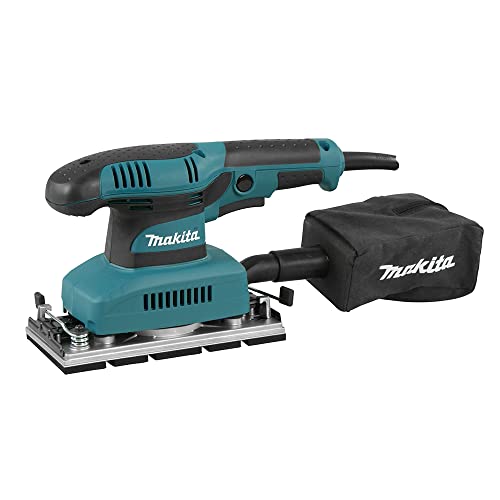
Makita BO3710 1/3 Sheet Finishing Sander

SKIL 5″ Random Orbital Sander SR211601
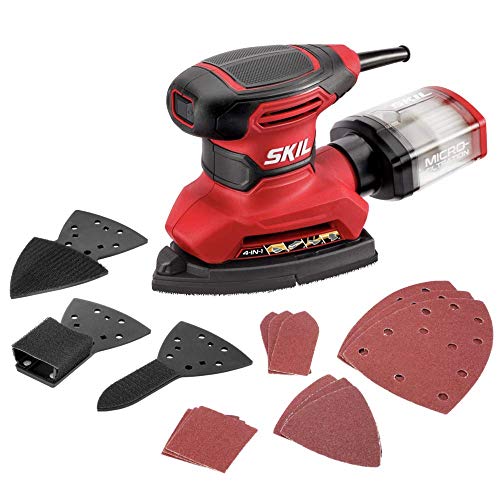
SKIL SR232301 Multi-Function Detail Sander
A Closer Look At Each Pick
The SKIL 2.0 Amp 1/4 Sheet Palm Sander is built around a feature that beginners don’t realize they need: pressure control. A sensor inside the pad warns you when you press too hard, which is the single most common cause of swirl marks and gouged veneer on a first refinishing project. You can feel the alert through the grip, and it teaches good technique without a single spoken word.
Pair that with a clear-view dust canister and a sealed switch, and you get a forgiving tool that handles garage benches and kitchen table restorations equally well. The vacuum adapter is the upgrade most owners appreciate, since it pulls the fine dust away before it scratches the next pass. It lacks the raw power of the DEWALT DWE6411 that follows, but the learning curve is gentler.
Bright Spots
- Pressure alert system helps new sanders avoid burn-through on thin veneer and soft pine
- Clear-view dust canister shows fill level, so you empty before suction drops
- Sealed switch resists dust ingestion, extending tool life on long refinishing jobs
- Vacuum adapter port accepts a standard shop vac hose for cleaner work
Things To Consider
- 2.0 amp motor runs slower than the DEWALT DWE6411 on heavy stock removal
- Counterbalance feel is lighter, so you may notice more hand fatigue on ceiling work
Who It Suits Best
First-time refinishers and casual DIYers who want forgiveness built into the grip rather than figured out the hard way.
Consider Something Else When
You’re stripping thick paint from doors or tabletops, in which case the Makita BO4900V 1/2 Sheet Finishing Sander covers more area per pass.
The DWE6411 has become the corded 1/4 sheet sander that pros reach for almost on reflex. Its 2.3 amp motor pulls 14,000 OPM (orbits per minute), and a separate counterweight keeps vibration from traveling up into your wrist during long sessions. Compared to the SKIL above, it feels tighter in the hand and noticeably more planted on the workpiece.
The shortened body lets you sand close to vertical edges without the housing bumping the wall, and the rubber overmold grip stays comfortable in summer humidity. The one-handed locking dust bag swaps out fast, though serious users typically route it into a shop vac instead. Corded tools demand an outlet, but you trade that for unlimited runtime, which matters on cabinet jobs.
The Case For It
- Counterweight system reduces vibration transfer, easing fatigue on multi-hour projects
- Compact body improves control on inside corners and tight cabinet faces
- 14,000 OPM output handles hardwoods and stubborn old finishes without bogging
- Locking dust bag stays attached when you flip the tool upside down on shelves
Points To Keep In Mind
- Corded design means dragging an extension cord across driveways and lawns
- Included dust bag fills quickly during heavy stripping, requiring frequent pauses
Right Fit For
Home workshop regulars and trim carpenters who value vibration control and consistent power over cordless convenience.
Look Elsewhere When
You already own DEWALT 20V MAX batteries, in which case the DCW200B 1/4 Sheet Cordless Sander drops the cord entirely.
Pulling the cord out of the picture changes how you work on a project, and the DCW200B leans into that freedom. A brushless motor (a design that uses electronic controllers instead of carbon brushes, lasting longer and running more efficiently) pairs with a variable-speed dial running from 8,000 to 14,000 OPM, so you can dial down for delicate veneers and back up for raw stock. The dust port is sized for direct hookup to a DWV010 or DWV012 dust collector, which is the cleanest way to use it.
The tool-only configuration keeps the upfront cost down, but only makes sense if you already own 20V MAX batteries and a charger. For shops standardized on the DEWALT XR platform, this sander slots right into the same batteries that already run drills, impacts, and saws. The body is a touch longer than the corded DWE6411, yet the trade-off is no extension cord tangling around sawhorses.
The Good Stuff
- Brushless motor extends runtime per charge and shrugs off workshop dust
- Variable speed dial matches aggression to grain, finish, and grit
- Locking dust bag accepts both bag and shop vac hookups
Worth Noting
- Battery and charger sold separately, raising true cost for new DEWALT owners
- Slightly longer body reduces corner access compared to the DWE6411
Key Product Details
Made For
Existing DEWALT 20V MAX owners tackling jobs anywhere a power outlet doesn’t reach, from porches to offsite client installs.
Skip It When
You’re buying into a cordless platform for the first time and would rather avoid buying batteries separately, in which case the SKIL 2.0 Amp 1/4 Sheet Palm Sander is friendlier on the wallet.
The BO4900V is the half-sheet sander that furniture refinishers buy once and then forget to replace. It accepts both 4-1/2″ x 9-1/8″ hook-and-loop sheets and 4-1/2″ x 11″ half sheets, which is a quietly useful detail when your shop runs through a mix of precut and bulk abrasives. The through-the-pad dust collection pulls debris out from under the paper, so scratches from recirculated grit drop noticeably.
A variable speed dial runs from 4,000 to 10,000 OPM, the lower end of the spectrum here, but the trade-off is genuine control on fine work. Compared to the DEWALT DWE6411, this is the tool you grab when a tabletop needs to come out glass-smooth, not when a deck railing needs fast material removal. Owners commonly report the contoured grip and balanced motor reduce hand cramping on full-day refinishing sessions.
A Favorable Mix
- Variable speed from 4,000 to 10,000 OPM supports delicate finish work on figured wood
- Large trigger switch is easier on fingers during extended sanding runs
- Accepts both hook-and-loop and standard half-sheet paper for abrasive flexibility
Trade Offs
- Top speed is lower than the 1/4 sheet picks, so heavy material removal takes longer
- Half-sheet footprint can feel bulky on small picture frame and trim projects
Feature Snapshot
Who Should Grab It
Serious refinishers and cabinetmakers who want a half-sheet workhorse for door panels, tabletops, and dresser faces.
Not Your Match When
Most of your work is small trim, drawer fronts, or quick patches, where the Makita BO4556 1/4 Sheet Finishing Sander is easier to maneuver.
The BO4556 has earned a quiet reputation as one of the smoothest 1/4 sheet sanders you can hold. Its 2.0 amp motor delivers 14,000 OPM, but the all-ball-bearing construction (a design where steel balls support rotating parts, reducing friction and wear) is what really sets it apart, lowering both noise and vibration at the same time. In a shared garage or basement workshop, that hush matters more than people expect.
You get the abrasive papers, dust bag, and a punch plate right in the box, so the tool is ready to work out of the package. The rubberized palm grip stays put even when your hands are dusty or damp from stripping a water-based finish. Where the DEWALT DWE6411 leans toward brute force, the BO4556 leans toward a quiet, considered touch.
A Strong Showing
- Ball-bearing motor reduces noise and vibration for shared-space sanding
- Contoured rubber grip stays secure during long finish-sanding sessions
- Includes abrasive sheets, dust bag, and paper punch in the box
Room For Improvement
- 2.0 amp motor has less headroom than the DEWALT DWE6411 on heavy stock removal
- Lacks a vacuum adapter port, so dust control relies on the included bag
Feature Overview
Best Suited To
Finish-focused woodworkers and apartment-dwelling hobbyists who care about quiet operation and clean lines over pure power.
Another Choice May Suit
You’re often sanding outdoors or in rough production conditions, in which case the DEWALT DWE6411 1/4 Sheet Palm Sander absorbs abuse more readily.
The BO3710 is the smallest 1/3 sheet sander in Makita’s finishing lineup, and that size is its real advantage. A 1.7 amp motor is modest on paper, but the built-in counterbalance system keeps the 11,000 OPM output from rattling your wrist during overhead sanding. For ceiling work, shelf undersides, and inside-cabinet corners, the compact frame simply gets in where larger sanders can’t.
The lock-on button on the two-finger trigger switch is a small detail that pays off when you’re sanding long moldings, since you don’t have to keep a constant grip pressure. Through-the-pad dust collection cleans as it cuts, and the rubberized grip holds steady even when your hands sweat under a face mask. It won’t keep up with the Makita BO4900V on a full tabletop, but that isn’t really the point.
Notable Upsides
- Compact 1/3 sheet pad reaches tight corners and inside-cabinet spaces
- Counterbalance system controls vibration on overhead and vertical sanding
- Lock-on trigger button reduces finger fatigue on long moldings
Honest Caveats
- 1.7 amp motor is underpowered for stripping thick paint or rough-sawn lumber
- Smaller pad means more passes to cover a tabletop or door panel
Whose Shelf It Belongs On
Trim carpenters, model makers, and homeowners handling small repair patches where a 1/4 sheet sander feels oversized.
Where A Sibling Pick Shines
Your projects lean toward larger flat surfaces like doors and tabletops, in which case the Makita BO4900V 1/2 Sheet Finishing Sander covers ground faster.
The SR211601 is technically a random orbital sander rather than a sheet sander, but it rounds out this list because finish work is where a lot of sanding actually happens. A variable speed dial runs from 7,000 to 13,000 OPM, and the random orbit pattern (a motion that moves the pad in small circles at varying angles) leaves surfaces swirl-free, the result you want before staining or sealing. The X-Flow cyclonic dust box separates fine particles from the airstream and keeps the filter from clogging mid-job.
Owners commonly report the 5-inch hook-and-loop pad (a quick-change system where abrasive discs stick to the pad without clamps) makes grit changes fast, and the included sanding sheets mean the tool is ready the day it shows up. Where the sheet sanders above all work in straight back-and-forth strokes, this one rotates in place, and that change in motion changes the kind of finish you can expect. It pairs naturally with a finishing sander rather than replacing it.
Points In Its Favor
- Random orbit motion eliminates visible swirl marks on stained and sealed surfaces
- X-Flow cyclonic dust box keeps suction strong across longer sanding runs
- Variable speed dial matches aggression to wood, metal, and plastic surfaces
- Hook-and-loop pad swaps abrasive discs in seconds without tools
Possible Compromises
- Random orbit pattern is overkill for rough paint removal, where sheet sanders cut faster
- Round pad shape can’t reach into square inside corners the way a sheet sander can
Quick Facts
Perfect Match For
Woodworkers and refinishers putting on the final pass before stain, paint, or clear coat, where swirl-free results are the entire point.
Swap It Out When
Your work is heavy paint stripping or rough shaping, where the DEWALT DWE6411 1/4 Sheet Palm Sander removes material faster per pass.
The SR232301 is the odd duck of this list, a detail sander in a sheet sander roundup, but it earns its spot because corners and curves show up in almost every real project. The 1.2 amp motor runs at 13,500 OPM, modest output paired with a triangular pad and three additional attachments. The base, finger, and contour profiles click on and off without tools, which is the feature that turns it from a single-purpose sander into a four-in-one kit.
Micro-filtration plus a 1-1/4″ dust port gives you two ways to manage dust, depending on the job. For detail work on chair spindles, picture frames, and tight window mullions, no 1/4 sheet sander can match the access. Owners commonly report that the included 12 sanding sheets cover most grits needed for small repairs, so the tool is useful from the day it lands.
Standout Benefits
- Four interchangeable profiles tackle large flats, corners, edges, and contours
- Tool-free attachment changes speed up switching between sanding shapes
- Micro-filtration plus vacuum port offers two dust management options
Points To Note
- 1.2 amp motor is the lightest in this roundup, so material removal is slow
- Small pad means covering a tabletop by hand takes significant time
Feature Rundown
Built With In Mind
Restorers and crafters working on furniture with carved details, slatted chair backs, and tight window trim where a flat pad can’t reach.
Reach For A Different Pick When
You mostly sand flat panels and need a fast, dedicated workhorse, in which case the Makita BO4900V 1/2 Sheet Finishing Sander is a stronger match.
What Matters When Choosing a Sheet Sander
Match the Pad Size to the Project
Sheet sanders come in three common footprints, and the right one depends on the surfaces you touch most. A 1/4 sheet palm sander handles detail, small repairs, and trim with nimble control. A 1/3 sheet model reaches tighter corners than its 1/4 cousins. A 1/2 sheet sander covers tabletops, doors, and dresser faces fast, but its size gets in the way on small parts. Picking the smallest pad that still finishes the job keeps the work less tiring and the result cleaner.
Weigh Vibration, Grip, and Noise
A sander that vibrates harshly turns a one-hour job into a hand-numbing chore. Counterweight systems, rubber overmold grips, and ball-bearing motors all reduce the sting, and the difference is obvious after twenty minutes of continuous use. If your workshop is shared or close to living space, lower noise and a soft grip become real priorities, not just comfort extras.
Decide Between Corded and Cordless Honestly
Corded sanders run unlimited sessions at full power, which matters during heavy stripping. Cordless models trade runtime for the freedom to work on ladders, porches, and offsite jobs. For a workshop near outlets, corded tools are usually the smarter call. For mixed work in and out of the house, a cordless sander on a platform you already own makes daily life easier.
Look at Dust Collection, Not Just Suction
A canister that fills in two minutes turns sanding into stop-and-go. Through-the-pad collection, sealed switches, and vacuum-ready ports cut dust at the source, and they protect the motor from fine-particle wear. The included dust bag is rarely the best long-term answer; routing to a shop vac or a dedicated dust collector pays off in cleaner air and longer tool life.
Key Considerations Across These Picks
Pitfalls Shoppers Hit
A common trap is buying the cheapest 1/4 sheet sander and expecting the same finish as a higher-end model, only to find the motor bogs on hardwood. Another is choosing a half-sheet sander for trim work, where the pad simply doesn’t fit. The fix is matching the tool to the largest surface you actually sand, not the largest surface you can imagine sanding. Cheap abrasive sheets also undo good tools, so factor paper cost into the decision, not just the sander.
Where The Extra Money Goes
Higher-tier sanders put the budget into brushless motors, counterweight systems, and better dust routing. Those upgrades show up as longer tool life, less hand fatigue, and cleaner finishes that need less rework. The upgrade pays off most when you sand often, sand large surfaces, or sand in tight living spaces where noise and dust are real concerns. For occasional weekend touch-ups, a solid mid-range model handles the workload without strain.
Frequently Asked Questions
What is a sheet sander used for?
A sheet sander smooths wood, removes old paint or finish, and preps surfaces for staining or sealing. It excels on flat panels, trim, and furniture faces where controlled, even material removal matters more than speed.
Can a sheet sander remove paint?
Yes, a sheet sander with coarse-grit paper strips paint from flat wood surfaces effectively. For layered paint on detailed molding, a detail sander or chemical stripper usually works faster and reaches further.
What is the difference between a sheet sander and a random orbital sander?
A sheet sander moves the pad in a straight or slightly orbital pattern and uses rectangular sandpaper. A random orbital sander moves the round pad in overlapping circles, producing swirl-free finishes that need less rework before staining or sealing.
How do I choose sandpaper grit for my sander?
Start coarse for paint removal and leveling, then step through medium grits for smoothing, and finish with fine grits for surface prep before finish. For raw wood, 80, 120, and 220 grits cover most steps without overkill.
How important is dust collection on a sheet sander?
Dust collection is critical for both finish quality and tool longevity. A good dust system keeps abrasive dust from clogging the paper, prevents swirl marks from recirculated grit, and protects the motor from fine-particle wear over time.




