


A tire going soft on a Sunday morning, a nail bed that needs refilling, a basketball that lost its bounce overnight. These are the small household jobs that turn a quiet weekend into a trip to the gas station or a hardware store. The right compact inflator lives in a closet, charges in the corner, and gets the job done before your coffee gets cold.
The Picks In Brief

Smart Tire Inflator, Auto Shut-Off

Titan Tools 19357 Digital Tire Inflator

ETENWOLF VORTEX S6 Cordless Inflator

ETENWOLF VORTEX S7 Heavy-Duty Inflator

Flexzilla Truck Tire Inflator Kit

Milwaukee M18 Inflator 2848-20
ETENWOLF S1 160PSI Cordless Inflator

Teslong 20V Dual Cylinder Inflator

VIAIR 400P Automatic Portable Compressor
Why These Options Stand Out
Set the pressure, walk away, and let the unit do the second-guessing for you. The WarWolf inflator is built around a preset-and-forget workflow that suits anyone who has never pumped a tire before. In a real driveway moment, a backlit digital readout shows the live number, and the unit clicks off the moment it hits the target. The range stretches from low-pressure inflatables up to high-PSI car tires, so the same device handles pool toys in the morning and a sedan in the afternoon.
For households that want one tool to grab and not think about, this is the gentlest entry point on the list. The catch is the unit’s modest footprint, which works against it for oversized truck tires, where the airflow starts to feel thin.
Notable Upsides
- Auto shut-off at the preset pressure removes the risk of over-inflating a tire
- Digital readout cycles through PSI, Bar, kPa, and kg/cm² for travelers abroad
- Wide pressure range covers both pool floats and car tires with one device
- Compact body fits a glovebox or a kitchen drawer between uses
- Sensible choice for first-time owners learning the PSI values for their vehicles
Points To Keep In Mind
- Best suited to small-to-medium tires, since larger volume fills run longer
- Charging between sessions is something owners commonly report managing
Feature Snapshot
Made For
Newcomers who want a no-learning-curve tool for car tires, bikes, and inflatables.
Consider Something Else When
Pickup owners with 33-inch tires will fill faster on the ETENWOLF VORTEX S6.
Unlike the cordless picks above, the Titan 19357 is a classic inline inflator, the kind you see clipped to a service-bay wall. The rubber-bumpered gauge face takes the kind of drops a garage tool is expected to survive, and the swivel chuck reaches awkward stems without twisting your wrist. Power comes from a built-in air-line, so there is no battery to nurse, which fits a shop or a permanent garage corner where a real compressor already lives.
For someone who already runs a compressor and wants a tidy wall-mounted finishing tool, this earns its spot. The trade-off shows up in portability: without a host air supply, it is just a fancy gauge.
Where It Helps
- Inline design draws from any shop air system, no charging needed
- Backlit LCD reads cleanly in low garage lighting
- Long swivel hose reaches inside-wheel or dual-wheel setups
- Rubber gauge guard absorbs the typical shop-bench drops
Trade-Offs To Consider
- Requires a separate air supply, so it is not a grab-and-go option
- Runs on AAA batteries, which need periodic replacement
Who It Suits Best
Home mechanics with a stationary compressor who want a dedicated inflation station.
Look Elsewhere When
You need cordless freedom, in which case the Milwaukee M18 Inflator is the better match.
The VORTEX S6 is where the cordless category starts to feel serious. Built for trucks and SUVs that punish small inflators, it pushes serious air at zero PSI and refills a 31-inch tire inside a minute. The built-in 19200 mAh battery removes the anxiety of running flat mid-fill, which matters on a camping trip or a long highway pull. Same story with the digital gauge: the spec sheet claims tight accuracy, and the unit supports multiple units so you can match whatever your tire placard shows.
The honest read is that this is overkill for a commuter sedan, where the S1 below does the job with less bulk. For truck households, it hits the right power-to-portability balance.
Positive Takeaways
- High airflow rate refills larger truck tires in roughly a minute
- Internal battery handles multiple fills per charge
- Multi-unit pressure display covers US and metric preferences
- Works on cars, bikes, balls, and pool floats when not on a truck
Some Limits To Know
- Larger body than compact-only inflators, so storage planning matters
- Not intended for stand-up paddleboards per the manufacturer guidance
Right Fit For
Pickup and SUV owners who need cordless truck-tire capacity without lugging a shop compressor.
Another Choice May Suit
Sedan owners who rarely top off big tires will find the ETENWOLF S1 easier to live with.
The S7 is the most aggressive cordless option in this lineup, doubling down on the S6’s truck-tire focus with a larger battery and dual-motor drive. For off-roaders running 35-inch tires at low PSI on the trail, that extra headroom translates into fewer panicked glances at the gauge. On a desert run, a battery this size can handle multiple airing-down and airing-up cycles before needing a top-up, which is the kind of margin that matters when you are far from a plug.
For suburban commuters, that capacity is dead weight, and the S7’s footprint reflects it. This is a specialty tool, not a glovebox filler.
Features That Help
- Dual-motor drive delivers the highest output in the ETENWOLF cordless range
- Large internal battery supports repeated heavy fills between charges
- Targets pickups, off-road rigs, and overland setups specifically
- Versatile enough to switch to bikes, balls, and pool floats in a pinch
Potential Compromises
- Bulk and weight push it past casual grab-and-go territory
- Manufacturer guidance excludes stand-up paddleboards
Best Suited To
Off-road and overland households that need real cordless muscle for aired-down tires.
Skip It When
Your driveway sees a daily commuter, where the VIAIR 400P 12V setup is a different kind of heavy hitter.
The Flexzilla kit ignores the cordless trend entirely and goes the other direction, a 50-foot hose that taps into a truck’s own air supply. Pull up to a trailer, plug into the glad-hand fitting, and walk around the rig without dragging the truck with you. The hybrid polymer hose stays flexible in conditions that would turn a rubber hose into a stiff pretzel, which matters at dawn in a cold yard or on a blacktop in July.
This is a working tool for someone who already owns a tractor or trailer with onboard air. Anyone without that supply will find it inert.
Everyday Advantages
- 50-foot reach covers full tractor-trailer configurations from one hookup
- Hybrid hose stays flexible from -40°F up to 140°F
- Crush-resistant fittings tolerate job-site handling
- Glad-hand attachment and dual-chuck combo suit commercial setups
Practical Considerations
- Requires a vehicle with onboard air, not a standalone inflator
- Coil length demands dedicated storage space when not in use
Perfect Match For
Owner-operators and fleet households with tractor, trailer, or service-truck air systems.
Reach For A Different Pick When
You want a self-contained cordless unit, where the Teslong 20V is the closer fit.
The Milwaukee 2848-20 is a tool, not a consumer gadget, and that is exactly the point. Run it on the same M18 batteries already sitting on your workbench, and tire top-offs stop being a separate purchase decision. The brass chuck threads on cleanly, the inflator tops off a 33-inch light-truck tire in well under a minute, and the accessory bundle covers needle, nozzle, and Presta needs without a separate run to the hardware store.
The catch is the platform tax: the tool is sold as a bare unit, so the M18 battery and charger need to already exist in your shop. First-time power-tool shoppers will find the total cost higher than the standalone picks above.
What Earns Its Place
- Fast refill times for light-truck tires within the M18 cordless platform
- All-brass chuck threads on securely without stripping plastic fittings
- Bundled accessories cover needle, Presta, and nozzle work out of the box
- Smart fit for anyone already invested in the Milwaukee ecosystem
Where It Is Less Suited
- Bare-tool pricing assumes you already own compatible batteries
- Heavier than consumer-focused inflators, so it lives in a truck bed, not a glovebox
Feature Snapshot
Who Will Love This
Tradespeople and serious DIYers who already run Milwaukee M18 batteries in their shop.
Where A Sibling Pick Shines
The ETENWOLF S7 is a better all-in-one choice for households without an existing battery platform.
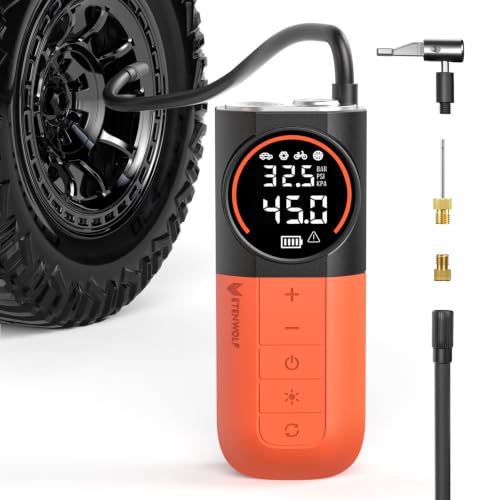
The S1 sits at the friendly end of the ETENWOLF line, sized for the sedan, the SUV, and the mountain bike in the garage. The 160 PSI ceiling handles passenger tires comfortably, and the motor refills a typical car tire from 30 to 35 PSI in about a minute. The internal battery keeps the cordless promise real, and the unit is light enough to toss in a trunk without thinking about it.
For a household whose tires are mostly compact and mid-size, this is the easier day-to-day tool. The catch is the same as the WarWolf above: aired-down truck tires will outrun the airflow.
Everyday Perks
- Refills a 195/65R15 tire in roughly 60 seconds from 30 to 35 PSI
- Internal battery supports multiple car tires on one charge
- Compact form lives in a trunk organizer without a dedicated mount
- Covers cars, SUVs, motorcycles, bikes, and sports balls
Where It May Fall Short
- Airflow is tuned for car tires, so heavy truck fills run longer
- Charging between weekend trips is a habit to build
Built With In Mind
Suburban households topping off sedans, hatchbacks, and bicycles on a routine schedule.
A Better Fit Elsewhere
Off-road households pulling 33-inch tires should step up to the ETENWOLF VORTEX S6.
The Teslong leans on a dual-cylinder layout, which is the engineering move that gets serious airflow out of a small body. The swappable 20V battery clicks in and out without tools, so a road-trip household can keep a charged spare in the glovebox and rotate them as needed. The inflated-time claims put it in the same league as the bigger ETENWOLF units for 225/65R17 SUV tires, which is impressive for the form factor.
That dual-cylinder design adds a touch of weight compared to single-cylinder options, and the platform is newer, so long-term support is something to keep an eye on. As an everyday travel companion, though, the swappable battery alone is a meaningful convenience.
Key Advantages
- Dual-cylinder motor delivers truck-class airflow in a portable body
- Tool-free battery swap keeps a charged spare within reach
- Top-off speed for SUV and pickup tires around the one-minute mark
- Compatible with both Schrader and Presta valves for varied travel needs
Less Ideal Details
- Dual-cylinder layout adds modest weight versus slimmer units
- Spare batteries are a worthwhile add-on, raising the total package cost
Feature Snapshot
Whose Shelf It Belongs On
Road-trip households and RV owners who want a swappable-battery travel inflator.
Swap It Out When
You only need to top off sedan tires at home, where the ETENWOLF S1 is more compact.
The 400P has been a fixture in the off-road world for a reason. Powered from a 12V source (your vehicle’s battery, in other words), it brings 150 PSI of headroom and a gearless direct-drive motor that runs cool on long fills. Up to 35-inch tires are within spec, which puts aired-down 33s and 35s back into service after a trail day without dragging a generator along. The carrying case keeps the hose and fittings tidy in a cargo area.
The trade-off is corded 12V operation: the compressor needs to be within reach of a cigarette-lighter or battery-clamp setup, which is a different workflow than a grab-and-go cordless unit. For trailhead and overland use, that is a feature, not a bug.
Reasons It Performs
- Rated for tires up to 35 inches, the largest in this roundup
- Direct-drive gearless motor runs cooler on extended fills
- Automatic shut-off behavior protects tires from over-pressure
- Carrying case keeps the hose and fittings organized on the trail
- Trusted name in the off-road community for overlanding builds
Worth Bearing In Mind
- Requires a 12V power source, limiting it to vehicle-side use
- Larger and heavier than any cordless pick in this list
Feature Snapshot
Who Should Grab It
Off-road and overland households running 33- to 35-inch tires who already work from a 12V setup.
Not Your Match When
You want a battery-powered indoor inflator, in which case the ETENWOLF S1 is the cleaner pick.
Choosing The Right Compact Inflator For Your Garage
A small air compressor earns its place by matching the tires and tasks you actually have, not the spec sheet’s biggest number. Start with the largest tire you expect to fill. A sedan topper can run on almost anything cordless, but a 35-inch off-road tire wants the airflow of a 12V workhorse like the VIAIR 400P, not a pocket-sized unit.
Pressure range matters more than people expect. Most household tires live between 25 and 50 PSI, so any unit that reaches 100 PSI handles daily life. The extra ceiling earns its keep when you move to trailer tires, bike shocks, or even a football, so wider is generally safer.
Battery versus 12V versus air-line is the real fork. Cordless inflators like the ETENWOLF S1 or Teslong dual-cylinder give grab-and-go freedom but cost you refill time on big tires. Inline shop tools like the Titan 19357 need a host compressor and live happily on a wall. Truck-side kits like the Flexzilla and VIAIR run from a vehicle’s own air or power and excel on the trail or in a fleet yard.
Build and accessories shape daily use. A brass chuck threads on more securely than a plastic one over time. Backlit displays help at dusk, and bundled Presta or needle fittings save a separate purchase. Match the chuck and accessory set to your household: cyclists want Presta, basketball players want a needle, and trailer owners want a dual-chuck setup.
Storage and noise round out the practical list. A unit that lives in a closet between uses should be light and cordless. A heavy unit that stays in a truck bed can be larger and louder, since it only runs outdoors anyway.
What The Right Inflator Buys You
A good portable inflator does two things at once: it removes the slow leak anxiety that quietly nags at every car owner, and it replaces the gas-station air machine with a tool that lives in your garage. The right pick also grows with the household, covering bikes, sports gear, and inflatables without a second purchase.
Common Shopping Slip Ups
The most common mistake is matching the unit to the tire pressure number on a placard and ignoring tire volume. A 150 PSI ceiling on a low-airflow motor still takes a long time to fill a 35-inch tire, so high-pressure capability without airflow is misleading.
A second trap is buying a bare tool without checking the battery ecosystem. The Milwaukee M18 inflator only makes sense if M18 batteries are already in the shop, and assuming otherwise turns a reasonable tool into an expensive paperweight.
Where The Extra Money Goes
Higher-tier models tend to spend the budget on airflow, battery capacity, and chuck quality. Dual-cylinder designs like the Teslong, larger batteries like the ETENWOLF VORTEX S7, and brass fittings on the Milwaukee 2848-20 all push the price up, and each one of those upgrades shows up in faster fills, longer runtime, and longer service life.
The upgrade is worth it for households running larger tires, frequent road trips, or off-road setups. For occasional sedan top-offs, a compact preset inflator covers the job without the extra spend.
Frequently Asked Questions
What PSI do most household tires need?
Passenger car tires typically run between 30 and 35 PSI, with the exact number listed on the driver’s-side door placard. SUV and light-truck tires often sit in the same range, while trailer and truck tires can run higher.
How long does a cordless inflator take to fill a car tire?
Most cordless units refill a standard sedan tire in about a minute, while larger SUV and truck tires can take two to four minutes depending on airflow and starting pressure.
Can a portable inflator handle bike tires and balls?
Yes, the picks on this list support bike valves and ball needles either with included accessories or as optional attachments, though high-volume air mattresses work best on units with dedicated low-pressure modes.
Do I need a 12V compressor if I already have a cordless one?
For most home users, a cordless unit is enough. A 12V compressor becomes useful for larger off-road tires, repeated fills, and situations where you prefer to draw from a vehicle’s power instead of recharging batteries.
Is a built-in gauge accurate enough to skip a separate one?
Built-in gauges on the picks above generally match tire-placard readings within a PSI or two, which is well within safe limits. For track-day or racing use, a calibrated separate gauge still earns its place.




