


A garage shop corner, a backyard fence repair, a small trailer with a loose hitch: these are the moments that send people looking for a small welder rather than a full industrial rig. You want something light enough to carry to the job, forgiving enough for a first-timer, and capable enough to lay a clean bead on thin steel, sheet metal, or rod stock. The nine picks below cover flux-core, MIG, and stick welders, plus a protective accessory and a helmet to round out a complete starter setup. Each one runs on standard 120V household power and keeps the learning curve manageable for weekend fabricators.
A Side-By-Side Look

Lincoln Electric 90i FC Flux Core Weld-PAK Welder (120V)

GZ GUOZHI 110V 130Amp Portable Handheld ARC Welder

Super Mini Stick Welder 110V 130A ARC MMA

Lincoln Electric Small Wire Feed Welder Canvas Cover

GZ GUOZHI 140A 3-in-1 MIG/ARC/Lift TIG Welder 110V
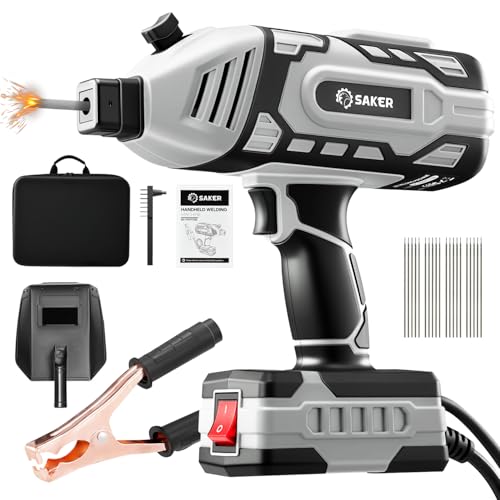
Saker Portable 110V Handheld ARC Welder 5-Level (Grey)

TOOLIOM 135A 110V Mini Stick Welder 2-in-1

Saker Portable 110V ARC Welder 5-Level IGBT

Saker Auto Darkening Welding Helmet LED True Color
Taking A Closer Look At The Options
The 90i FC is Lincoln Electric’s answer for people who want a reputable name on a starter flux-core machine. It plugs into any standard 120V outlet, weighs in light enough to carry with the included shoulder strap, and ships in a protective metal case that takes the worry out of tossing it in a truck bed. Flux-core wire (a tubular wire that shields the weld from contaminants without external gas) feeds automatically, so there is no shielding gas cylinder to buy or store. For thin steel repair, exhaust brackets, or small trailer fabrication, the 90i FC is a confident first welder.
Where it really pays off is for someone who values support and a long parts pipeline over bleeding-edge features. The included shoulder strap, metal case, and full accessory kit mean you can unbox and start welding on a Saturday morning. Compared to the GZ GUOZHI handheld units later in this list, the 90i FC trades portability for a more traditional wire-feed experience with a familiar Lincoln control layout.
Good Reasons To Consider
- 120V plug-and-go setup that works on any household circuit, no special wiring required.
- Self-shielded flux-core wire means no gas cylinder to buy, refill, or store.
- Protective metal case and shoulder strap make transport between garage and job site straightforward.
- Lincoln’s brand backing typically translates to easier parts sourcing and clearer documentation.
- Wide accessory kit in the box saves a separate shopping trip for consumables.
Things To Consider
- Flux-core produces more spatter and visible smoke than MIG with shielding gas, so cleanup takes longer.
- Limited to thinner materials; heavy plate work is outside its duty cycle.
At A Glance
Who It Suits Best
First-time welders and homeowners who want a trusted brand, a complete starter kit, and the simplicity of gasless wire-feed welding on 120V power.
Where Another Pick Suits Better
Shoppers who need genuine MIG with shielding gas or TIG should look at the GZ GUOZHI 140A 3-in-1 MIG/ARC/Lift TIG Welder later in this roundup.
This GZ GUOZHI unit leans into the handheld welder trend with a gun-style body, an integrated digital current display, and an IGBT inverter (a modern solid-state power module that produces smoother, more controllable output than older transformer designs). Output runs from 20 to 130 amps, which covers most thin steel, mild steel, and iron repairs around the home and farm. The aerospace-inspired housing is unusual for the category and earns the Travel Ready badge by being genuinely light and easy to throw in a truck.
Overhead work, fence post repairs, or jobs where you can’t bring the work to the welder all benefit from a one-handed gun format. Built-in protections guard against overheating, overcurrent, and overload, which is reassuring for a hobbyist who may not know the exact duty limits. In our view, the digital readout alone is worth it for anyone dialing in unfamiliar rod sizes for the first time.
Advantages To Know
- Handheld gun format makes overhead and field work far less awkward.
- Digital current display removes guesswork when switching between rod sizes.
- Built-in hot start helps the arc strike cleanly on cold metal.
- Multi-layer protection (overheating, overcurrent, overload) extends component life.
Points To Note
- Not rated for aluminum; stick with steel and iron work.
- Handheld format is less stable than a benchtop unit for long, straight beads.
- Some users may find the 130A ceiling tight for heavier stock.
Who It Suits Best
Mobile repair work, farm and ranch fixes, and hobbyists who frequently weld in awkward positions where a benchtop machine is impractical.
Not Your Match When
Users who need MIG with shielding gas or aluminum capability should consider the GZ GUOZHI 140A 3-in-1 MIG Welder in this list instead.
About the size of a small lunchbox and weighing roughly 3.5 pounds, this stick welder is the definition of a grab-and-go unit. Despite the tiny frame, it still pushes up to 130 amps and accepts common rod types for light fabrication and repair. The adjustable shoulder strap turns it into a wearable tool, which is genuinely useful when you are climbing a ladder or kneeling over a tractor wheel.
Where the Super Mini earns its keep is in tight storage. Apartment dwellers, condo owners, and anyone with a single shelf in a shared garage can keep this on hand without rearranging the space. The catch is duty cycle (the percentage of a 10-minute window the machine can actually run before needing to cool), which is shorter than larger machines, so you will need to pace long welds. For spot repairs and short beads, though, it punches well above its size class.
Real Benefits
- Ultra-compact 8-by-3-by-4.5 inch housing fits on a shelf or in a small drawer.
- 3.5-pound carry weight with shoulder strap for hands-free transport.
- 110V plug compatibility removes any electrical upgrade from the to-do list.
- 130A output handles a wide range of household stick welding tasks.
Worth Noting
- Limited duty cycle means longer welds require cooling breaks.
- Not designed for production or heavy industrial use.
Right Fit For
Homeowners and hobby welders with limited space who mostly need a welder for occasional short repairs and small fabrication projects.
Look Elsewhere When
Anyone planning long continuous welds or thicker plate work should step up to the Lincoln Electric 90i FC Flux Core Weld-PAK Welder for a more robust duty cycle.
Not every addition to a welder shortlist has to be a machine. Lincoln’s red canvas cover slips over a compatible Power MIG or Square Wave TIG unit and shields it from dust, moisture, and shop grime between uses. The flame-retardant, mildew-resistant, water-repellent fabric holds up to garage humidity and the occasional splash, and a side pocket keeps the gun or torch close at hand.
If you already own (or plan to own) a Power MIG 140 MP, 180C, 180 Dual, 210 MP, or Square Wave TIG 200, this cover is the cheapest insurance on the list against corrosion on controls and fan inlets. Compared to a plastic sheet or tarp, the tailored fit and the dedicated gun pocket make daily use less of a chore. It’s a small add-on that extends the working life of a much larger investment.
Positive Takeaways
- Tailored fit for specific Lincoln Power MIG and Square Wave TIG models.
- Flame-retardant, mildew-resistant, and water-repellent canvas for shop environments.
- Side pocket keeps the torch or gun organized with the machine.
Points To Keep In Mind
- Only fits specific Lincoln models; confirm compatibility before ordering.
Best Suited To
Existing owners of compatible Lincoln Power MIG or Square Wave TIG welders who want to protect their machine from shop dust, humidity, and incidental spills.
Skip It When
Shoppers who do not own one of the listed Lincoln welders should pass on this accessory and prioritize one of the actual welding machines in this roundup.
This is the multi-tool of the roundup. The GZ GUOZHI 140A combines flux-core MIG, stick (ARC), and lift TIG (a simplified TIG arc-start method where you touch the tungsten to the workpiece and lift to start) in a single 110V unit, with synergistic control that automatically adjusts voltage and wire feed speed when you set the current. For a hobby welder who isn’t sure which process will suit tomorrow’s project, that flexibility removes the need to buy a second machine later.
The 140-amp ceiling gives more headroom than the 130-amp units earlier in the list, which helps when stepping up to slightly thicker steel. The trade-off shows up in weight and complexity: this is a benchtop unit, not a handheld, and there is a real learning curve to flipping between processes cleanly. You may find the first few sessions feel slower than a single-purpose welder as you build muscle memory with the controls.
Practical Pluses
- Three welding processes in one machine reduce the need for future upgrades.
- Synergistic control simplifies setup by auto-matching voltage and wire feed speed.
- 140A ceiling handles a wider range of material thicknesses than entry-level units.
- Standard 110V operation keeps electrical requirements simple.
Room For Improvement
- Heavier and bulkier than single-process stick welders in this list.
- Multi-process versatility means more menu navigation and a steeper learning curve.
- Shielding gas cylinder for true MIG is sold separately.
Who Will Love This
DIYers and hobbyists who want one machine to grow with them, from flux-core auto body work to stick repairs and the occasional lift TIG project.
Swap It Out When
Pure stick-welding purists who only need arc work should look at the TOOLIOM 135A 110V Mini Stick Welder for a lighter, more focused tool.
Saker’s handheld stick welder strips the experience down to five current levels, which is exactly the right amount of choice for a first-timer. The IGBT inverter board inside delivers stable arc output with relatively low spatter (molten metal droplets that scatter off the weld), and the gun-style body keeps setup time short. Fits standard 3/32 inch rods, which is the most common hobby size and the easiest to find at any hardware store.
The five-level dial matters more than it looks. Instead of guessing at an unmarked current knob, you can match the setting to a chart for the rod size and material thickness. That’s a real ownership win for someone still learning what 80 amps feels like compared to 110. Compared to the Saker 5-Level ARC Welder later in this list, this model is the more grab-and-go of the two, leaning into portability over maximum power.
Bright Spots
- Five clearly marked current levels remove the dial-in guesswork for beginners.
- IGBT inverter tech keeps arc stable and spatter manageable.
- Handheld format with light carry weight suits quick repairs and ladder work.
- Standard 3/32 inch rod compatibility uses the most common consumable size.
Less Ideal Details
- 3/32 inch rod limit means heavier rods require stepping up to a larger machine.
- Lower output ceiling than the 140A multi-process options in this roundup.
Perfect Match For
Brand-new welders who want a forgiving, low-cost entry into stick welding without burying themselves in technical settings.
Another Choice May Suit
Shoppers who want both stick and lift TIG in one box should consider the TOOLIOM 135A 110V Mini Stick Welder covered elsewhere in this list.
TOOLIOM’s 135A mini stick welder is the rare hobbyist unit that handles both MMA (manual metal arc, the standard stick welding process) and lift TIG from a single IGBT inverter platform. It accepts common rods like 6011, 6013, 6014, and 7018, which covers the bulk of stick welding work done in home shops. Built-in anti-stick, arc force, and hot start functions smooth out the parts of stick welding that frustrate new users most.
The lift TIG mode is a bonus, not a flagship feature. It requires a separate lift TIG torch (the TOOLIOM TL-WP-17V-10-25 is the matching accessory), so factor that into your budget if TIG is part of the plan. For the money, though, the combination of small footprint, helpful arc-control features, and TIG upgrade path is hard to beat for hobbyists with limited shop space.
Well-Handled Touches
- 2-in-1 MMA and lift TIG capability on a compact 110V platform.
- Anti-stick, arc force, and hot start functions ease common beginner frustrations.
- Broad rod compatibility including 6011, 6013, 6014, and 7018.
- IGBT inverter power system for stable, efficient output.
Small Caveats
- Lift TIG torch is sold separately.
- Lift TIG is a basic arc-start method; production TIG users will want a dedicated machine.
Made For
Hobbyists who want to start with stick welding but keep the option to try lift TIG on small steel and stainless projects without buying a second welder.
Reach For A Different Pick When
If you specifically want flux-core MIG as the starting point, the Lincoln Electric 90i FC Flux Core Weld-PAK Welder is a stronger fit for that process.
This Saker unit is the value entry in the roundup: a 110V IGBT stick welder with the same five-step current control as its sibling reviewed above, but tuned for the simplest possible setup. It fits standard 3/32 inch rods, which is the rod size most beginners should start with anyway. The arc initiation is described in the source as easy, and the reduced spatter helps keep cleanup time down after a session.
The trade-off is what you don’t get. No multi-process flexibility, no advanced digital readouts, no MIG option. You may find the 3/32 inch rod limit a real constraint if you graduate quickly to heavier work, in which case the TOOLIOM 135A or GZ GUOZHI 140A 3-in-1 reviewed earlier will be the more natural step up. For the very first stick welder in a starter toolkit, though, this is a low-fuss way to begin.
Useful Strengths
- Accessible price point makes it a low-risk first welder.
- Five-level current control simplifies settings for a new welder.
- IGBT inverter design provides stable arc output with minimal spatter.
- Standard 3/32 inch rod compatibility matches the most common consumable size.
Trade Offs
- Limited to 3/32 inch rods, which caps material thickness.
- Single-purpose stick welder without MIG or TIG capability.
Who Should Grab It
First-time welders on a tighter budget who want a simple, no-frills stick welder to learn on before investing in a more capable machine.
A Better Fit Elsewhere
Shoppers who anticipate welding thicker steel or aluminum should move up to the GZ GUOZHI 140A 3-in-1 MIG/ARC/Lift TIG Welder for process flexibility.
No small-welder shortlist is complete without a helmet, and Saker’s auto-darkening model is the natural pair to any of the welders above. The true color lens (rated 1/1/1/2 optical class, meaning top-tier clarity, consistent light scatter, and minor peripheral variation) gives a much more natural view of the weld pool than the green-tinted lenses on older helmets, which makes placing the bead on thin metal noticeably easier. A built-in LED task light on the front helps in low-light corners of a garage or under a car.
Auto-darkening means the lens adjusts shade the instant the arc strikes, so you can keep the helmet down between passes and avoid the neck-flick flip-up of a passive hood. For most home shop setups, this is a meaningful comfort and safety upgrade over the bargain-bin helmets that ship with some entry welders. The honest read is that a good helmet outlasts the welder it was bought for, so the investment carries over to the next machine you own.
The Case For It
- True color 1/1/1/2 optical class lens reduces eye strain and improves weld pool visibility.
- Auto-darkening shade adjustment lets you keep the helmet down between passes.
- Built-in LED task light helps in dim garage and basement work areas.
- Universal fit pairs with any of the welders in this roundup.
Honest Caveats
- Battery life and replacement depend on the auto-darkening cartridge, which may need eventual service.
Whose Shelf It Belongs On
Anyone buying a small welder for home or hobby use who doesn’t already own a modern auto-darkening helmet and wants a safer, clearer view of the work.
Consider Something Else When
Welders who already own a current auto-darkening helmet can skip this pick and put the budget toward a process upgrade on the welder itself.
What To Weigh Before Choosing A Small Welder
Match The Process To Your Work
Stick welding (also called MMA) is the most forgiving on dirty or rusty metal, which makes it a common starting point for farm and repair work. Flux-core wire feed is similar to MIG but self-shielded, so there is no gas cylinder to manage. True MIG with shielding gas produces cleaner beads on auto body and sheet metal, but adds the cost and storage of a gas bottle. Lift TIG is a basic entry into cleaner, more precise work on steel and stainless, but not aluminum on most small units. Pick the process that matches the projects you actually have, not the one with the longest feature list.
Check The Amperage Ceiling
The amp rating on a small welder is the upper limit of useful output. Thinner sheet metal, exhaust brackets, and small repairs usually need 70 to 100 amps. Thicker steel, gate repairs, and heavier fabrication can push past 100 amps and benefit from a 130 or 140 amp ceiling. A machine that maxes out at the low end will leave you underpowered for any future project that involves thicker stock.
Think About Duty Cycle And Power
Duty cycle is the percentage of a 10-minute window the welder can actually run before it needs to cool. Compact units often have shorter duty cycles at their top amp settings, which is fine for short repair welds but slow on long seams. Most small welders run on standard 120V household circuits, so confirm your outlet and extension cord are rated for the draw, and keep the cord short to avoid voltage drop that hurts arc stability.
Size, Storage, And Extras
A handheld gun format or a compact 8-inch chassis changes how and where you can weld, especially in apartments, basements, or shared garages where space is at a premium. Accessories like protective cases, shoulder straps, and a compatible auto-darkening helmet affect how often the welder actually comes off the shelf. Cover your bases on the supporting gear before you fall in love with a single spec sheet.
Key Considerations Across These Picks
Where Shoppers Go Wrong
A common slip-up is buying a welder based on the highest amp number without checking the duty cycle at that setting. Another is choosing a unit that lacks the process you actually need, then adding expensive accessories later to cover the gap. Measure your typical material thickness and pick a welder that comfortably covers it at a reasonable duty cycle, not one that just barely scrapes by on paper.
Where The Extra Money Goes
Stepping up from a basic single-process stick welder to a multi-process unit or a name-brand flux-core machine typically buys you better arc control, a longer duty cycle, and stronger support when something goes wrong. For occasional hobby use, the entry-level tier is often plenty. The upgrade pays off most when you start running longer welds, thicker materials, or want to expand into MIG or TIG without buying a second machine.




