


Soldering throws off fine flux smoke that stings your eyes and lingers in a small room long after you’ve put the iron down. A dedicated fume extractor pulls that plume away from your face before it spreads, turning a nose-tickling workbench into a place you can actually spend an afternoon. Hobbyists, electronics students, and bench technicians all benefit from the same thing: air that doesn’t fight back while you focus on a clean joint.
The Picks In Brief

SainSmart Solder Fume Extractor Smoke Absorber 4 Pack

WEP 948DQ-II Fume Extractor Soldering Station

Hakko FA400-04 Smoke Absorber

SainSmart Magnetic Helping Hands Soldering Combo

Hakko FX430-KIT1 Fume Extractor Kit

FumeClear FC-2002A Laser Fume Extractor
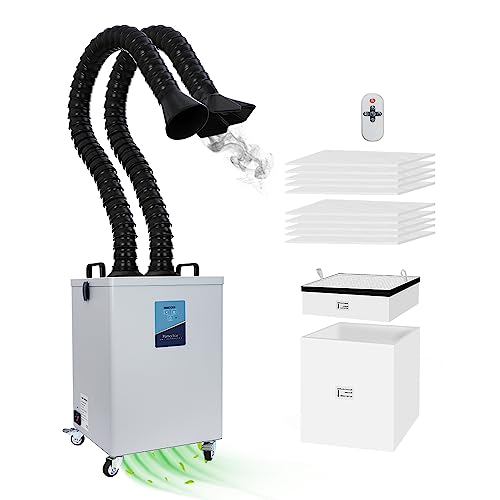
FumeClear FC-2003 Dual Ports Fume Extractor
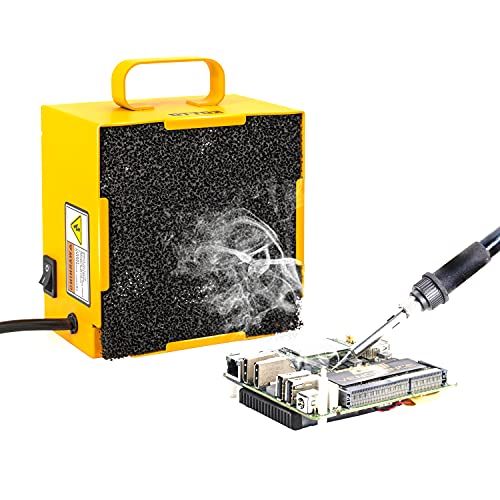
KOTTO Solder Smoke Absorber Remover
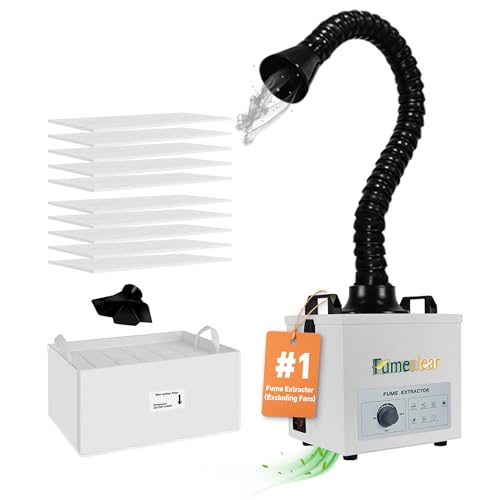
FumeClear FC-100A Fume Extractor 3-Stage
The Strengths Of Each Pick
The SainSmart bench-top smoke absorber is the kind of unit that earns its space on a crowded desk. Its pure copper motor (copper being a material known for durability and efficient heat transfer in small electric motors) paired with a 3300 RPM fan moves a respectable amount of air right at the source, claiming a capture distance around 7.9 inches from the tip. In a typical home workspace, that reach is enough to pull rising flux smoke before it curls toward your face.
You get four carbon filters in the box, so swapping in a fresh one takes seconds rather than a separate parts run. The whole unit sits low, with a footprint small enough to park next to a helping-hands stand without crowding your elbow room.
Standout Benefits
- 3300 RPM fan with a published capture reach around 7.9 inches
- Includes four activated carbon filters, so replacements are already on hand
- Pure copper motor for steady, long-running airflow
- Low-profile housing that tucks beside a soldering station
Honest Caveats
- Carbon filters need replacement as they saturate, and you’ll feel suction drop when it is time
- Capture distance is shorter than ducted options, so positioning matters
Who It Suits Best
First-time solderers and casual hobbyists who want a plug-and-play extractor with spare filters included.
Look Elsewhere When
You run a shared production bench, where the Hakko FX430-KIT1 source-capture arm pulls smoke straight from the tip.
WEP’s 948DQ-II folds a soldering station and a fume extractor into a single chassis, a useful move for a workbench that is still finding its layout. PID temperature control (a closed-loop system that holds the tip at a precise setpoint) keeps the iron steady for fine pitch work, and the sleep mode cools the tip automatically when you set it down. It’s the kind of thoughtful pair-up that saves you from buying a station and a separate fan.
The unit ships with three tips, a 35g roll of solder, a tip cleaner, and a stand. That bundle is genuinely useful for someone just building out a first setup, and the double-filter design gives the smoke path more surface area to trap fumes.
The Case For It
- Combines a PID-controlled soldering station with a fume extractor in one body
- Double-filter design extends the time between filter swaps
- Sleep mode protects the tip during pauses in your workflow
- Includes three tips, solder, and a tip cleaner for a ready-to-go station
Worth Noting
- Single shared housing means the fan and the iron share one footprint, which can feel cramped on tight desks
- Filters still require periodic replacement, so ongoing maintenance is part of ownership
Key Specs
Made For
Beginners and students who want a complete soldering-and-extraction station without buying pieces separately.
Consider Something Else When
You already own a station you love, in which case the standalone SainSmart Solder Fume Extractor Smoke Absorber 4 Pack is the simpler add-on.
Hakko has long been a familiar name in soldering shops, and the FA400-04 reflects that background. The unit accepts a vertical or low-profile orientation, with the source data noting airflow can increase noticeably in the laying-down position. That flexibility is helpful when your workbench changes shape between repair jobs and a long assembly session.
There are no digital readouts or fancy modes here. It’s a focused smoke absorber for someone who already knows the Hakko ecosystem and just wants a quiet, reliable add-on to a bench that’s already in motion.
Reasons It Performs
- Two-position design, with a low-profile mode that increases airflow
- Compact bench footprint for small workspaces
- Brand pedigree that pairs naturally with other Hakko gear
Small Caveats
- No duct or capture arm, so you position the unit close to the joint
- Filter life depends on workload, and heavy lead-free work saturates pads faster
Right Fit For
Hobbyists and techs who already use Hakko irons and want a brand-matched smoke absorber on the bench.
Not Your Match When
You need true source capture with an arm, where the Hakko FX430-KIT1 takes over.
Where most extractors sit beside your project, this SainSmart combo folds four magnetic gooseneck arms, a heat gun holder, an iron holder, and a smoke absorber into a single base. The magnets lock each accessory down, so a stray elbow won’t knock a hot iron loose. For board-level repair work, that integration is genuinely handy, because your hands stay free to hold solder and a flux pen at the same time.
The trade-off is reach. Source capture here is right at the board, so you’ll want to lean the extractor arm over the joint rather than expect a far-field pull. In practice, that means positioning the work between the arms before you start.
Notable Gains
- Magnetic base lets you reposition goosenecks and holders without tools
- Four flexible arms hold boards, lights, or small tools in any angle
- Smoke absorber lives above the work for direct capture
- Heat gun and iron holders keep hot tools secured during pauses
Practical Considerations
- Capture window is small, so the board needs to sit close to the extractor head
- Multiple goosenecks and accessories can feel busy on a tiny desk
Best Suited To
Repair techs and detail-oriented hobbyists who need both hands free while soldering small boards.
Skip It When
You mostly solder larger assemblies, where the KOTTO Solder Smoke Absorber Remover offers a wider capture area on the bench.
The Hakko FA-430 moves out of the hobby category and into light production territory. The kit ships with a 2.2-inch diameter duct arm and a rectangular nozzle, letting you position extraction right at the solder joint. For someone running the same joint repeatedly, that’s a meaningful upgrade over a passive bench unit.
The system is built around a three-stage filter that handles progressively finer particles. Combined with the source-capture nozzle, the FA-430 keeps the visible plume from ever reaching your breathing zone. You’ll feel the difference during a long assembly run.
The Practical Payoff
- Three-stage filter for progressively finer particle capture
- Duct arm with rectangular nozzle for direct source capture
- Quiet operation suited to extended bench sessions
Some Limits To Know
- Larger footprint than a desktop absorber
- Filter replacements are a recurring cost owners should plan for
Quick Facts
Whose Shelf It Belongs On
Small production lines, repair shops, and serious makers who want ducted source capture rather than passive bench extraction.
Another Choice May Suit
Casual hobbyists who only solder on weekends, where the FumeClear FC-100A Fume Extractor 3-Stage is friendlier to a small desk.
The FC-2002A bridges two worlds: bench soldering and small laser engraving. Its outdoor vent line is the headline feature, routing captured air outside rather than recycling it through a filter. For a workshop in a garage or shed, that venting path removes the toughest odors from your room entirely.
The published airflow of around 260 m³/h (153 CFM) is a strong pull for a unit in this size class. You’ll want a window or wall port ready before installing, and you should expect the unit to make itself heard while running. You may find that worthwhile if you regularly cut acrylic or solder heavier joints.
What Helps Most
- Outdoor vent expels air rather than filtering and recirculating
- Airflow near 260 m³/h supports 10 to 40W laser engravers and heavier soldering
- Effective for odors that carbon filters can’t fully scrub
Factors To Consider
- Requires a window or wall vent, which adds installation effort
- Louder than a sealed filter unit, so plan ear protection for long sessions
Who Should Grab It
Makers who split time between laser engraving and soldering and want one exhaust path for both.
Reach For A Different Pick When
Your workspace is indoors with no venting option, where the FumeClear FC-2003 Dual Ports Fume Extractor stays fully self-contained.
Two ports, one box. The FC-2003 lets you run hoses to two separate workstations or machines from a single unit, a layout that suits a small studio with a couple of soldering benches. The remote control is a small but meaningful touch, so you can toggle the fan without reaching across a hot work area.
Published efficiency numbers for this class of multi-stage filtration sit at 99.97% capture for sub-0.3-micron particles, which is reassuring if you work with leaded solder or resin-based fluxes. The trade-off is size: it’s a meaningful piece of gear to find a corner for.
A Few Strong Suits
- Two ports serve multiple workstations from one unit
- Three-stage filtration with high capture efficiency for fine particles
- Remote control adds convenience during long sessions
Things To Consider
- Larger housing than a single-port desktop model
- Two-arm setups may need planning to keep hoses out of the way
Feature Snapshot
Perfect Match For
Studio owners and small labs running two soldering or light assembly stations at once.
Swap It Out When
Your bench is a single setup, in which case the FumeClear FC-100A Fume Extractor 3-Stage is the simpler, smaller choice.
The KOTTO is a focused little unit that does one job at an entry-level price. The 3000 RPM fan pulls air across a 0.4-inch thick activated carbon filter, capturing flux smoke, gases, and the lighter chemical odors that come with through-hole work. The four non-slip feet hold it steady when you nudge the bench.
Capture reach is around 5 to 6 inches from the source, so it works best when the joint sits squarely in front of the intake. For weekend electronics tinkering, that’s a perfectly workable setup.
Useful Strengths
- 0.4-inch carbon filter pads trap flux smoke and chemical odors
- Four non-slip feet keep the unit planted on a smooth bench
- Compact size fits beside a laptop and a small parts tray
Honest Caveats
- Shorter capture reach than larger 3300 RPM units
- Single carbon filter means no pre-filter stage for larger particles
Built With In Mind
Beginners and weekend hobbyists who want simple, affordable smoke capture without overthinking specs.
A Better Fit Elsewhere
You solder daily for long hours, where the SainSmart Solder Fume Extractor Smoke Absorber 4 Pack’s stronger motor and replacement filters earn their keep.
The FC-100A is a small-footprint extractor with a meaningful filtration setup: a three-stage path topped with a high-iodine carbon stage, which is useful for capturing volatile organic compounds from rosin-core solder. For a home workshop where the bench doubles as a desk, the low-noise profile is what makes it livable.
Source data pegs maximum no-load power at 100W, and the unit is positioned for small bench soldering rather than laser engravers or high-volume production. Think of it as a focused, quiet helper rather than a heavy-duty workhorse.
Advantages To Know
- Three-stage filtration with a high-iodine carbon layer for VOCs (volatile organic compounds, the gases released by heated flux and resin)
- Low-noise design fits a home or apartment workshop
- Compact bench footprint for tight desks
Trade-Offs To Consider
- Not built for laser engraving or larger fume loads
- Filter changes are part of ownership, especially under heavy use
Feature Card
Who Will Love This
Home solderers in apartments or shared rooms who need a quiet, compact extractor that handles rosin fumes well.
Where A Sibling Pick Shines
You want two-station reach, in which case the FumeClear FC-2003 Dual Ports Fume Extractor covers a wider layout.
What Matters Most When Choosing Solder Fume Extractors
Capture Style And Reach
Soldering smoke rises in a thin, fast column right above the iron tip. Capture style determines whether the extractor pulls that plume at the source or waits for it to spread. A passive bench unit works when the joint sits squarely in front of the intake, but a ducted arm (like the one on the Hakko FX430-KIT1) follows the tip. Reach matters because flux smoke cools and settles within seconds, so every inch of distance from the joint reduces effective capture.
Filtration Stages And Carbon Quality
Activated carbon is the workhorse of most soldering extractors, because it adsorbs (traps on its surface) the gases and odor molecules that a paper filter cannot. Single-layer pads are common in budget units, while three-stage filtration adds a pre-filter for particulates and a final carbon layer for VOCs. For rosin-core solder or lead-free work that runs hot, a deeper carbon bed extends service life and keeps output air cleaner.
Noise, Footprint, And Power Draw
A noisy extractor gets switched off, which defeats the point. Low-noise designs are worth prioritizing if your bench shares a room with a desk or a sleeping area. Footprint matters too: a unit that overruns a small workbench tends to get pushed aside. Power draw under 100W is common for small bench models, while ducted production units pull more.
Maintenance And Filter Availability
Filters saturate. Plan a replacement schedule based on workload, and confirm the brand stocks replacements before you commit. Units that ship with spare filters in the box, like the SainSmart 4 Pack, take the sting out of the first swap.
Key Considerations Across These Picks
Pitfalls Shoppers Hit
The most common slip is choosing a unit by capture reach alone and ignoring filter life. A fan that pulls smoke from 8 inches is only useful if the carbon still absorbs fumes after a month of nightly work. Another trap is underestimating installation, especially for vented units like the FumeClear FC-2002A, which assume you already have an outdoor vent path. Finally, mixing up laser-rated extractors with soldering-rated ones leads to overpaying for airflow you won’t use.
Where The Extra Money Goes
Higher-tier models like the Hakko FX430-KIT1 and the FumeClear FC-2003 spend the extra on multi-stage filtration, ducted capture, and dual-port plumbing. That pays off when you solder daily or share a bench with another workstation. For a hobbyist who lights up an iron a few times a month, a compact single-stage unit handles the workload without the added cost or counter space.




