


Jewelry soldering lives in a different world from circuit board work. You’re working with tiny jump rings, fine bezel wire, and sheet metal that punishes any sloppy heat control, so the gear you choose shapes every result. Helping hands and bench magnifiers matter as much as the iron itself, because steady hands and clear sight often decide whether a seam flows cleanly or puckles. This roundup focuses on stations and third-hand setups designed for the close, patient, small-scale work that jewelry making demands, from beginner hobby tables to dedicated craft benches.
A Side-By-Side Look
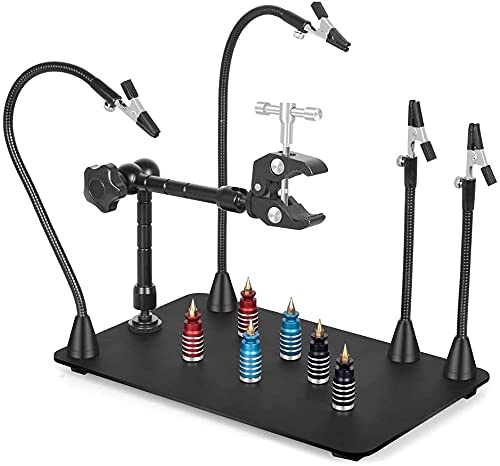
NOEVSBIG Magnetic Helping Hands Soldering Station with Heavy Duty Base

NOEVSBIG Helping Hands Soldering Station with 5X Magnifying Lamp

Super Magnetic Helping Hands Soldering Station with Alligator Clips
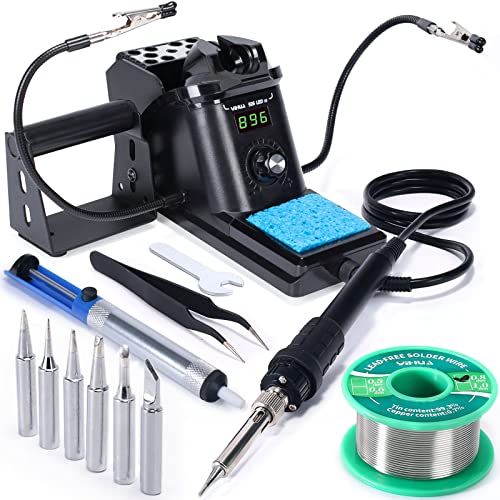
YIHUA 926 III 60W Digital Display Soldering Iron Station Kit
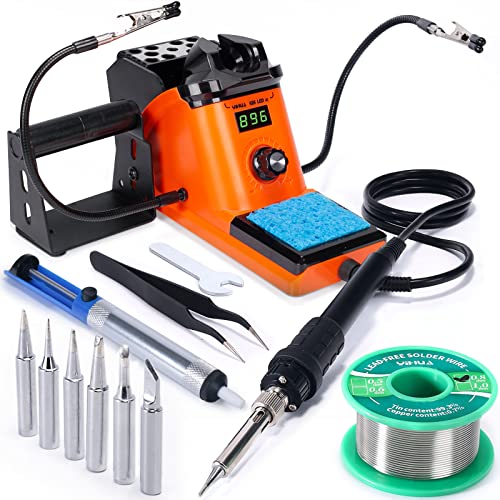
YIHUA 926 III 60W LED Display Soldering Iron Station Kit

YIHUA 926 III Soldering Iron Station Kit with 12-in-1 Helping Hands

Helping Hands Soldering Station with 12X Magnifying Glass and Light

Helping Hands Soldering Station with 12X Magnifier and Magnetic Holders

Helping Hands Soldering Station with Soldering Clamp and Hot Air Holder
The Details Behind The Selections
Workmanship on a jewelry bench gets ruined the second your helping hands wobble. The NOEVSBIG Magnetic Helping Hands Soldering Station leans on a powder-coated steel base weighing over 3.3 pounds, and that mass is the headline feature. Anchored to the bench, the rig doesn’t skate around when you nudge a workpiece or apply pressure mid-joint.
Four flexible gooseneck arms each end in a magnetic foot, so you can reorient them to cradle rings, pendants, or short wire segments from any angle. The included soldering clamp opens to 2.16 inches, which handles chunkier bezels and small findings without forcing you to disassemble the rig between tasks.
Where It Excels
- Weighted steel base stays planted during forceful soldering passes.
- Magnetic gooseneck feet reposition in seconds, no tools required.
- Wide-jaw clamp grips oversized bezels and small tools alike.
- Rubber feet keep the bench free of scuffs and metal-on-wood noise.
Things To Consider
- No magnifier included, so you’ll likely pair it with a loupe or separate lamp.
- Owners commonly report the powder-coated finish showing wear after extended bench use.
Key Specs
Best Suited To
Jewelers and crafters who already own a magnifier and want a planted, no-slide base for repeated bench sessions.
Consider Something Else When
Skip this for the NOEVSBIG Helping Hands Soldering Station with 5X Magnifying Lamp if built-in magnification matters more to you than raw base mass.
Close-up soldering punishes your eyes long before your hands give out. NOEVSBIG’s Helping Hands Soldering Station with 5X Magnifying Lamp solves that with a real optical glass lens that pulls tiny solder joints into clear focus, rather than a plastic lens that fuzzes at the edges. The lamp also lights the workpiece, so you stop hunching over a separate desk lamp.
You still get the same heavy 11″ x 7″ powder-coated steel base that anchors the brand’s first entry, plus four sturdy flexible arms and a 360-degree rotating clamp. Where this model pulls ahead is the integrated magnifier, which makes it a more self-contained jewelry station out of the box.
Everyday Advantages
- 5X optical glass lens stays sharp across the viewing area, not just the center.
- Built-in lamp removes one extra piece of bench clutter.
- Same planted steel base as the first NOEVSBIG pick, no swap in stability.
Worth Noting
- 5X magnification is moderate; ring sizers and tiny stone settings may still feel small.
- The lamp’s bulb or LED module is the one component most likely to need replacement over years of use.
Who It Suits Best
Mid-level jewelry makers assembling small findings and wirework who want magnification built into the station, not added later.
Look Elsewhere When
Pick the Helping Hands Soldering Station with 12X Magnifying Glass with Light instead if you regularly work on stone settings or filigree finer than 2mm.
Hobby soldering setups often need to move between projects, not stay locked to one bench. The Super Magnetic Helping Hands Soldering Station leans into that portability with a non-slip base and gooseneck arms that detach via strong magnetic feet. The alligator clips at the arm tips are the classic third-hand grip most jewelry hobbyists already know how to use.
It’s a lighter, more flexible alternative to the steel-plate NOEVSBIG stations above. You trade planted weight for reconfigurability, which makes the rig easier to reposition when you’re photographing finished pieces or moving between a jewelry station and an electronics repair desk.
Positive Points
- Strong magnetic arm feet lock firmly yet release on demand.
- Alligator clip tips hold irregularly shaped findings without custom jigs.
- Non-slip base works on glass, wood, and laminate benches alike.
- Four-arm layout covers multi-piece joints in a single setup.
Trade Offs
- Lighter base can drift when you apply sideways force to a stubborn solder joint.
- No magnifier, so detail-heavy jewelry work still needs a loupe or separate lamp.
- Alligator clip teeth may mark soft metals like fine silver if you clamp too tightly.
Made For
Casual jewelry hobbyists and mixed electronics-and-jewelry users who reconfigure their workbench often and don’t mind adding magnification separately.
Skip It When
Choose the NOEVSBIG Magnetic Helping Hands Soldering Station with Heavy Duty Base if your bench stays in one place and force-on-joint work is routine.
The YIHUA 926 III in its digital display configuration is the closest thing on this list to a complete first-station. You get a 60W iron with PID temperature stabilization (a feedback loop that keeps the tip at your set point rather than drifting), a digital display, and a kit that includes six extra tips, lead-free solder, a desoldering pump, stainless tweezers, and two helping-hand fixtures. For a beginner opening the box on day one, that means zero extra shopping.
The 194°F to 896°F range covers everything from delicate silver solder to higher-temp brass and steel findings, depending on your project. °C/°F switching, calibration support, and an auto-sleep function round out a station that grows with you rather than getting boxed up after the first six months.
A Favorable Mix
- Full kit of consumables and tools, no immediate accessory gap.
- PID temperature stabilization holds heat steady through long joints.
- Wide temperature range handles silver, gold, and brass solders.
- Auto-sleep extends tip life between bench sessions.
Points To Note
- No magnifier included, so stone setting still requires a separate loupe or lamp.
- Two helping hands are basic; you may outgrow them on complex multi-piece joints.
Key Specs
Right Fit For
First-time jewelry solderers who want a complete starter kit with a digital readout instead of guessing the temperature on a knob.
Swap It Out When
Pick the YIHUA 926 III 60W LED Display Soldering Iron Station Kit if you prefer an LED display look and want the same core kit in a slightly different configuration.
The LED-display sibling of the previous YIHUA 926 III shares its core iron, temperature range, and PID stabilization, but routes the readout through an LED screen rather than a different display style. For most first-time jewelry solderers, the difference is purely cosmetic, since both formats communicate the same set temperature clearly.
What’s worth noting is that this version is a near-identical kit, so the decision between it and the digital-display version usually comes down to availability and presentation preference. You still get the same six extra tips, lead-free solder roll, desoldering pump, stainless tweezers, and the two helping hands that let you start a first project without a second trip to the retailer.
The Upside
- Same 60W output and PID stabilization as the sibling model.
- LED display reads clearly even under bright bench lighting.
- Full accessory bundle matches the previous kit.
- Auto-sleep function preserves tip life between sessions.
Honest Caveats
- Differences from the digital display model are minimal; double-check the listing before assuming a separate feature set.
- Like its sibling, the included helping hands are entry-level rather than heavy-duty.
Best Suited To
New jewelry solderers who want a complete YIHUA 926 III starter and prefer an LED display aesthetic over the digital-style readout.
Not Your Match When
Choose the YIHUA 926 III Soldering Iron Station Kit with 12-in-1 Helping Hands if you want integrated helping hands and a solder dispenser built into the station body.
When bench space is tight, every accessory that lives separately costs you room. YIHUA’s 926 III 12-in-1 station folds the helping hands, solder dispenser, heat-resistant iron holder, and a desoldering pump directly into the station’s housing. The result is a single footprint rather than a cluster of loose tools that drift across the desk.
The iron itself remains the same 60W ESD-safe (electrostatic discharge protected, so it won’t zap sensitive components) design with PID temperature control, but the framing around it changes. For jewelry makers working at a small kitchen table or shared craft room, that integrated layout removes the usual “where do I put the solder spool” friction.
Practical Advantages
- Integrated 12-in-1 layout cuts bench clutter down to one station.
- Built-in solder dispenser keeps the wire feeding cleanly.
- ESD-safe design protects sensitive components and findings.
- Heat-resistant iron holder stays cool during long sessions.
Less Ideal Details
- Compact footprint means integrated helping hands have less reach than the standalone NOEVSBIG units.
- Fewer included tips than the previous two YIHUA kits, depending on retailer configuration.
Perfect Match For
Jewelry hobbyists with limited bench space who value an all-in-one station footprint over maximum tip count.
Another Choice May Suit
Pick the YIHUA 926 III 60W Digital Display Soldering Iron Station Kit if you want a larger tip variety and prefer separate helping hands you can position farther from the iron.
Stones, prongs, and miniature jump rings all hide detail that 5X magnification flattens. This MagnieOpti helping hands station jumps to 12X magnification through a 4.3-inch real glass lens, paired with a three-mode LED light that adjusts color temperature from warm to cool and dims from 10% to 100%. The combination turns stone setting and filigree from guesswork into something you can actually see.
Four magnetic third-hand arms handle the workholding side, and the LED lighting reduces eye fatigue on long sessions. Compared to the NOEVSBIG 5X station, this is a step up in visual precision at the cost of a slightly bulkier desk footprint.
Notable Upsides
- 12X real glass magnifier handles stone-level detail work.
- Three color modes and stepless dimming match different solder temperatures and materials.
- Magnetic third-hand arms reposition without tools.
- 4.3-inch lens covers a usable work area, not a postage-stamp spot.
Where It May Fall Short
- Higher magnification means a shallower working distance, so you’ll need to lean in closer.
- The lamp assembly adds height that may not suit low-clearance shelves or drawer storage.
Whose Shelf It Belongs On
Jewelry makers focused on stone setting, prong work, and filigree who need genuine 12X detail under steady LED light.
Reach For A Different Pick When
Pick the Helping Hands Soldering Station with 12X Magnifier and Magnetic Holders if you want height-adjustable magnetic posts for variable board thickness.
Thicker jewelry pieces and stacked components don’t sit flat on a fixed-height platform. The MagnieOpti station with 12X magnifier and magnetic holders answers that with magnetic pillars that step between three heights, roughly 0.51″, 1.18″, and 1.96″ off the base. The 12X glass lens, four magnetic third-hand arms, and four PCB holders round out a setup that adapts to whatever you set on it.
For crafters who split time between thin wire bezels and chunky cuff soldering, that height range is the standout feature. Most budget magnifier stations lock you into a single plane, which either leaves taller workpieces shadowed or pushes shorter workpieces out of focus.
The Helpful Details
- Three-step magnetic pillar height adjusts to thick and thin workpieces.
- 12X magnifier stays clear across the lens, with built-in LED support.
- Four magnetic holders grip irregular shapes firmly.
Possible Compromises
- Three height steps are preset rather than continuously adjustable.
- Magnetic holders and the magnifier lamp share the same base footprint, so plan the layout before mounting.
Key Specs
Built With In Mind
Jewelers who alternate between flat wire work and taller, layered assemblies and want the magnifier to keep up with each shape.
A Better Fit Elsewhere
Choose the Helping Hands Soldering Station with Soldering Clamp and Hot Air Holder if you also need a cradle for a hot air gun alongside magnifier work.
Plumbers and metal sculptors aren’t the only ones who want a hot air gun on standby. Some jewelry repairs call for heat-shrink tubing, resin curing, or gentle warm-up before solder flows, and a hot air gun sitting on a folded towel is a tip-over risk. The MagnieOpti station with soldering clamp and hot air holder gives that tool a proper 360-degree rotating cradle that doubles as a wide-jaw work clamp.
You still get the 12X magnifying glass, four magnetic third-hand arms, and four PCB holders, so the magnifier story matches the previous MagnieOpti stations. The hot air holder is the differentiator, and it makes the rig a sensible choice for crafters who already own or plan to add a heat gun to their workflow.
Features That Help
- 360-degree hot air gun holder doubles as a wide-jaw clamp, single-knob control.
- 2.3-inch clamp jaw opening grips larger workpieces than most helping hands clamps.
- 12X magnifier keeps detail work sharp alongside heat-tool tasks.
- Magnetic third-hand arms release without tools when you switch between hot and cold tasks.
Some Limits To Know
- Hot air gun not included, so factor that into your total setup cost.
- The 360-degree clamp’s single-knob design means all sections move together, limiting fine angle tweaks.
Who Should Grab It
Jewelry makers and mixed crafters who already use a hot air gun for shrink tubing, resin, or gentle preheating and want a tidy home for it on the bench.
Where A Sibling Pick Shines
Pick the Helping Hands Soldering Station with 12X Magnifier and Magnetic Holders if you’d rather spend the budget on height-adjustable magnetic posts than a heat-tool cradle.
What Matters Most Before Choosing Soldering Irons For Jewelry
Temperature Control and Tip Variety
Jewelry soldering covers a wide heat range, from low-temp silver solder to higher-melt brass and steel findings, so an iron that holds temperature steadily (not one that overshoots or sags) matters more than raw wattage. Look for stations with PID stabilization, a readable display, and a tip selection that includes both fine conical points for wirework and slightly broader tips for sheet metal. The trade-off is cost: stations with broader tip compatibility and tighter temperature control usually cost more than single-tip budget irons, but for mixed jewelry work the upgrade is worth it.
Magnification and Lighting
Jewelry detail lives in the half-millimeter range, and your eyes fatigue before your hands do. A 5X lens handles general findings, while 12X is closer to what stone setting and filigree really demand. Real glass lenses stay clear at the edges; plastic magnifiers often blur. Pair the lens with adjustable LED lighting, since the warm/cool color choice changes how solder flow reads on different metals.
Workholding Stability
Helping hands live or die on their base. Heavy steel plates stay planted, lighter magnetic bases reposition easily but drift under force. Magnetic PCB holders and gooseneck arms are flexible, while fixed clamps grip harder. Match the workholding style to the work: heavy bezels want planted mass, while quick hobby sessions appreciate tool-free magnetic reconfiguration.
Bench Footprint and Integration
All-in-one stations save space, but integrated helping hands usually have shorter reach than standalone units. Separate bases let you position the magnifier and the iron holder apart, which is easier on a wide bench. A crowded kitchen-table workspace benefits from integration; a dedicated craft room benefits from separation.
Smart Buying Advice Across These Picks
Where Shoppers Go Wrong
First-time jewelry solderers often buy the cheapest iron and skip the helping hands, then wonder why their joints look messy. The bigger problem is usually a missing third hand or a loupe, not the iron itself. Another common trap is assuming higher wattage means better results; without temperature stabilization, a 60W iron and a 100W iron can perform similarly on small joints. Plan the bench setup, not just the iron wattage.
What Separates Premium From Basic
The premium tier in this category buys you tighter temperature control, real glass magnification, planted steel bases, and integrated accessories that turn a kit into a workstation. The extra cost usually shows up where you use the station daily rather than once a month. For occasional hobby work, mid-tier kits cover the same tasks with slightly less polish, while for daily crafters, the premium touches pay off in reduced eye strain and more consistent joints.
Frequently Asked Questions
What temperature should a soldering iron reach for jewelry work?
Jewelry soldering typically needs between 350°F and 700°F depending on the metal and solder type, with fine silver work sitting at the lower end and brass findings at the upper end. A station with PID stabilization and a digital readout handles those shifts without overshooting delicate pieces.
Do I really need a magnifier for jewelry soldering?
A magnifier reduces eye strain and lets you see solder flow on small joints, which matters more as piece size shrinks. A 5X lens covers most wire and bezel work, while 12X is the right call for stone setting and filigree.
Can I use a regular electronics soldering iron for jewelry?
Electronics irons work for low-temperature silver solder on small findings, but they usually lack the tip variety and heat capacity for thicker pieces. A station designed for varied temperature ranges and fine tip selection adapts better across jewelry tasks.
How important is the base weight on a helping hands station?
A heavier base keeps the rig planted when you apply force to a stubborn joint or adjust clamped pieces. Lighter magnetic bases trade stability for portability, so the right pick depends on whether your bench stays put or moves with your projects.
What’s the benefit of PID temperature control in a soldering station?
PID control uses a feedback loop to hold the tip at the set temperature, rather than cycling above and below it. That stability gives cleaner solder flow, reduces the chance of cold joints, and protects heat-sensitive materials from accidental spikes.




