


Refreshing a tired wooden fence usually means a long weekend with a brush in hand, sore shoulders, and uneven coverage on every other board. A purpose-built spray gun turns that chore into a smoother, faster job, so long as you match the tool to the fence material, the coating you plan to use, and the scale of the project. This roundup covers nine options across tip upgrades, gravity-feed guns, and handheld stain sprayers, with notes on what each one is genuinely good at.
Your Options, Compared

Graco 221411 Reversible Airless Spray Tip (RAC IV, 411)

Wagner Spraytech Control Pro 130 HEA Paint & Stain Sprayer

Graco 60-Mesh Spray Gun Filter for SG2/SG3

RRJ R500 LVLP Spray Gun Kit with Four Nozzles

RRJ R500 LVLP Air Spray Gun with Regulator

RRJ R500 LVLP Spray Gun with Mixing Cups
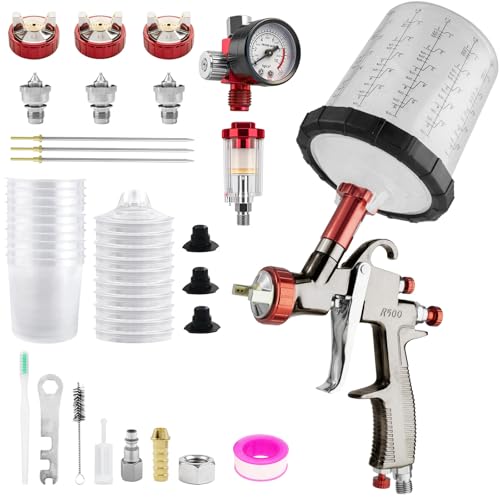
RRJ R500 LVLP Spray Gun with 10 Disposable Cups

Wagner Spraytech Control Spray QX2 HVLP Stain Sprayer

Wagner Spraytech FLEXiO 570 HVLP Sprayer (iSpray Nozzle)
Why These Options Stand Out
If you already own an airless paint sprayer, the 411 tip is one of those small parts that quietly changes how a project feels. It’s an airless spray tip, meaning it meters the fluid flow and fan width right at the nozzle, and the RAC IV series is the format most homeowner-grade Graco guns use. The “411” code tells you the fan is roughly 8 to 10 inches wide and the orifice sits at 0.011 inch, a sweet spot for thin coatings.
That fan width is friendly to a fence: wide enough to clear a board in one pass, narrow enough to keep stain off the neighbor’s shrubs. The reversible feature is the real reason to swap in a fresh one mid-project, because a quick twist clears a clog in seconds.
Everyday Advantages
- The 8 to 10 inch fan suits fence boards, rails, and pickets without wasted overspray.
- 0.011 inch orifice is well-matched to semi-transparent stains, water sealers, and polyurethanes.
- Reverse-A-Clean action lets you clear clogs without disassembly or extra tools.
- Slips onto existing spray gun guards without tools, which matters mid-project when your hands are coated.
Things To Consider
- It is a wear part, not a sprayer, so owners commonly rotate a spare tip rather than waiting for one to fail.
- Confirm your gun’s guard threads match RAC IV before ordering, since the wrong seal interface leaks at pressure.
Who It Suits Best
Anyone who already owns a Graco airless sprayer and wants a tip dialed in for staining a fence rather than thick latex paint.
Look Elsewhere When
The Wagner Spraytech FLEXiO 570 suits you better if you do not yet own a full airless rig and want a self-contained handheld option.
The Control Pro 130 lives in the airless category, meaning it pushes paint through a small tip at high pressure rather than relying on a compressor. The HEA suffix, short for High Efficiency Airless, is Wagner’s way of saying the pump is tuned to reduce the misty overspray that older airless machines are notorious for. For a fence, that means less stain drifting into your lawn and more of it landing on the wood.
Set-up is approachable for a first-timer: fill the cup, dial the pressure, and pull the trigger. Owners tackling full-perimeter fence runs on a single day tend to appreciate the continuous flow that airless systems deliver, compared to the slower pass-by-pass rhythm of a handheld HVLP unit.
Points In Its Favor
- Handles unthinned paints and stains straight from the can, saving the trial-and-error of thinning.
- Lower overspray than older airless designs, which keeps more product on the wood where it belongs.
- Steady flow rate across a long session, useful for fence runs that stretch 50 feet or more.
Points To Note
- Like any airless rig, flushing the line after use is non-negotiable if you want the pump to last.
- It is stationary and hose-fed, so working around tight fence corners means repositioning the unit more than once.
Key Specs
Made For
Homeowners staining or painting a full fence in one session who want airless power without a commercial-sized rig.
Skip It When
The Wagner Control Spray QX2 HVLP Stain Sprayer makes more sense for a short picket run you plan to finish in under an hour.
Filters rarely make a shopping list on their own, yet they decide whether your afternoon stays productive or turns into a troubleshooting session. The 60-mesh filter threads into Graco SG2 and SG3 spray guns, where it catches dried paint flecks and stray debris before they reach the tip. On a fence project, that single layer of screening is often the difference between a clean fan pattern and a spitting gun that ruins a board.
Replacement is a wash-and-swap job rather than a repair. Owners commonly report a clogged filter once it darkens past roughly 20 percent with residue, which is the signal to swap in a fresh one.
Features That Help
- Traps debris that would otherwise lodge in the tip and spoil the fan pattern.
- Direct compatibility with Graco SG10, SG20, SG Pro, and other SG2/SG3-series guns.
- Affordable enough to keep spares on hand, which matters during multi-day fence work.
Room For Improvement
- It is a consumable, not a tool, so it has no impact on spray quality by itself.
- Some owners install it and forget about it, which is the exact use case where it fails most quietly.
Best Suited To
Anyone already running a Graco SG2 or SG3 gun on stain or latex paint who wants fewer tip clogs mid-project.
Consider Something Else When
The RRJ R500 LVLP Spray Gun Kit is a better match if you do not yet own a Graco gun and need the main tool first.
LVLP stands for Low Volume Low Pressure, a spray-gun design that uses less compressed air than a traditional HVLP setup while still producing a soft, controlled atomization. The R500 kit arrives with four nozzle sizes (1.3, 1.5, 1.7, and 2.0 mm), which is unusually generous and gives you the right hole for everything from thin sealers to thicker latex fence paint.
You also get a 600 ml reusable plastic cup plus a 650 ml pack of disposable liners, so cleanup is mostly a matter of peeling out a liner and tossing it. The trade-off is that LVLP guns need an air compressor with reasonable CFM output, and that compressor is not in the box.
A Few Highlights
- Four nozzles cover thin sealers through thicker latex paint without guesswork.
- Disposable cup liners cut cleanup time, which matters on a long day of fence work.
- Three-control valve for paint flow, fan width, and air pressure keeps adjustments independent.
Points To Note
- You supply the compressor, so total cost climbs once that is factored in.
- The gun body is gravity-feed, which is comfortable but slightly top-heavy on long horizontal passes.
Quick Facts
Whose Shelf It Belongs On
Shops or serious diyers with a mid-sized air compressor who want one gun that can move between fence stain, furniture finish, and car touch-ups.
Where Another Pick Suits Better
The Wagner Control Spray QX2 HVLP Stain Sprayer fits you better if you do not own a compressor and want a self-contained unit.
Where the four-nozzle kit focuses on versatility, this R500 variant leans into build quality and includes a mini air regulator right on the handle. The body is one-piece forged aluminum with a Teflon coating, which matters when fence work exposes the gun to drips and the occasional drop onto gravel. The stainless-steel fluid nozzles are a step up from plated steel in corrosion resistance.
Air consumption lands between 3.0 and 3.9 CFM, which is modest enough to run from a small pancake compressor, and the working pressure tops out at around 50 PSI. For most fences, that is plenty of headroom.
Useful Strengths
- Forged aluminum body with Teflon surface holds up to outdoor use and solvent clean-up.
- On-handle regulator lets you trim air pressure without walking back to the compressor.
- Stainless-steel fluid nozzles resist corrosion from water-based stains.
Trade Offs
- No disposable cup liners in the box, so cleanup between coats is a manual wash.
Who Will Love This
Regular users who want a more durable gun body than entry-level LVLP kits offer and value the inline air regulator.
Reach For A Different Pick When
The Wagner FLEXiO 570 suits you better if you do not own a compressor and prefer an all-in-one handheld.
This R500 variant keeps the same Teflon-coated forged aluminum body as its sibling, then pairs it with a 650 ml mixing cup and a pack of 10 disposable liners. The included nozzles are 1.3, 1.7, and 2.0 mm, skipping the 1.5 mm middle option in favor of a wider spread between thin and thick coatings.
For a weekend fence project, the disposable liners are the quiet highlight. You can swap from stain to sealer in under a minute without scrubbing the cup, and you finish the day tossing used liners rather than chasing the last of the residue with a brush.
Where It Helps
- 10 disposable cup liners included, enough for a full weekend of color changes.
- Teflon-coated body releases dried paint more easily than bare aluminum.
- Nozzle spread covers sealing coats and thicker latex paint without re-buying hardware.
Softer Spots
- Air regulator is not built in, so pressure adjustments happen at the compressor.
The Right Fit
Diyers planning a short fence run who want a low-fuss cleanup path between stain and top coat.
Swap It Out When
The Wagner Spraytech Control Pro 130 HEA is the better pick for a long fence perimeter where continuous flow matters more than cup changes.
The third R500 variant in this roundup, and the one most suited to first-time LVLP users, ships with the smallest nozzle set: 1.3, 1.5, and 1.7 mm. Skipping the 2.0 mm keeps the focus on thinner coatings, which is exactly where most newcomers struggle. A smaller orifice atomizes more easily, lays down a softer fan, and forgives minor pressure mistakes.
The 10 disposable cup liners mean you can practice on scrap, switch to the actual fence boards, and still have clean cups left for the second coat. Less scrubbing, more spraying.
Noteworthy Benefits
- Smaller nozzle trio is forgiving for users still learning pressure and distance.
- Quick-disassembly design speeds cleaning once the project wraps.
Potential Drawbacks
- No 2.0 mm nozzle means thicker latex paint is a stretch without switching guns.
- Still requires a compressor that can sustain around 3 CFM, which rules out the smallest portable units.
Feature Snapshot
Who Should Grab It
First-time LVLP users staining a fence who want a setup that forgives small technique mistakes.
Not Your Match When
The Wagner Spraytech Control Pro 130 HEA is the better fit for large fence perimeters that need airless throughput.
The QX2 is a handheld HVLP, or High Volume Low Pressure, stain sprayer built for outdoor wood projects. It runs from a standard wall outlet, which means no compressor to drag around the yard, and offers three spray patterns you can dial in depending on whether you are hitting wide fence faces, narrow rails, or the lattice work above a gate.
Stains generally need a wider fan and a slower pass than paint, and the QX2’s pattern adjustments make that easier to control. For a one-fence homeowner project, it tends to be a more practical choice than dragging out an airless rig.
Everyday Wins
- Three spray patterns suit fence faces, rails, and tight lattice without swapping nozzles.
- No compressor required, so setup stays in the backyard rather than the garage.
Honest Caveats
- HVLP flow is slower than airless, so very long fence perimeters take patience.
- Some owners report needing to thin certain thick stains slightly, which adds a prep step.
At A Glance
Built With In Mind
Homeowners with a single fence to stain who want a self-contained unit that runs from a household outlet.
A Better Fit Elsewhere
The Wagner Spraytech Control Pro 130 HEA is a smarter pick for a multi-sided fence that needs serious throughput.
The FLEXiO 570 is the most flexible handheld in Wagner’s fence-friendly lineup. It ships with the iSpray nozzle for broad outdoor surfaces and a Detail Finish nozzle for tighter work, and the turbine sits in the body of the unit rather than a separate box. That keeps the hose short and the whole rig manageable to carry down a fence line.
You can spray unthinned latex and stains straight from the can on most projects, which removes a step that slows down a lot of first-time sprayer users. For a shop that hits fences, interior walls, and furniture in the same season, the FLEXiO rarely feels out of place.
What Pays Off
- Two included nozzles cover wide fence faces and detail work without buying extras.
- Handheld form factor is easy to carry to remote fence corners.
- Handles unthinned paint and stain, reducing prep time on most projects.
Factors To Consider
- Air is pulled from a built-in turbine, so runtime noise is louder than a compressor-fed LVLP gun.
Technical Highlights
Perfect Match For
Shops and homeowners who want a single handheld unit for fences, interior walls, and small furniture pieces.
Where A Sibling Pick Shines
The Wagner Spraytech Control Pro 130 HEA fits you better if your fence perimeter is long enough to demand continuous airless flow.
Choosing The Right Fence Sprayer For Your Project
Fence projects vary more than people expect. A 30-foot cedar privacy fence in a small backyard calls for a different tool than a 200-foot chain of stockade panels wrapping a rural lot, and a cedar split-rail fence drinks stain differently than a pressure-treated pine panel.
The first decision is coating compatibility. Latex paint, oil-based stain, and clear sealer each behave differently through a nozzle, and the tip size listed in the spec sheet is your best guide. Smaller orifices handle thin sealers and semi-transparent stains cleanly, while thicker latex paints want a larger hole. Buying a gun that includes multiple nozzles is a quiet way to cover future projects without re-buying hardware.
The second decision is the air source. Airless systems and HVLP turbine units run on wall power, while LVLP guns need a separate compressor that can sustain 3 to 4 CFM. Compressor-fed guns are usually cheaper, but they are only a bargain if you already own a compressor that can keep up.
The third decision is scale. For a single fence pass in a Saturday morning, a handheld HVLP makes the day easier. For a full-perimeter refinish, an airless rig or a high-flow LVLP kit saves real time. Weight, hose length, and the distance from your power outlet all nudge the choice as well.
Finally, look at cleanup. Disposable cup liners and quick-disassembly air caps make end-of-day cleanup far less of a deterrent, which means you are more likely to start the second coat on Sunday rather than putting it off.
Key Considerations Across These Picks
Common Buying Mistakes Around Fence Sprayers
Many shoppers pick a sprayer based on the largest fan width the box advertises, then discover on the first board that the fan is too wide to keep stain off the lawn. Match the fan to the surface, not to the brochure.
Another common slip is buying an LVLP gun without checking compressor CFM. A 2.0 mm nozzle demands more air than a small pancake compressor can deliver steadily, and starved airflow looks like bad technique rather than an undersized compressor.
What Higher-Tier Models Add
Stepping up to a higher tier in this category usually buys you a more durable gun body, an included air regulator, or a sealed pump that flushes faster. For a one-fence project, those upgrades are nice rather than essential. For a shop that runs the gun weekly across cars, fences, and furniture, they pay back in saved maintenance time and longer service life.
Frequently Asked Questions
What size tip is right for fence stain?
Most semi-transparent fence stains flow well through a 0.011 inch orifice, which is the size on common 411-series airless tips. Thicker solid stains and latex fence paint usually want a 0.013 to 0.015 inch orifice. Match the tip to the coating rather than the other way around.
Can you spray a fence with a handheld HVLP sprayer?
Yes, handheld HVLP units like the Wagner QX2 and FLEXiO 570 are well suited to fence staining because the low pressure lays down stain without blasting it into the yard. Expect a slower pass than an airless rig, but a cleaner result on a calm day.
Do I need an air compressor to use these sprayers?
Only the LVLP options from RRJ need a separate compressor. The Wagner handheld units and the Wagner Control Pro 130 HEA generate their own airflow from a built-in pump or turbine, so a standard outdoor outlet is enough.
How do you clean a fence spray gun after use?
For water-based coatings, flush the cup, lines, and nozzle with warm water and a few drops of dish soap until the runoff runs clear. For oil-based coatings, use the appropriate solvent and follow with a soapy water rinse. Cleaning right after the last coat is what keeps a gun working project after project.
How long does it take to spray a typical backyard fence?
A handheld HVLP on a 100-foot fence perimeter usually takes 2 to 3 hours of actual spray time, plus setup and cleanup. An airless system on the same fence can finish in roughly an hour of spray time, though setup takes longer and overspray control needs more attention.




