


Picking up welding as a hobby or side trade doesn’t have to feel like decoding a manual. Most first-timers want a machine that forgives shaky hands, runs on a normal 120V outlet, and doesn’t punish a small budget when something goes wrong. This roundup focuses on entry-friendly welders and supporting gear that meet those basics, from flux-core workhorses and lightweight stick units to a multi-process machine that grows with you. The list also covers a helmet worth pairing with your new setup.
The Picks In Brief

Hobart Handler 125 Flux-Core Wire Feed Welder

Lincoln Electric 90i FC Weld-PAK Flux Core Welder

GZ GUOZHI 130A Handheld ARC Welder

GZ GUOZHI Super Mini Stick Welder 130A

GZ GUOZHI 140A 3-in-1 MIG/ARC/Lift TIG Welder
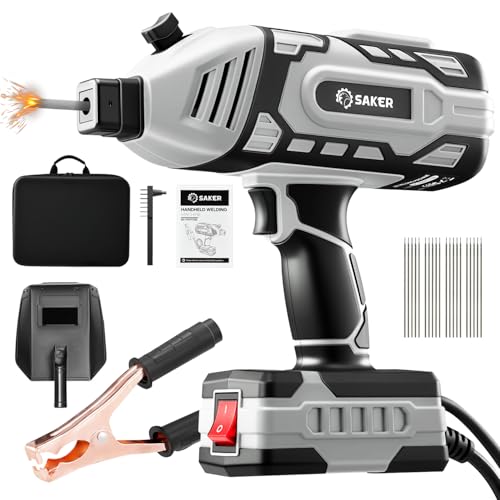
Saker 110V Portable ARC Welder with IGBT

Saker Portable 110V ARC Welder 5-Level IGBT

Saker Auto Darkening Welding Helmet with LED

BESTMIG 145A 4-in-1 Multi-Process Welder
What Each Pick Brings To The Table
The Hobart Handler 125 sits at the top of the list because it covers the widest range of first projects without forcing a quick upgrade. It runs on standard 120V household power, and the 25–130A output window handles thin sheet metal through 1/8″ steel with room to grow. For a homeowner patching a trailer, building a workbench, or trying automotive rust repair, that flexibility removes a lot of early guesswork.
Compared to the smaller Lincoln 90i FC that follows it, the Handler 125 leans heavier and more workshop-bound, but it pays back in duty cycle and gas-valve MIG capability once you want to add a shielding gas tank. It’s a long-term platform more than a quick fix.
The Upside
- Wide 25–130A range covers hobby and light fabrication
- MIG-capable with a built-in gas valve for cleaner welds
- Reputation for durable internal components and long service life
- Plenty of third-party consumables, tips, and support resources
Honest Caveats
- Heavier than entry-level flux-core units, less grab-and-go friendly
- Out-of-the-box flux-core welds need practice to look clean on bodywork
- Owners commonly report the included gun is fine for thin stock but wears faster on thicker passes
Who It Suits Best
Home garage users and hobbyists who want a single machine that scales from first beads to mid-sized fabrication projects.
Where Another Pick Suits Better
Pick the Lincoln Electric 90i FC Weld-PAK Flux Core Welder if you mostly haul the machine to job sites and need something lighter on the shoulder.
The Lincoln Electric 90i FC Weld-PAK strips welding down to the essentials, and that is exactly the point for a first machine. The protective metal case shrugs off a few drops in the shop, and the included shoulder strap makes it easy to walk out to the driveway or a job site. Plug it into any 120V outlet, feed in some flux-core wire, and you’re welding in minutes.
Where the Hobart Handler 125 stretches toward heavier fabrication, the 90i FC is happiest on small repairs: gate hinges, mower decks, exhaust pipes. That focus keeps the controls simple, which lowers the learning curve for someone still figuring out voltage and wire feed speed.
Real-World Strengths
- Compact, portable design with shoulder strap for easy carry
- Simple control layout that flattens the beginner learning curve
- Built-in metal case offers solid everyday protection
Worth Noting
- Lower output range limits you on thicker steel sections
- Spool size and duty cycle constrain longer continuous beads
Made For
First-timers handling small repair jobs around the house who want a forgiving, easy-to-transport machine.
Consider Something Else When
Reach for the Hobart Handler 125 if your projects trend toward 1/8″ steel and longer weld passes.
The GZ GUOZHI 130A handheld ARC welder goes where bigger machines can’t. The aerospace-style handheld body and integrated digital current display make it feel closer to a power tool than a stationary welder, and the IGBT inverter keeps the arc stable even on imperfect shop power. For rooftop repairs, fence work, or anything up on a ladder, that portability is the whole point.
Stick welding (also called ARC or MMA welding) trades wire-feeding simplicity for fewer consumables, so there’s no spool to load and less to go wrong mid-job. Owners commonly rely on it as a quick-response tool rather than a primary shop machine.
Features That Help
- Compact handheld form factor ideal for aerial and tight-space work
- Digital amp readout removes the guesswork from current setting
- Built-in overheating, over-current, and overloading protection circuits
- Hot start function helps establish the arc faster on cold steel
Trade Offs
- Limited to steel, stainless, and iron, since aluminum is not supported
- Stick process means more spatter cleanup than MIG or flux-core
Right Fit For
Field repair work, fence and gate fixes, and hobbyists who frequently weld in awkward positions off the bench.
Not Your Match When
Go with the GZ GUOZHI 140A 3-in-1 MIG/ARC/Lift TIG Welder if you want cleaner bead appearance on body panels or furniture projects.
At roughly 3.5 lb and a footprint closer to a lunchbox than a welder, the GZ GUOZHI Super Mini Stick Welder is the most stowable option here. The adjustable shoulder strap makes it genuinely wearable, so you can walk to the back fence with both hands free until you’re ready to strike an arc. It accepts common rods like E6011, E6013, E7014, and E7018 under 1/8″, covering the most popular stick options for hobby welding.
The trade-off for the size is duty cycle and heat management. It shines on quick fixes, not on a long day of production cutting. The form factor also encourages keeping a small rod stash with the unit, which is one less trip back to the shop mid-project.
A Favorable Mix
- Ultra-compact body slips into a toolbox or backpack
- Compatible with widely available common stick electrodes
- Shoulder strap adds genuine hands-free carrying for field use
- Simple two-knob control panel keeps setup fast
Points To Note
- Small chassis means shorter duty cycles before cooldown
- Best on thinner material, since heavy plate will test its limits
Best Suited To
Rural homeowners, small-acreage work, and anyone who needs a backup stick welder that lives in a truck or ATV.
Look Elsewhere When
Choose the Saker Portable 110V ARC Welder 5-Level IGBT if you want more granular current control on slightly thicker stock.
When one project calls for flux-core MIG and the next calls for stick repair work, swapping machines gets old fast. The GZ GUOZHI 140A combines flux MIG, ARC stick, and Lift TIG (a simplified TIG arc-start method) in a single 110V unit, with synergic control that adjusts voltage and wire feed speed automatically when you change current. For a hobbyist still exploring, that flexibility keeps options open without buying three separate welders.
Where the Saker portable stick welders keep things minimal, this unit leans into versatility. Setup is more involved, and the included MIG gun is functional but not heavy-duty, yet for a learner that variety often matters more than peak amperage.
What It Does Well
- Three welding processes in a single compact body
- Synergic control simplifies setup for new users
- IGBT inverter helps maintain a stable arc across processes
- Black housing design keeps it looking like a shop tool, not a toy
Some Limits To Know
- Lift TIG requires a separate TIG torch, not always included
- Multi-process convenience comes with more menus to learn upfront
Who Should Grab It
Garage hobbyists who want a single machine that handles auto body, fence repair, and the occasional stainless project.
A Better Fit Elsewhere
The BESTMIG 145A 4-in-1 Multi-Process Welder makes more sense if you also want dual-voltage capability and a bundled helmet.
The Saker portable electric welder keeps the form factor small but adds five current adjustment steps, giving beginners more granular control than a single-knob stick welder. IGBT inverter technology (a solid-state power module that smooths and regulates current) helps with arc stability, which matters when you’re still learning to hold a steady bead. The grey housing and integrated handle make it look at home on a workbench next to a grinder and a drill.
It’s designed around 3/32″ rods, so it favors thin to mid-gauge steel. You may find it less comfortable on heavy plate where larger diameter electrodes are common, but for the typical hobby workload that’s a reasonable trade.
What Works In Its Favor
- Five variable current steps help match rod size to material thickness
- Stable arc performance from the IGBT inverter design
- Compact body with carry handle for easy repositioning
- Cleaner welds with reduced spatter compared to basic transformer welders
Honest Caveats
- Rod capacity tops out around 3/32″, limiting heavy plate work
- Stock is limited to common steel types, not aluminum
Built With In Mind
Beginners working on thin sheet metal, exhaust repairs, and small brackets who want step-by-step current control.
Swap It Out When
Pick the GZ GUOZHI 130A Handheld ARC Welder for overhead and ladder work where an even smaller stick unit helps.
The Saker 5-Level IGBT stick welder sits between the brand’s portable model and the more ambitious multi-process units. The five-step current selector is the same control philosophy as its sibling, but the simpler interface and standard 3/32″ rod focus make this an easy recommendation for someone buying a first welder on a tight budget. Easy arc initiation is a recurring theme in Saker’s beginner-focused lineup, and that’s exactly what new users need most.
It’s not a production machine, and it won’t replace a true MIG setup on a car restoration. As a learning tool that builds real stick technique, though, the price-to-capability balance tends to land well for first-timers.
Key Advantages
- Five current levels cover most beginner stick scenarios
- Reliable arc starts reduce frustration during early practice
- Lightweight enough to move between garage and driveway jobs
Potential Drawbacks
- Limited duty cycle compared to higher-amperage shop welders
- No flux-core or MIG option, so you must invest in stick rods
Who Will Love This
First-time learners on a budget who want a low-pressure introduction to stick welding fundamentals.
Reach For A Different Pick When
The Hobart Handler 125 fits better if you anticipate moving into MIG welding with shielding gas within the first year.
A welding helmet isn’t optional, but it can still be an upgrade worth choosing carefully. The Saker auto-darkening helmet uses true color view technology (a lens system that renders the weld pool in more natural hues instead of the traditional green tint), which makes it easier to see the puddle and avoid common mistakes like undercutting or slag inclusions. The integrated LED worklight is a small but meaningful touch, especially in dim garages and basement workshops where shadows hide your workpiece.
Pairing this with any of the welders above turns a budget setup into a more comfortable learning environment, particularly for users still learning to read the weld pool. It’s a sensible add-on for first-timers who don’t already own a fixed-shade hood.
Useful Strengths
- True color view lens reduces eye strain during longer sessions
- Built-in LED light brightens the workpiece before and after striking an arc
- Auto-darkening reaction keeps hands in position without flipping a hood
Worth Bearing In Mind
- Spare lens cartridges and headgear parts are worth sourcing early
Perfect Match For
First-time welders working in dim garages or shops where puddle visibility is a real challenge.
Where A Sibling Pick Shines
The BESTMIG 145A 4-in-1 Multi-Process Welder ships with its own helmet, so you may not need to buy one separately.
The BESTMIG 145A is the most ambitious unit on this list, and the most “future-proof” pick for someone serious about learning. It runs on 110V or 220V, covers MIG, gasless flux core, MMA stick, and Lift TIG, and pairs with a synergy IGBT inverter that handles parameter matching. You also get a welding helmet and gloves in the box, so the first session can start as soon as the unit is unboxed.
Where the smaller GZ GUOZHI 3-in-1 keeps things approachable, the BESTMIG 145A leans toward long-term skill development. Depending on your home electrical setup, the dual-voltage capability can be a real asset, but you may find the learning curve steeper than a single-process starter. For motivated learners, the headroom is the appeal.
What Helps Most
- Four welding processes in one unit, including 220V MIG and TIG
- Synergy IGBT inverter simplifies parameter selection
- Helmet and gloves included, useful for a complete starter kit
- Broad wire compatibility, including flux-cored and stainless options
Where It Is Less Suited
- More setup and process switching than a single-purpose starter welder
- 220V outlet is required for full power, which not every home shop has
The Right Fit
Motivated learners who want one machine that grows with their skills across MIG, stick, and TIG.
Skip It When
The Lincoln Electric 90i FC Weld-PAK Flux Core Welder is the better match for someone who only wants to fix a few household items.
Key Factors When Shopping For Your First Welder
Match The Process To Your Real Projects
Stick and flux-core welders are the most forgiving for beginners, since they tolerate dirty or slightly rusty steel without much fuss. MIG gives cleaner results, but needs shielding gas and cleaner metal. If your project list leans toward auto body or furniture, MIG is worth the learning curve. For fence and farm repairs, flux-core or stick handles the conditions better.
Pay Attention To Power And Duty Cycle
Every welder on this list runs on a standard 120V outlet, which keeps installation simple, but duty cycle (the percentage of a 10-minute window a welder can run before needing cooldown) varies widely. Smaller handheld units cool faster in real terms but also need more breaks during long beads. If you weld mostly in short bursts, a compact unit is fine. For longer passes, a heavier chassis with a higher duty cycle pays off.
Prioritize Protective Gear From Day One
A quality auto-darkening helmet, gloves, and a jacket matter more than a slightly more powerful machine. Eye protection that lets you see the puddle clearly makes a real difference in learning speed. Budget for those basics before chasing extra amperage.
Smart Angles Before You Commit
Common Shopping Slip Ups
First-timers often overspend on amperage they won’t use, or buy a MIG machine without planning for a shielding gas tank and regulator. Others pick a tiny stick welder expecting it to handle 1/4″ plate, then stall out on the first heavy repair. Match the machine to the projects you actually have, not the ones you imagine starting.
Where The Extra Money Goes
A higher-tier multi-process unit like the BESTMIG 145A gives you dual-voltage flexibility, broader process support, and bundled safety gear. That investment makes sense when you plan to grow into MIG, stick, and TIG work over a year or two. For someone who only needs to fix a gate hinge, a simpler Lincoln or Saker unit is the smarter spend.




