


A step bit replaces a stack of separate drill bits, letting you bore multiple hole sizes from a single tool by stepping up gradually through each diameter. The right one cuts cleanly through sheet metal, doesn’t wander when you start the hole, and holds up to repeated use in mild steel, aluminum, and other common shop materials. This lineup covers everything from compact bits for tight electrical boxes to heavy-duty cobalt options for daily fabrication work, so you can match the bit to the job without overpaying for capacity you won’t use.
A Closer Look At The Lineup

Greenlee GSB12 1-3/8″ Step Bit (#12) Metal Cutter

Milwaukee 48-89-9205 Step Bit #5 1/4″ – 1-3/8″

DEWALT Step Drill Bit Impact Ready (DWA1783IR)

Bestwork M35 Cobalt Step Bit 7/8″-1-3/8″ 19 Step

Milwaukee SHOCKWAVE Impact Duty Step Bit 3-Piece Set

toolant Mini Step Drill Bit 1″ M2 HSS Hex Shank

Bestwork 5-Piece HSS Step Bit Set 1/8″-1-3/8″
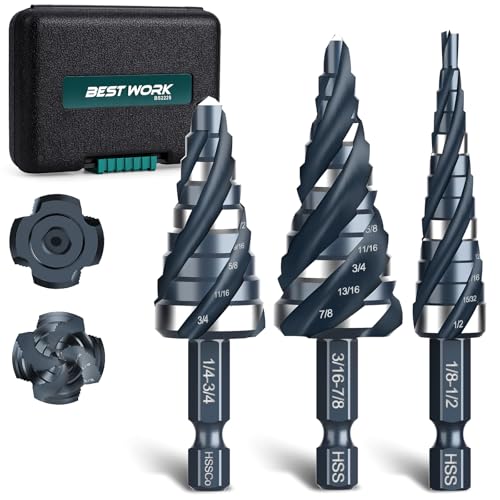
Bestwork 3-Piece HSS Step Bit Set 1/8″-7/8″

Bestwork 5-Piece HSS Step Bit Set 1/8″-1-3/8″
A Breakdown Of The Leading Choices
The Greenlee GSB12 lands at the top of the list because it solves a specific problem well: cutting clean, large-diameter holes in thin metal without grabbing or wandering. Its patented split-step design creates a sharper starter point, so you can begin a hole on a curved surface like conduit or pipe without the bit skating across the metal. The 1-3/8″ maximum diameter covers most common knockout sizes, and the 1/2″ shank fits standard drill chucks found on most corded and cordless drills in a working shop.
Where the Greenlee earns its reputation is in trade work. Electricians running 1″ or 3/4″ conduit, plumbers drilling through steel enclosures, and HVAC techs punching pass-throughs all benefit from a bit that starts fast and finishes clean. Compared to the Milwaukee #5 covered later, this one prioritizes diameter range over impact compatibility, so it’s better suited to standard drill presses and hand drills than impact drivers. For most professionals drilling sheet steel daily, it’s the dependable workhorse you reach for first.
Everyday Advantages
- The split-step tip starts cleanly on curved or uneven metal surfaces, saving you from center-punching every hole.
- The 1-3/8″ max diameter covers standard conduit knockouts in a single pass.
- Works across mild steel, aluminum, brass, copper, wood, fiberglass, and laminates.
- The 1/2″ shank provides solid grip in standard drill chucks, reducing slip under load.
Things To Consider
- Not designed for use in impact drivers, so it won’t pair with the SHOCKWAVE or DEWALT impact-ready picks below.
- Single-size tool means you need additional bits for smaller holes under 1/4″.
- Owners commonly report needing cutting fluid on thicker steel to extend bit life.
Who It Suits Best
Trade professionals in electrical, plumbing, and HVAC fields who need reliable, large-diameter holes in sheet metal every week.
Look Elsewhere When
The toolant Mini Step Drill Bit is a smarter match when you need to drill small holes inside cramped electrical boxes where a 1-3/8″ bit simply won’t fit.
The Milwaukee 48-89-9205 covers a wide 1/4″ to 1-3/8″ range in a single bit, making it the go-to when you don’t know exactly what size hole you’ll need next. Its dual-flute geometry, meaning two spiraling channels that evacuate chips faster, keeps the cut smooth even in thicker mild steel. The black oxide coating adds a layer of corrosion resistance and reduces friction during extended drilling sessions, which matters when you’re running the bit through a full fabrication job.
Where this Milwaukee earns its spot is in fabrication and HVAC shops where hole sizes vary throughout the day. Unlike the Greenlee GSB12, which targets the upper end of the diameter range, this one gives you nine usable sizes from 1/4″ upward in 1/8″ increments. The 3/8″ shank fits most standard corded and cordless drills, though it isn’t optimized for impact drivers like the SHOCKWAVE set below. For shop owners handling varied sheet metal work, it eliminates the need to swap bits constantly.
A Few Highlights
- Nine step sizes from 1/4″ to 1-3/8″ handle most common drilling needs.
- Black oxide surface treatment reduces heat buildup and resists corrosion in humid shops.
- Dual-flute design clears chips efficiently, keeping cuts cool and fast.
Worth Noting
- The 3/8″ shank may not fit smaller 1/4″ chuck drills, limiting tool compatibility.
- Not impact-rated, so it isn’t the right match for high-torque impact drivers.
Key Specs
Made For
Sheet metal fabricators, HVAC installers, and maintenance techs who need one bit to cover most hole sizes in steel and aluminum.
A Better Fit Elsewhere
The DEWALT DWA1783IR is worth a look when you primarily use an impact driver and need a bit rated for that tool’s higher torque output.
The DEWALT DWA1783IR fills the small-hole gap that the Greenlee and Milwaukee bits leave behind. Its 1/8″ to 1/2″ range handles electrical box cutouts, low-voltage wiring pass-throughs, and HVAC bracket mounting holes, all without the need to swap bits. The split-point tip starts on contact, which is helpful when you’re working on a finished surface and don’t want to chase the bit across the metal.
What sets this DEWALT apart is its impact-ready rating. While the previous picks work fine in standard drills, this one is engineered to withstand the higher torque and concussive force of impact drivers, so you can use it with the same tool you drive lag bolts with. The titanium nitride coating extends bit life compared to standard black oxide finishes, though it’s optimized for the smaller diameter range. Compared to the toolant mini covered later, this DEWALT offers more step sizes but a longer overall body that may not reach into tight enclosures.
Bright Spots
- Impact-rated construction handles the higher torque of 18V and 20V impact drivers without cracking.
- Titanium nitride coating extends cutting life compared to standard finishes.
- The 1/8″ starting size handles small pilot and pass-through holes that larger bits can’t reach.
Points To Keep In Mind
- Max diameter tops out at 1/2″, so it can’t cover conduit or knockout-sized holes.
- Smaller overall range means you’ll need a second bit for medium and large holes.
Best Suited To
Electricians and low-voltage installers who need small, clean holes in metal enclosures and want to use their impact driver as the power source.
Skip It When
The Milwaukee 48-89-9205 makes more sense when you need to step up to 3/4″ or larger holes for conduit runs and standard bit steps don’t cover the range.
The Bestwork M35 cobalt step bit targets the hardest materials on this list, namely stainless steel, hardened alloys, and thick plate where standard HSS bits dull quickly. M35 is a cobalt-containing high-speed steel (HSS is the standard for general-purpose drill bits, and cobalt alloys improve heat resistance) that holds its hardness at elevated temperatures, so you can run the bit longer between cool-downs. The TiAlN coating (titanium aluminum nitride, a hard ceramic layer that reduces friction and wear) adds another layer of heat and wear protection, making this a smart pick for daily production work.
The 19-step range from 7/8″ to 1-3/8″ gives you fine size control, which matters when you’re drilling for specific conduit fittings or trade-sized knockouts. Compared to the DEWALT DWA1783IR, which targets smaller holes, this Bestwork is a specialty tool for upper-range work in tough metals. For shops that fabricate in stainless regularly, the bit pays for itself in reduced replacement costs and fewer job interruptions.
The Helpful Details
- M35 cobalt construction holds hardness at high temperatures, ideal for stainless and hardened steel.
- TiAlN coating reduces friction and extends tool life under heavy use.
- Nineteen fine-step increments let you match trade-specific hole sizes precisely.
Honest Caveats
- The 7/8″ starting size means you need a separate bit for smaller holes.
- Cobalt bits are more brittle than standard HSS, so they can chip if dropped or side-loaded.
Who Will Love This
Fabrication shops, welders, and metalworkers who regularly drill stainless steel, chrome-moly, or other tough alloys and need a bit that won’t soften under heat.
Reach For A Different Pick When
The Bestwork 3-Piece HSS Set is a better everyday match when you mainly work in mild steel and aluminum and want a full range of sizes for occasional projects.
The Milwaukee SHOCKWAVE set brings together three impact-rated step bits covering the most-used size ranges for trade and DIY work. The 1/4″ hex shank, the same quick-change format used by most impact driver bits, snaps directly into your impact driver’s collet, so you don’t need to swap chucks. The optimized SHOCKZONE body absorbs the peak torque from impact drivers, which extends bit life compared to standard step bits used in the same tools.
Where this set shines is versatility. You get coverage for small electrical holes, mid-range conduit pass-throughs, and larger mounting holes, all with bits built specifically for impact driver use. Compared to the single Greenlee GSB12 above, you sacrifice the 1-3/8″ max diameter but gain the ability to drill multiple sizes without changing bits. For anyone already invested in the Milwaukee M18 or M12 platform, the set integrates cleanly into the existing bit ecosystem and storage cases.
Useful Touches
- The SHOCKZONE body absorbs peak impact torque, reducing the risk of shank failure.
- Three bits cover the most common step ranges in one purchase.
- 1/4″ hex shank works directly in impact drivers and quick-change systems.
Trade Offs
- Higher upfront cost than single bits, though the set format often costs less per bit.
- Maximum size is smaller than the single Milwaukee 48-89-9205, so very large holes still need a dedicated bit.
Perfect Match For
Tradespeople and serious DIYers who already run impact drivers and want a matching set that handles most hole sizes without breaking the impact-rated bit standard.
Where A Sibling Pick Shines
The DEWALT DWA1783IR is the right call for tool users already standardized on DEWALT’s 20V MAX platform and a single small-range bit.
The toolant mini step bit solves a problem the other picks can’t: drilling stepped holes in places where a full-size bit physically won’t fit. At 47mm total length with a 1″ cutting body, it reaches into recessed electrical boxes, panel enclosures, and tight control cabinets where standard step bits bind against the surrounding hardware. The 1/4″ hex shank also means it works with both standard drill chucks and impact driver quick-change systems.
The 1/8″ to 1/4″ range is narrow, but it covers the most common small-hole needs: wire pass-throughs, pilot holes, and small fastener clearance. M2 HSS is a step up from carbon steel in heat resistance, though it doesn’t match the cobalt content of the Bestwork M35 above. For low-voltage installers, AV techs, and anyone who routinely works inside cramped enclosures, this compact bit fills a gap that no full-size step bit can.
A Few Strong Suits
- The 47mm total length fits inside recessed boxes and tight enclosures where standard bits bind.
- The 1/4″ hex shank works with both standard chucks and impact driver quick-change systems.
- M2 HSS construction handles mild steel and aluminum without immediate dulling.
Less-Strong Areas
- The 1/4″ max diameter is far smaller than other picks, so you need additional bits for larger holes.
- Compact size means a shorter cutting life before resharpening or replacement.
Quick Facts
Right Fit For
Low-voltage installers, AV techs, and control panel builders who need to drill stepped holes in tight enclosures where standard bits can’t reach.
Another Choice May Suit
The DEWALT DWA1783IR is a better everyday match when you work in open spaces and want a wider range of step sizes from a single bit.
The Bestwork 5-piece set covers the full spectrum of step bit sizes, from 1/8″ all the way up to 1-3/8″, without the cobalt premium of the M35 model above. The HSS construction with four-spiral flute geometry clears chips efficiently, and Rockwell 62-65 hardness, a measure of steel toughness on a standardized scale, gives you reasonable durability for general shop use. For someone setting up a workshop from scratch or replacing a worn collection, buying a set is more cost-effective than picking up individual bits over time.
Where this set falls short is in extreme-duty applications. Without the cobalt content of the M35 or the impact rating of the Milwaukee SHOCKWAVE, these bits are best for standard drilling in mild steel, aluminum, and copper. Compared to the 3-piece version covered next, you get more size coverage at the expense of a higher upfront cost and a more crowded bit drawer.
Notable Gains
- Five bits cover the full range from small pilot holes to 1-3/8″ knockouts.
- Four-spiral flute design evacuates chips smoothly in mild steel and aluminum.
- Set format costs less per bit than buying individual sizes over time.
Points To Note
- Standard HSS lacks the heat resistance of cobalt, so production work in stainless will shorten tool life.
- No impact rating means these aren’t designed for use in impact drivers under heavy load.
Whose Shelf It Belongs On
Home workshop owners and DIYers who want full size coverage for occasional projects in mild steel, aluminum, and other common metals.
Swap It Out When
The Bestwork M35 Cobalt Step Bit is the right replacement when you regularly drill stainless or hardened alloys and need a bit that holds up under heat.
The 3-piece Bestwork set offers a more approachable entry point for DIYers and homeowners who don’t need the full 1-3/8″ range. The 1/8″ to 7/8″ coverage handles most home workshop tasks: electrical box modifications, plumbing bracket installation, and sheet metal fabrication for custom projects. The HSS construction with Rockwell 62-65 hardness provides enough durability for occasional use without the cost of cobalt-grade materials.
Compared to the 5-piece set above, this one trades the larger sizes for a more focused size range that’s easier to understand. You won’t find yourself grabbing for a bit you don’t need, and the smaller set fits in standard tool drawer organizers without dominating the space. For someone making their first step bit purchase, this covers the common sizes without overwhelming the wallet or the toolbox.
Everyday Wins
- Focused size range covers most home and DIY drilling tasks.
- HSS construction handles mild steel, aluminum, and copper without specialty tooling.
- Three-bit set is easier to store than larger collections.
Possible Compromises
- Maxes out at 7/8″, so larger conduit and knockout holes require a separate purchase.
- Not rated for impact drivers, limiting use to standard drill tools.
Built With In Mind
DIY homeowners and hobbyists starting their first step bit collection for occasional metalworking projects around the house or garage.
Not Your Match When
The Greenlee GSB12 is the right tool when you need to drill holes larger than 7/8″ for conduit work and standard plumbing installations.
The second Bestwork 5-piece set on this list shares the same range as the first, from 1/8″ to 1-3/8″, but features a four-blade cutting geometry with vibration-reducing design. The HSS steel body holds up to typical shop conditions, and the multi-bit format means you can dedicate one bit per common size range without constantly swapping tools. For shops running multiple workstations, having backup bits on hand prevents downtime when a bit dulls mid-project.
Compared to the Milwaukee SHOCKWAVE set covered earlier, this Bestwork trades impact rating for a broader size range. The four-flute geometry keeps cuts smooth, though it doesn’t have the SHOCKZONE absorption that protects against impact driver torque spikes. It’s a practical all-rounder for general metalwork, and the price-per-bit math works out well for anyone buying step bits for the first time.
The Practical Payoff
- Four-flute geometry delivers smooth, low-vibration cuts in mild steel.
- Full size range from 1/8″ to 1-3/8″ covers small to large drilling needs.
- Multiple bits allow dedicated use by size range, reducing wear on the most-used bits.
Potential Drawbacks
- Standard HSS construction limits production use in stainless or hardened steel.
- Not impact-rated, so high-torque impact drivers may shorten bit life.
Feature Snapshot
The Right Fit
Small to mid-sized shops and serious DIYers who want a full range of step bits at a reasonable cost without the cobalt or impact-rated premium.
Consider Something Else When
The Milwaukee SHOCKWAVE set is the better match for users on the Milwaukee M18 platform who need impact-rated bits that integrate with their existing tool ecosystem.
Choosing The Right Step Bit For Your Work
Step bits are deceptively simple tools, but a few attributes determine how well they perform on real shop tasks. Material composition matters most: standard HSS handles mild steel and aluminum but softens quickly in stainless, while M35 cobalt holds hardness at the higher temperatures that hard metals generate. Shank size and type affect compatibility with your drill or impact driver, and step range determines whether one bit covers the hole sizes you need or whether you’re constantly swapping tools.
Coating also plays a role in tool life. Black oxide is the entry-level finish that reduces friction and resists rust. Titanium nitride adds a harder surface that extends cutting life, and TiAlN (titanium aluminum nitride) provides the best heat resistance for high-temperature drilling. For occasional home use, black oxide is sufficient. For production work or stainless steel, the upgraded coatings pay back their higher cost through longer bit life.
Impact rating is a separate consideration. Standard step bits work in regular drills but can shatter under the high torque and concussive force of impact drivers. Bits labeled “impact rated” or “impact ready” use a more flexible shank design that absorbs those forces, making them safer for use in cordless impact drivers. The Milwaukee SHOCKWAVE and DEWALT DWA1783IR on this list carry that rating.
Size range matters as much as build quality. A bit that goes from 1/4″ to 1-3/8″ in nine steps covers most general work, but if you primarily drill small holes for electrical work, a focused 1/8″ to 1/2″ bit like the DEWALT is more useful. Larger sets make sense when you want full workshop coverage, though the tradeoff is a bulkier tool drawer and a higher upfront cost.
Smart Shopping Moves For Step Bits
Where Shoppers Go Wrong
A common slip-up is buying a single large-range bit and assuming it covers every need. In practice, step bits work best within a focused size window, and forcing a 1-3/8″ bit to start a 1/8″ pilot hole means slow starts and unnecessary wear. Matching the bit to the job is faster and extends tool life. Another mistake is overlooking shank size. A 3/8″ shank won’t fit a 1/4″ chuck drill, and a standard round shank isn’t designed for impact drivers regardless of chuck size.
What Separates Premium From Basic
The jump from standard HSS to M35 cobalt roughly doubles the bit cost, and the upgrade is worth it only for regular work in stainless steel, chrome-moly, or other heat-generating materials. The same logic applies to TiAlN coatings. For occasional drilling in mild steel and aluminum, standard black oxide or titanium nitride finishes deliver plenty of life. Premium bits earn their price through durability under heat, not through sharper cutting on soft metals, so the upgrade makes sense for production shops but is overkill for weekend DIY projects.
Frequently Asked Questions
What materials can a step bit cut through?
Step bits designed for metal cutting handle mild steel, stainless steel, aluminum, copper, brass, and typically softer materials like wood, plastic, and fiberglass. Hardened steel and thick plate may require cobalt-grade bits and cutting fluid for clean results.
Can you use a step bit in a regular drill?
Most step bits work in standard corded and cordless drills with a compatible chuck size. Bits with 1/4″ hex shanks fit impact drivers directly, while bits with 3/8″ or 1/2″ round shanks need a drill chuck that matches the shank diameter.
How do you prevent a step bit from wandering when starting a hole?
Start with light pressure and a slow speed, allowing the split-point tip to seat itself before increasing feed. For difficult surfaces, a center punch or pilot hole gives the bit a defined starting point, though bits with split-step or split-point designs like the Greenlee GSB12 reduce wandering without those aids.
What is the difference between HSS and cobalt step bits?
HSS (high-speed steel) is the standard material for general-purpose drill bits. Cobalt alloys like M35 add cobalt to the steel mix, which improves heat resistance and hardness retention at high temperatures, making cobalt bits last longer in stainless steel and other hard metals.
How long does a step bit typically last?
Lifespan depends on the material being cut, cutting speed, and use of cutting fluid. Standard HSS bits in mild steel may last through dozens of holes before resharpening, while production work in stainless can wear a standard bit in a single session. Cobalt bits typically last two to three times longer than standard HSS in demanding applications.




