


Hanging a heavy mirror, mounting a TV, or anchoring shelves to plaster walls is a particular kind of puzzle. Plaster is denser and more brittle than modern drywall, so you need a stud finder that reads the fasteners through thicker material without false positives. The lineup below pairs simple magnetic locators with multi-sensor electronic scanners, each suited to a different kind of home project.
A Quick View Of The Lineup

CH Hanson Magnetic Stud Finder with Rare Earth Magnets

CH Hanson 03040 Magnetic Stud Finder (2 Pack)

SNUNGPHIR CH Hanson 03040 Magnetic Stud Finder
Rack-A-Tiers Stud Ball Magnetic Stud Finder
Franklin Sensors ProSensor 710+ 13-Sensor Wall Scanner

Franklin Sensors ProSensor 710 13-Sensor Wall Scanner

Franklin Sensors ProSensor M210 13-Sensor Stud Finder
Inside Each Recommended Option
Magnetic stud finders sidestep the calibration dance that electronic units sometimes demand. The CH Hanson uses rare earth magnets (an alloy that produces an unusually strong pull for its size) to lock onto the nails or screws holding the lath to the stud. Run it across the wall until you feel the pull, and you’ve found your anchor point.
Compared to the pocket-friendly 03040 later in this list, this model adds a two-way level built into the body, which removes a step when you need to mark a perfectly horizontal mounting line for a shelf or TV bracket. For most plaster walls in older homes, the magnet reaches through the surface cleanly without any power source.
A Favorable Mix
- No batteries, charging, or calibration means it works straight out of the package
- Built-in two-way level saves a trip back to the toolbox
- Strong rare earth magnets detect fasteners through plaster and paneling
- Compact enough to toss in a drawer between projects
- Soft-touch housing feels secure during long sweeping motions
Things To Consider
- Magnetic units locate fasteners, not the stud edges, so marking requires some guesswork
- Two-way level adds bulk that smaller pocket models skip
Who It Suits Best
Homeowners hanging shelves, mirrors, or a mid-size TV on plaster walls who want a one-step tool with a built-in level and zero setup.
Where Another Pick Suits Better
For very thick plaster or tile, the Rack-A-Tiers Stud Ball offers a stronger 27-pound magnetic pull that punches through heavier surfaces.
Buying a two-pack shifts the value math considerably for larger projects. Each unit is the same compact 03040 form factor, so you can stage one at each end of a long wall and scan from opposite sides without walking back and forth. For whole-room gallery walls or wainscoting runs, that saves real time.
The two-way level on each body still helps you mark clean horizontal lines. The soft-grip shell sits comfortably in hand, and the whole thing slips into a back pocket when you climb the ladder. For renters or anyone tackling plaster walls in multiple rooms, having a backup on hand keeps the project moving when one goes missing mid-job.
What Earns Its Place
- Two units for roughly the cost of one premium electronic finder
- Compact pocket-sized form factor for ladders and tight corners
- Two-way level built into each unit for marking accuracy
- Battery-free operation, ready whenever a project comes up
Worth Noting
- International sourcing means labeling and instructions may differ from domestic versions
- Two units only helps if you actually need two, otherwise a single pack is the leaner buy
Made For
Anyone running projects across several rooms, working with a partner, or simply wanting a spare on hand for frequent plaster-wall hangs.
Consider Something Else When
Solo workers handling one-off projects may prefer the single-pack SNUNGPHIR CH Hanson 03040 to avoid paying for an unused second unit.
This is the same 03040 platform that the previous two-pack uses, sold solo for shoppers who only need one. The soft-grip housing makes the unit pleasant to drag across textured plaster, and the strong magnets hold the tool in place on the wall once a fastener is detected, freeing both hands to mark the spot.
Like the larger CH Hanson at the top of this list, the 03040 doesn’t require any power source. The two-way level along the body is slim enough to stay out of the way. For occasional household tasks such as hanging a single heavy frame or a coat rack, this is a tool you can leave in a junk drawer and grab without thinking about batteries.
A Strong Showing
- Compact size fits comfortably in a shirt pocket or tool belt pouch
- Hands-free use once a fastener is detected
- Soft-grip surface prevents slipping on dusty or uneven plaster
- No batteries to replace or forget about
Trade Offs
- Smaller magnets than the heavier-duty Rack-A-Tiers Stud Ball
- International packaging may differ from US retail versions
Best Suited To
Casual DIYers handling one or two hanging projects a year who want a grab-and-go magnetic locator without extra features.
Look Elsewhere When
Pros running daily jobs or anyone working on thick ceramic tile may want the stronger pull of the Rack-A-Tiers Stud Ball instead.
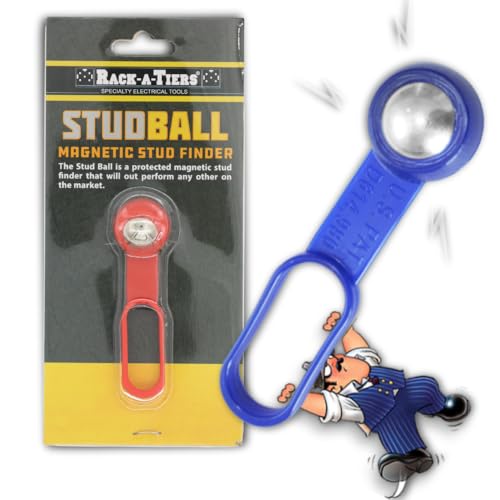
The Stud Ball takes a different shape from the rectangular CH Hanson models. It’s a sphere with a rare earth magnet at its core, rated at 27 pounds of pull, which is enough force to detect fasteners through dense plaster, ceramic tile, and even 3/4-inch plywood paneling. Tradespeople working on renovation jobs reach for this kind of muscle regularly.
Because it’s a free-floating ball in a protective housing, the magnet naturally swings toward the nearest metal fastener. You don’t need to hold it perfectly level. For bathroom remodels, kitchen backsplash projects, or anywhere tile meets plaster, this beats a flat magnetic locator that struggles to read through layered materials.
Reasons It Performs
- 27-pound pull magnet reads through ceramic tile, thick plaster, and plywood
- Spherical design self-orients toward the strongest magnetic source
- Works through 1/2-inch and 5/8-inch drywall where standard magnetic units sometimes struggle
- No batteries or electronics to fail on a job site
Points To Keep In Mind
- Heavier and bulkier than pocket-sized magnetic alternatives
- No built-in level, so a separate tool is needed for accurate marking
Who Will Love This
Tradespeople and serious DIYers working in bathrooms, kitchens, or any space where plaster meets tile or thick paneling.
Skip It When
For standard drywall with thin plaster, the smaller CH Hanson models handle the job with less weight on your wrist.
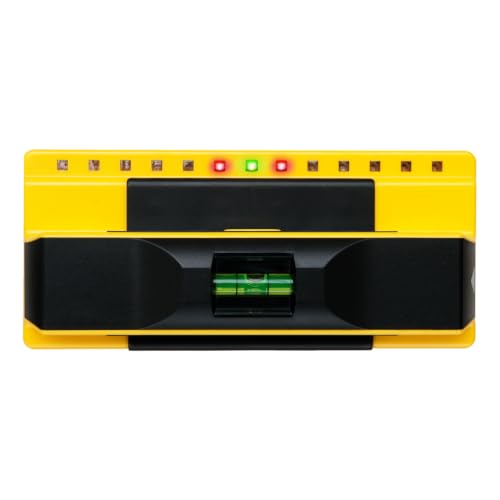
The jump from magnetic to electronic stud finding is significant, and the ProSensor 710+ is one of the more capable electronic options. Thirteen individual sensors run simultaneously across the body, lighting up LEDs that show the stud’s center and both edges at once. You’re not chasing a beep, you’re reading a visual map.
For older homes with mixed wall construction, where plaster may sit over traditional lath, the unit auto-calibrates and detects through a single layer of standard sheetrock. Worth flagging: the manufacturer specifically does not recommend it for thick plaster, tile, or exterior siding. If your walls are standard interior plaster over lath, it works well. If you suspect heavier construction, step back to the magnetic side of this list.
Bright Spots
- Thirteen sensors read the full stud width instead of a single point
- Wide LED bar shows center and edges simultaneously, reducing guesswork
- No sliding required; press the unit against the wall and read the display
- Auto-adjusts for depth, no manual calibration step
Honest Caveats
- Not recommended for thick plaster, tile, stucco, or double-layer walls
- Higher cost than any magnetic option in this lineup
Right Fit For
Experienced DIYers and pros working on standard interior walls who need precise stud-edge data for cabinetry or detailed trim work.
Not Your Match When
For thick plaster or tile, the Rack-A-Tiers Stud Ball delivers readings where this electronic unit falls short.
The base ProSensor 710 shares the thirteen-sensor array and press-and-read design of the 710+, but strips out the extras. For most home users, that’s a feature, not a compromise. You still get the wide LED display that maps the stud edge-to-edge, and you still avoid the sliding-and-calibrating routine of conventional electronic finders.
Beginners especially benefit here because the unit forgives minor mistakes. Place it roughly where you think a stud is, and the LEDs show you the real position immediately. You can start scanning anywhere on the wall, no need to begin at a known reference point. Renter-friendly operation, since you don’t have to slide and scuff the surface.
Everyday Wins
- Thirteen sensors provide a wide reading in a single placement
- No sliding required, which reduces wall scuffs and false starts
- Beginner-friendly; place it, read the lights, mark the stud
- Detects studs without manual calibration
Points To Note
- Lacks the live-wire detection that the M210 model adds
- Same wall-type limitations as the 710+ regarding thick plaster and tile
Perfect Match For
First-time stud-finder users and renters who want a forgiving electronic unit that reads clearly without a learning curve.
A Better Fit Elsewhere
Homes with older wiring benefit from the ProSensor M210’s live-wire detection, which adds a layer of safety when drilling.
The M210 layers live wire detection on top of the same thirteen-sensor platform found in the other Franklin models. In older homes where knob-and-tube or aging Romex wiring runs through walls, knowing where energized lines sit before you drill can prevent a serious mistake. The M210 highlights those zones in addition to standard stud locations.
It keeps the press-and-read simplicity that makes the Franklin line approachable. Press a button, hold it against the wall, and the LED array lights up across stud and wire locations simultaneously. The trade-off is that all these electronics need power, so battery life becomes a real ownership consideration over months of occasional use.
What Helps Most
- Detects energized wiring alongside studs, a meaningful safety layer
- Thirteen sensors read full stud width without sliding
- No calibration step, scan from anywhere on the wall
- Combines two readings into a single display pass
Practical Considerations
- Battery-powered, unlike the magnetic options in this roundup
- Same thick-plaster and tile limitations as other Franklin models
- Live-wire detection is a helpful tool, not a substitute for proper caution near electrical lines
Built With In Mind
Homeowners in older properties where wiring age and placement are genuine concerns during any drilling project.
Swap It Out When
For pure stud-finding on simple walls, the base ProSensor 710 delivers the same sensor performance at a lower tier.
Picking Stud Finders That Actually Work On Plaster
Plaster behaves differently from modern drywall, so the stud finder you choose should match the wall in front of you. Magnetic units locate the metal fasteners that hold the lath (the thin wood strips behind old plaster) to the studs. Electronic units detect density changes in the wall material itself. Neither approach is universally better, and the right pick depends on what’s hiding behind the surface.
Wall Construction And Detection Depth
Older homes often have true plaster over wood lath, which can run 3/4 inch to 1 inch thick. Newer construction may use veneer plaster over drywall, a thinner setup that most electronic scanners handle easily. The source materials and depth drive the entire buying decision, so identify your wall type before settling on a tool.
Magnetic Versus Electronic Trade Offs
Magnetic stud finders are nearly indestructible and need no power. They find fasteners, not stud edges, so marking takes a small leap of faith. Electronic sensors give you precise edge data, but require batteries and can struggle with thick plaster or unusual wall compositions. Many homeowners keep one of each on hand.
Reading Accuracy And Edge Detection
If your project demands precision, like mounting a cabinet where the stud center matters to the millimeter, an electronic unit with multiple sensors pays off. For most shelf and picture-hanging work, a magnetic locator with a built-in level gets you close enough without the cost or setup.
Key Considerations Across These Picks
Where Shoppers Go Wrong
The most common mistake is buying an electronic stud finder and expecting it to read through ceramic tile, stucco, or thick plaster. Manufacturers list those surfaces as incompatible because the wall material confuses the sensor array. Check your wall type first, then match the tool to the surface, not the other way around.
When Paying More Pays Off
Higher-tier electronic models earn their cost through multi-sensor accuracy, live-wire alerts, and forgiving press-and-read operation. The upgrade is worth it for anyone running frequent projects or working in homes with mixed wall types. For occasional single-room jobs, a magnetic locator at a fraction of the cost handles the work without complication.
Frequently Asked Questions
Do magnetic stud finders work on plaster walls?
Yes, magnetic units work well on plaster because they detect the nails or screws holding the lath to the stud, regardless of plaster thickness. They cannot, however, tell you exactly where the stud edges sit, only where the fasteners are.
Can electronic stud finders read through old plaster?
Most electronic stud finders are designed for standard drywall and may struggle with thick plaster, lath, or tile. Check the manufacturer’s specifications for compatible wall types before relying on an electronic unit on plaster.
What is the difference between stud edges and stud centers?
Stud edges are the outer boundaries of the wood beam, while the stud center is the midpoint. Electronic multi-sensor units display both, which helps when mounting items that need to attach to the stud’s middle for maximum holding strength.
Do I need live wire detection in a stud finder?
Live wire detection adds a layer of safety when drilling into walls that may contain electrical wiring. In newer homes with accessible wiring diagrams, it’s less critical. In older homes with unknown wiring paths, it’s a meaningful upgrade.
How accurate are magnetic stud finders compared to electronic ones?
Magnetic stud finders pinpoint fasteners with high accuracy but don’t reveal stud width. Electronic multi-sensor units show the full stud profile but may give false readings on incompatible wall materials. Each approach has strengths the other lacks.




