


A hand plane on a rough-sawn board can be satisfying for a Saturday afternoon, but the moment you start sizing doors, milling cabinet parts, or flattening glued-up panels, you need a surface planer. The right machine saves your shoulders, keeps your thicknesses consistent, and turns twisted lumber into stock that actually fits your joinery. Hobbyists building a garage shop and seasoned pros running tight production runs both face the same core question: which surface planer, or which supporting accessory, earns its spot on the bench? This list covers benchtop planers, hand-held power planers, and the blades and jigs that keep them cutting cleanly, so you can match a pick to your workflow instead of your budget alone.
The Picks In Brief
Makita KP0800 240V 82mm Cepilladora
DEWALT DCP580B 20V MAX Brushless Planer
FOXBC 12-Inch Planer Blades for Makita 2012NB
FOXBC 12-1/2-Inch Planer Blades for Craftsman
12-Inch Portable Planer Knife Setting Gauge
Ryobi EPN7582NHG Planer 750W
VEVOR 13-Inch Three-Blade Benchtop Planer

VEVOR 13-Inch Two-Blade Benchtop Planer
VEVOR 13-Inch Foldable Benchtop Planer
The Picks, Examined More Closely
The Makita KP0800 is a corded hand planer built for trim carpenters and furniture makers who want hand-tool control without the elbow grease. Its 82mm (roughly 3-1/4 inch) planing width covers most standard door edges and board faces, while a 2.0mm depth of cut lets you hog off material in measured passes. The 240V European-spec version suits shops on that mains supply, and the double-insulated housing keeps the chassis manageable even during long sessions. Compared to the budget Ryobi that follows later, this Makita trades raw power for finesse: the fine depth adjustment and dust port setup feel more like a cabinetmaker’s tool than a demolition accessory.
You will appreciate the unit when fitting doors, chamfering edges, or trimming down a stubborn workpiece that won’t fit through your benchtop planer. The vacuum port is a quiet win for basement shops, since pairing it with a shop vac keeps the air noticeably clearer during extended runs.
Everyday Advantages
- Fine depth adjustment dial delivers consistent, even finish across multiple passes.
- Integrated dust port pairs cleanly with a shop vac, keeping your bench clearer.
- Double-insulated housing is comfortable to grip and reduces operator fatigue.
- 82mm width handles the majority of trim and edge work in one or two passes.
Trade Offs To Consider
- 240V spec means U.S. shoppers on 120V mains need to verify compatibility or a step-up transformer.
- Corded design limits reach on large assemblies compared to the brushless DEWALT below.
Feature Snapshot
Who It Suits Best
Trimmers, cabinetmakers, and hobby woodworkers on 240V power who want refined hand-planer control for door fitting and edge work.
Where Another Pick Suits Better
Shoppers on standard 120V U.S. household circuits who want a cordless experience should look at the DEWALT DCP580B 20V MAX Brushless Planer instead.
The DEWALT DCP580B swaps a cord for a 20V MAX battery, and that single change reshapes how you use a hand planer. A brushless motor (a design with no carbon brushes, so it runs cooler and lasts longer) drives the cutter at 32,000 cuts per minute, while the calibrated depth knob clicks in small, repeatable increments up to roughly 2mm. The included DW6655 HSS blades arrive ready to resharpen, which is unusual for a kit at this level. Versus the Makita KP0800 above, the trade-off is obvious: you give up unlimited corded runtime, but you gain the freedom to plane a workbench in the driveway, on a deck, or in a client garage without a generator.
You will value the quick-set knife system when swapping a dull edge mid-project, and the calibrated dial removes the guesswork from shaving fractions of a millimeter off a tight-fitting door. Tool-only packaging means you bring your own battery and charger, which actually appeals to anyone already running the 20V platform.
What Helps Most
- Brushless motor extends runtime per charge and reduces long-term wear.
- Calibrated depth knob gives repeatable, precise shavings for fine joinery.
- 32,000 cuts per minute leaves a cleaner surface with less sanding.
- Resharpenable HSS blades stretch ownership costs over years of use.
Worth Noting
- Tool-only kit: no battery or charger included, which adds to the total cost for new platform shoppers.
- Runtime depends on amp-hour battery size, so heavy hardwood sessions may need a spare pack on hand.
Key Product Details
Right Fit For
Existing 20V MAX platform users and jobsite carpenters who need cordless freedom without sacrificing a refined finish.
Look Elsewhere When
Hobby woodworkers on a tight budget who don’t already own 20V batteries will find the Ryobi EPN7582NHG Planer a more economical corded starting point.
These FOXBC blades are a direct-fit replacement set for the Makita 2012 and 2012NB benchtop planers, two workhorse machines that have lived in small shops and pro trucks for years. The 12-inch length matches the OEM cutter head, and the high-speed steel (HSS) construction with double-edged reversible design gives you two fresh cutting edges per blade. The replacement part number 793346-8 mirrors the original Makita spec, so installation follows the same procedure your manual describes. Compared to the Craftsman blades coming up next, the key difference is the fitment model line.
You will reach for this set when your factory edges finally go dull after hundreds of board feet, or when you simply want a sharp spare on the shelf before starting a hardwood run.
Where It Delivers
- Reversible double-edge design doubles the working life per blade.
- Direct OEM fitment means no shimming or modification during installation.
- HSS material holds an edge well on both softwoods and domestic hardwoods.
Points To Keep In Mind
- Disposable (not resharpenable), so heavy users will cycle through sets more often than with carbide-tipped options.
- Specific to the Makita 2012 and 2012NB only; will not fit the 2012N or other planer lines.
Best Suited To
Existing Makita 2012-series owners who want an affordable, drop-in replacement blade set for routine shop maintenance.
Consider Something Else When
Craftsman benchtop planer owners shopping for their own replacement blades should jump to the FOXBC 12-1/2-Inch Planer Blades for Craftsman instead.
FOXBC turns its attention to the Craftsman side of the benchtop market with this 12-1/2-inch HSS replacement set. The fitment list covers several model numbers including the CMEW320 and the 351.21758 / 351.27523 series, so it’s a useful shelf item for shops that run older Craftsman units. The M2 laminated high-speed steel construction (a hardened tool steel blend designed to resist wear and hold a keen edge) stays sharper longer than conventional knife stock, and the reversible double-edge format gives you two fresh cutting sides per blade. The 12-1/2-inch length sits slightly longer than the Makita replacements above, which is the key dimensional clue for matching blades to the right machine.
You will appreciate the straightforward installation when it’s time to swap a dulled edge mid-project, and many small shops keep an extra set on hand so a blade change never stalls a finish-day deadline.
The Upside
- M2 laminated HSS construction holds an edge well across extended runs.
- Reversible double-edge design extends working life before replacement.
- Broad model fitment covers several common Craftsman benchtop planers.
Some Limits To Know
- Not resharpenable, so plan on replacing rather than honing the edges.
- Fitment is specific to the listed Craftsman model numbers; verify your planer before ordering.
Made For
Craftsman benchtop planer owners who need a reliable drop-in replacement set for routine blade changes and production runs.
Skip It When
Makita 2012-series owners should grab the FOXBC 12-Inch Planer Blades for Makita 2012NB instead, since the lengths and mountings differ.
This 12-inch knife setting gauge is the kind of unglamorous jig that pays for itself the first time you swap planer blades. It fits the Delta 22-540 type 1 and type 2, plus the TP300, working on 48mm diameter cutter heads. The jig holds the blade at a consistent height while you set the screws, removing the “eyeball and prayer” approach that ruins a freshly sharpened set. Versus the blade-only picks above, this is a setup tool rather than a consumable, and it lives on your shop wall for years.
You will lean on it whenever you rotate or replace knives on a Delta planer, especially if you prefer resharpening your HSS rather than buying new sets each cycle. Owners commonly report that skipping the gauge leads to uneven depth-of-cut, snipe, and visibly ridged boards, so the jig is a quiet insurance policy against ruined lumber.
Good Reasons To Consider
- Removes guesswork from blade height setup after sharpening or replacement.
- Direct fit for common Delta 22-540 variants and the TP300 planer.
- Compact, easy to store on a shop wall or in a drawer when not in use.
Honest Caveats
- Fitment is limited to specific Delta and TP300 models, so it is a specialty rather than universal jig.
Perfect Match For
Delta 22-540 and TP300 owners who sharpen or rotate their own HSS blades and want consistent depth setup without trial-and-error fitting.
A Better Fit Elsewhere
Shoppers without a compatible Delta planer will get far more value from a fresh blade set like the FOXBC replacements above.
The Ryobi EPN7582NHG is a straightforward corded hand planer aimed at the entry-level DIY market. The 750W motor drives an 82mm cutter at 16,000 rpm, with a 2mm depth of cut that handles most trimming and edge-squaring jobs in a small shop. Parallel guides on both sides help keep your passes square to the reference edge, and the integrated dust extraction port lets you hook up a vacuum for cleaner indoor work. The kit typically includes two HM (tungsten carbide-tipped) reversible blades and a carry bag, which is a useful bonus for anyone storing the tool between projects. Compared to the Makita KP0800 earlier in the list, this Ryobi makes clear compromises: lower cut speed, less refined fit and finish, and a less precise depth dial, but it lands in a much friendlier price bracket for a first-time planer shopper.
You will appreciate the included bag and spare blades when you need to grab the tool for a quick weekend job, and the parallel fences are a real time-saver when fitting shelves or trimming a stubborn door.
Where It Helps
- Affordable entry point for first-time hand planer shoppers.
- Parallel side guides support accurate, square passes on edges.
- Carbide-tipped reversible blades extend working life between changes.
- Carry bag and dust port make transport and cleanup easier in a home shop.
Things To Weigh Up
- 16,000 rpm is noticeably slower than the Makita and DEWALT picks, which can show as tear-out on figured hardwoods.
- Fit, finish, and depth-dial precision are budget-tier rather than cabinetmaker-grade.
Who Should Grab It
First-time DIY woodworkers and weekend renovators who want a capable hand planer without a premium outlay.
Another Choice May Suit
Trimmers and furniture makers who want a more refined cut should consider the Makita KP0800 240V 82mm Cepilladora instead.
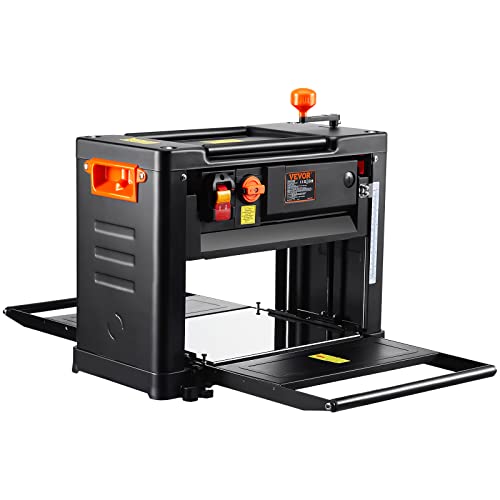
VEVOR’s 13-inch benchtop planer broadens the playing field for hobbyists who need to plane wider boards than the typical 12-inch class allows. A three-blade cutter head spreads the cut across more edges, which tends to leave a smoother surface and reduce the visible ridges a two-blade head can leave on figured grain. The two-speed feed lets you slow down for dense hardwoods and speed up for softwood dimensioning, and the cast iron bed adds weight that helps reduce snipe (the slight over- or under-cut at the start and end of a board). Versus the smaller hand planers earlier in this roundup, this is a stationary machine for a dedicated bench, not a trim carpenter’s grab-and-go tool.
You will value the 13-inch width when milling glued-up panels, wide table tops, and slab-style workpieces. In a small shop, the weight of the cast bed is a real asset, since lighter aluminum-bodied planers tend to chatter and skate during heavy cuts.
Useful Highlights
- Three-blade cutter head reduces ridges and improves surface finish.
- Two-speed feed adapts to hardwood and softwood milling.
- Cast iron bed adds mass for vibration damping and snipe reduction.
- 13-inch width handles wider glue-ups and panels in one pass.
Practical Considerations
- Heavier cast construction demands a sturdy bench and a committed spot in the shop.
- Larger footprint than a hand planer, so it is not a mobile option.
Whose Shelf It Belongs On
Home woodworkers milling wide panels and glued-up tops who want smoother finishes than a two-blade benchtop can deliver.
Reach For A Different Pick When
Mobility matters more than width, and you need a tool you can carry to a jobsite; the DEWALT DCP580B 20V MAX Brushless Planer is the better portable option.
The 15-Amp, 2000W motor on this VEVOR benchtop planer puts it squarely in the heavy-output category for the 13-inch class. The two-blade cutter head keeps the mechanical design simple and easier to service, while the 12-inch extended infeed table gives long stock a stable platform before the cutter head. Both soft and hard wood species are within the design’s scope, and the wider 13-inch capacity suits everything from cabinet parts to small furniture panels. The trade-off compared to the three-blade VEVOR pick just before it: slightly more visible ridges on figured grain, in exchange for a simpler cutter that many home users find easier to set and maintain.
You will appreciate the high-torque motor when feeding dense oak or maple through the cutter at production pace, and the extended infeed becomes essential when working with boards longer than your arm span.
What Stands Out
- 2000W, 15-Amp motor handles dense hardwood without bogging down.
- 13-inch width covers wide stock and cabinet parts in one pass.
- 12-inch extended infeed supports long boards and reduces tip-down snipe.
Less Ideal Details
- Two-blade head can leave slightly more pronounced ridges than the three-blade sibling above.
- Draws significant current; on a shared 15A circuit you may need to manage other loads during heavy cuts.
Built With In Mind
Small-shop production woodworkers running dense hardwoods and long stock who need serious torque and a wide capacity.
Not Your Match When
Finish quality is the top priority and you want the cleanest cut out of the box; the VEVOR 13-Inch Three-Blade Benchtop Planer is the smoother-finish alternative.
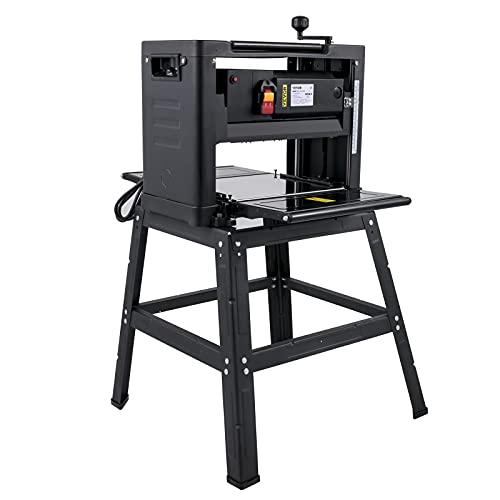
The foldable design on this VEVOR sets it apart from the other benchtop planers in the roundup. The iron stand and frame fold down for transport or stowage, which is a real advantage in a small garage or a shared workspace where the machine needs to clear the bench when you’re not cutting. The 2000W motor matches the heavier-duty VEVOR above, and the 6 m/min feed rate is a useful number for planning production time on a stack of boards. Two double-cutter blades handle the slicing work, and the dust exhaust port supports a shop vac hookup for indoor runs.
You will appreciate the fold-down stand when floor space is tight, and the same iron construction that supports the cutter also dampens vibration well during cuts.
A Few Strong Suits
- Foldable iron stand saves floor space and aids transport.
- 2000W motor and 6 m/min feed handle production-paced milling.
- Dust exhaust port supports shop-vac hookup for cleaner indoor work.
Soft Spots
- Two-blade cutter will leave a slightly less polished finish than the three-blade VEVOR earlier in the list.
- Foldable stand adds moving parts that need periodic checks for tightness.
The Right Fit
Small-shop and apartment woodworkers with limited floor space who still need a full-size 13-inch planer for serious projects.
Swap It Out When
You have a permanent bench space and want the smoothest factory finish; the VEVOR 13-Inch Three-Blade Benchtop Planer delivers a cleaner cut without the folding stand.
What To Weigh Before Choosing A Surface Planer
Cutting Width And Capacity
Cutting width is the first spec to match to your work. Hand-held planers like the Makita KP0800 and Ryobi EPN7582NHG sit around 82mm, which covers door edges and trim but forces multiple passes on wider boards. Benchtop planers at 12 to 13 inches open the door to furniture panels, glue-ups, and slab work in a single pass. Plan for the widest stock you realistically run, not the narrowest, since adding capacity later usually means replacing the whole machine.
Power, Speed, And Cut Quality
Motor power and cutter speed work together. A 2000W benchtop motor can chew through dense hardwood without bogging down, while a slower 16,000 rpm hand planer is more likely to tear out figured grain. Cutter-head design matters too: a three-blade head spreads each shaving across more edges, which usually leaves a smoother surface than a two-blade head on the same board. Look for cuts-per-minute and feed rate together, since both numbers shape your finish.
Blade Material And Maintenance
High-speed steel blades are affordable, reasonably durable, and resharpenable on the right machines. Carbide-tipped blades cost more but last much longer between changes. Whichever you choose, plan on a replacement strategy: keep a spare set on the shelf so a dull edge never halts a project. The FOXBC replacement sets in this list are useful whether you run a Makita 2012NB or a Craftsman CMEW320.
Hand-Held Versus Benchtop
Hand-held planers win on portability and trim work. Benchtop planers win on consistency, capacity, and finish. A small shop that mostly fits doors and shelves may never need a stationary planer. A shop building furniture or resawing rough lumber will outgrow a hand tool quickly. Many woodworkers end up owning one of each, using the hand planer for fit-up and the benchtop for dimensioning rough stock.
Key Considerations Across These Picks
Where Shoppers Go Wrong
The most common mistake is buying by widest capacity alone, without checking the actual thickness range and motor power. A 13-inch planer with a weak motor will stall on hard maple, no matter how wide the opening. The second pitfall is ignoring blade replacement costs: a bargain planer with expensive or hard-to-source blades can cost more over five years than a slightly pricier machine with affordable FOXBC or OEM replacements. Skipping the knife setting gauge on a Delta 22-540 is another subtle trap, since an uneven blade height ruins lumber before you even notice the problem.
What Separates Premium From Basic
Higher-tier benchtop planers earn their place with three-blade cutter heads, heavier cast iron beds, and two-speed feeds that adapt to species. Those features translate directly into smoother finishes, less snipe, and faster material removal on dense wood. A premium hand planer earns its keep with brushless motors, calibrated depth dials, and resharpenable blades. The upgrade is worth chasing for anyone running the tool daily, while occasional DIYers will find the mid-tier picks more than adequate for weekend projects.
Frequently Asked Questions
What Is A Surface Planer Used For?
A surface planer flattens one face of a board and brings it to a uniform thickness, which is essential for furniture making, cabinetry, and any project where parts need to fit together precisely. It saves hours of hand-planing and delivers consistent results across a stack of boards.
Corded Or Cordless Hand Planer: Which Should I Choose?
Corded models like the Makita KP0800 offer unlimited runtime and steady power, which suits long trim days. Cordless options like the DEWALT DCP580B trade some runtime for the freedom to work anywhere, and they make the most sense if you already own the battery platform. For shop-bound work, corded usually wins on value; for jobsite and renovation work, cordless pays off in convenience.
How Often Should I Replace Planer Blades?
Replacement frequency depends on the wood species, board feet processed, and whether you catch nails or grit. Hobby users cutting softwood may go a year between changes, while pros running hardwood daily can wear out a set in weeks. Inspect edges regularly for nicks and a fuzzy cut, and keep a spare set on hand so a swap never stalls a project.
Can A Surface Planer Handle Hardwood?
Yes, as long as the machine has the motor power and blade speed for the species. A 2000W benchtop planer handles dense maple and oak comfortably, while a lower-wattage hand planer will struggle and show tear-out. Take lighter passes on hardwood and let the cutter work at its designed feed rate.
What Is Snipe And How Do I Reduce It?
Snipe is the slight over- or under-cut that shows up at the start or end of a board, usually as a shallow dip. Heavier cast iron beds, extended infeed and outfeed supports, and a steady hand feed pressure all help reduce it. Supporting the board as it exits the cutter head is one of the simplest and most effective fixes.




