


A solid table saw setup pulls double duty in a busy shop. It handles the cuts, and it keeps your workflow organized when sheet goods, trim, and accessories start piling up around the workspace. The right gear makes all the difference, from a saw that rip-cuts clean to accessories that keep your blades and your fingers safe.
The picks below cover the saws themselves plus a few accessories that round out a complete table saw cabinet setup. Cabinet installers, weekend builders, and hobbyist woodworkers all find something here that fits how they actually work.
A Side-By-Side Look

DEWALT Portable Table Saw with Stand 8-1/4 inch (DWE7485WS)

DEWALT 15 Amp 8-1/4 in. Compact Portable Jobsite Table Saw (DWE7485)

Circular Saw Blade Storage 10″ 6 Pack Protects Blade Edges
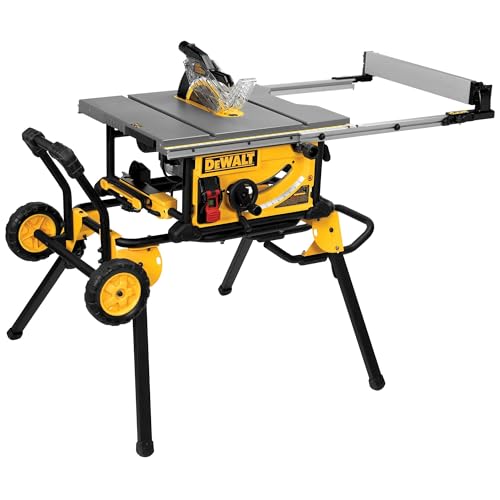
DEWALT 10″ Table Saw with Foldable Rolling Stand (DWE7491RS)
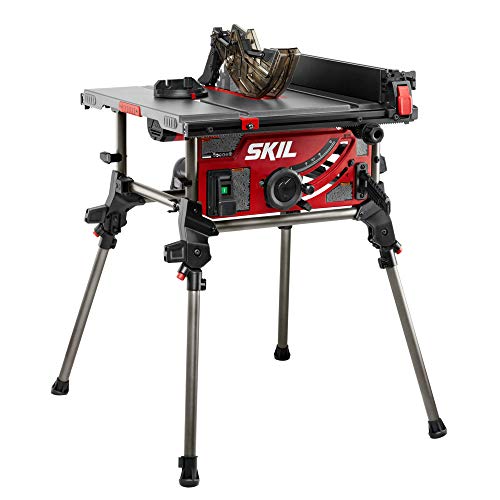
SKIL 15 Amp 10-Inch Jobsite Table Saw with Folding Stand (TS6307-00)
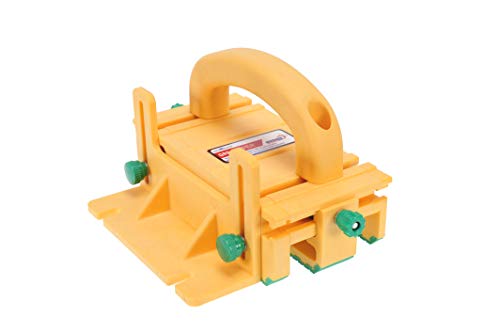
MICROJIG GRR-RIPPER GR-100 3D Table Saw Pushblock (Yellow)
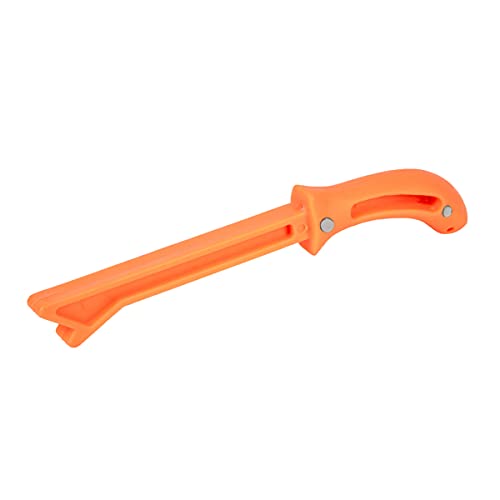
POWERTEC Magnetic Push Stick for Table Saw, Router Table, Jointer (71029)
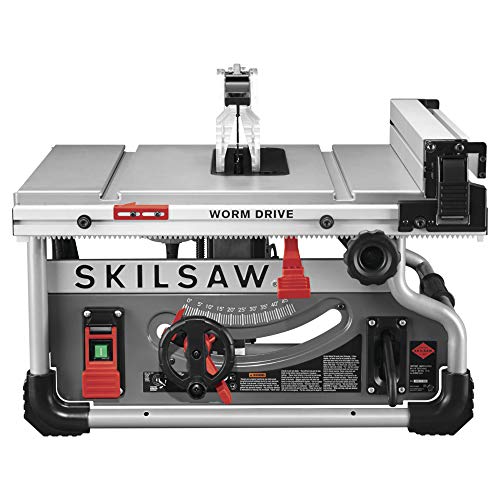
SKIL 8-1/4″ Portable Worm Drive Table Saw (SPT99T-01)

POWERTEC 48″ Miter T Track 4-Pack for Router Table and Table Saw Sleds (71167-P4)
A Breakdown Of The Leading Choices
This DEWALT model earns its place at the top by pairing a compact 8-1/4 inch blade with a stand that rolls out and folds back without hassle. Cabinet installers hauling sheet goods between job sites find the 24.5 inch rip capacity handles 4×8 plywood without gymnastics, and the rack and pinion fence rails make micro-adjustments feel confident rather than guesswork.
For shop-to-truck-to-job workflows, the lighter footprint pays off daily. The onboard storage keeps the guard, riving knife, miter gauge, and push stick close, so accessories stop disappearing. The 15 amp motor at 5800 RPM chews through most ripping tasks you’ll face in residential cabinet work.
A Favorable Mix
- 24.5 inch rip capacity handles full sheet goods
- Rack and pinion fence gives clean, repeatable adjustments
- Compact frame fits tight truck beds and small shop corners
- Power-loss reset prevents surprise restarts after outages
- Onboard accessory storage keeps small parts from walking off
Trade Offs
- 8-1/4 inch blade limits depth on thicker hardwood stock
- Stand adds bulk compared to bare-saw alternatives
Key Specs
Best Suited To
Cabinet installers and trim carpenters who move between job sites and need a saw that travels well without sacrificing rip capacity for sheet goods.
Look Elsewhere When
You regularly rip wider panels, in which case the DEWALT DWE7491RS with its 32-1/2 inch rip capacity stretches further.
The DWE7485 strips back the rolling stand to deliver the same cutting performance in a tighter, more portable package. For remodelers working out of a small van or garage shops with limited floor space, the lighter frame and smaller footprint translate into real daily convenience.
It carries the same 15 amp motor, 5800 RPM, and rack and pinion fence as its stand-equipped sibling, so you trade the rolling base for a saw that’s easier to load and store. Cabinet work that doesn’t demand full sheet ripping, such as face frames, trim, and smaller casework, fits this saw’s strengths nicely.
Features That Help
- Lighter build for solo transport to job sites
- Same proven fence system as larger DEWALT models
- Onboard storage for guards, miter gauge, and push stick
- Compact frame fits in tight shop corners
Points To Note
- Requires a separate stand or work surface for proper use
- 8-1/4 inch blade limits max cut depth
- Less stable than a purpose-built rolling stand for heavy sheet goods
Whose Shelf It Belongs On
Mobile remodelers and small-shop hobbyists who want proven DEWALT cutting performance without the bulk of a rolling stand.
Swap It Out When
You need an integrated rolling stand for daily site-to-site transport, in which case the DEWALT DWE7485WS covers that workflow more directly.
Blade storage rarely gets attention until someone reaches into a drawer and finds a nicked finger. This Tsbelout six-pack solves that problem with rigid covers that slip over 10 inch blades, shielding the teeth and keeping labels visible. For shops running multiple blades, dedicated covers keep each one identifiable at a glance.
The snug fit means blades stop knocking against each other in a drawer or shop bin, which preserves the carbide edges that actually matter for clean cuts. Owners commonly report the covers stack neatly, and the rigid build tends to hold shape over time rather than warping like soft alternatives.
Positive Points
- Protects blade edges from contact damage during storage
- Keeps blade labels visible for quick identification
- Six-pack covers match shops running multiple blade types
- Snug fit prevents rattling inside drawers or toolboxes
Soft Spots
- Only fits 10 inch blades, not smaller or larger sizes
Perfect Match For
Woodworkers who swap between rip, crosscut, and finish blades and want a safer, more organized blade storage setup.
Not Your Match When
You primarily run the 8-1/4 inch blades common on portable saws like the DEWALT DWE7485, since this cover is sized for 10 inch blades only.
The DWE7491RS steps up to a 10 inch blade and a 32-1/2 inch rip capacity, putting full sheet goods on the table with room to spare. The rolling stand folds down for transport and locks out into a stable cutting platform that handles hardwood ripping without the wobble lighter stands sometimes show. For cabinet shops running heavy production, the wider rip and beefier construction justify the step up.
Tool-free guarding adjustments speed up blade swaps and cleanup, which matters when you’re running the saw hard all day. The 15 amp motor at 4800 RPM trades a bit of speed for torque, a sensible choice for thicker stock. Compared to the DWE7485WS, this model feels planted rather than portable.
Notable Gains
- 32-1/2 inch rip handles full sheet goods with overhang
- Rolling stand folds for transport, locks for stability
- Tool-free guarding changes speed up blade swaps
- 10 inch blade handles thicker hardwood and dado work
Honest Caveats
- Heavier than 8-1/4 inch portable saws, harder for solo transport
- Lower blade RPM trades surface speed for torque
- Takes up more shop floor space when set up
- Higher cost tier than compact alternatives
Feature Snapshot
Right Fit For
Cabinet shops and trim carpenters who regularly rip full sheet goods and need a stable, higher-capacity cutting platform.
Another Choice May Suit
You mainly cut trim and small stock, in which case the SKIL TS6307-00 delivers 10 inch cutting at a friendlier size and cost.
SKIL’s TS6307-00 lands in the sweet spot for DIYers who want 10 inch cutting capacity without stretching into premium pricing. The integrated folding legs save setup time, and the rack and pinion fence rails handle adjustments smoothly. A 25-1/2 inch rip capacity covers most cabinet and trim work without forcing awkward material repositioning.
The 15 amp motor chews through hardwood at a comfortable pace, and the dust port elbow helps keep the work area visible during cuts. For homeowners building bookcases, garage workbenches, or a closet system, this saw gives full-size cutting power in a package that doesn’t dominate a one-car garage. It feels lighter than premium competitors, though, which shows up during heavy production days.
Useful Highlights
- 10 inch blade handles deeper cuts than compact 8-1/4 inch saws
- Integrated folding legs speed up setup and breakdown
- Dust port keeps cut line visible during operation
- Approachable cost for full-size jobsite cutting
Where It May Fall Short
- Not as heavy-duty as the DEWALT DWE7491RS for daily production
- 25-1/2 inch rip capacity is shorter than premium models
Built With In Mind
DIYers and homeowners who want a real 10 inch table saw for weekend projects without paying for contractor-grade capacity.
Consider Something Else When
You run a professional cabinet shop with daily full-sheet ripping, where the DEWALT DWE7491RS offers more rip width and a sturdier platform.
The GRR-RIPPER changed how many woodworkers approach narrow rips and small stock. Instead of a flat pushblock, the GR-100 uses three directional grippers that hold the workpiece down, forward, and against the fence simultaneously. For anyone who’s ever fought a tiny offcut during a finish cut, this tool earns its place in the drawer fast.
Kickback becomes a much smaller concern when the stock can’t wander into the rising blade. Cabinet door parts, drawer bottoms, and small trim pieces all benefit from the control. It also works on router tables and jointers, so the tool earns its keep beyond just the table saw. Owners commonly find their cut quality improves because the workpiece stays flat through the cut.
A Few Strong Suits
- Three-direction grip controls narrow and small stock precisely
- Significantly reduces kickback risk on small parts
- Works on table saws, router tables, and jointers
- Improves cut accuracy by keeping stock flat
Worth Bearing In Mind
- Takes practice to use fluidly on wide stock
- Higher cost than basic push sticks
Who Should Grab It
Woodworkers who frequently cut narrow rips, small parts, or figured wood where workpiece control matters more than raw speed.
Where A Sibling Pick Shines
You mainly push full-width sheet goods through larger cuts, where the POWERTEC Magnetic Push Stick covers basic safety at a lower cost.
POWERTEC’s push stick takes a clever approach to a basic safety tool. The magnetic base lets the stick cling to ferrous table surfaces when you set it down, so it stops sliding off the saw and disappearing into sawdust. For shops moving between a table saw, router table, and jointer, having one push stick that handles all three simplifies the workflow.
The ergonomic handle keeps your hand in a natural position during cuts, reducing fatigue on longer rip sessions. It won’t replace a pushblock for narrow rips, but for standard cuts where you need a simple, reliable pusher, this one stays where you put it. Owners commonly appreciate that the magnetic feature seems like a small thing until you’ve fished a push stick out from behind a blade guard a dozen times.
The Case For It
- Magnetic base keeps the stick on metal surfaces
- Works across table saws, router tables, and jointers
- Ergonomic handle reduces hand fatigue on longer cuts
- Lightweight and easy to maneuver
Small Caveats
- Magnetic feature only works on ferrous metal tables
- Less control than the MICROJIG GRR-RIPPER on narrow stock
Made For
Shop owners who use multiple woodworking machines and want a single push stick that stays put between cuts.
Skip It When
You primarily cut narrow rips and small parts, where the MICROJIG GRR-RIPPER offers better three-direction control.
The SPT99T-01 packs worm drive torque into a portable 8-1/4 inch package, a combination that framer and remodel crews have wanted for years. Worm drive gearing delivers higher torque at lower blade speeds, which translates to aggressive cuts through dimensional lumber without bogging down. The 2-5/8 inch depth of cut and 25 inch rip capacity cover most framing and remodeling tasks.
All-metal construction stands up to jobsite abuse that would rattle lighter saws apart. Compared to direct-drive competitors like the DEWALT DWE7485, this SKIL feels more planted under load. It weighs more than other portables, so the trade-off is real: you get torque and durability, but loading it into a truck takes more effort.
Notable Upsides
- Worm drive gearing delivers strong torque on heavy cuts
- All-metal construction holds up to jobsite conditions
- 25 inch rip capacity handles most sheet goods
- 2-5/8 inch depth handles 3x lumber in one pass
Things To Weigh
- Heavier than direct-drive portable saws
- 8-1/4 inch blade limits cut depth on thicker stock
- Worm drive requires periodic gearbox maintenance
Spec Overview
Who Will Love This
Framing crews and remodel carpenters who need worm drive torque in a saw that still travels to the job.
Reach For A Different Pick When
Cabinet building is your main focus, where the DEWALT DWE7485WS offers lighter transport and accurate trim cuts.
POWERTEC’s T-track four-pack gives shop builders the raw material for custom jigs, sleds, and fixtures. Each 48 inch aluminum extrusion accepts standard T-track hardware, so you can bolt down feather boards, hold-downs, and stops wherever a project demands. For woodworkers building crosscut sleds or router table fences, this track is the foundation layer.
The aluminum construction resists warping under shop conditions, which matters for jigs that need to stay flat for accurate cuts. The four-pack covers multiple projects at once, so you can build a crosscut sled and still have track left for a router table upgrade. Owners commonly report the track machines cleanly with standard woodworking tools when fitting custom projects.
Reasons It Performs
- Four 48 inch tracks cover multiple jig and fixture projects
- Aluminum build resists warping in shop environments
- Standard T-track profile accepts common hardware
- Machines cleanly for custom fitting
Where It Is Less Suited
- Requires separate T-track hardware and fasteners
- Not a finished jig, so build time is on you
The Right Fit
Shop builders constructing custom crosscut sleds, router table fences, or dedicated jigs for repetitive cuts.
A Better Fit Elsewhere
You need a ready-to-use push tool rather than jig-building material, where the POWERTEC Magnetic Push Stick serves that role directly.
What Matters Most Before Choosing Table Saw Cabinets
Rip Capacity and Sheet Good Handling
Rip capacity is the measurement of how far the fence sits from the blade, and it determines the widest cut your saw can make. Cabinet installers working with 4×8 plywood need at least 24 inches of rip capacity to handle full sheets, while 25-1/2 to 32-1/2 inches gives you overhang for cleaner cuts and safer material support. A smaller 8-1/4 inch saw with 24.5 inch capacity handles most trim and smaller sheet work, while a 10 inch saw with 32-1/2 inch capacity opens up full sheet ripping without gymnastics.
Portability Versus Stability
Portable saws win on jobsite transport but trade off cutting platform stability. Rolling stands like those on the DEWALT DWE7485WS and DWE7491RS fold for transport and lock into a rigid cutting position, so you get both mobility and a solid base. Bare saws like the DEWALT DWE7485 need a separate work surface, which matters if you move frequently between sites but want a lighter load. Worm drive saws like the SKIL SPT99T-01 add torque but also add weight, so consider how often you load and unload.
Safety Accessories and Push Control
Push tools prevent kickback, and the right one depends on your typical cuts. Standard push sticks cover most cuts, while pushblocks with three-direction grip like the MICROJIG GRR-RIPPER handle narrow rips and small parts that basic sticks can’t control. Magnetic push sticks like the POWERTEC model stay where you put them, which sounds minor until you’ve lost one in a sawdust-filled shop. Match the push tool to your typical stock size for the best safety gains.
Key Considerations Across These Picks
Pitfalls Shoppers Hit
A common mistake is chasing blade size over rip capacity. An 8-1/4 inch saw with 24.5 inch rip capacity handles more real-world work than a 10 inch saw with limited rip width. Another trap is ignoring the stand question: a saw without a proper stand becomes a benchtop tool, which limits its usefulness on job sites. Finally, buying push safety as an afterthought leaves you making do with whatever’s nearby during cuts, when a dedicated push tool is the smarter move.
Where The Extra Money Goes
Higher tier table saws earn their price through beefier stands, wider rip capacity, and stronger motors that hold up under daily production. The DEWALT DWE7491RS costs more than the SKIL TS6307-00 because it handles full sheet goods with a heavier stand that doesn’t flex during cuts. The upgrade pays off for shops running the saw every day, while weekend builders get plenty of value from mid-tier options that don’t see constant use.
Frequently Asked Questions
What size table saw do cabinet installers need?
A 10 inch saw with at least 25 inches of rip capacity handles most cabinet work, including full sheet plywood cuts. The DEWALT DWE7491RS and SKIL TS6307-00 both fit this profile, with the DEWALT offering wider rip capacity for sheet goods.
How important is a rolling stand for a portable table saw?
A rolling stand speeds up setup and breakdown on job sites and provides a stable cutting platform that benchtop use can’t match. For frequent transport, an integrated stand like those on the DEWALT DWE7485WS or DEWALT DWE7491RS pays off quickly.
Do I need a pushblock or just a push stick?
Push sticks cover most standard cuts, while a pushblock like the MICROJIG GRR-RIPPER handles narrow rips and small parts where extra control matters. Many woodworkers keep both on hand for different cut types.
What’s the benefit of a worm drive table saw?
Worm drive gearing delivers higher torque at lower blade speeds, which keeps the saw cutting aggressively through thick or dense lumber without bogging. The SKIL SPT99T-01 brings this advantage to a portable format for framers and remodelers.
How do I store saw blades safely?
Rigid blade covers like the Tsbelout six-pack protect carbide edges from contact damage and keep labels visible for quick identification. Storing blades covered in a dedicated drawer or rack prevents dulling and the finger nicks that come from reaching into a bin of bare blades.




