Choosing the right saw changes everything about a project, from how clean the cuts feel to how often you actually finish the build. Woodworkers, hobbyists, and small-shop owners all face the same core decision: power, precision, and footprint have to match the work and the space. This roundup breaks down nine tools that cover everything from full-size jobsite saws to compact benchtop picks for crafts, plus a few mini machines worth knowing for lighter work.
A Snapshot Of The Selections

DEWALT Portable Table Saw with Stand 8-1/4 inch (DWE7485WS)

DEWALT 15 Amp 8-1/4 in. Compact Portable Jobsite Table Saw (DWE7485)

DEWALT FLEXVOLT 60V MAX* Table Saw 8-1/4-Inch (DCS7485B)

Zericuf Super Mini Table Saw for Crafts & Hobbyists

Zericuf Mini Table Saw for Crafts Dual 795 Motors

AcmeFlare 4-Axis All-Metal Micro Lathe 60W
AcmeFlare All-Metal Elevated Mini Safety Lathe 36W

AcmeFlare All-Metal Mini Lathe 36W with 0.02mm Scale

AcmeFlare Mini Milling Machine Electroplated Metal 3-Axis
Taking A Closer Look At The Options
Contractors hauling tools between trucks and job sites tend to want one saw that does it all, and the DWE7485WS is built around that idea. The integrated rolling stand folds out in seconds, so setup at a client site feels closer to a quick table deploy than a full shop build. Compared to the bare DWE7485 reviewed next, this version saves you from buying a stand separately, which most remodelers eventually do anyway.
A 15 amp motor driving the 8-1/4 inch blade at 5800 RPM handles sheet goods and dimensional lumber with room to spare. The rack and pinion fence stays square across its travel, so rip cuts on 4×8 plywood or OSB sheets line up without drift. For crews that need angle work, the bevel range extends to 48 degrees, a generous spread for furniture builders and trim carpenters.
A Few Strong Suits
- Folding stand with rolling wheels makes transport between sites realistic for one person
- 24.5 inches of rip capacity covers full 4×8 sheet goods without extension tables
- Rack and pinion fence adjustments stay smooth and square during long cut runs
- On-board storage keeps the riving knife, push stick, and wrenches from disappearing on site
- Power-loss reset prevents surprise restarts after a tripped breaker or unplugged cord
Things To Consider
- At around 90 pounds with the stand, lifting into a truck bed takes some effort
- 8-1/4 inch blade limits maximum depth of cut compared to 10 inch contractor saws
- Owners commonly report dust collection works best with a shop vac, not the basic port alone
Key Specs
Who It Suits Best
Contractors, remodelers, and serious hobbyists who move their saw often and want a rolling stand already dialed in.
Where Another Pick Suits Better
Shop-only woodworkers with steady power and a fixed bench should look at the corded DEWALT DWE7485, which trims the cost by skipping the stand.
The DWE7485 is the same saw as the wheeled version above, just stripped of its rolling stand. For woodworkers who already own a sturdy workbench or plan to mount the saw on a custom cart, the bare tool keeps things lean and costs less. The compact footprint also suits tighter shops where a full-size contractor saw would crowd the room.
Daily cutting routines, whether that’s ripping 2x4s for framing or breaking down sheet goods for cabinets, get the same 15 amp, 5800 RPM performance. The on-board accessory storage keeps the anti-kickback pawls, riving knife, and miter gauge from cluttering the bench. For most remodelers, this is the version they actually carry to the truck.
Noteworthy Benefits
- Lightest of the three DEWALT jobsite saws, so loading solo stays manageable
- Same rack and pinion fence accuracy as the wheeled DWE7485WS
- Compact body fits on smaller benches and mobile carts without overhang
- Power-loss reset adds a useful safety net on rough job-site circuits
Points To Note
- No stand included, so budget for a bench or aftermarket cart
- 8-1/4 inch blade caps depth of cut versus 10 inch saws
- Dust port works best paired with a shop vac, which is an extra purchase
Right Fit For
Framers, remodelers, and small-shop woodworkers who already have a bench or a mobile base ready to go.
Swap It Out When
Need a rolling stand right out of the box, the DWE7485WS removes the cart-buying step and folds up for transport.
Cutting sheet goods on a deck build or framing a backyard shed away from any outlet is where the DCS7485B earns its place. The FLEXVOLT platform auto-switches voltage when paired with compatible batteries, giving the saw genuine corded-class power without dragging an extension cord across the yard. Compared to the corded DWE7485 above, you trade a constant power feed for complete mobility.
The metal roll-cage base sets this saw apart from plastic-bodied cordless options, since it shrugs off the drops and bumps that come with outdoor work. The 24 inch rip capacity still covers 4×8 plywood when the battery is fresh. For crews already invested in the FLEXVOLT battery system, this tool slides into the lineup without buying new chargers or packs.
Practical Pluses
- True cordless freedom for remote sites, rooftops, and backyards
- Metal roll-cage base holds up to jobsite drops better than plastic housings
- 24 inch rip capacity covers full 4×8 sheets on a single charge
- Rack and pinion fence mirrors the accuracy of the corded DWE7485
Practical Considerations
- Tool only, so batteries and charger add to the overall cost
- Runtime drops on heavy hardwood ripping versus lighter dimensional cuts
- 8-1/4 inch blade still limits maximum depth of cut for thick stock
Feature Snapshot
Made For
Cordless-first crews, deck builders, and remodelers already running FLEXVOLT batteries who work away from outlets often.
Look Elsewhere When
You mostly cut in a wired shop, the corded DEWALT DWE7485 delivers the same accuracy for less money and zero battery anxiety.
Stepping away from full-size jobsite saws, the Zericuf Super Mini lives on a workbench next to the glue and clamps, not in the back of a truck. Model makers, jewelry hobbyists, and small-scale woodworkers get four functions in one: cutting, drilling, engraving, and polishing, switched through dual motors and a separate control for each. It is a different class of tool than the DEWALT saws above, and that is the point.
Up to 200W of output with seven speed settings gives just enough range to handle balsa, basswood, thin plywood, and softer plastics without burning the work. The cast-iron body adds weight where it counts, keeping vibration down during detail cuts. For creators gifting a starter setup, the 122-piece accessory kit covers most of the bits and blades a beginner will burn through in a year.
The Helpful Details
- Four functions in one tool save bench space and accessory clutter
- Cast-iron body absorbs vibration for cleaner detail work on small parts
- 122-piece accessory bundle gets a new hobbyist cutting on day one
- Seven speed settings match different materials without swapping motors
Honest Caveats
- 200W ceiling rules out ripping lumber or breaking down sheet goods
- Compact bed limits workpiece size, so furniture-scale builds are off the table
- Accessory changes take practice, so plan time to learn the collet and bit swaps
Best Suited To
Model makers, jewelry hobbyists, and craft creators working on small parts who want cut, drill, engrave, and polish in a single benchtop unit.
Not Your Match When
You build furniture or frame walls, the DEWALT DWE7485 brings real rip capacity and a 15 amp motor that this mini cannot match.
Where the Zericuf Super Mini leans into multi-function versatility, this sibling model focuses on cutting performance within the same compact footprint. Dual 795 motors and a 26mm adjustable height table mean slightly thicker stock fits under the blade, which matters for layered craft work and stacked cuts. For hobbyists running weekend projects at a small desk, the upgrade in cut depth feels meaningful.
Up to 12,000 RPM at 200W max output gives the blade the bite to push through denser craft materials without stalling. Compared to the larger DEWALT jobsite saws, this is firmly benchtop territory, so expectations should match the size. The accessory kit covers the same starter needs, making it giftable for someone just opening a craft corner.
Practical Advantages
- 26mm adjustable table height handles slightly thicker stock than most mini saws
- Dual motor design spreads load across two 795 units for steadier cuts
- 12,000 RPM top speed clears craft wood and thin plywood cleanly
- Compact desktop footprint fits apartments, dorms, and small craft rooms
Smaller Limitations
- 200W ceiling still rules out ripping dimensional lumber
- Smaller work surface limits the size of pieces you can square up
- Owners commonly report that dust control is minimal, so plan on a bench brush
Perfect Match For
Weekend crafters, hobbyists, and gift-givers targeting beginners who want a step up in cut depth without jumping to a full table saw.
Reach For A Different Pick When
You need cut, drill, engrave, and polish in one tool, the Zericuf Super Mini covers four functions where this one stays focused on cutting.
Woodworking workshops often bump into small turning and facing work that a table saw cannot touch, and that is where a micro lathe earns its bench space. The AcmeFlare 4-axis model adds an A-axis with 2.5 degree indexing accuracy on top of the standard X, Z, and Z1 setup, which lets you machine multiple faces in a single setup. Hobbyists working in gold, silver, copper, and aluminum will appreciate that flexibility.
All-metal construction with T-slot and dovetail joinery keeps the bed rigid under load, a real concern on small lathes where flex ruins tolerances. Handwheel scales at 0.02mm accuracy give measurable feedback for fine adjustments. Compared to the wood-only mini table saws above, this is a step into a different craft category, more machining than carpentry.
Real-World Strengths
- Four-axis control handles multi-face work without reclamping the part
- 2.5 degree A-axis indexing supports repeatable angular features
- 0.02mm handwheel scales give real precision for fine finishing passes
- All-metal frame dampens vibration during longer cuts
A Few Limitations
- 60W motor suits small parts, so large-diameter work is off the table
- Learning curve is real for woodworkers new to lathe operation
- All-metal body adds weight, so plan a stable bench before mounting
Who Will Love This
Hobbyist machinists and small-shop metalsmiths working on jewelry, model parts, and precision components under 60W of cut demand.
Another Choice May Suit
You mainly turn wood and want a simpler setup, the AcmeFlare All-Metal Elevated Mini Lathe keeps the focus on standard two-axis turning at a friendlier learning curve.
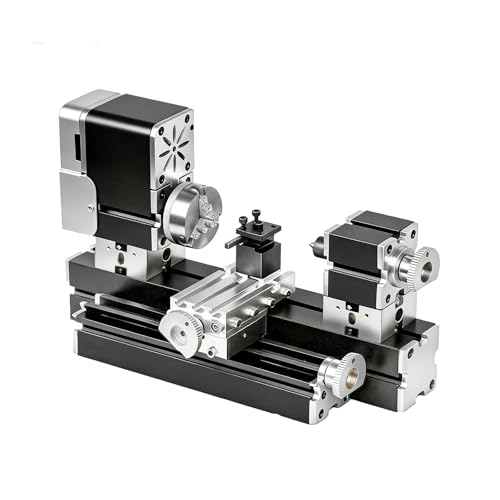
Compact lathes often share one ergonomic problem: the work sits too low, forcing the operator to hunch over for hours. The elevated design here raises the spindle to a more comfortable working height on a desktop footprint of 310 by 100 by 175mm, with a 315 by 200mm base for stability. It feels more like a scaled-down toolroom lathe than a toy.
At 36W and 20,000 RPM, the motor handles wood and soft-metal turning for pens, small bowls, and model parts. The 0.02mm handwheel precision carries over from the larger AcmeFlare sibling, so fine adjustments stay consistent. Education settings and hobbyist classes will find the elevated stance easier on students during long sessions.
A Strong Showing
- Elevated design reduces back strain during longer turning sessions
- 0.02mm handwheel precision supports fine detail work
- All-metal body adds the rigidity that plastic mini lathes often lack
- 20,000 RPM range covers wood and soft-metal turning without bogging
Trade-Offs
- 36W motor suits small parts only, not full furniture spindles
- Compact bed restricts the diameter of work you can swing
- Owners commonly note that small chips escape the included safety guard during longer runs
Built With In Mind
Hobbyists, students, and small-part turners who want a comfortable, durable desktop lathe for pen turning, model making, and classroom use.
A Better Fit Elsewhere
You need multi-face machining in one setup, the AcmeFlare 4-Axis Micro Lathe adds an A-axis that this two-axis design does not offer.
This is the simpler, lower-stance sibling of the elevated AcmeFlare model above, aimed at hobbyists who want precision handwheel feedback without the raised work height. The 0.02mm molded scale on every handwheel gives the same measurable accuracy for fine passes, so finishing work stays controlled. For desktop turners with a lower bench or a workshop tray setup, the lower profile can actually fit better.
All-metal construction runs from the spindle housing through the gears, handwheels, and sliders, which gives the lathe the rigidity that stamped-metal and plastic-bodied mini lathes often miss. It handles wood, copper, and aluminum at 20,000 RPM without complaint, assuming the work stays within the small-part envelope. The dovetail connection blocks with square nuts prevent the kind of screw slippage that wrecks accuracy over time.
Real Benefits
- Full-metal spindle, gears, and sliders improve long-term rigidity
- 0.02mm handwheel scales give measurable, repeatable adjustments
- Dovetail blocks with square nuts resist slippage during heavy cuts
- Compact footprint works on crowded benches and shared workspaces
Possible Compromises
- Lower stance means more hunching during long turning sessions
- 36W motor caps the practical workpiece size for metal turning
- No included 4-jaw chuck, so eccentric work may need a separate purchase
Whose Shelf It Belongs On
Desktop hobbyists turning pens, small bowls, and model parts in wood or soft metals who value precision scales over ergonomic height.
Consider Something Else When
Back comfort matters during long sessions, the AcmeFlare All-Metal Elevated Mini Lathe raises the work to a friendlier height for the same precision.
Milling closes the gap between a tabletop lathe and a real machine shop, and the AcmeFlare Mini Mill brings that capability down to a desktop footprint. Three-axis control across X, Y, and Z with 0.02mm precision handwheels covers contour cuts, slot work, hole patterns, and basic gear milling for small parts. Woodworkers adding metal capabilities to a small shop get a sensible second machine here.
Electroplated all-metal construction resists rust and holds rigidity better than painted steel housings, which matters for any tool stored in a damp garage or unheated workshop. The included scaled vise keeps work aligned without buying a separate fixture. At 36W and 20,000 RPM, expectations should match the size: small parts in metal, wood, and plastic, not large structural milling.
Features That Help
- Three-axis precision covers contour, slot, and hole work in one setup
- Electroplated body resists corrosion in damp shop environments
- Included scaled vise saves a separate purchase for most small jobs
- Compact vertical footprint fits a workbench corner without dedicated space
Less-Strong Areas
- 36W motor caps you to small parts, not heavy steel milling
- Mini mill geometry has a learning curve compared to a drill press
- Limited spindle travel, so plan workpieces to fit the available Z-axis range
Quick Facts
Who Should Grab It
Detail-oriented hobbyists and small-shop machinists adding contour and slot work to a workshop that already has a lathe or table saw.
Skip It When
You mainly need turning and facing work, the AcmeFlare 4-Axis Micro Lathe handles rotational machining without the milling learning curve.
What To Weigh Before Buying A Table Saw For Woodworking
The first decision is power source. Corded saws like the DEWALT DWE7485 and DWE7485WS deliver constant output, which matters for all-day ripping of hardwood or sheet goods. Cordless options such as the FLEXVOLT DCS7485B free you from extension cords, but runtime depends on battery capacity and the wood you are cutting. For shops with steady power, corded usually wins on cost and consistency.
Rip capacity is the second big lever. A 24 to 24.5 inch rip handles 4×8 sheets without extension tables, which saves real time on cabinet and furniture builds. Smaller craft saws trade rip capacity for footprint, so match the saw to the size of work you actually do. Benchtop and mini lathes or mills cover detail work that a table saw cannot, so think of them as complement machines, not replacements.
Finally, consider the build around the blade. Roll-cage bases, rack and pinion fences, and metal housings all extend service life on tools that take real abuse. On mini machines, all-metal frames and electroplated finishes resist flex and corrosion in shop conditions. The right saw for your shop is the one whose capacity, power, and durability match the projects you already have on the bench.
Smart Considerations Before You Commit
Common Shopping Slip Ups
Many first-time shoppers chase the lowest amp count or the smallest footprint without matching the saw to the work. A compact jobsite saw with an 8-1/4 inch blade handles trim and small panels, but a heavy rip on thick hardwood will stall it. Measure the largest sheet or board you plan to cut, then confirm the rip capacity and depth of cut cover that material with room to spare.
Another trap is buying a tool-only cordless saw without checking battery inventory. The DEWALT FLEXVOLT DCS7485B runs on FLEXVOLT packs, so shoppers without batteries and chargers end up doubling the real cost. On the craft side, mini saws ship with accessory kits, but those bits wear out, so factor replacement bits into the budget rather than assuming the included set lasts forever.
Where The Extra Money Goes
Higher-tier table saws tend to spend the money on fences, bases, and motors that survive years of use. A rack and pinion fence on the DEWALT DWE7485WS stays square across thousands of cuts, where a basic fence drifts and ruins accuracy. Metal roll-cage bases on the FLEXVOLT DCS7485B shrug off drops that would crack plastic housings, so the upgrade pays back in fewer replacements.
On the small-machine side, all-metal lathes and electroplated milling bodies resist the flex and rust that plastic frames cannot. A 0.02mm handwheel scale on the AcmeFlare lathes sounds tiny, but it is the difference between guesswork and measurable precision on fine parts. For shops that use these tools weekly, that precision and rigidity save time and scrap, which is where the higher price really returns value.
Frequently Asked Questions
What size table saw blade do most woodworkers need?
An 8-1/4 inch blade, like the ones on the DEWALT DWE7485 and DCS7485B, handles trim, plywood, and most dimensional lumber cuts with ease. Larger 10 inch contractor saws offer more depth of cut for thick hardwood, but the trade-off is weight and footprint. Match the blade size to your largest typical stock rather than buying the biggest saw you can fit.
Corded or cordless table saw, which is better?
Corded saws deliver constant power, which matters for heavy ripping and all-day work. Cordless saws like the FLEXVOLT DCS7485B shine on remote sites, rooftops, and any spot without a convenient outlet. For shop-only woodworkers with reliable power, corded usually wins on cost. For crews that move often, the cordless flexibility is hard to beat.
Can a mini table saw replace a full-size table saw?
Mini table saws like the Zericuf models handle craft cuts, model making, and small parts, but they cannot rip dimensional lumber or sheet goods. Their small work surfaces and lower power cap them to hobby and detail work. For furniture, cabinetry, or framing, a full-size jobsite or contractor saw is the right tool, with the mini saw as a complement.
What accessories matter most for a new table saw?
A sharp, clean blade and a reliable push stick matter more than any add-on. A good blade reduces tear-out on plywood and hardwood, while a push stick keeps hands away from the blade during narrow cuts. Dust collection, whether a basic bag or a shop vac hookup, keeps the work area visible and the air cleaner during longer sessions.
How do I maintain a table saw for longer life?
Keep the blade clean and sharp, since pitch buildup and dull teeth strain the motor and ruin cut quality. Wipe down the table surface after each session to prevent rust, and check the fence for square periodically, because even a quality fence drifts over time. For cordless models, store batteries at room temperature and avoid running them flat before recharging.