Walk a real framing crew through a workday and the tool belt stops being optional fast. Hand-fastener pouches, tape clips, hammer loops, and a level sleeve turn a frantic shuffle into a steady rhythm on the deck. The right belt spreads weight across the hips, keeps the dominant hand free, and survives months of kneeling, climbing, and bouncing off ladders. The wrong one drags on the lower back, sags under load, and frays inside a season.
The list below covers framers, carpenters, electricians, and scaffold crews who carry different tool kits and demand different things from a belt. You will see full leather rigs for tradies who want one belt for life, lighter nylon-and-leather hybrids for warm-weather framers, and pink-handled options that hold their own on any site. Pick the one that matches your trade, your waist size, and the volume of fasteners you move in a single day.
The Essentials At A Glance
PickWhy We Picked ItBest ForAction
Editor’s Choice
Occidental Leather OxyLights 7 Bag Framer Set (Small)
The OxyLights Framer Set pairs a familiar Occidental layout with an industrial nylon body, which cuts a noticeable chunk of weight off the all-leather 5089 most crews already know. The OxyRed leather at the main bag corners adds structure exactly where you kneel, while a no-spill tool holder system keeps your speed square and pencils from sliding out when you bend to a plate. For warm-weather framers who climb all day, the hybrid build makes the difference between a belt that fades into your hips and one that drags at the small of your back.
Twenty-two pockets and tool holders run across the small frame, so the layout leans toward framers who carry fastener bags, a hammer, a tape, a utility knife, and a handful of pencils rather than a full electrical kit. Compare that to the heavier Occidental Seven Bag Set further down, which throws every pouch at you in full leather. The trade-off is durability over time: hybrid materials last, but full-grain leather outlives nylon by years when you treat it right.
The Helpful Details
✓Hybrid leather-and-nylon build eases hip fatigue on long shifts
✓Reinforced bag corners survive daily kneeling on decks and subfloors
✓Twenty-two pockets cover a framer’s core tool loadout
✓Hand-specific holder layout supports a smooth right-and-left rhythm
Things To Consider
•Small sizing runs tight on waists above the listed range
•Nylon panels will outwear the leather components, so you may retire the belt sooner than a full-leather rig
Who It Suits Best
Active framers working in hot weather who want a lighter belt that still organizes like a serious piece of gear.
Look Elsewhere When
Tradies who haul unusually heavy loads should reach for the LAUTUS Heavy-Duty Top Grain Leather Tool Belt further down, which trades hybrid comfort for thicker 4mm leather.
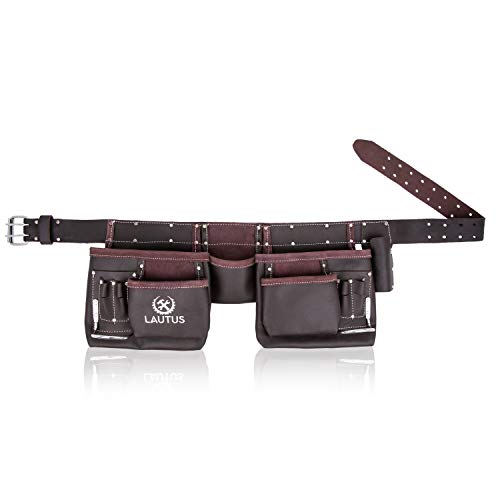
Scaffold work punishes belts. You twist, lean over ledgers, and swing tools up to a platform, so the rig needs to ride high and stay put. The LAUTUS 6-Piece scaffold rig answers with oiled tanned leather that grips a sweatshirt instead of sliding down, plus five movable tool holders that you can slide into the position that matches how you reach. The dark brown finish hides scuffs, and the 2-inch web belt gives you the wide contact patch that scaffolds tend to prefer.
You can reconfigure the holder layout every morning, which is the feature most scaffolders care about. Compared to the OxyLights hybrid above, this is a much stiffer belt out of the box, and the dark oiled finish softens into a working patina over a few weeks. If your trade is framing rather than scaffolding, the LAUTUS 4mm belt at the end of the list is the more useful shape.
Real Benefits
✓Oiled tanned leather holds position when you lean and twist at height
✓Five repositionable holders let you match your dominant hand and reach pattern
✓2-inch web belt spreads weight across the waist during long lifts
✓Adjusts from roughly 32″ to 46″ to fit most crew members
Points To Note
•Leather runs stiff at first and needs a short break-in period
•Dark finish can leave a temporary dye rub on light-colored pants
•Six-piece layout is heavier than the OxyLights hybrid, which matters on long climbs
Key Specs
Feature
Specification
Why It Matters
Material
Oiled tanned leather
Grips clothing and ages into a softer feel over weeks of use
Belt width
2 inches
Wide enough for stable support without binding under a harness
Tool holders
5 movable positions
Lets you arrange the rig to match your dominant-hand reach
Waist range
32″ – 46″
Covers most adult crew members without ordering a custom size
Made For
Scaffolders who want a stiff leather rig with a layout they can reconfigure for level, tape, spanners, and hammer.
Where Another Pick Suits Better
Roofers should consider the WELKINLAND 39-Pocket Tool Belt With Suspenders, which shares load between the waist and shoulders during overhead work.
Roofing is where a regular belt quietly destroys your lower back. The WELKINLAND rig answers the load problem with a suspender system that pulls the weight off your hips and onto your shoulders, plus a dual-layer 4.3-inch padded waist belt that breathes. The package is heavy by design: 39 pockets, two pouches, a hammer holster, and four belt loops, all sized to hold the fastener bags, snips, and chalk line a roofer cycles through a shift.
The set leans roof- and framing-first, and the HD EVA padding in the suspenders is a real upgrade on hot days when a leather belt would soak through. Compare that to the Occidental HD 3″ Ranger Work Belt coming up, which is a foundation piece without the suspender system. If you do less overhead work, the suspenders feel like overkill and add bulk under a harness.
What Earns Its Place
✓Suspender system shares the load during long roof shifts
✓Padded 4.3″ waist band with breathable lining reduces sweat build-up
✓39 pockets cover a full roofer’s tool count without crowding any single pouch
✓HD EVA padding in the suspenders softens shoulder pressure
Honest Caveats
•Suspenders add bulk that can interfere with a fall-arrest harness
•Higher pocket count means more to organize each morning
•Heavier than a waist-only rig when you only need a hammer and tape
Best Suited To
Roofers and framers who spend full days carrying 15+ pounds of tools and want shoulder support along with hip support.
Skip It When
Electricians working in tight panels will find the Occidental HD 3″ Ranger Work Belt a simpler, lighter foundation that does not interfere with overhead reach.
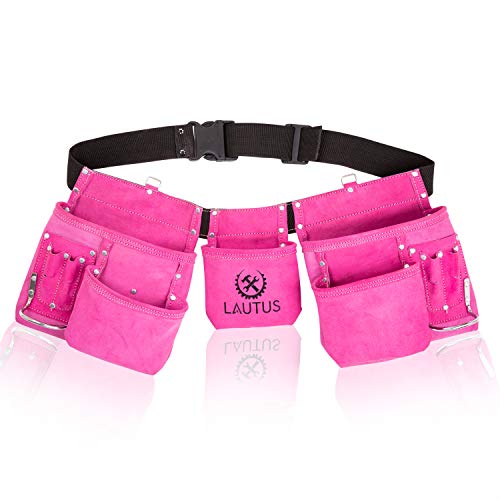
The Pink Tool Belt earns its place here because color matters on a busy site. Pink is easy to spot in a pile of lumber, and a leather belt in a stand-out color stops being “my belt” the moment a coworker picks up the wrong one. Underneath the color, the build is the same LAUTUS oiled tanned leather you find in the larger 6-Piece scaffold rig, so the structure is familiar.
You get 11 pockets and two steel hammer holders, which is a sensible count for carpenters, framers, and electricians who carry a tight tool list. Compared to the bigger LAUTUS 4mm belt at the end of the article, this one skips the extra D-rings and tape measure clip, so it suits a more streamlined kit. You may find the bright color fades a little under heavy sun, depending on how often you leave the belt on a tailgate.
Bright Spots
✓Color-coded leather is hard to mix up with crew belts
✓Two steel hammer holders let you carry a hammer and a hatchet or second hammer
✓Real oiled tanned leather, not a coated split
✓Adjusts across a wide waist range, similar to other LAUTUS rigs
Worth Noting
•Bright dye can transfer to pale shirts during the first few wears
•Eleven pockets are enough for most carpenters but tight for full fastener crews
•No dedicated tape measure clip on the belt itself
Who Will Love This
Tradies who want a recognizable belt on a shared site, plus anyone who simply prefers a brighter look on a tool rig.
Not Your Match When
Framers running full nail and screw bags will find the Occidental Seven Bag Framer Set better matched to the volume of fasteners they move per hour.
Some crews like to build their own rig one piece at a time, which is where the HD 3″ Ranger Work Belt earns its keep. It is a foundation: a 12-14 oz bridle leather strap with a 2-inch heavy tongue and a nickel-plated steel roller buckle, edge stitched for the kind of clean finish you expect from a belt you will own for a decade. You add pouches separately, which lets you tune the layout to your trade.
The 3-inch body gives you a wider contact patch under load, which spreads hip pressure compared to a 2-inch scaffold belt. The trade-off shows up on hot days: this is a thick leather strap, and it does not breathe. For crews who already own a pouch set they trust, this is the kind of belt you replace once and forget about.
Notable Gains
✓12-14 oz bridle leather is built to last a working career
✓3-inch body spreads weight across the hips under full loads
✓Nickel-plated steel roller buckle glides smoothly even with cold hands
✓Edge stitching adds long-term durability at the seams
Trade Offs
•Foundation-only: pouches sold separately, so the full setup costs more out of the gate
•Thick leather needs a clear break-in period before it sits comfortably
•2XL waist range may be too generous for smaller-framed tradies
Feature Snapshot
Feature
Specification
Why It Matters
Leather weight
12-14 oz bridle leather
Heavy enough to support a loaded pouch set without sagging
Buckle
Nickel-plated steel roller
Roller design glides under load and resists corrosion on a damp site
Belt width
3 inches main, 2 inch tongue
Wide base supports pouches while a narrower tongue keeps the buckle flat
Perfect Match For
Experienced tradies with a pouch collection they already love, who want a heavy leather foundation belt to tie everything together.
Swap It Out When
First-time shoppers will find the Occidental Seven Bag Framer Set a friendlier one-and-done solution with pouches already matched to the belt.
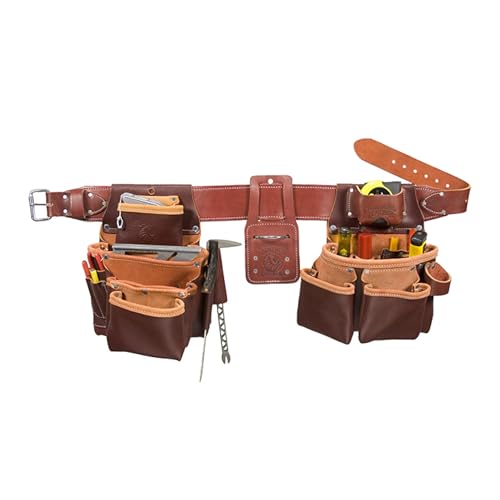
The Seven Bag Framer Set is the most storage-heavy leather rig Occidental makes, and it shows. Twenty-three pockets and tool holders sit across a top-grain leather build that is hand-assembled in Sonoma County, with hand-specific tool holder placement for right- and left-handed use. Copper rivets reinforce the main bags, and a no-spill tool holder system keeps your speed square where you drop it instead of letting it slide into the bottom of the bag.
At 5.6 lbs empty, this is a heavy belt, and that is the point. The weight is the leather, and the leather is the durability. The kit ships with a 3 Pouch Pro Tool Bag, a 4 Pouch Pro Fastener Bag, a hammer holder, and the HD 3″ Ranger Work Belt. Compare that to the LAUTUS 4mm rig at the end of the article, which is a single all-in-one belt with 18 pockets. If you carry that volume of fasteners every day, the Seven Bag layout justifies its weight.
Notable Upsides
✓Premium top-grain leather ages into a personal fit over years
✓Twenty-three pockets and holders cover a full framing tool loadout
✓Hand-specific holder layout supports a smooth right- and left-hand rhythm
✓Made in USA build quality with copper rivet reinforcement
Possible Compromises
•5.6 lb empty weight adds up over a 10-hour shift
•Premium leather demands basic care, like the occasional conditioning
•Higher pocket count takes longer to organize each morning
Key Attributes
Feature
Specification
Why It Matters
Total pockets and holders
23
Covers a framer’s full set of fasteners, tools, and pencils without forcing you to leave anything in the truck
Empty weight
5.6 lbs
Heavier than hybrids, lighter than an all-leather loadout in a bucket
Construction
Top-grain leather, copper rivets
Premium materials and reinforcement at the high-stress points
Origin
Made in USA
Domestic hand assembly supports tighter quality control
The Right Fit
Full-time framers who want the most storage a leather rig can offer and are willing to carry the weight for the durability.
Another Choice May Suit
Tradies who prefer a lighter, more breathable rig should look at the Occidental OxyLights 7 Bag Framer Set, which keeps the layout but swaps leather for nylon in the panels.
The 7-Piece Scaffolder Set is the larger sibling of the 6-Piece LAUTUS rig earlier in this list. The headline difference is sizing: the belt runs from 32″ up to 50″, which makes it the right answer for bigger-framed crew members the smaller rig cannot fit. The leather is 3.5mm thick, oiled tanned, and cut for scaffolding, with six tool holders that you can move to match your dominant hand.
You can think of this as the same LAUTUS formula with one extra placement position. The trade-off is weight: a thicker leather belt with one more holder sits heavier on the hip than the 6-Piece version. If you wear a 44″ waist or larger and you climb all day, this is the one to choose.
Strong Points
✓Wider waist range (32″–50″) covers larger crew members
✓3.5mm oiled tanned leather handles daily wear at height
✓Six repositionable holders let you customize the layout
✓Solid build quality aimed at long-term use
A Few Limitations
•Heavier than the 6-Piece LAUTUS due to thicker leather and extra holder
•Stiff out of the box, with a noticeable break-in curve
•Less flexible fit on smaller waists below the 32″ mark
Spec Overview
Feature
Specification
Why It Matters
Leather thickness
3.5mm oiled tanned
Thick enough to support scaffolding use without flexing under tool weight
Tool holders
6 movable positions
Lets you match the layout to your hand and reach
Waist range
32″ – 50″
Covers a much wider range than most scaffold belts on the market
Built With In Mind
Larger scaffolders who have been sized out of the smaller 6-Piece rig and want the same LAUTUS leather quality in a wider size range.
Reach For A Different Pick When
Roofers and framers who need shoulder support should consider the WELKINLAND 39-Pocket Tool Belt With Suspenders instead of a waist-only rig.
The classic LAUTUS oil-tanned rig is the no-fuss option in the line. It uses the same oiled tanned leather as the larger scaffold rigs, with a layout aimed at carpenters, framers, handymen, and electricians who want one belt to cover most jobs. The pocket count is conservative, which keeps the weight reasonable for full-day wear.
Adjustability runs from 28″ up to 46″, so it covers a wider size range than the dedicated scaffold rigs. The honest read is that this is the multi-trade belt: it is not the heaviest-duty option on the list, and it is not the lightest either. Compare that to the LAUTUS Heavy-Duty 4mm belt at the end of the article, which is a step up in leather thickness if you find the standard oil-tanned feel a little soft.
Everyday Wins
✓Versatile across carpentry, framing, handyman, and electrical work
✓28″–46″ waist range fits a broad range of crew members
✓Genuine oiled tanned leather with a familiar LAUTUS build
✓Lower pocket count keeps the belt lighter than a full rig
Room For Improvement
•Lower pocket count limits fastener carrying capacity for active framers
•Leather can run stiff until broken in, depending on how it was stored
•No dedicated scaffold-rated configuration, so it suits scaffold less than the dedicated 6- and 7-Piece rigs
Whose Shelf It Belongs On
Multi-trade handymen and weekend pros who want a leather belt that handles small framing, trim, and electrical work without specializing in one.
A Better Fit Elsewhere
Scaffolders who need specific tool placement for level, tape, spanners, and hammer will find the LAUTUS 6-Piece Scaffold Belt a more focused rig for their trade.
The 4mm Top Grain Leather Tool Belt is the thickest belt in the LAUTUS line, built for framers, carpenters, and electricians who carry a full day of fasteners, wrenches, and measuring tools. Top-grain leather means the outer surface of the hide, which is the toughest part, runs at 4mm thick to support the weight of a loaded rig without sagging. Two D-rings, two loops, and a tape measure clip add small touches that disappear into a normal day until you need them.
Eighteen pockets and holders run across a single-belt layout, which is more streamlined than the multi-pouch Occidental Seven Bag Set. The catch is the weight and the break-in curve, which is a real commitment for the first two weeks. You may find that the 4mm thickness feels like too much belt for trim and finish work, where a lighter rig is the right answer.
The Good Stuff
✓4mm top-grain leather handles heavy loads without stretching
✓Two D-rings give you clip points for tape, keys, or a holster
✓Dedicated tape measure clip keeps your tape where you reach for it
✓Eighteen pockets cover a full multi-trade day
Less Ideal Details
•Heavier than the standard LAUTUS oil-tanned belt by a clear margin
•Stiff leather takes a noticeable break-in period
•Single-belt layout offers less specialization than a multi-bag rig
Feature Card
Feature
Specification
Why It Matters
Leather thickness
4mm top grain
One of the thickest single-belt builds in the category, so it resists stretch under load
Total pockets
18 pockets and holders
Covers a full day of fasteners, wrenches, and measuring tools
Extras
2 D-rings, 2 loops, tape clip
Small touches that make a busy day easier without bloating the layout
Who Should Grab It
Framers and carpenters who carry a full loadout every day and want one of the thickest single-belt leather rigs available.
Where A Sibling Pick Shines
Trim carpenters running a lighter load should look at the LAUTUS Oil Tanned Leather Tool Belt, which trades 4mm thickness for an easier break-in.
What To Weigh Before Buying A Construction Tool Belt
A construction tool belt is the one piece of gear that stays on your body from the first cut to the last cleanup, so the fit and the materials matter more than the pocket count on paper. A belt that fits badly puts pressure on the wrong part of the hip, and a belt in the wrong leather fails inside a season. Spend a few minutes matching the rig to your trade, your waist, and the tools you actually carry, and the belt pays you back across the year.
Leather Weight And Construction
Leather thickness is usually quoted in millimeters or in ounces (a leather weight, not a kitchen measure, where 1 oz equals roughly 0.4mm of thickness). Anything in the 3mm to 4mm range is built for full-time site work, while thinner leather is fine for trim and finish. Top-grain leather uses the tough outer layer of the hide, while oiled tanned leather is treated with oils to stay flexible and water-resistant. Oiled tanned breaks in faster, top-grain lasts longer.
Belt Width And Fit Range
A 3-inch main belt spreads weight across the hips, which matters once you load it with fasteners, while a 2-inch belt gives you more flexibility under a harness or a tighter fit. Most leather rigs run from 28″ or 32″ up to 46″ or 50″, but you should check the listed range against your actual waist measurement over a shirt, not bare skin. Sizing up slightly and using a hole punch for a custom fit is the usual approach for between sizes.
Pouch Count And Layout
More pockets is not always better. A framer wants seven or more dedicated fastener bags, while an electrician needs fewer, larger pockets for pliers, strippers, and a voltage tester. Hand-specific layouts (right-hand and left-hand pockets placed differently) make a real difference on long shifts, because the belt matches how you reach. A no-spill tool holder system keeps small items where you drop them instead of letting them slide to the bottom.
Climate And Weight
Hot climates punish thick leather, which is why hybrid leather-and-nylon rigs exist. The Occidental OxyLights line keeps the leather at the high-stress points and swaps the rest for industrial nylon, which cuts a meaningful amount of weight. If you work in heat or carry a heavy load, a suspender system shares the work between the hips and shoulders.
Smart Choices Across This List
Common Shopping Slip Ups
Most tool belt regrets come from buying for a job you do not actually have. Framers often buy small electrician-style belts because they look tidy, and the belt does not hold enough fasteners to last a wall. Electricians sometimes buy a heavy framer’s rig and find the weight wears them out by mid-morning. Match the belt to the trade you run most days, not the trade you might run once.
Another common mistake is sizing by the belt number rather than by your actual waist over work clothes. Leather relaxes a small amount, but it does not stretch enough to take a too-small belt and make it fit. If you are between sizes, the better move is to size up and add a hole with a leather punch, rather than sizing down and hoping it breaks in.
What The Higher Tier Buys
Premium belts cost more because the leather is thicker, the hardware is heavier, and the layout is more specialized. The Occidental Seven Bag Framer Set is a good example: 23 pockets, copper rivets, and a leather build that is hand-assembled in the USA. For a full-time framer, that upgrade is a real quality-of-life change. For a part-time DIYer, the extra cost usually goes to weight and complexity that you do not need, and a lighter LAUTUS rig is the smarter spend.
Higher-tier belts also tend to last longer, which changes the math. A premium belt that costs more up front but lasts a decade is cheaper per year than a budget belt that needs replacing after two seasons. For full-time tradies, that long-term math usually wins. For occasional users, the upfront cost usually wins.
Frequently Asked Questions
QWhat Is The Best Tool Belt For Construction Framers?
A framer’s belt needs at least five to seven dedicated fastener bags, a hammer loop, a tape clip, and a level sleeve. Full-leather rigs like the Occidental Seven Bag Framer Set carry the most, while hybrid rigs like the OxyLights cut weight. Choose leather for durability, hybrid for heat and lighter loads.
QHow Do I Size A Tool Belt For Construction?
Measure your waist over the shirt you usually wear on the job, then pick a belt whose range brackets that number. Most LAUTUS and Occidental rigs adjust across 14 to 18 inches of range, so you usually land inside the spread. Between sizes, go up and add a hole with a leather punch.
QHow Many Pockets Do I Need On A Construction Tool Belt?
For framers, count on at least 18 to 23 pockets and holders to cover a full day. For carpenters and electricians, 10 to 15 is usually enough, with more space per pocket. Anything below 10 pockets usually forces you to leave tools in the truck or the bag, which defeats the purpose.
QAre Leather Or Nylon Tool Belts Better For Construction?
Leather lasts longer, holds its shape under load, and ages into a personal fit. Nylon and hybrids are lighter, breathe better, and dry faster in wet weather. Full-time framers usually pick leather; part-time and warm-climate workers often pick hybrids or nylon-reinforced rigs.
QHow Do I Maintain A Leather Tool Belt For Construction?
Wipe it down at the end of each week, condition the leather every few months with a leather conditioner, and store it flat or hung, never folded. Avoid leaving a wet leather belt in a hot truck, which can warp the shape. A little care once a season keeps a leather belt working for years.
Tool Staff
We research how different tools work, where they are best used, and what features matter for different jobs. Our content covers drills, hand tools, power tools, saws, and other equipment with a focus on practical, useful information.