Laminate and vinyl plank flooring looks simple in photos and less simple the moment you reach the last wall of the room. A clean end cut separates a professional-looking install from one that reveals every shortcut. The right tool turns a stack of rigid planks into tight seams at doorways, corners, and transitions, and it does it without sending dust into the rest of the house. Whether you’re tackling a single bedroom or a full main floor, the picks below cover the main approaches: cordless oscillating multitools for detail work, corded jig saws for curves and bevels, and manual floor cutters that slice planks quietly in occupied rooms.
A Fast Comparison Of The Options

DEWALT 20V MAX XR Oscillating Tool Kit (DCS356C1)

NAACOO 13″ Heavy Laminate Floor Cutter

BLACK+DECKER 5-Amp Jig Saw (BDEJS600C)
NAACOO 17mm Heavy Laminate Floor Cutter

NAACOO 13″ Laminate Floor Cutter

MAIHUITE 10mm Pro Vinyl Floor Cutter

MAIHUITE 10mm Vinyl Cutter with Extra Blade
MAIHUITE 8.5mm Pro Vinyl Floor Cutter
More On The Choices That Made The List
The DEWALT 20V MAX XR Oscillating Tool Kit handles the awkward cuts that pure manual cutters can’t reach, including door jambs, vent openings, and the last sliver of plank against a wall. An oscillating multitool (a small handheld saw whose blade moves in rapid side-to-side arcs rather than spinning) gives you clean plunge cuts where a circular saw would skate across the surface. The brushless motor (no internal brushes to wear, so it runs cooler and uses battery more efficiently) and three-speed trigger put you in control of delicate trim work and aggressive cuts through thicker laminate.
It’s the tool you grab after the main floor is down and you need to undercut a door casing or notch around a register. For most DIYers tackling a full room, it pairs well with a manual floor cutter doing the long straight runs. The kit includes a battery, charger, and starter blades, so you can start working the same day you unbox it.
Noteworthy Benefits
- Cordless design means no hunting for an outlet in a half-finished room or dragging an extension cord across fresh planks.
- Three-speed selector lets you slow down for finish cuts near visible edges and speed up for rough notches hidden under trim.
- Universal accessory adaptor accepts most aftermarket blades, so you’re not locked into a single brand.
- LED work light helps you see the cut line in low-light corners like under cabinets or inside closets.
Trade Offs To Consider
- Battery runtime drops on heavy cuts through dense boards, so a second battery is worth budgeting for larger projects.
- Oscillating cuts are slower than powered circular saws for long, straight runs, which is why the manual cutters below still earn their place.
Who It Suits Best
Homeowners who already own other 20V MAX batteries and want a versatile multitool for finish work.
Consider Something Else When
The NAACOO 13″ Heavy Laminate Floor Cutter handles the high-volume straight cuts more efficiently for installers who only need a specialty flooring tool.
The NAACOO 13″ Heavy Laminate Floor Cutter is a manual guillotine-style cutter that slices planks up to 13 inches wide and 13mm thick. It runs on hand power alone, which is exactly why it earns a spot here: no cord, no dust, no noise complaints from the next room. For occupied homes where a power saw would send sawdust through the rest of the house, this approach keeps the mess contained to a small work area on the floor itself.
The aluminum alloy frame and HDPE (high-density polyethylene, a tough, weather-resistant plastic) base hold up to repeated cuts, and the wheel-driven handle gives you the leverage to push the blade through rigid planks without straining your hand. Unlike the DEWALT above, this tool is purpose-built for one job, and it does that job well enough that many pros keep one on the truck.
A Few Highlights
- Zero dust and zero noise make it safe to use at night or in apartments with thin walls.
- Multiple angle stops at 0°, 15°, 30°, and 45° cover most wall transitions without a protractor.
- Upgraded square base panel adds stability on uneven subfloors compared to older L-shaped frames.
- Single-step length and angle adjustment saves time when you have dozens of identical cuts.
Small Caveats
- Limited to straight cuts, so you’ll still need a jig saw or oscillating tool for curves and notches around vents.
- 13mm maximum thickness rules out some premium rigid-core boards, which is where the NAACOO 17mm model below steps in.
Key Specs
Right Fit For
DIYers doing a full-room install in a lived-in home where dust and noise are deal-breakers.
Look Elsewhere When
The BLACK+DECKER 5-Amp Jig Saw is the better match when you need curved cuts around toilets or rounded corners.
The BLACK+DECKER 5-Amp Jig Saw covers the cuts that manual floor cutters can’t: rounded corners around toilet flanges, arched doorways, and the L-shaped notches at door jambs. A jig saw uses a straight up-and-down blade motion (with optional orbital action, where the blade also rocks forward on the upstroke, for faster cuts) that lets you steer through curves rather than just straight lines. The 3,000 strokes-per-minute top speed and four orbit settings give you control from aggressive cuts to clean finish work.
Where the NAACOO cutter above handles the bulk straight cuts on the open floor, this tool is what you reach for the moment a vent, pipe, or column shows up in the layout. The 45-degree bevel shoe and adjustable orbital action mean you’re not just limited to vertical cuts, which is useful for transitions where the new floor meets a lower threshold.
What Pays Off
- Four curve-control settings let you match the orbit aggressiveness to the material, fast cuts in soft vinyl, slow clean cuts in dense laminate.
- Tool-free blade change speeds up swaps when you switch between wood and finish blades.
- 5-amp motor delivers enough power for most residential flooring without bogging down in thick planks.
- Adjustable shoe improves stability and lets you tackle beveled cuts for thresholds.
Points To Keep In Mind
- Corded design means you’ll need a long extension cord for room-spanning projects.
- Produces more dust than a manual cutter, so a shop vac or dust collection setup is worth planning for.
- Blade selection matters; fine-tooth blades chip less on laminate faces.
Best Suited To
First-time flooring DIYers who need a versatile saw for shapes and straight cuts alike without buying a specialty tool.
Swap It Out When
The NAACOO 13″ Heavy Laminate Floor Cutter takes over for homeowners doing long, straight runs across a whole floor where the jig saw would slow you down.
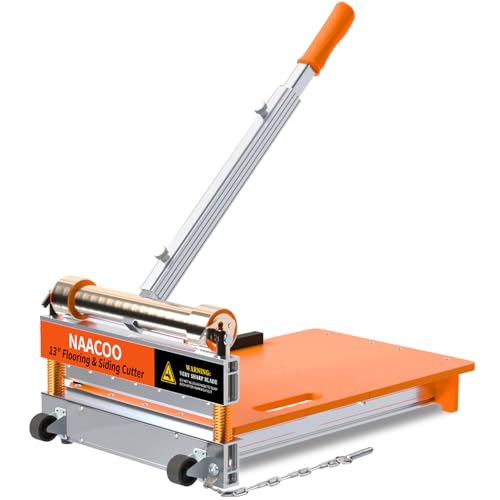
The NAACOO 17mm Heavy Laminate Floor Cutter is the upgraded version of the 13mm model reviewed above, built to push through thicker rigid-core boards and premium laminates. The 17mm cutting depth is the difference between a tool that struggles at the edge of its capacity and one that handles today’s dense SPC (stone plastic composite, a hard vinyl-and-limestone core material used in rigid planks) and WPC (wood plastic composite, a slightly softer foamed-core vinyl plank) products without complaint.
Compared to the 13mm NAACOO reviewed earlier, this version uses a thicker frame plate and heavier blade assembly to keep the cut clean even under serious pressure. If your flooring choice has skewed toward premium rigid-core planks, the 13mm version above may struggle; this one won’t.
Notable Upsides
- 17mm depth handles rigid-core luxury planks that defeat lighter-duty cutters.
- Square base panel upgrade improves stability compared to the older L-frame design used in budget cutters.
- High-strength aluminum alloy frame resists bending during heavy daily use on job sites.
- Same 0°/15°/30°/45° angle stops as the smaller NAACOO, so workflow stays consistent.
Honest Caveats
- Heavier than the 13mm model, so moving it between rooms takes a little more effort.
- Overkill for thin LVP under 8mm, where the MAIHUITE 8.5mm model below is a better size match.
Feature Snapshot
Made For
Installers working with premium rigid-core or thicker laminate boards who need consistent cuts without burning through blades.
Reach For A Different Pick When
The MAIHUITE 8.5mm Pro Vinyl Floor Cutter is a better match for thinner LVP jobs where extra cutting depth just adds weight.
The NAACOO 13″ Laminate Floor Cutter is the original 13mm manual cutter from the brand, sharing the same dimensions as the Heavy version reviewed earlier but with a slightly lighter frame. The result is a tool that’s easier to carry from the car to a third-floor walk-up and easier to store in a small apartment closet between projects. Same angle stops, same aluminum and HDPE construction, just a friendlier weight class.
Where the heavier NAACOO above targets pros doing daily installs, this version targets the homeowner who’ll use it a few times a year. The cut quality is similar on boards under 13mm, which covers most residential laminate and standard vinyl plank.
What Makes Sense
- Lighter than the NAACOO 17mm version, so it stores easily in a closet or under a workbench.
- Quiet operation means you won’t anger downstairs neighbors during evening projects.
- One-step length and angle adjustment keeps the workflow simple for occasional use.
- Reusable design outlasts disposable blade tools used in cheap scoring cutters.
Worth Noting
- Not built for high-volume daily job-site use the way the heavier NAACOO 17mm is.
- Still limited to straight cuts; pair with a jig saw for anything curved.
Whose Shelf It Belongs On
Condo or apartment owners who need a quiet, dust-free way to handle the occasional plank repair or single-room install.
Not Your Match When
Contractors running multiple rooms a week should step up to the NAACOO 17mm Heavy for better long-term durability.
The MAIHUITE 10mm Pro Vinyl Floor Cutter is purpose-built for vinyl plank, LVT, LVP, SPC, PVC, WPC, and VCT flooring, which means it skips the heavier frame of general laminate cutters and focuses on the cuts that vinyl projects actually need. The 10mm depth covers the bulk of rigid-core planks sold at home improvement retailers, and the cutter’s design supports straight, angle, and L-shaped cuts from a single setup.
Where the NAACOO cutters above lean toward the laminate side of the family, this one makes no apologies for being a vinyl specialist. A built-in aluminum ruler keeps the workpiece aligned without you holding a tape measure against the bed, which is a small detail that adds up across a long weekend of cuts.
What Works In Its Favor
- Supports L-cuts and U-cuts in addition to straight and angle cuts, useful around door frames and pipes.
- Built-in aluminum ruler improves repeatability on long runs of identical cuts.
- No electricity needed, so you can work in basements, garages, or any spot without an outlet.
- Lightweight compared to the heavier NAACOO cutters, easier for one person to reposition.
Potential Drawbacks
- Not rated for laminate, hardwood, or porcelain tile, so verify your flooring type before buying.
- 10mm depth caps out before some premium rigid-core planks, which is where the upgraded MAIHUITE below steps in.
Perfect Match For
Weekend warriors installing click-lock vinyl plank in a basement, laundry room, or home office where dust is a concern.
Where Another Pick Suits Better
Homeowners working with 8.5mm or thinner LVP will get cleaner results from the MAIHUITE 8.5mm Pro cutter below.
The MAIHUITE 10mm Vinyl Cutter with Extra Blade takes the same 10mm cutter reviewed above and bundles a replacement blade into the box. Blades on manual floor cutters dull over time, especially when cutting dense SPC cores, so a spare in the package means you don’t stop mid-project to hunt down a replacement. For DIYers planning more than one room, that spare is the difference between finishing on Saturday and waiting for a part to ship.
The tool itself supports the same straight, angle, L, and U cuts as the standard 10mm version, and the aluminum ruler detail is preserved. The extra blade is a quiet upgrade that adds practical value to anyone doing a high cut count.
Real Benefits
- Spare blade included means zero downtime mid-project for blade swaps.
- Same L-cut and U-cut support as the standard 10mm model, useful for tricky corners.
- Manual operation keeps noise and dust out of the equation for indoor work.
- Engineered specifically for vinyl-based materials, which matches the most common DIY flooring types.
Less-Strong Areas
- Material compatibility is limited to vinyl, so it cannot step in for laminate or hardwood cuts.
- Heavier than expected for a 10mm cutter, so plan your work area before unpacking.
Quick Facts
Who Should Grab It
DIYers tackling two or more rooms of click-lock vinyl who want a backup blade on hand from day one.
Skip It When
The DEWALT 20V MAX XR Oscillating Tool Kit is the better fit when your project includes a lot of detail cuts and undercuts rather than long straight runs.
The MAIHUITE 8.5mm Pro Vinyl Floor Cutter is the thinnest-plank specialist in the roundup, sized for the popular 5mm to 8mm LVP boards that dominate the budget-friendly end of the vinyl market. The lower cutting depth lets the manufacturer tune the blade geometry for cleaner edges on thinner material, and you may find the result is less chipping on the visible face of the plank compared to heavier cutters used at the bottom of their range.
Like the 10mm version above, it ships with an extra blade and supports straight, angle, L, and U cuts. The 8.5mm ceiling means you shouldn’t reach for this on premium 10mm SPC, but for the average DIY LVP project it’s the right size for the job.
Advantages To Know
- Tuned for thinner LVP, where the cut edge is less likely to chip on the visible face.
- Spare blade included matches the value of the larger 10mm MAIHUITE package.
- Lighter than the 10mm version, easier to reposition on a small work area.
- Same L-cut and U-cut versatility for tight corners around door frames.
Factors To Consider
- Cannot cut 10mm SPC, so homeowners with premium planks need the 10mm MAIHUITE above instead.
- Limited to vinyl-based materials; laminate and hardwood are off the menu.
Built With In Mind
DIYers installing standard 5mm to 8mm LVP in a single room or a starter home where budget planks are the realistic choice.
Another Choice May Suit
The BLACK+DECKER 5-Amp Jig Saw is the better match when cuts around curved obstacles matter more than speed on straight runs.
What To Weigh Before Choosing A Laminate Cutting Tool
Cutting laminate or vinyl plank cleanly comes down to matching the tool to the type of cuts your room demands. A typical room uses 80% straight cross-cuts and lengthwise rips, with the remaining 20% falling on notches, curves, and undercuts around door casings and vents. If you optimize for the 80%, a manual floor cutter handles most of the work quietly and dust-free. If you optimize for the 20%, a powered jig saw or oscillating multitool earns its keep.
Manual Cutter Versus Power Tool
Manual guillotine cutters use a long lever and sharp blade to slice planks in one motion. They shine on straight cuts, generate no dust, and run silent. The trade-off shows up when the layout demands a curve, a tight U-cut around a pipe, or a notch for a heat register. For those situations, a powered jig saw or oscillating tool is the right call, even though it brings noise and dust into the room.
Material Compatibility Matters
Cutter specs list a maximum thickness, but they also imply a material family. NAACOO’s cutters are built for laminate and vinyl. MAIHUITE’s cutters are vinyl-only and explicitly warn against laminate and hardwood. Running a vinyl-only cutter on laminate will damage the blade and may chip the plank face. Before ordering, confirm your flooring’s material and thickness match the cutter’s ratings.
Width And Angle Capacity
Standard residential planks run 5 to 9 inches wide, well within any 13-inch cutter’s reach. If you pick wider boards, double-check the cutter’s width rating. The four common angle stops (0°, 15°, 30°, 45°) cover standard corner transitions; you may find yourself improvising with a protractor for non-standard angles like bay window corners.
Portability And Storage
A manual cutter weighs between 10 and 25 pounds depending on the frame, which matters if you haul it up stairs or store it between projects. Power tools add battery and charger weight, plus the bulk of a case. Pickers in apartments and condos often lean manual for the storage and weight savings alone.
Key Considerations Across These Picks
Common Shopping Slip Ups
The most frequent mistake is choosing a cutter based on price alone without checking the material compatibility. A budget vinyl-only cutter cannot handle laminate, and a laminate-rated cutter may chip thin vinyl plank. Measure your flooring’s actual thickness with calipers, not the nominal spec on the box, before deciding. The other common slip is buying a cutter that can’t handle your plank width, especially on wide-format luxury vinyl.
Where The Extra Money Goes
Higher-tier models in this category earn their price through thicker frames, hardened blades that stay sharp longer, and refined angle-stop mechanisms. For a single-room DIY, the entry level is plenty. For a multi-room job or a rental you’ll re-floor in a few years, the upgrade to a thicker frame and included spare blade pays off in faster cuts and less downtime. Power tool upgrades tend to add brushless motors, longer runtime batteries, and better ergonomics, which matter more as the project size grows.
Frequently Asked Questions
What is the easiest tool to cut laminate flooring with?
A manual guillotine-style floor cutter is the easiest for straight cuts, with no learning curve and no power required. For curves and notches, a corded jig saw with a fine-tooth blade is the most beginner-friendly power option.
Can you cut laminate flooring without a saw?
You can score and snap thinner laminate planks with a utility knife, but the cut quality is inconsistent and the method is slow. A manual floor cutter gives cleaner results with the same dust-free benefit.
What blade works best for laminate on a jig saw?
A fine-tooth wood-cutting blade, typically 10 to 12 TPI (teeth per inch), gives the cleanest edge on laminate. Coarser blades chip the visible face of the plank.
Are vinyl-only floor cutters safe for laminate?
No. Vinyl-only cutters use a blade geometry tuned for softer vinyl material. Cutting laminate with one can chip the plank face and damage the tool’s blade.
How thick of laminate can a manual cutter handle?
Most residential manual cutters handle up to 13mm of laminate, which covers the majority of standard planks. Premium rigid-core boards over 13mm require a heavy-duty cutter like the 17mm NAACOO reviewed above.