


A track saw lives or dies by its blade. A wobbly tooth or a chip that catches mid-cut can ruin a sheet of ply and your afternoon, so the blade you mount matters as much as the saw itself. This roundup covers nine options sized for the most common plunge saws and guide rails, from cordless Makita builds to 160mm Festool setups. You will find thin-kerf blades for fast slicing, ATB grinds for cleaner cross-cuts, and a few specialty picks worth knowing about. Match the tooth count, kerf, and arbor to your saw and your typical material, and cuts stay crisp without burning edges or bogging down the motor.
A Side-By-Side Look

Milwaukee 48-Tooth Fine Finish Track Saw Blade, 165mm

WEN BL6556 6.5-Inch 56-Tooth ATAFR Track Saw Blade

FOXBC 6-1/2 Inch 56-Tooth Thin-Kerf Track Saw Blade

FOXBC 6-1/2 Inch 48-Tooth Track Saw Blade, 2.2mm Kerf

Makita B-57342 6-1/2″ 56T Cordless Plunge Saw Blade
FOXBC 160mm 48T ATB Track Saw Blade for Festool
FOXBC 6-1/2 Inch 56T Track Saw Blade, 1.8mm Kerf
FOXBC 42T Fine-Cut Track Saw Blade for Festool TS 55 F
FOXBC 28T Universal Track Saw Blade for Festool TS 55 F
The Strengths Of Each Pick
The Milwaukee 48T blade leans toward fine-finish territory without going to a specialty 60+ tooth grind. On a jobsite where you are bouncing between ripping down sheets and trimming cabinet sides, the 48-tooth count splits the difference: clean enough for hardwood ply, fast enough that you are not feeding the saw like a snail.
The 165mm diameter fits a range of common track saws, though you will want to confirm the arbor and registration on your specific model. It is the kind of blade that earns its keep on a remodel where you cut a few sheets of oak ply one day and a stack of MDF the next.
Well-Handled Touches
- 48 teeth handle cross-cuts and rips without bogging down the saw
- 165mm diameter fits many popular 6.5-inch track saw platforms
- Carbide construction holds an edge through repeated sheet cuts
- Fine-finish tooth geometry helps reduce tearout on veneered ply
Worth Noting
- Mid-range tooth count cannot match the polished edges of a 56T or 60T blade
- Heavy users on abrasive MDF may notice edge life drop faster than on premium options
Feature Snapshot
Who It Suits Best
Remodelers and cabinet makers who cut a mix of plywood, MDF, and solid stock on the same day and want one blade that handles both without compromise.
Where Another Pick Suits Better
Cabinet shops chasing glass-smooth melamine edges should look at the FOXBC 42T Fine-Cut Track Saw Blade for Festool TS 55 F instead.
The WEN BL6556 stands out for one specific touch: a PTFE (polytetrafluoroethylene, the slick non-stick coating used in cookware) finish that keeps resin and pitch from sticking to the plate. If you have ever stopped mid-cut to scrape gummed-up sawdust off a hot blade, that coating earns its place fast.
ATAFR tooth geometry (Alternate Top Alternate Face with Raker, a pattern that alternates angled teeth with flat rakers for smoother finishes) means each tooth takes a different angle on the wood, producing cleaner edges than a simple flat-top grind. The thin-kerf design also reduces motor strain, which matters on corded track saws sharing a circuit with other tools. Compared to the Milwaukee pick above, this blade leans further toward finish quality and away from brute ripping speed.
What Pays Off
- PTFE coating reduces resin buildup on long rip cuts
- 56-tooth ATAFR pattern delivers smoother edges than a flat grind
- Thin kerf lowers load on the saw motor
- Carbide tips hold geometry through repeated sheet cuts
Trade Offs
- Thin plate can flex slightly under heavy side pressure
- PTFE wears off eventually, especially on abrasive MDF
Right Fit For
Finish carpenters and trim installers who prioritize clean cuts over maximum feed speed, and anyone tired of stopping to clean pitch off the blade mid-job.
Skip It When
Heavy production shops running hundreds of feet of MDF daily will burn through the thin plate faster, and the FOXBC 6-1/2 Inch 48-Tooth Track Saw Blade with its thicker 1.6mm plate handles that workload better.
Battery-powered track saws live and die by efficiency. A 1.5mm kerf (the width of material the blade removes, basically how thin the cut is) shaves drag compared to a 2.2mm plate, and over a day of trimming panels that difference adds up to noticeably more cuts per charge. The FOXBC 6-1/2 inch 56T blade leans hard into that cordless-first design.
It targets the most common 20mm-arbor saws, including the DeWalt DWS520 and Makita SP6000, so most cordless track saw owners can drop it in without adapters. The 56-tooth count produces clean enough edges for cabinet backs and shelving where the cut is hidden. If you do not need the heavy-duty rigidity of the 2.2mm kerf option below, this blade stretches a battery further.
Where It Excels
- Ultra-thin 1.5mm kerf reduces battery drain on cordless saws
- Fits common 20mm-arbor saws like DeWalt DWS520 and Makita SP6000
- 56 teeth produce clean edges for hidden cabinet cuts
Points To Note
- Thin plate can wander slightly on thick hardwood
- Not ideal for heavy production work or abrasive materials
Quick Facts
Made For
Cordless plunge saw users building cabinets or trim work who need every bit of runtime from a battery and do not want to sacrifice cut quality on hidden seams.
Look Elsewhere When
You cut a lot of dense hardwood or need maximum plate rigidity, in which case the Makita B-57342 6-1/2″ 56T Cordless Plunge Saw Blade is a sturdier OEM-style alternative.
The 2.2mm kerf on this FOXBC blade is roughly 50% thicker than the budget-friendly 1.5mm version above, and that extra plate mass shows up where it counts: rigidity through dense material. A 1.6mm plate body resists deflection when the saw is working hard, which means truer cuts and less wandering on thick hardwood or deep rips.
It fits the same common 20mm-arbor saws, including the DeWalt DWS520, Makita SP6000, and WEN BL655. For shops cutting melamine, MDF, or hardwood ply all day, the heavier plate and 48-tooth count strike a balance between speed and finish. The trade-off is more battery drain on cordless saws, but corded track saws do not care.
A Few Highlights
- 1.6mm plate body resists deflection during heavy cuts
- 2.2mm kerf handles dense hardwood and MDF without flex
- Compatible with DeWalt DWS520, Makita SP6000, and WEN BL655
- Carbide tips extend blade life on abrasive sheet goods
A Few Limitations
- Thicker kerf drains cordless batteries faster than thin-kerf options
- Heavier plate adds a touch of saw fatigue on long rips
Best Suited To
Shop owners and production carpenters running corded track saws through stacks of MDF, melamine, or hardwood ply who need plate rigidity over battery savings.
Not Your Match When
You are running a cordless plunge saw on a job site and want to stretch runtime, since the WEN BL6556 6.5-Inch 56-Tooth ATAFR Track Saw Blade with its thin kerf is far easier on batteries.
Makita designs its cordless plunge saw blades specifically to pair with the SP6000 platform, balancing tooth count, kerf, and plate thickness for the saw’s motor output. The B-57342 is the OEM-style 56-tooth option for wood cutting, and you can feel the engineering in how the saw settles into the cut without bogging or wandering.
The 56-tooth count produces clean enough edges for finish carpentry and cabinetry, while the cordless-optimized kerf keeps amp draw manageable on battery power. If you already run a Makita cordless plunge saw and want a no-guesswork replacement, this is the blade Makita designed for that saw. Compared to the FOXBC thin-kerf option above, this one trades a bit of battery efficiency for OEM confidence.
Positive Points
- OEM design for Makita SP6000 and compatible cordless plunge saws
- 56T carbide-tipped teeth handle wood, plywood, and laminate
- Cordless-optimized kerf balances cut quality and battery life
- Engineered to match the saw’s RPM and motor curve
Honest Caveats
- Premium price compared to third-party alternatives with similar specs
- Wood-focused design is not ideal for metal or masonry cuts
Key Product Details
Who Will Love This
Makita cordless plunge saw owners who want a factory-engineered blade and are willing to pay a small premium for guaranteed compatibility and balance.
Consider Something Else When
Budget matters more than OEM branding, since the FOXBC 6-1/2 Inch 56-Tooth Thin-Kerf Track Saw Blade delivers similar tooth count and kerf at a noticeably lower price point.

Festool’s 160mm platform is its own ecosystem, and blades for the TS 55 and TSC 55 saws need a 20mm arbor and a specific registration geometry. This FOXBC blade targets that platform with an ATB (Alternate Top Bevel) tooth pattern and laser-cut expansion slots that quiet the cut and reduce vibration, a real plus when you are trimming panels inside a finished home.
It replaces the Festool 495377 and 491952, so existing Festool owners have a third-party option worth considering. The 2.2mm kerf is on the sturdier side, which makes sense for the deeper cuts a 160mm blade delivers. Compared to the fine-cut 42T option below, this 48T is a touch faster and a touch rougher on the finish, depending on your stock.
Standout Benefits
- Laser-cut expansion slots reduce noise and vibration
- Compatible with Festool TS 55, TSC 55, ATF 55, and AP 55
- ATB tooth geometry produces clean cross-cuts in sheet goods
- Replaces common Festool OEM part numbers
Points To Keep In Mind
- Not compatible with the TS 55 F or TSC 55 K models
- Check your saw’s registration geometry before ordering
Perfect Match For
Festool TS 55 and TSC 55 owners cutting in noise-sensitive environments like finished homes or occupied offices where blade volume matters as much as cut quality.
Reach For A Different Pick When
You own a newer TS 55 F or TSC 55 K, since the FOXBC 42T Fine-Cut Track Saw Blade for Festool TS 55 F is specifically built for those models.
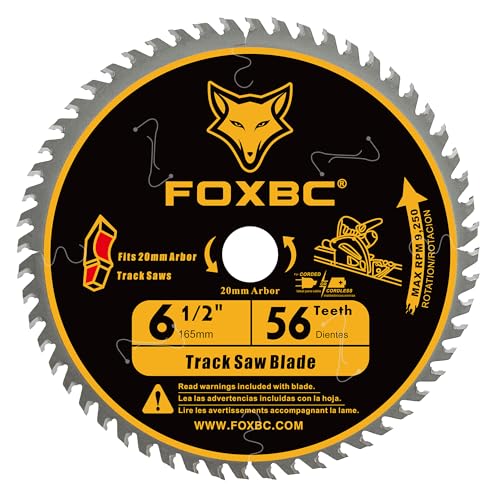
The 1.8mm kerf on this FOXBC blade lands between the ultra-thin 1.5mm budget option and the heavier 2.2mm workhorse, which makes it a smart middle-ground for shops that bounce between cordless and corded saws. You give up a hair of battery efficiency compared to the thinner blade, but you gain plate rigidity for occasional deep cuts.
It targets the same broad compatibility as other FOXBC 6-1/2 inch options, including the DeWalt DWS520, Makita SP6000 and B-57342, and WEN BL655. The 56-tooth count delivers finish-grade edges for cabinet work. This is the blade that quietly handles a full day of mixed sheet goods without complaint.
The Helpful Details
- 1.8mm kerf balances battery life and plate rigidity
- Works with DeWalt, Makita, and WEN 6-1/2 inch track saws
- 56-tooth count produces clean cabinet-grade edges
- Carbide tips hold up to repeated laminate and ply cuts
Less-Strong Areas
- Not specialized for any single task, so dedicated users may prefer a dedicated blade
- Laser slots help with noise but do not eliminate it on long rips
Built With In Mind
Cabinet shops and trim carpenters who run both DeWalt and Makita track saws and want one replacement blade that fits both without swapping arbors.
A Better Fit Elsewhere
You only run Festool TS 55 saws, in which case the FOXBC 160mm 48T ATB Track Saw Blade for Festool is purpose-built for that platform.
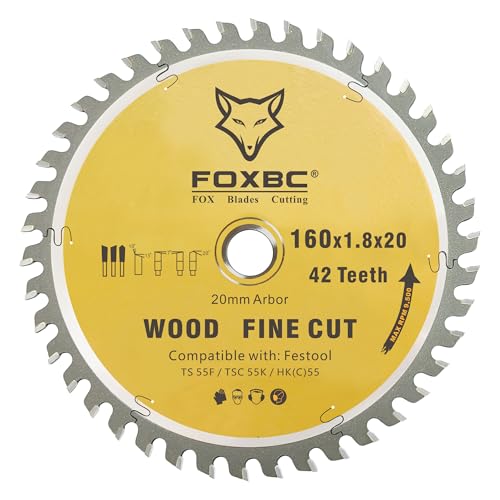
The 42-tooth count sounds low compared to the 48T and 56T options earlier in this list, but the trapezoidal cross-cut tooth geometry (a grind pattern that shears wood fibers like a pair of scissors instead of scraping them) is what sets this blade apart. It produces near-polished edges on veneered plywood and melamine, where tearout would mean sanding or edge-banding extra work.
This blade specifically fits the newer Festool TS 55 F and TSC 55 K plunge saws, plus the HK 55 and HKC 55 carpentry saws. It replaces the Festool 205561 and 205553 part numbers. If you own an older TS 55 or TSC 55 (pre-F and pre-K variants), this is not your blade, and you should look at the 48T option above instead.
Notable Upsides
- Trapezoidal tooth pattern reduces tearout on veneered ply
- Replaces Festool 205561 and 205553 OEM blades
- 160mm diameter is the modern Festool standard
- Cuts melamine and laminate cleanly enough to skip edge banding
Things To Consider
- Limited compatibility with newer Festool models only
- Lower tooth count means slower cuts than the 48T sibling blade
Feature Rundown
Who Should Grab It
Cabinet builders and finish carpenters cutting visible-grade plywood and melamine on a newer Festool TS 55 F or TSC 55 K, where edge quality matters more than feed speed.
Swap It Out When
You cut a mix of materials and want a faster blade, since the FOXBC 28T Universal Track Saw Blade for Festool TS 55 F handles varied stock with more bite.
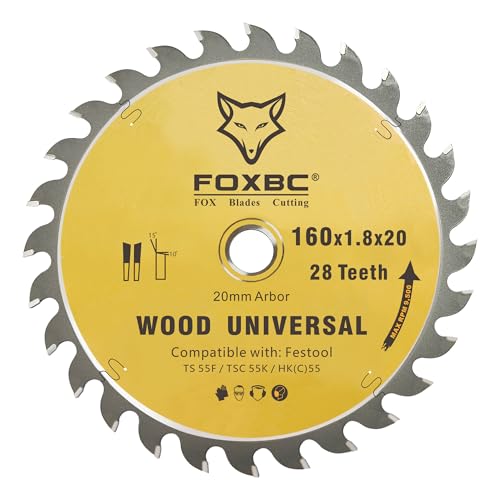
A 28-tooth blade on a track saw is deliberately aggressive. The 15-degree chip angle and 10-degree relief angle (geometry that lets each tooth bite cleanly and clear sawdust fast) make this the blade to reach for when you are cutting framing lumber, thick construction ply, or any stock where feed speed beats finish quality.
It is built for the same Festool TS 55 F, TSC 55 K, HK 55, and HKC 55 platform as the fine-cut option above, but the tooth count and grind are tuned for general-purpose ripping and cross-cutting. One word of caution: this blade is not compatible with TSC 55 models manufactured before 2021, so verify your saw’s generation before ordering.
Points In Its Favor
- Aggressive 28-tooth design feeds fast through thick stock
- Handles all wood types and wood-based sheet materials
- Replaces Festool 205560 OEM blade
- Same 160mm platform as the fine-cut option for easy swaps
Where It May Fall Short
- Low tooth count leaves rough edges on veneered or melamine surfaces
- Not compatible with pre-2021 TSC 55 models
Whose Shelf It Belongs On
Carpenters and remodelers who cut a mix of dimensional lumber, OSB, and construction-grade plywood, and who want one blade to handle varied site work without swapping constantly.
Where A Sibling Pick Shines
You are cutting cabinet-grade materials and need polished edges, so the FOXBC 42T Fine-Cut Track Saw Blade for Festool TS 55 F is the better tool for visible finish work.
Choosing Track Saw Blades That Match Your Saw and Your Stock
Tooth Count and What It Controls
Tooth count sets the personality of the cut. Blades in the 24-tooth to 32-tooth range feed fast and leave a rougher edge, which is fine for framing lumber and construction sheathing. Mid-range 40-tooth to 48-tooth blades split the difference, handling general sheet goods without bogging down. Anything above 50 teeth leans toward finish work, producing cleaner edges on plywood, melamine, and veneered panels, but at a slower feed rate. Match the count to your most common material, not your worst-case scenario, and you will spend less time fighting the saw.
Kerf, Plate, and Cordless Considerations
Kerf width directly affects how much material the blade removes and how much energy the saw spends pushing through a cut. Thin-kerf blades (1.5mm to 1.8mm) extend battery life on cordless track saws and reduce motor strain, but the thinner plate can flex under heavy side loads. Thicker kerf options (2.0mm to 2.4mm) ride truer through dense hardwood and deep cuts, at the cost of battery efficiency. For cordless-only shops, lean thin. For corded or mixed-use shops, a 1.8mm or 2.0mm kerf is a sensible compromise.
Compatibility and Tooth Geometry
Arbor size (the center hole that mounts to the saw spindle), diameter, and registration features all have to match your saw exactly. Most 6-1/2 inch track saws use a 20mm arbor, but Festool’s 160mm platform has its own geometry, and the newer TS 55 F and TSC 55 K use a different registration than the older TS 55 and TSC 55. Beyond fit, tooth geometry matters: ATB (Alternate Top Bevel) patterns cut cleanly across the grain, flat-top grinds rip faster, and trapezoidal cross-cut patterns produce near-polished edges on sheet goods.
What to Watch Before You Click Buy
Common Buying Slip Ups
The single most common mistake is grabbing a blade with the right diameter but the wrong registration, especially on Festool saws where the TS 55, TS 55 F, and TSC 55 K all look similar but use different mounting geometries. Another trap is buying a thin-kerf blade for a corded shop, where the rigidity tradeoff does not pay off, or a thick-kerf blade for cordless work, where the battery drain adds up. Always cross-check your saw model against the blade’s compatibility list before ordering.
Where the Higher Price Goes
Premium blades earn their higher cost through tighter tooth geometry, better plate balance, and coatings that reduce resin buildup. A PTFE-coated blade like the WEN BL6556 stays cleaner through long rips, which means fewer stops to scrape the plate. OEM blades like the Makita B-57342 are engineered to the saw’s exact RPM and motor curve, which can extend motor life and produce slightly cleaner cuts than a generic equivalent. For occasional use, the upgrade rarely pays back. For daily production, it does.




