


The right upright air compressor turns a frustrating Saturday project into a smooth one. Truck owners topping off 35-inch tires, woodworkers running brad nailers, and homeowners inflating pool toys all need steady airflow without dragging a steel tank across the garage. This lineup balances cordless convenience with plug-in muscle, weighing portability against tank size and noise. Each pick fits a specific situation, so matching compressor type to how you actually work matters more than chasing the biggest motor on the shelf.
A Closer Look At The Lineup

ETENWOLF VORTEX S6 Tire Inflator

ETENWOLF VORTEX S7 Heavy-Duty Tire Inflator

ETENWOLF ZEPHYR S3 Tire Inflator

Makita MAC2400 Big Bore Air Compressor

Makita MAC320Q Quiet Series Air Compressor
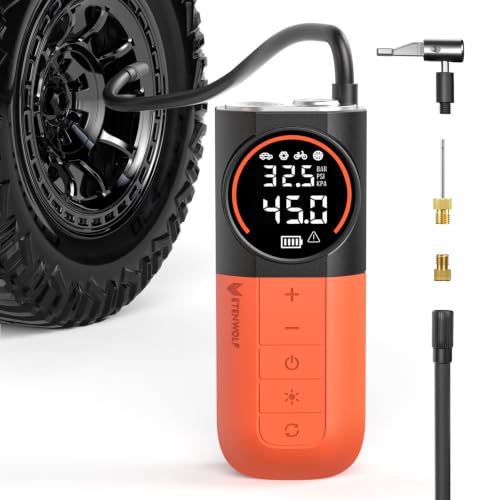
ETENWOLF S1 Tire Inflator

ETENWOLF Zephyr S5 Heavy-Duty Tire Inflator

Makita MAC210Q Quiet Series Air Compressor
A Deeper Look At The Lineup
Pickup owners who top off tires before trail runs will appreciate how the VORTEX S6 cuts inflation time without dragging out a hose. CFM at 0 PSI describes the volume of air a compressor moves when unrestricted, and this unit’s rating helps it fill a 31-inch tire in roughly a minute. The integrated battery removes the need for a power outlet, which matters when you are airing down at a remote campsite.
For weekend overlanders, the S6 reads pressures within about 1 PSI, close enough for trail adjustments. The unit also covers bicycles and pool floats, so it earns its garage space outside of truck duty.
Noteworthy Benefits
- High airflow rating shortens fill times on large tires, saving real minutes at the trailhead
- Cordless design frees you from running a generator in the field
- Pressure gauge accuracy supports reliable airing-down for off-road conditions
- 160 PSI maximum handles a wide range of vehicles and inflatables
Honest Caveats
- Heavier than smaller commuter-focused pumps, which may matter for motorcycle riders packing light
- Battery life depends heavily on tire size, so heavy users may need a top-up charge mid-session
Who It Suits Best
Pickup and SUV owners who adjust tire pressure for changing terrain and want cordless convenience.
Swap It Out When
Sedan commuters and casual cyclists will find the ETENWOLF ZEPHYR S3 easier to handle for routine top-offs.
The VORTEX S7 targets the larger end of the tire world, where single-motor pumps slow to a crawl. Dual motors deliver higher wattage output, translating to faster fill times on 35-inch and 37-inch tires common on lifted trucks. Its battery capacity dwarfs the S6, which matters when you are airing up four corners plus a spare after a long day on the rocks.
Compared to the S6, this model trades portability for raw output. Overlanders running heavy beadlock wheels or those who frequently pull a trailer will find the extra muscle justifies the added weight in the gear bag.
Standout Benefits
- Dual-motor setup keeps large tires inflating quickly, cutting trail recovery time
- Massive 38,400 mAh battery supports multiple full fills before recharging
- 160 PSI ceiling matches commercial shop expectations for heavy vehicles
- Functions as a power bank for accessories, reducing the need for extra batteries on extended trips
Trade Offs
- Bulk and weight make it less practical for bicycle or motorcycle use
- Price tier sits above smaller inflators, so the upgrade only pays off for heavy-tire owners
Key Product Details
Made For
Off-road enthusiasts and heavy-truck drivers who need rapid inflation on tires that overwhelm smaller pumps.
Another Choice May Suit
Drivers of standard pickups and daily SUVs can save weight and budget with the ETENWOLF VORTEX S6.
Commuters and small-SUV owners rarely need the tire-filling muscle of heavy-duty rigs, and that is where the ZEPHYR S3 finds its lane. Its airflow rating and battery capacity are tuned for 26-inch passenger tires rather than off-road monsters. The lighter frame slips into a trunk organizer without turning the cargo area into a garage shelf.
Where the S6 and S7 focus on trucks, the S3 targets the daily top-off scenario, the kind of pressure check you do before a highway road trip. You may find the cycle life extends further here because the motor is not constantly pushed to its ceiling.
The Practical Payoff
- Airflow and battery sized for passenger tires, avoiding overbuilt weight
- Compact form factor stores easily in sedan trunks and hatchbacks
- 160 PSI ceiling still covers bicycles, balls, and smaller inflatables
- Pressure gauge accuracy within about 1 PSI supports confident cold-tire readings
Points To Keep In Mind
- Fill times on tires larger than light-truck size stretch noticeably
- Owners with multiple vehicles may want a second unit or a larger inflator for the bigger set
Feature Snapshot
Right Fit For
Daily drivers and compact-SUV owners who want a trunk-friendly inflator for routine pressure maintenance.
Look Elsewhere When
Off-road truck owners will need the higher-output ETENWOLF VORTEX S7 for serious aired-down recovery.
Framing crews, roofers, and serious woodworkers graduate to plug-in compressors because cordless pumps cannot keep up with framing nailers. CFM at 90 PSI measures the working airflow a compressor delivers under load, and the MAC2400’s 4.2 CFM rating supports continuous tool operation rather than the stop-and-start cycle of smaller tanks. The cast-iron pump and Big Bore cylinder are built for the recovery time that high-demand tools demand.
Unlike the cordless inflators earlier in this list, the MAC2400 is a stationary workhorse. Roll-cage framing protects the motor on job sites where drops and bumps are routine, and the 2.5 HP motor starts on circuits that would trip lesser units.
The Good Stuff
- High CFM output supports framing nailers and impact wrenches without long pauses
- Cast-iron pump construction tends to outlast aluminum alternatives under heavy use
- Low amp draw reduces tripped breakers on shared job-site circuits
- Roll-cage frame handles transport and rough job-site conditions
Small Caveats
- Significant weight makes it a two-person lift for truck bed loading
- Oil-lubricated pump requires periodic maintenance, unlike the oil-free Makita models in this lineup
Best Suited To
Contractors and serious DIYers running pneumatic framing or roofing tools on active job sites.
Skip It When
Garage hobbyists and trim carpenters will find the Makita MAC320Q quieter and easier to live with.
Garage workshops attached to living spaces have a noise problem that loud shop compressors solve poorly. The MAC320Q runs at roughly 60 dB, about the level of normal conversation, which makes early-morning trim work less likely to wake the household. The 3-gallon tank sits in a sweet spot for finish nailers and small brad nailers, while the 1-1/2 HP motor keeps recovery reasonable.
Where the MAC2400 above focuses on raw tool-feed capacity, this model trades CFM for sound control. The oil-free pump also skips the maintenance schedule that contractors manage on cast-iron units.
Benefits That Matter
- Low-decibel operation makes it neighbor-friendly in attached garages
- Oil-free pump eliminates oil-change maintenance and reduces mess
- Lower RPM running extends motor and pump life expectancy
- Roll-cage construction survives transport between projects
A Few Limitations
- 3-gallon tank cycles more often during continuous framing nailer use
- Output sits well below the MAC2400, so heavy tool-feed work is not its strength
Quick Technical Notes
Whose Shelf It Belongs On
Garage woodworkers and remodelers who run finish nailers, brad nailers, and small spray guns in noise-sensitive settings.
A Better Fit Elsewhere
Framing crews needing nonstop airflow for roofing or structural nailing should consider the Makita MAC2400 instead.
Motorcycle riders, bicycle commuters, and sedan owners who only top off tires a few times a year do not need the battery banks of larger ETENWOLF units. The S1 keeps the core 160 PSI capability and a 20 L/min airflow rating while trimming size and cost. The 5,200 mAh battery is small by truck-inflator standards but plenty for a couple of car tires or a stack of bicycle top-offs.
Compared to the ZEPHYR S3 earlier in the lineup, the S1 targets the lighter end of inflation tasks. You may find the cycle life and portability more useful than the extra headroom.
Bright Spots
- Lightweight design slips into saddlebags and small trunk compartments
- 160 PSI ceiling covers cars, motorcycles, bikes, and sports equipment
- Simple controls make it approachable for first-time inflator owners
- Lower price tier fits casual maintenance budgets
Worth Noting
- Smaller battery requires recharging more often under heavy use
- Airflow sits below larger ETENWOLF units, so SUV fills take longer
Perfect Match For
Bicycle commuters, motorcycle riders, and casual drivers who want a portable backup pump for occasional top-offs.
Not Your Match When
Pickup and SUV drivers needing faster fills on larger tires should upgrade to the ETENWOLF ZEPHYR S5.
Family fleets and overlanding SUVs occupy the middle ground between passenger cars and lifted trucks. The Zephyr S5 fills that niche with enough battery capacity for roughly 30 SUV tires per charge, depending on size, while keeping the form factor manageable. The 15,600 mAh battery also serves as a power bank for camping accessories, a useful side feature on extended trips.
Where the S6 and S7 push toward extreme tire sizes, the S5 targets mainstream SUV and crossover duty. You may find its 1.5 CFM airflow lands in a comfortable middle for owners who occasionally head off-pavement but do not run 37-inch mud-terrains.
The Helpful Details
- Strong battery capacity supports many fills before recharging, useful for multi-vehicle households
- Pressure gauge accuracy helps with precise airing for varied terrain
- 160 PSI maximum covers light trucks, SUVs, and trailer tires
- Doubles as a power bank for phones and small accessories on the road
Factors To Consider
- Sits between the S3 and the heavy-duty S7, so extreme off-roaders may outgrow it
- Battery charging time between deep cycles can interrupt multi-day trips without a top-up
Core Details
Who Should Grab It
Overlanders and family-fleet owners with SUVs and crossovers who want cordless convenience without going full heavy-duty.
Where A Sibling Pick Shines
Drivers of full-size lifted trucks will get faster fills from the higher-output ETENWOLF VORTEX S7.
Apartment dwellers and basement hobbyists need compressed air without rattling neighbors, and the MAC210Q answers with the same low-noise approach as its larger sibling. The 2-gallon tank shrinks the footprint further, fitting under workbenches where a 3-gallon unit would crowd storage. Trim carpenters find the 1 HP motor sufficient for finish nailers and small staplers.
Compared to the MAC320Q earlier in this lineup, the MAC210Q trims both tank size and motor output. You may find the lighter form factor more practical for occasional weekend projects, though continuous spray painting will outpace its recovery time.
The Value In It
- Low noise output suits basement workshops and shared walls
- Compact 2-gallon tank fits tight storage spaces and small workbenches
- Oil-free pump reduces maintenance and avoids oil-mist in indoor air
- Roll-cage frame protects the unit during occasional transport
Practical Considerations
- Small tank requires more frequent cycling during continuous use
- 1 HP output falls short for high-demand framing or roofing tools
Built With In Mind
Apartment hobbyists and trim carpenters who run finish nailers and need a quiet, compact compressor.
Reach For A Different Pick When
Roofers and framers will need the higher CFM and larger tank of the Makita MAC2400 for serious tool work.
Picking The Right Compressor For Your Work
Matching a compressor to your most common task prevents the frustration of a unit that cannot keep up or one that overbuilds the bill. CFM ratings, tank size, and noise levels each matter differently depending on whether you are topping off tires or running pneumatic tools.
Tire Inflators Versus Tank Compressors
Cordless tire inflators like the ETENWOLF lineup trade airflow for portability, making them ideal for roadside and trail use. Tank compressors like the Makita models deliver sustained CFM for tools but require a power outlet and a stationary setup. CFM at 90 PSI is the working measurement for tool-driven compressors, while inflators commonly list CFM at 0 PSI because they push volume rather than sustained pressure.
Tank Size And Recovery Time
Smaller tanks recover faster but cycle more often under continuous demand. The Makita MAC210Q’s 2-gallon tank suits finish nailers that pulse briefly, while the MAC2400’s larger setup supports framing nailers that fire repeatedly. Pick the smallest tank that handles your heaviest tool without constant cycling.
Noise Levels And Indoor Use
Compressors measured at 60 dB or lower, like the Makita Quiet Series, work in attached garages and basements without disturbing neighbors. Open-construction oil-lubricated units tend to run louder but often last longer under heavy contractor use. The trade-off between sound and service life is real, so think about where the compressor will live.
Power Source And Mobility
Cordless inflators free you from outlets and generators, useful for overlanders and cyclists. Plug-in tank compressors provide unlimited runtime for shop work but need extension cords or dedicated circuits. Heavy users may want both: a cordless inflator for the vehicle and a tank compressor for the workshop.
Key Considerations Across These Picks
Pitfalls Shoppers Hit
Choosing by motor horsepower alone often backfires, because a 2 HP unit with poor CFM cannot outrun a 1.5 HP model with stronger airflow. Buyers also underestimate noise impact, only realizing after the first project that the compressor wakes the household. Tank size confusion is common too: a 6-gallon pancake compressor and a 6-gallon upright behave very differently when stacked beside a workbench.
When Paying More Pays Off
Higher-tier models in this category justify the cost through faster recovery, longer pump life, and better sound insulation. The Makita MAC2400’s cast-iron pump is the kind of upgrade that pays back over years of contractor use, not months. Cordless inflators climb in price with battery capacity, so the S7’s premium makes sense for owners who actually need 38,400 mAh of reserve power rather than a marketing number.
Frequently Asked Questions
What CFM rating do most home workshops need?
A 4 CFM rating at 90 PSI handles most finish nailers, brad nailers, and small spray guns comfortably. Heavy framing or continuous spray painting benefits from 6 CFM or higher, which points toward larger shop compressors.
Are cordless tire inflators reliable for daily use?
Modern cordless inflators from established brands handle routine top-offs for years when charged properly. Their batteries do degrade over time, so heavy daily users should plan for eventual battery service or replacement.
How loud is too loud for a home garage compressor?
Anything above 75 dB tends to disturb neighbors in attached housing. Compressors in the 60 dB range work comfortably indoors, and many manufacturers list sound ratings in their product documentation.
Can I use a tire inflator for air tools?
Tire inflators deliver volume rather than sustained working pressure, so most pneumatic tools underperform when connected to one. Tool-driven compressors like the Makita lineup are built for the airflow patterns that nailers and wrenches require.
What maintenance do upright air compressors need?
Oil-lubricated units need periodic oil checks and changes, while oil-free pumps skip that step but still benefit from drain-down after use. Draining moisture from the tank after each session extends valve and fitting life across all compressor types.




