


Your first welding table can feel like a parts catalog exploded across the bench. The good news: the rod itself does most of the heavy lifting, and the right one forgives a shaky hand while teaching you what proper arc control feels like. This list covers the entry-level rods and tungsten electrodes a new welder is most likely to encounter, with notes on which suits your machine, your metal thickness, and your learning curve.
The Lineup, Simplified

Midwest Tungsten Service TIG Welding Tungsten Electrodes 10-Pack 1/16″ (Grey, WC20)

TOOLIOM E6013 Welding Rod 3/32″ 10LB
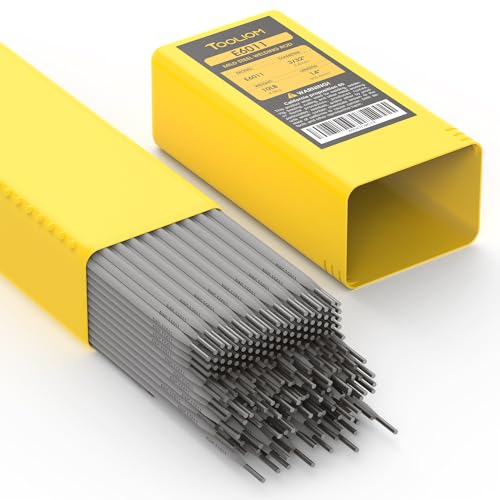
TOOLIOM E6011 Welding Rod 3/32″ 10LB

TOOLIOM E7018 Welding Rod 1/8″ 10LB Low-Hydrogen

TOOLIOM E7018 Welding Rod 3/32″ 10LB Low-Hydrogen

TOOLIOM E7018 Welding Rod 3/32″ + 1/8″ 5LB

TOOLIOM E6011 Welding Rod 1/8″ 10LB
The Picks, Examined More Closely
TIG work uses a non-consumable tungsten electrode that holds the arc while filler rod feeds in by hand, so the electrode you choose sets the tone for every bead. This 2% ceriated tungsten (the grey band, also marked WC20 or EWCe-2) is a forgiving starting point because it strikes an arc at lower amperage and resists contamination when you touch the puddle by accident.
At 1/16″ diameter, it suits steel from roughly sheet-metal gauge up through 1/8″ plate on a typical 150 to 200 amp machine, which is exactly the range most hobbyists learn on. If your welder is a transformer-based AC/DC TIG unit from the usual starter brands, this diameter lands in the right amperage window without burning tips.
Practical Pluses
- Ceriated composition strikes easily on DC, helping first-time TIG operators get a stable arc without arc wandering.
- 1/16″ diameter handles a wide range of steel thicknesses, so one pack covers most home-shop projects.
- Ten-piece count means you have replacements when a tip gets contaminated or over-ground.
- Works on both AC and DC polarity, giving you room to branch into aluminum later.
Honest Caveats
- Storage matters: a closed plastic tube in a dry spot keeps the tip clean between sessions, since contamination is the most common cause of arc wander.
- For aluminum on AC at higher amps, a 2% lanthanated electrode is often preferred, so you may outgrow this rod as you advance.
Key Specs
Right Fit For
First-time TIG welders running a small inverter or transformer machine on mild steel and ready to learn arc length and filler control without the higher cost of specialty electrodes.
Where Another Pick Suits Better
Stick-weld learners who do not yet own a TIG setup will get more mileage from the TOOLIOM E6013 3/32″ 10LB instead.
If stick welding is your entry point, the 3/32″ E6013 is the rod that teaches you the craft without punishing mistakes. The E6013 classification means a high-titania coating that produces a soft, steady arc and a bead you can grind smooth without a fight. Slag lifts off in long ribbons, which is one less thing to worry about when you are still learning drag angle and travel speed.
At 3/32″ diameter, this rod runs on small 120V inverter welders as well as larger 240V machines, and it welds in all positions. In a home garage, that flexibility is gold: you can tack up a small steel bracket, then flip it and run a lap joint on the bench without swapping rods.
Strong Points
- Smooth arc and forgiving slag make cleanup easier for first beads.
- Runs on both AC and DC power, so it pairs with entry-level 120V flux-core or stick machines.
- 10-pound pack covers many practice sessions before you need to reorder.
- All-position capability supports learning vertical and overhead work safely.
Worth Noting
- 3/32″ diameter limits you to thinner steel; heavy plate work calls for a 1/8″ rod like the E7018 covered later.
- On dirty or rusted metal, expect more spatter than an E6011, so clean the surface when you can.
Quick Facts
Made For
Brand-new stick welders working on sheet metal, brackets, and light home-fabrication projects where forgiveness matters more than deep penetration.
Skip It When
You expect to weld thick structural steel or greasy repair metal, since the TOOLIOM E6011 3/32″ 10LB handles those conditions better.
The 3/32″ E6011 is the rod that stays in the box when real work shows up. Its cellulose coating produces a forceful, penetrating arc that digs into dirty, painted, or slightly rusted steel, which is what you face on a tractor, a trailer, or an old gate. That deep penetration also makes it a forgiving rod for beginners on slightly imperfect fit-ups.
Compared with the E6013 above, this rod is more aggressive and less “pretty” out of the gate. The trade is penetration: it welds through light surface contamination, helps bridge gaps in poorly fitted joints, and lays a bead you can trust on structural repairs. For many home welders, the E6011 becomes the everyday rod and the E6013 the cosmetic one.
A Strong Showing
- Penetrating arc handles rust, paint, and oil better than most general-purpose rods.
- All-position welding gives you vertical, overhead, and flat capability on a small machine.
- Beads are dense and slag coverage is solid, helping reduce porosity on marginal base metal.
Some Limits To Know
- 3/32″ diameter limits the maximum plate thickness you can weld cleanly; expect to switch to 1/8″ for heavier stock.
- Spatter is heavier than an E6013, so expect more grinding and cleanup.
- Store the box in a dry spot: cellulose-coated rods absorb moisture, and damp sticks cause porosity and arc chatter.
Best Suited To
Beginners who plan to do real repair work around the farm, garage, or driveway, where clean metal is the exception rather than the rule.
Reach For A Different Pick When
You mostly weld clean, thin sheet and value smooth cosmetic beads, in which case the TOOLIOM E6013 3/32″ 10LB is a more comfortable match.
Move past the beginner rods and you land on the E7018, a low-hydrogen, iron-powder rod used in structural and code work. The 1/8″ diameter suits plate from roughly 1/8″ up through heavier trailer and equipment steel, and the low-hydrogen coating keeps the weld tough and crack-resistant, which is the real reason code work demands it.
For a beginner, the catch is technique: 7018 rods like a short arc, a steady drag, and a clean, dry workpiece. The 1/8″ size also draws more amperage than the 3/32″ rods, so you will need a welder with the amperage to run it. If you have access to a 200-amp machine, this is the rod to graduate to once you are comfortable with E6011 and E6013.
Real-World Strengths
- Low-hydrogen flux produces strong, ductile welds suitable for structural and code-grade work.
- 1/8″ diameter handles thick plate and heavy repair work that smaller rods cannot reach.
- Runs on AC and DC for compatibility with most shop machines.
Practical Considerations
- Moisture-sensitive: keep the rods in a dry rod oven or sealed container to prevent porosity.
- Not a starting rod: technique is more demanding than E6011 or E6013, so expect a learning curve.
Whose Shelf It Belongs On
Beginners working up to trailer fabrication, equipment repair, or any thicker plate where strength matters more than forgiveness.
Consider Something Else When
You are still practicing on 1/8″ or thinner steel, since the TOOLIOM E7018 3/32″ 10LB is friendlier to the same low-hydrogen chemistry at lower amperage.
Same low-hydrogen chemistry as the 1/8″ rod above, scaled down to 3/32″ so it runs on smaller hobby machines. For a learner, that is the meaningful difference: you can practice proper 7018 technique, like a tight arc and consistent travel speed, without needing a 200-amp welder on the bench.
This diameter is also useful for thin-to-mid steel, fence panels, brackets, and small trailer repairs where the parent metal is not too thick. It is the right rod to own alongside a 3/32″ E6011 so you have one forgiving rod for dirty work and one low-hydrogen rod for the cleaner, stronger joints.
Good Reasons To Consider
- 3/32″ diameter makes 7018 chemistry accessible on smaller hobby welders.
- All-position welding keeps the rod flexible for a range of joints.
- Low-hydrogen flux produces cleaner, tougher welds than general-purpose rods.
Less Ideal Details
- Moisture sensitivity is real: a sealed container or rod oven matters once the box is open.
- On heavily oxidized or oily steel, an E6011 still wins for arc forgiveness, so plan to keep both rod types on hand.
Who Should Grab It
Beginners who have outgrown general-purpose rods and want to build skill on the same low-hydrogen chemistry the pros use.
Look Elsewhere When
Your welder cannot run a 3/32″ rod cleanly, or you only need a general-purpose rod for occasional light work, in which case the TOOLIOM E6013 3/32″ 10LB is more cost-effective.
Sometimes the smartest buy is the one that solves two problems at once. This 5-pound pack splits the rods between 3/32″ and 1/8″ diameters so you have the right low-hydrogen electrode on hand whether you are welding thin sheet or heavier plate. For a beginner, that means you can complete a project end to end without reordering mid-job.
Compared with the 10-pound 7018 packs above, the smaller total weight also reduces the cost of testing technique. You get enough rods to learn on, and you can see which diameter you actually use more before committing to a larger box. The downside is smaller quantity per diameter, so heavy users will run out faster.
Where It Excels
- Two diameters in one box eliminate the guesswork of which size to stock first.
- Same low-hydrogen E7018 chemistry as the larger 10-pound packs.
- Smaller pack size is a more comfortable first buy for casual welders.
Trade Offs
- Only 5 pounds total means frequent users will outgrow it quickly.
- Same moisture sensitivity as other 7018 rods, so plan for sealed storage once the box is open.
Perfect Match For
Beginners who want one box of low-hydrogen rod that covers both thin and mid-thickness steel without committing to two full 10-pound packs.
Not Your Match When
You already know you will weld mostly thick plate, since the TOOLIOM E7018 1/8″ 10LB gives you more of the heavier rod per dollar.
The 1/8″ E6011 is the thick-plate sibling of the 3/32″ rod covered earlier. Same cellulose coating, same deep-penetration arc, just more metal deposited per pass. For outdoor work, trailer repairs, and farm equipment, this is the rod most hobbyists reach for once the steel gets serious.
Beginners benefit from the forgiveness of E6011’s arc on dirty metal, but the 1/8″ diameter requires more amperage and a steadier hand than the 3/32″ version. In practice, you learn on the smaller rod, then graduate to 1/8″ when projects call for thicker plate or deeper penetration. Owning both gives you a rod for almost any stick welding job a homeowner faces.
Why It Works Well
- 1/8″ diameter delivers deep penetration on thick plate and heavy repair work.
- Same forgiving arc on dirty or painted steel as the 3/32″ E6011.
- All-position welding for field repairs at any angle.
Points To Note
- Spatter is heavier than an E6013, so plan on extra grinding and slag chipping time.
- Cellulose coating absorbs moisture: store the box closed in a dry place to avoid porosity.
Who Will Love This
Beginners doing trailer, gate, and farm-equipment repair on steel from 1/8″ upward, where deep penetration and arc forgiveness matter most.
A Better Fit Elsewhere
Your work is mostly thin sheet or cosmetic welds, in which case the TOOLIOM E6013 3/32″ 10LB is the smoother, cleaner choice.
What To Weigh Before Choosing Welding Rods For Beginners
Match The Rod To Your Machine
A 120V hobby welder usually runs 3/32″ rods comfortably, while a 240V machine with 200 amps opens the door to 1/8″ diameters. Pick a rod your machine can actually push: thin rod on a big machine just sputters, and thick rod on a small machine stalls. Beginners often do best starting with 3/32″ because it is forgiving and widely supported.
Understand The Coating Codes
The “E” in E6011 or E7013 stands for electrode, and the next two digits are the tensile strength in thousands of psi. The third digit tells you about welding positions and current type, while the last digit describes the coating chemistry. A 1 in the last position (like 6011) means a cellulose coating for deep penetration, while a 3 (like 6013) is a high-titania coating for smooth, cosmetic beads.
Know Your Base Metal
Clean, thin steel rewards smooth rods like E6013. Rusty, painted, or slightly oily steel rewards the forceful arc of E6011. Thicker plate and structural work call for low-hydrogen rods like E7018 once you are ready for the technique. Buying one rod for every job is a recipe for frustration, so plan to keep at least two types on hand.
Plan For Storage And Safety
Cellulose-coated rods like E6011 absorb moisture and should be kept sealed, while low-hydrogen E7018 rods really do benefit from a rod oven once the box is open. A simple airtight container goes a long way for casual users. Always weld in a ventilated space, wear an auto-darkening helmet, and keep a fire extinguisher within reach.
Key Considerations Across These Picks
Pitfalls Shoppers Hit
One of the most common mistakes is buying rods before checking whether the diameter matches the welder’s amperage range. Another is assuming any rod works on any metal: a cosmetic rod on dirty steel is a frustrating experience. Beginners also tend to overbuy one rod and skip a second type, then struggle when the next project calls for thicker plate or cleaner welds.
Where The Extra Money Goes
Higher-tier rods like low-hydrogen E7018 cost more because the chemistry demands tighter moisture control and stricter manufacturing tolerances. The payoff is a tougher, more crack-resistant weld that meets structural codes, which matters once you start welding load-bearing parts. For hobby work, the premium is usually worth paying once you have a feel for the arc, but it is not where a brand-new welder should start.




