Choosing the right wet tile saw shapes how smoothly a bathroom remodel or backsplash project actually goes. The wrong tool chips porcelain, struggles with thick stone, or leaves you hauling water back and forth across the job site. This lineup covers full-size bench saws, a compact masonry option, and a spread of diamond blades so you can match the tool to the tile in front of you. Eight picks, no filler.
A Quick View Of The Lineup
DEWALT Wet Tile Saw with Stand, 10-Inch, Corded (D24000S)

DEWALT Wet Tile Saw, 10-Inch, 15-Amp (D36000S)

DEWALT Wet Tile Saw with Stand, 10-Inch (D24000S & Goggles)

DEWALT DWC860W 4-3/8-Inch Wet/Dry Masonry Saw

FACHLICH 4-Inch Diamond Tile Saw Blades (2-Pack)

FACHLICH 10-Inch Diamond Wet Saw Blade

FACHLICH 4-1/2-Inch Diamond Tile Saw Blade

FACHLICH 12-Inch All-Purpose Diamond Blade
A Breakdown Of The Leading Choices
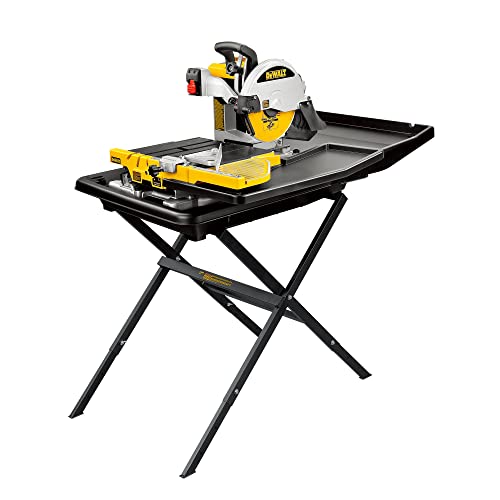
The D24000S has been a fixture on tile jobs for years, and the included stand is what separates it from a bare saw on a workbench. The 10-inch blade pairs with a 1.5 HP motor that handles porcelain tile without bogging down, and the rolling cart design lets you push large format pieces through instead of fighting them. For a bathroom remodel where every cut needs to land clean, the stable platform and consistent water flow matter more than the headline specs.
Compared to the D36000S that follows, this model trades some raw rip capacity for a more manageable footprint on a tighter jobsite. Where it really earns its keep is on diagonal cuts across 18-inch porcelain, where the integrated cart side extension gives the material somewhere to land.
Notable Gains
- 10-inch diamond blade handles porcelain and ceramic cleanly
- Stand raises the saw to a comfortable working height
- Submersible pump keeps the water reservoir circulating
- Side extension supports oversized tile during long cuts
- Plunge cut capability speeds up notches and outlet openings
Things To Consider
- At roughly 69 pounds plus the stand, transport takes planning
- Setup time runs longer than a handheld option
- Pan draining and cleanup after a day of cuts is part of the deal
Feature Snapshot
Right Fit For
Contractors and serious DIYers running full bathroom or kitchen remodels where clean porcelain cuts matter.
Swap It Out When
You mostly handle small repair patches, where the DEWALT DWC860W 4-3/8-Inch Wet/Dry Masonry Saw is far easier to grab and go.
The D36000S is the high-capacity sibling in the DEWALT lineup, built for shops that push 36-inch tile through on a regular basis. Its 15-amp motor produces 1,220 MWO (max watts out) of cutting power, and the rail system supports longer rip cuts than most competitors in this class. Where the D24000S is the dependable standard, this one leans into the high end of the spec sheet.
For anyone working with oversized plank tile, the 18 inches of cutting clearance to the left of the blade means a 36-inch tile can be split in half without flipping the piece. The trade-off is the saw takes up more floor space than the D24000S, and you really need a dedicated workstation to keep it dialed in.
Strengths Worth Knowing
- 37-inch rip capacity handles large format tile in one pass
- 8-1/2 inch crosscut for sill work and narrow pieces
- 15-amp motor cuts cleanly through dense porcelain
- Accuracy spec of 1/32 inch over 30 inches for tight fits
Trade Offs
- Footprint is larger than the D24000S, so plan floor space
- Price reflects the pro-tier build, which may stretch budgets
- Water management on long cuts requires steady attention
Whose Shelf It Belongs On
Tile professionals and renovation shops ripping large format material day after day.
Look Elsewhere When
You mostly handle standard 12-inch or smaller tile, where the D24000S covers the same ground for less.
This bundle pairs the same D24000S saw covered in pick one with DEWALT safety goggles, so you get the cutting platform and eye protection in a single order. The hard-coated lens on the goggles is rated for scratch resistance, which matters when tile dust and slurry are flying. For a new shop setup, that single bundled purchase removes one more item from the shopping list.
The saw itself delivers the same 1.5 HP motor, 10-inch blade, and 3-1/8 inch depth of cut as the standalone version. Where this bundle pulls ahead is the convenience factor for first-time buyers who would otherwise need to source goggles separately. Compared to buying the saw alone, the goggles add meaningful value for a beginner.
Real Benefits
- Saw and eye protection arrive together, ready to work
- Hard-coated lens holds up to slurry and dust exposure
- Same 18-inch diagonal cut capacity as the bare saw
- Plunge cut range supports outlet and notch work
Room For Improvement
- Bundled goggles may not match preferred fit for everyone
- No upgrade to the saw itself versus the standalone listing
Made For
First-time wet saw owners who want a complete starter setup without sourcing safety gear separately.
Reach For A Different Pick When
You already own solid safety glasses, in which case the standard D24000S listing is the cleaner choice.
The DWC860W sits in a different category from the bench saws above. It is a handheld 4-3/8 inch wet/dry masonry saw with a 10.8 amp motor, designed for small cuts on stone, porcelain, and concrete where a full-size saw would be overkill. The continuous-rim diamond blade keeps edges chip-free, which matters on finished stone pieces where a chip means a ruined workpiece.
For a kitchen backsplash with a handful of outlet cuts, this saw is faster to deploy than dragging out a 10-inch wet saw. It also handles small stone repairs, threshold trims, and detail cuts where the larger DEWALT models would feel clumsy. The catch is depth, since a 4-3/8 inch blade tops out around 3 centimeters of cut, so it does not replace a full-size saw for floor tile.
Real-World Strengths
- 10.8 amp motor powers through granite and concrete
- Continuous-rim blade keeps finished edges clean
- Wet and dry cutting in one tool for jobsite flexibility
- Handheld form factor reaches tight spaces
Points To Note
- Limited to about 3 cm depth of cut
- Water delivery is manual, so an external source is needed for wet cuts
- Not a substitute for a bench saw on floor tile work
Quick Facts
Best Suited To
Remodelers handling detail cuts, outlet openings, and small stone repairs without dragging out a full bench saw.
A Better Fit Elsewhere
You are laying an entire floor, where the DEWALT D24000S 10-Inch saw handles long rip cuts more efficiently.
The FACHLICH 4-inch blades are sold as a two-pack, which makes them a practical spare to keep on hand for the DWC860W or any 4-inch angle grinder setup. Each blade is hot-pressed with diamond grain for a longer service life, and the reinforced ring core on both sides of the blade helps reduce wobble during cuts. The 105 mm diameter targets ceramic tile, porcelain, marble, and granite.
For small jobs, the two-pack format means you are not stuck waiting on a replacement when a blade finally gives up. The 1.2 mm thickness is on the thin side, so cuts stay clean but you want to avoid forcing the blade through dense material.
The Value In It
- Two-pack format keeps a spare ready on the bench
- Hot-pressed diamond grain extends working life
- Works wet or dry for flexible jobsite setup
- Reinforced core reduces blade wobble during cuts
Honest Caveats
- 1.2 mm thickness is thin, so pushing too hard risks chipping
- Best suited to lighter trim and ceramic work, not heavy stone
Who Should Grab It
Anyone using a 4-inch handheld saw for ceramic trim or backsplash work who wants an affordable backup blade.
Consider Something Else When
You need a 10-inch replacement for a full-size wet saw, where the FACHLICH 10-Inch Diamond Wet Saw Blade is the direct match.
The FACHLICH 10-inch blade slots into both DEWALT saws from picks one and two as a direct replacement. The 10 mm segment height supports a long cutting life, and the 1.8 mm thickness gives the blade more rigidity than thinner economy options. For shop owners running through porcelain all day, having a spare 10-inch blade ready keeps downtime short.
Where this blade pulls ahead of cheaper replacements is the segment bond, which holds up to repeated wet cuts without stripping the diamonds too quickly. It is also a sensible backup to keep in the truck for the day an XP4 porcelain blade finally calls it quits mid-project.
Reasons It Performs
- 10 mm segment height supports extended cutting life
- 1.8 mm thickness adds rigidity for straight cuts
- Hot-pressed diamond grain for cleaner edges
- Drops into most 10-inch wet saws without adapters
Some Limits To Know
- Not a specialized blade, so it lacks the polish of premium diamond lines
- Bond hardness may need matching to your specific tile density
Perfect Match For
Shop owners needing a dependable replacement blade for a 10-inch DEWALT or similar wet saw.
Skip It When
You cut primarily 4-1/2 inch tile on an angle grinder, where the FACHLICH 4-1/2-Inch Diamond Tile Saw Blade fits that tool.
The 4-1/2 inch FACHLICH blade fits a standard angle grinder, and the 25 mm segment height is unusually tall for this size class. That extra segment depth translates to longer blade life before the diamond layer is gone. The included reducer washer lets the blade fit both 22.23 mm and 15.875 mm arbors, so it adapts to most angle grinders without hunting down an extra part.
Beyond straight cuts, the spec sheet lists edge grinding as a supported use, so the same blade handles both slicing tile and smoothing rough edges after a cut. For DIYers who already own an angle grinder and do not want a separate dedicated tool, this blade pulls double duty.
Where It Delivers
- 25 mm segment height extends blade life beyond typical 4-1/2 inch options
- Reducer washer fits two common arbor sizes
- Cuts and grinds, covering two tasks with one blade
- Works on porcelain, ceramic, marble, and artificial stone
Practical Considerations
- Requires a separate angle grinder, which is not included
- Wet cutting on a grinder means a careful water setup
Who Will Love This
DIYers who already own an angle grinder and want a blade that handles both cutting and edge grinding.
Where Another Pick Suits Better
You need a full-size wet saw platform, where the DEWALT D24000S with stand is the right step up.
The 12-inch FACHLICH blade is built for hand-held power cutters and cut-off machines, with a 25.4 mm arbor and 3 mm thickness that gives it more rigidity than thinner tile-focused blades. The 5,100 max RPM rating keeps it within safe operating limits for most 12-inch cut-off saws. Where it stands out is the material list, which spans granite, marble, aluminum, rebar, copper pipe, PVC, and steel metal.
For renovation work where you might cut tile in the morning and rebar or metal trim in the afternoon, one blade covers both jobs. The trade-off is specialization, since a dedicated tile blade will always outlast an all-purpose option on a single material. For varied demo work though, the flexibility pays off.
A Strong Showing
- Cuts tile, metal, rebar, and masonry with one blade
- 3 mm thickness adds rigidity for straight cuts
- 25.4 mm arbor fits standard 12-inch cut-off saws
- 5,100 max RPM rating covers most handheld cutoff tools
Less Ideal Details
- All-purpose bond wears faster on a single material than a dedicated blade
- Heavier than tile-specific blades, so handling takes more effort
Built With In Mind
Contractors handling demo and renovation work that mixes tile with metal and masonry in the same day.
Not Your Match When
You only cut ceramic and porcelain, where the FACHLICH 10-Inch Diamond Wet Saw Blade keeps edges cleaner.
What To Weigh Before Choosing A Wet Tile Saw
Wet tile saws vary more than the basic 10-inch form factor suggests, and the wrong match leaves you fighting the tool instead of the tile. The most important split is between bench saws for full projects and handheld saws for detail work.
Match The Saw To The Tile Size
A 10-inch bench saw covers standard floor and wall tile up to about 18 inches diagonal, which handles most residential jobs. Larger format tile, anything 24 inches and up, benefits from a high-capacity model like the DEWALT D36000S, where the rip clearance and rail length keep long cuts accurate. Handheld options make sense for outlet cuts and small repairs, but they cannot replace a bench saw for big layouts.
Motor Power And Blade Speed
For dense porcelain, motor power matters because the blade needs to keep its speed through the cut. A 1.5 HP motor on a 10-inch saw is a reasonable baseline, while 15-amp motors with higher MWO ratings handle repeated production cuts without thermal shutdown. For occasional DIY use, lower-power saws still get the job done, just with a slower feed rate.
Water Management Setup
Every wet saw needs a reliable water supply to the blade to keep dust down and prevent overheating. Built-in reservoirs with submersible pumps are common on bench saws, while handheld saws often need a separate water source. Drain and refill time is part of the workflow on any wet saw, so factor that into setup and cleanup at the end of the day.
Key Considerations Across These Picks
Pitfalls Shoppers Hit
The most common mistake is buying a saw that is too small for the actual project. A 4-1/2 inch angle grinder blade cannot rip a 12-inch floor tile, and a 10-inch bench saw handles backsplash cuts with room to spare. Match the saw to the largest tile you plan to cut, not the smallest.
Another trap is overlooking the water system. Saws with small reservoirs need frequent refills on long jobs, and clogged pumps slow everything down. A quick check of the pump and water path before each project prevents mid-cut interruptions.
Where The Extra Money Goes
Premium bench saws like the D36000S cost more because of the rail system, motor capacity, and accuracy tolerances. The upgrade matters most for shops running long rip cuts daily, where accuracy and repeatability save time across many cuts. For a one-time bathroom remodel, the step up to a pro-tier saw rarely pays for itself in time savings. Blades are a different story though, since a higher-quality diamond blade outlasts several economy blades and often produces cleaner edges on the same material.