


You pull the lever, the pump hisses, and what hits the cup is the difference between a flat shot and one with crema worth photographing. That difference almost always starts at the grinder. Espresso tolerates very little inconsistency in grind size, so the burr type, step resolution, and dose control on your grinder quietly decide how your morning tastes. Runners logging long distances, parents juggling school runs, and remote workers chasing a tight schedule all hit the same wall: stale pre-ground coffee never delivers, and a cheap blade grinder shreds beans into dust and boulders at the same time.
The picks below cover home baristas who want café-quality pulls, travelers who refuse to drink hotel-room coffee, and anyone upgrading from a blade grinder to their first real burr setup. Each one earns its place for a different reason, and the trade-offs are spelled out so you can match the right tool to the way you actually brew.
The Leading Options At A Glance

SHARDOR Conical Burr Espresso Coffee Grinder Electric with Precision Timer 2.0, 51 Settings

Alpaca Ventures Manual Coffee Grinder for Espresso, Pour Over & French Press

Lonkion Burr Coffee Grinder Electric, 28 Settings, Stainless Steel

SHARDOR Electric Coffee Grinder, 70g Capacity, Black

OXO Brew Compact Conical Burr Coffee Bean Grinder, 50g
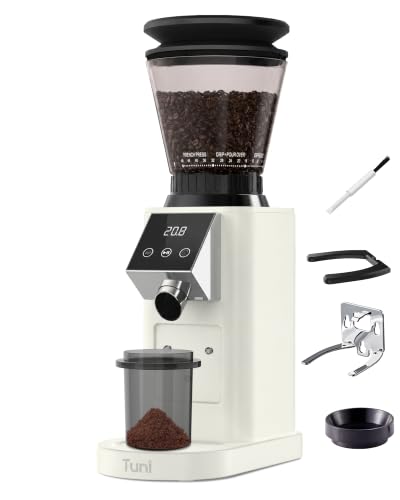
Tuni G1 Conical Burr Coffee Grinder, 48 Settings, Ivory

SHARDOR 64mm Flat Burr Coffee Grinder, 100 Settings, Black

LEBURRY Portable Espresso Grinder, Cordless, 38 Settings

Neretva Stainless Steel Espresso Grinder with Portafilter Holder
A Deeper Look At The Lineup
For home baristas who pull one or two shots a day and want a grinder that disappears into the routine, the SHARDOR Conical Burr Espresso Coffee Grinder covers a lot of ground. The 40 mm stainless steel conical burrs (crush beans between two ring-shaped surfaces rather than chopping them) keep grind temperature low, which preserves the volatile oils that give espresso its depth. You dial in with a touchscreen, set a cup count from 1 to 12, and walk away while it works.
What makes this model stand out in a crowded category is the 51-step grind range. You can chase a fine ristretto pull one morning and switch to a coarse French press grind the next without swapping tools. The anti-static build means less chaff stuck to the counter, and the stainless steel housing feels sturdy enough to survive years of daily use.
A Few Highlights
- 51 grind settings cover espresso through French press, so one grinder replaces two or three specialty tools
- Touchscreen timer with 1-12 cup selection removes the guesswork from morning dosing
- Anti-static design keeps grounds in the bin rather than on the counter
- 40 mm conical burrs run cooler than blade alternatives, protecting flavor compounds
- Stainless steel body resists fingerprints and wipes clean with a dry cloth
Trade Offs To Consider
- Touchscreen controls can feel finicky with wet or oily hands during early-morning sessions
- Housing takes up more counter width than compact options, which may matter in galley kitchens
- Burrs may need occasional recalibration after heavy daily use to hold a tight espresso range
Key Product Details
Built With In Mind
Home baristas who split time between espresso and other brew methods, and who want one grinder that handles both without compromise.
Look Elsewhere When
Counter space is the limiting factor, in which case the OXO Brew Compact Conical Burr Coffee Bean Grinder fits a tighter footprint.
The Alpaca Ventures Manual Coffee Grinder exists for one specific scenario: you want real burr-ground coffee somewhere an outlet doesn’t reach. Hand-cranked, with a lengthened stainless steel handle and a built-in bearing (a small internal ring that lets the burr spin smoothly with less effort), it pulls double duty as a camp coffee maker and a backup home grinder. No batteries, no cords, no noise.
The adjustable burr lets you swing from a tight espresso range to a coarse press grind, which is unusual for a hand grinder at this size. Where the SHARDOR above does the work for you, this one trades automation for portability. You get a quiet morning ritual instead of a button push, and the grounds end up in a small catch chamber that empties cleanly.
What Makes Sense
- No electricity required, so it works in tents, RVs, dorm rooms, and power-outage mornings
- Stainless steel conical burr holds a consistent grind for the size
- Compact body fits in carry-on luggage or a hiking pack
- Adjustable range covers espresso through French press without swapping tools
Small Caveats
- Hand-cranking 18 to 20 grams for a double shot takes around two minutes of steady effort
- Burr recalibration after travel can be fiddly without a reference card
- Smaller capacity means multiple rounds for anyone brewing a full pot
Whose Shelf It Belongs On
Campers, van-lifers, and minimalists who want fresh-ground coffee without depending on power or loud motors.
Reach For A Different Pick When
You brew multiple cups every morning on autopilot, where the SHARDOR 64mm Flat Burr Coffee Grinder hands you that routine.
Stepping up from a blade grinder to a real flat metal burr at an entry-level price is the Lonkion Burr Coffee Grinder’s whole pitch. Flat burrs crush beans uniformly between two parallel rings, producing a grind profile that conical and blade designs struggle to match, especially for espresso. With 28 settings and a 2 to 12 cup range, this grinder does the practical things a first burr grinder needs to do without piling on extras you won’t use yet.
The trade-off versus the SHARDOR at pick 1 is granularity: 28 steps is plenty for most people, but finer espresso dialing can feel like hunting across the range. For shoppers who want burr quality without paying for 50-step touchscreens, this lands in a useful middle ground.
Benefits That Matter
- Flat metal burr delivers even particle size for cleaner espresso
- 28 settings span the practical range from Turkish-fine to French-press coarse
- 2 to 12 cup dosing supports single morning shots and weekend brunch pots
- Stainless steel exterior wipes down easily after daily dosing
Honest Caveats
- Fewer grind steps than higher-tier picks, so micro-dialing espresso takes patience
- Hopper capacity may require refilling mid-batch for large gatherings
- Static buildup can be noticeable in dry winter kitchens
Right Fit For
First-time burr grinder shoppers moving up from a blade model who want flat-burr quality without the premium price tag.
Skip It When
You pull multiple espresso shots a day and want the dial-in precision of 50+ steps, where the SHARDOR Conical Burr Espresso Coffee Grinder earns its keep.
The SHARDOR Electric Coffee Grinder takes a different approach than the burr picks above: it uses a blade system, but pairs it with a visual timing knob marked in seconds so you can hit a repeatable grind window. The 70-gram capacity yields enough grounds for up to 12 cups in one pass, and the same chamber handles herbs, spices, and grains, which makes it a kitchen counter multitasker rather than a coffee-only tool.
For shoppers who want one grinder that handles coffee in the morning and coriander seeds in the evening, this earns a place. The catch is grind consistency: a blade grinder will never match a burr model for espresso dialing, so for straight espresso work the picks above are better suited.
Points In Its Favor
- 70-gram capacity covers a full pot in one batch, reducing refill stops
- Visual timing knob removes the guesswork from grind duration
- Quieter operation than many blade grinders in the same class
- Doubles as a spice and grain grinder, replacing a separate appliance
Worth Bearing In Mind
- Blade design produces inconsistent particle size compared to burr picks like the Lonkion above
- Spice and coffee cross-use requires thorough cleaning to avoid flavor carryover
- Less suited for serious espresso dialing where uniform grounds matter most
Quick Facts
Made For
Shoppers who want a single countertop tool for coffee and cooking, and who brew drip or French press rather than tight espresso shots.
Where Another Pick Suits Better
Espresso-focused home baristas will find the Neretva Stainless Steel Espresso Grinder with Portafilter Holder a better match for portafilter work.
OXO built the Brew Compact for kitchens where every inch of counter matters. The footprint shrinks without giving up the conical burr set, and the 50-gram hopper is sized for two to six cups, which covers most weekday morning routines. You also get 15 settings with 29 micro-adjustments between them, so dialing in espresso on a tight counter is doable.
Compared to the SHARDOR 64mm Flat Burr Coffee Grinder, you trade a step range for footprint. Where the SHARDOR 64mm holds enough beans to push through a brunch crowd, the OXO Brew Compact asks for a refill between batches. For solo drinkers and couples, that tradeoff barely registers.
The Upside
- Compact footprint fits galley kitchens and small apartment counters
- Stainless steel conical burrs deliver even grind size for the size class
- 15 settings plus 29 micro-adjustments allow fine espresso dialing
- 50-gram hopper suits typical morning routines without frequent refills
Less-Strong Areas
- Hopper runs dry faster than larger picks, requiring refills for batch brewing
- Fewer coarse settings may frustrate French press devotees
- Static cling can be noticeable when dosing into a small portafilter
Best Suited To
Solo coffee drinkers and couples in apartments where counter space is the real constraint.
Where A Sibling Pick Shines
Households brewing for four or more should look at the SHARDOR Conical Burr Espresso Coffee Grinder for its wider 51-step range and larger hopper.
The Tuni G1 Conical Burr Coffee Grinder leans into the parts of a grinder you actually touch. An LED touchscreen handles grind time in 0.5-second increments up to 40 seconds, and the 48 settings cover everything from espresso through cold brew. The ivory finish stands out next to the usual black-and-steel grinder crowd, and the stainless steel anti-static burr mill keeps grounds moving into the catch bin instead of clinging to the chute.
You may find the timer increments useful for repeatable dosing once a recipe is dialed in. Compared to the SHARDOR 64mm Flat Burr Coffee Grinder at pick 7, the Tuni prioritizes finish and touchscreen over a flat-burr profile, so flavor preference and aesthetic both play into the choice.
The Good Stuff
- 48 settings cover espresso, drip, cold brew, and French press
- 0.5-second timer increments allow precise grind time repeatability
- LED touchscreen reads cleanly in dim morning light
- Anti-static stainless steel burr set reduces counter mess
Trade-Offs To Consider
- Touchscreen needs dry fingers for reliable input during rushed mornings
- Ivory finish shows coffee dust and fingerprints more than darker housings
- Conical burrs produce a different particle distribution than flat burrs, which some espresso drinkers prefer less
Perfect Match For
Home baristas who value a polished design and a clean touchscreen interface as much as the burr quality itself.
Not Your Match When
You want a flat-burr profile and a portafilter cradle in one tool, where the SHARDOR 64mm Flat Burr Coffee Grinder takes over.
Espresso-focused home baristas who chase that textbook 1:2 ratio shot will spend time with the SHARDOR 64mm Flat Burr Coffee Grinder. The 64 mm flat burrs (larger and heavier than the conical burrs on most picks above) crush beans into a tight particle distribution, and 100 settings give you room to chase small taste differences from one pull to the next. The 260W motor and all-metal grinding chamber handle heavy daily use, and the included silicone bellows push grounds out of the chamber without leaving clumps behind.
The portafilter holder is the practical detail that ties this grinder to real espresso setups. You dose straight into the portafilter basket, which cuts a step out of the routine. Compared to the Tuni G1, this leans toward a flat-burr flavor profile and a more workmanlike aesthetic, but the precision is the draw.
Noteworthy Benefits
- 64 mm flat burrs deliver uniform grounds ideal for espresso extraction
- 100 settings allow fine adjustments between ristretto and lungo pulls
- All-metal grinding chamber supports long-term durability under daily use
- Portafilter holder streamlines workflow for espresso machine setups
- Anti-static design plus silicone bellows reduce retained grounds
Possible Compromises
- Larger footprint demands dedicated counter or shelf space
- 100 settings can overwhelm shoppers who don’t dial in espresso regularly
- 120V-only design limits use in regions with different mains voltage
Core Details
Who Should Grab It
Espresso-focused home baristas who want flat-burr precision, a portafilter-ready workflow, and a grinder built for daily pulling.
Swap It Out When
You split brewing across drip and pour over and want a smaller footprint, in which case the OXO Brew Compact Conical Burr Coffee Bean Grinder makes more sense.
Where the Alpaca Ventures manual grinder trades electricity for effort, the LEBURRY Portable Espresso Grinder trades counter space for a rechargeable battery. The cordless design uses a stainless steel conical mill with 38 settings, so you can grind for espresso through pour over in a hotel room, a tent, or an Airbnb kitchen. The compact body fits in a carry-on side pocket, and the build keeps weight low enough that backpacking with it isn’t a chore.
Compared to the SHARDOR Conical Burr Espresso Coffee Grinder at pick 1, you give up the touchscreen timer and the 51-step range. The tradeoff shows up in the workflow: charging becomes part of the routine. For travelers who want a real burr grind on the road, that’s a fair swap.
Notable Gains
- Rechargeable cordless design works without an outlet
- Stainless steel conical burr holds a consistent grind in a travel body
- 38 settings cover espresso through pour over
- Compact form slips into luggage or a daypack
Points To Keep In Mind
- Battery requires routine charging, which can be inconvenient on long trips without power
- Grind capacity is sized for single doses rather than batch brewing
- Fewer fine-tuning steps than full-size electric burr picks
Who Will Love This
Travelers, campers, and remote workers who want a real burr grind in places an outlet isn’t available.
Consider Something Else When
You mostly brew at home and want a full kitchen workflow, where the SHARDOR Conical Burr Espresso Coffee Grinder earns its place on the counter.
The Neretva Stainless Steel Espresso Grinder with Portafilter Holder sits in the middle of this list for a reason. It combines a stainless steel conical burr with 30 grind settings, anti-static design, and a portafilter holder that accepts most standard 58 mm baskets. You dose directly into the portafilter, tamp, and lock into your espresso machine, which cuts a step out of the morning routine. The same grinder handles French press, drip, and siphon at the coarser end of the range.
Versus the SHARDOR 64mm Flat Burr Coffee Grinder at pick 7, you trade flat-burr profile and step count for a smaller footprint and a friendlier learning curve. For home baristas building out a single-machine setup, this is a sensible middle pick.
Where It Excels
- 30 grind settings cover espresso through siphon brewing
- Portafilter holder streamlines dosing for espresso machine users
- Anti-static chamber reduces grounds scatter on the counter
- Stainless steel conical burr holds up well to daily use
A Few Limitations
- Portafilter holder may not fit non-standard basket sizes
- 30 settings give less fine-tuning than 50+ step picks like the SHARDOR 64mm
- Conical burrs produce a different particle profile than flat burrs, which may suit lighter roasts less
Feature Snapshot
The Right Fit
Home baristas with a standard espresso machine who want portafilter-ready dosing at a mid-tier step count.
A Better Fit Elsewhere
Espresso devotees chasing the tightest possible pull should look at the SHARDOR 64mm Flat Burr Coffee Grinder for its 100 settings and flat-burr profile.
What To Weigh Before Choosing Espresso Bean Grinders
Burr type sets the foundation. Conical burrs (two cone-shaped surfaces nested together) are common in home grinders and produce a slightly bimodal particle distribution, which some drinkers prefer for espresso body. Flat burrs (two parallel rings) tend toward a tighter, more uniform grind, favored for clarity in lighter roasted espresso. Your preference depends on the roast and taste you chase, not on which is “better” in the abstract.
Step count matters more than most shoppers expect. A 28-step grinder can hit an espresso range, but a 50+ step model gives you the micro-adjustments that turn a sour shot into a balanced one. Runners logging long distances and dialing in for race-day nutrition may not need 100 settings, but a home barista chasing consistent extractions will.
Capacity and footprint should match your kitchen, not the spec sheet. A 70-gram hopper covers a full pot in one pass, but takes up space an OXO Brew Compact grinder doesn’t. For a galley kitchen or a small apartment counter, a compact conical burr with 15 to 30 settings hits the practical sweet spot.
Anti-static design and chute geometry are real ownership concerns. Grinds that cling to the chamber or fly across the counter are a daily nuisance in dry climates. Anti-static coatings and silicone bellows (collapsible pumps that push grounds out of the chamber) reduce that friction.
Key Considerations Across These Picks
Pitfalls Shoppers Hit
The most common mistake is buying a blade grinder and expecting espresso results. Blade grinders chop beans unevenly, leaving fine dust and coarse chunks in the same dose, which wrecks extraction. A real burr grinder is the only way to get consistent espresso, and the picks above all qualify.
Another trap is over-prioritizing step count at the cost of motor and burr size. A 100-step grinder with a small motor and 40 mm burrs can’t deliver the same shot quality as a 50-step grinder with 64 mm flat burrs. Match the spec to your actual brewing, not to the number on the box.
Where The Extra Money Goes
Spending more on grinders usually means larger burrs, more durable housings, and finer step resolution. The SHARDOR 64mm Flat Burr Coffee Grinder at pick 7 shows where the upgrade lands: 64 mm flat burrs, an all-metal chamber, 100 settings, and a portafilter holder. For daily espresso drinkers, those additions pay for themselves in shot consistency. For weekend drip brewers, a 28-step pick like the Lonkion at pick 3 covers the routine without stretching the budget.
Frequently Asked Questions
What grind size do you use for espresso?
Espresso calls for a fine grind, often described as similar to table salt. Within a grinder’s range, espresso usually sits at the finer end, so a model with 30 or more settings gives you useful room to dial in taste and extraction time.
Are conical burrs better than flat burrs for espresso?
Neither is universally better. Conical burrs often produce a slightly wider particle spread, which can add body and sweetness. Flat burrs typically yield a tighter distribution that emphasizes clarity and brightness. Many espresso drinkers develop a preference over time, and both styles pull good shots when dialed in.
How many grind settings do you actually need?
For most home espresso drinkers, 30 to 50 settings is enough to find a balanced shot and make small taste adjustments. Above 50 steps, the gains get smaller unless you chase specific flavor targets pull to pull.
Can one grinder handle espresso and French press?
Yes, when the grinder offers a wide range. The SHARDOR Conical Burr Espresso Coffee Grinder at pick 1 spans espresso through French press across 51 settings, and the OXO Brew Compact supports both at the cost of fewer coarse steps.
How often should you clean a coffee grinder?
Cleaning every two to four weeks keeps oils from building up and affecting flavor. Burrs benefit from brushing out fines, and a few grinder models include cleaning tablets or disassembly for deeper cleaning. Owners commonly report that a quick brush between beans keeps the routine simple.
Closing Remarks
The right grinder is the one that matches the way you actually brew, not the one with the longest spec sheet. Match burr type and step count to your drinks, and pick a footprint that fits the kitchen you have today. Start with the brewing method you reach for most often, and let that lead the choice.




