Clumpy grounds are the quiet reason your espresso tastes sour one morning and bitter the next. A distribution tool fixes that in ten seconds of stirring before you tamp, and it costs less than a bag of good beans. This roundup covers five well-regarded options, from a full kit with spare needles to a retractable design built for cluttered counters and curious hands.
A Closer Look At The Lineup

MHW-3BOMBER WDT Tool Espresso Distribution Tool T6126

Normcore 53.3mm Coffee Distribution Tool Espresso Leveler

Subminimal Flick WDT Espresso Distribution Tool

Normcore WDT Distribution Tool V2 9 Prong Needle Stirrer
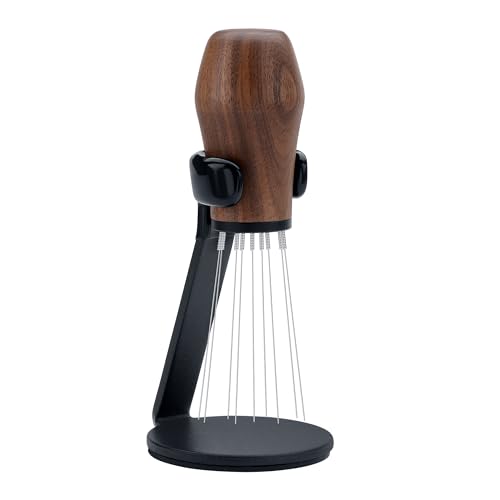
Normcore WDT Distribution Tool V3 with Stand Walnut Handle
Why These Options Stand Out
WDT stands for Weiss Distribution Technique, the habit of stirring grounds with fine needles to break clumps before tamping. This MHW-3BOMBER kit leans into that routine with eight ultra-fine 0.4mm stainless needles plus six spares, so a bent prong never ends your workflow. The adjustable range lets you widen or narrow the needle spread to match your basket size.
That adjustability is the real draw here. Unlike the fixed-prong Normcore stirrers later in this list, you can tune coverage between a 51mm and 58mm basket without buying a second tool, which matters if you run more than one machine at home.
Useful Strengths
- Eight 0.4mm needles reach deep into dense beds without tearing them apart
- Six spare needles mean a bent prong is an inconvenience, not a replacement purchase
- Adjustable spread adapts across 51, 54, and 58mm portafilters
- The magnetic stand docks the tool beside your grinder, keeping sharp tips off the counter
- Fine wires disturb the puck gently, preserving an even surface for tamping
Things To Consider
- More needles means more surfaces to wipe clean after oily dark roasts
- The adjustment mechanism adds a step some users may find fiddly during rushed mornings
Key Specs
Who It Suits Best
Home baristas running multiple basket sizes who want one tool that adapts instead of three that don’t.
Where Another Pick Suits Better
Anyone wanting a simpler grab-and-stir motion will prefer the Normcore WDT Distribution Tool V2, which skips the adjustment dial entirely.
This one takes a different approach than the needle tools around it. Instead of stirring, its flat stainless base sweeps across the basket to level the bed, giving you a uniform surface before the tamper ever lands. At 53.3mm it’s sized specifically for Breville’s 54mm portafilters, where generic 58mm accessories leave a stubborn ring of un-tamped grounds.
The adjustable-depth collar matters more than it sounds. You set it once to match your typical dose, then every leveling pass compresses the bed identically, which is how repeatable shots actually happen. Owners commonly report it pairs naturally with a light tamp afterward rather than replacing one.
Where It Helps
- Creates a flat, even bed so channeling drops noticeably shot to shot
- Depth adjustment locks in consistency across sessions
- Stainless base wipes clean in seconds after each use
Small Caveats
- It levels but doesn’t de-clump, so pairing with a needle stirrer gives the fullest result
- The 53.3mm sizing is purpose-built for 54mm Breville baskets and won’t suit wider ones
- Oily grounds can build up along the base edge, worth a quick brush weekly
Made For
Breville Barista Express and similar 54mm machine owners tired of uneven pucks from oversized accessories.
A Better Fit Elsewhere
Standard 58mm machine owners should look at the Subminimal Flick below, whose retractable needles handle both clumps and leveling prep.
Every traditional WDT tool shares one flaw: bare needles pointing outward in a drawer or on a counter. The Flick solves that with a click mechanism that deploys the prongs for stirring and retracts them fully inside the body when done. In a kitchen with kids, or simply a crowded drawer, that single detail changes how comfortable you feel owning it.
Compared with the MHW-3BOMBER’s magnetic stand approach, this trades docking hardware for built-in safety, which suits smaller setups better. One-click operation also keeps the ritual quick, no cap to unscrew mid-shot. The honest trade-off is fewer needles than multi-prong rivals, so coverage per sweep is slightly narrower depending on your dose size.
Points In Its Favor
- Retractable needles eliminate exposed-tip worry in shared or busy kitchens
- One-click deploy and retract keeps the pre-tamp step fast
- Pocketable body stores in a drawer without a stand or sheath
- Smooth retraction protects needle tips from bending in transit
Worth Noting
- The moving mechanism is one more part to keep free of compacted grounds over time
Feature Snapshot
Right Fit For
Apartments, shared kitchens, and anyone who values tidy storage over maximum needle count.
Not Your Match When
Dose-heavy 58mm shooters chasing broad coverage will get more from the Normcore WDT Distribution Tool V3 with its nine prongs.
Strip away the extras and this is what a first WDT tool should be: nine spring wires, a machined aluminum handle, nothing to learn. The 0.3mm wires are slightly thicker than the MHW-3BOMBER’s 0.4mm set, which makes them more resistant to bending while still fine enough to crumble clumps. For someone building a routine, that durability counts for a lot.
The anodized aluminum handle has real heft, and the nonstick-coated wires rinse clean under a tap. There’s no stand and no adjustment, just a tool that lives next to the grinder and does its job. That simplicity is exactly why it earns a spot here.
Key Advantages
- Nine stiff 0.3mm wires resist bending through years of daily stirring
- Anodized aluminum handle feels solid and cleans with a damp cloth
- No settings or parts, so the learning curve is essentially zero
Points To Note
- Exposed needles need careful drawer storage since no stand or guard ships with it
- Fixed prong count offers no tuning for different basket diameters
- No spare wires included, unlike the MHW-3BOMBER kit
Best Suited To
Newcomers to espresso prep who want a dependable, low-cost entry into consistent extraction.
Look Elsewhere When
Counter space and aesthetics matter equally, then the Normcore V3 with its walnut handle and dock is the stronger match.
The V3 takes the V2’s proven nine-prong layout and dresses it for a serious coffee station. American walnut replaces the aluminum grip, warm against the palm and visually at home beside wood-accented grinders. The included stand solves the storage problem outright, holding the tool upright with needles safely seated between shots.
Functionally it mirrors its sibling: nine wires, same stirring motion, same easy-clean coating. What you’re paying extra for is finish and convenience, and in our view that’s a fair exchange once your setup stops living in a cupboard. The walnut does ask for slightly gentler care than metal, kept away from soaking water.
Useful Highlights
- American walnut handle brings warmth and grip that metal can’t match
- Included stand keeps needles protected and the counter organized
- Nine prongs cover wide 58mm baskets in fewer passes
- Nonstick wire coating rinses clean after sticky, oily roasts
- Same reliable stirring geometry as the well-regarded V2
The Fine Print
- Wood handles dislike dishwashers and prolonged soaking, so hand-wipe only
Product At A Glance
Who Will Love This
Dedicated home baristas with a permanent coffee corner who want their tools to look as considered as they work.
Swap It Out When
Multi-basket flexibility outranks looks, then the adjustable MHW-3BOMBER T6126 remains the smarter buy.
Choosing Between These Espresso Accessories
Needle Count And Wire Gauge
Fine wires, typically 0.3mm to 0.4mm, slip through dense grounds and shatter clumps without compacting the bed. More prongs cover a 58mm basket faster, though each added wire adds cleaning surface. Light-roast drinkers benefit most from finer gauges, since those beans clump hardest after grinding.
Basket Size Compatibility
Measure your portafilter before anything else. Breville’s 54mm machines need purpose-sized accessories like the Normcore leveler above, while standard E61 and prosumer group heads take 58mm gear. An adjustable tool sidesteps the problem entirely for mixed households.
Storage And Safety
Bare needles live dangerously in drawers. A magnetic stand, a dock, or a retractable design keeps tips straight and fingers intact. Daily brewers should weight this heavily, because a bent prong quietly ruins distribution long before you notice the sour shots.
Build Materials
Stainless wires resist rust and rinse clean; coated versions shed oily residue faster. Handles split between anodized aluminum, which shrugs off abuse, and hardwood, which rewards gentle care with a better feel. Match the material to how roughly your mornings actually go.
Key Considerations Across These Picks
Traps First Timers Fall Into
The classic error is buying a 58mm tool for a 54mm machine, leaving a ring of loose grounds every shot. Another common misstep is treating a leveler as a complete solution, when clump-breaking and leveling solve different problems. Check your basket diameter first, then decide whether you need one tool or a small pair.
Where The Extra Money Goes
Higher-tier picks spend on materials and convenience: walnut instead of aluminum, stands instead of bare needles, spare wires instead of none. None of that changes extraction physics much. Pay up for daily-use comfort and longevity, stay basic while you’re still learning your grinder.
Frequently Asked Questions
Do I really need a distribution tool?
If your shots swing between sour and bitter for no clear reason, uneven grounds are a likely culprit. A ten-second stir costs little and removes one major variable.
Can I use a toothpick instead?
You can, and many beginners start there. Dedicated needles are stiffer, finer, and far less likely to snap off into your puck.
Does WDT replace tamping?
No, the two steps complement each other. Stirring evens the grounds out, tamping compacts them evenly into a firm puck.
Which comes first, WDT or a leveler?
Stir first to break clumps, then level to flatten the surface. That order gives your tamper the most uniform bed possible.
How do I clean these tools?
A quick rinse and dry after use handles most residue. Oily dark roasts may need an occasional wipe with a damp cloth on the wires.
Closing Remarks
Every pick here solves the same problem for a few dollars, so the decision mostly comes down to your machine, your counter, and your habits. Measure your basket, pick the shape that fits your routine, and give it two weeks of consistent use. Your taste buds will tell you whether it earned its spot.